
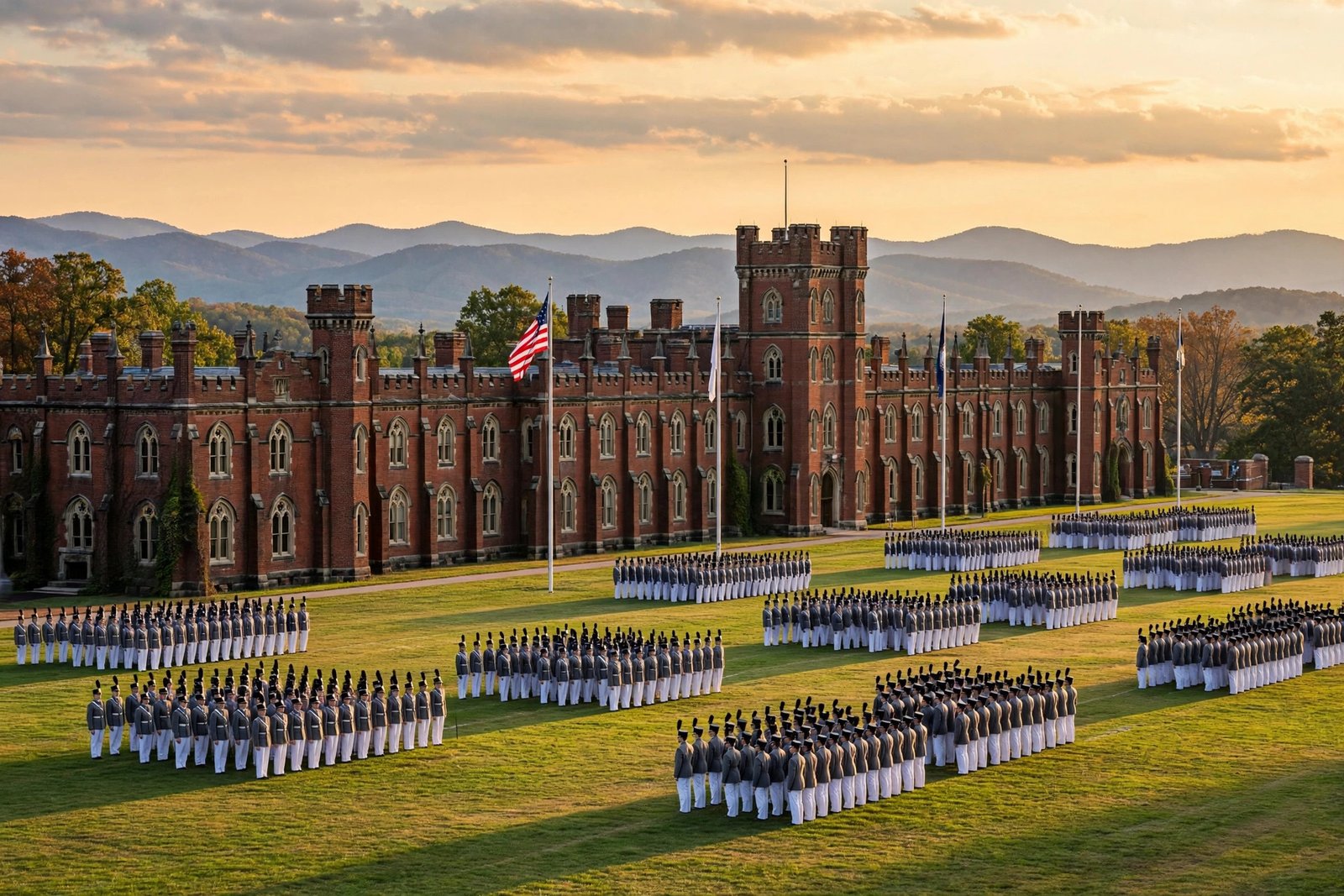
Virginia Military Institute (VMI)
Founded in 1839 in Lexington, Virginia, the Virginia Military Institute is America’s first state-supported military college — and one of the few colleges in the world where every single student is a cadet. This complete directory guide covers VMI’s history, academic programmes, admission requirements, the step-by-step application process, costs, career outcomes and answers to the questions prospective cadets ask most.
Directory Information
| Full name | Virginia Military Institute |
|---|---|
| Commonly known as | VMI — the Keydets |
| Location | Lexington, Virginia, United States |
| Official address | 319 Letcher Avenue, Lexington, VA 24450 |
| Admissions phone | 540-464-7211 |
| Official website | https://www.vmi.edu/ |
| Founded | 11 November 1839 |
| Type | Public senior military college (state-supported) |
| Cadet strength | Approximately 1,500–1,600 cadets |
| Student–faculty ratio | 10:1 |
About & History
On 11 November 1839, in falling snow, 23 young Virginians were mustered into the service of the state, and the first cadet sentry — John B. Strange of Scottsville, Virginia — took his post. That guard duty remains the oldest tradition of the Virginia Military Institute, and every cadet still experiences it today. VMI’s founder, Lexington lawyer John T. L. Preston, declared that the Institute’s unique programme would produce “fair specimens of citizen-soldiers” — a mission that has defined the Institute for nearly two centuries.
As VMI’s own Quick Facts page records, the Institute is the nation’s first state-supported military college. Unlike every other senior military college in the United States, VMI enrols cadets only and awards bachelor’s degrees exclusively: there is no civilian student body, and no graduate programmes. Its first superintendent was Francis H. Smith, a graduate of the United States Military Academy, whose fifty-year tenure built the Corps, broadened the curriculum and grew the faculty.
The Institute’s early history is inseparable from the American Civil War. Thomas J. Jackson joined the VMI faculty in 1851, serving until the outbreak of war; he would become the Confederate general known to history as “Stonewall” Jackson, who said of the Institute’s men at Chancellorsville: “The Institute will be heard from today.” On 15 May 1864, the VMI Cadet Corps fought as a unit at the Battle of New Market — ten cadets were killed and 47 wounded — in what remains the only time in American history that the entire student body of an American college fought in battle as a unit. The Institute honours the New Market cadets in formal ceremonies every 15 May. Union forces shelled and burned the Institute on 12 June 1864, but the efforts of Superintendent Smith and a dedicated faculty allowed VMI to reopen on 17 October 1865.
The modern Institute grew steadily through the twentieth century: the Bachelor of Arts degree was first awarded in 1912, more than 4,000 alumni served in the Second World War, and the Barracks was enlarged in 1948 to welcome returning veterans. The Corps has also grown more diverse — the first African American cadets graduated in 1972, and women first entered the Corps in 1997, now making up roughly 14 per cent of cadets.
Among VMI’s alumni is General of the Army George C. Marshall, Class of 1901 — the Second World War Army Chief of Staff, architect of the Marshall Plan and Nobel Peace Prize winner — and the Institute counts 266 alumni who have achieved general or flag officer rank in the armed forces of the United States and several foreign countries. In athletics, VMI’s Keydets compete at NCAA Division I level, and some 30 per cent of the Corps are Division I athletes.
Programmes Offered
VMI offers 14 academic majors and 27 minors across engineering, the sciences and the liberal arts, with a 10:1 student–faculty ratio and just over half of all cadets enrolled in STEM fields. The Institute includes three dedicated engineering programmes and three distinct tracks in computer and information science. Degree options are:
Bachelor of Science (B.S.)
- Applied Mathematics
- Biology
- Chemistry (including a pre-medical track)
- Civil Engineering
- Computer Science
- Electrical and Computer Engineering
- Mechanical Engineering
- Physics
- Psychology
Bachelor of Arts (B.A.)
- Biology
- Chemistry
- Economics and Business
- English
- History
- International Studies
- Modern Languages and Cultures
The core curriculum is deliberately rigorous: all cadets complete a broad foundation in mathematics, science, English and the humanities alongside their major, and transfer between majors is permitted with departmental approval. Academics run in parallel with a demanding military programme. By Virginia law, every VMI cadet must participate in an Army, Navy, Marine Corps or Air Force ROTC programme throughout enrolment — the Corps of Cadets is organised as a single Army-style infantry regiment of roughly 1,600 cadets in three battalions and nine line companies, plus the Regimental Band.
Admission Requirements
VMI seeks young men and women who aspire to both an academic degree and a military commission. The key eligibility conditions are:
- Age: applicants are normally not less than 16 or more than 22 years of age at matriculation; age waivers may be granted for applicants who have served on active duty in the armed forces.
- Marital status: applicants may not be married and/or be the parent of a child.
- ROTC eligibility: federal ROTC regulations require participants to have an eligible US immigration status, so applicants must be able to document US citizenship, lawful immigration status or eligibility for a student visa.
- Standardised tests: VMI is test-optional for the current application cycle — SAT or ACT scores are not required (SAT code 5858, ACT code 4418), although some scholarships do require them.
Required application documents include the VMI Application or the Common Application, an official high school transcript, and (for transfer applicants) official college transcripts. A personal statement is optional but recommended, and college transfer applicants should include a letter of recommendation from a college instructor. International applicants follow the same process but must also submit English proficiency results (TOEFL, IELTS or Duolingo) if English is not their first language, plus a financial certification form and a copy of their passport for the F-1 visa process.
How to Apply: Step by Step
- Choose your application route. Apply either through VMI’s own application at apply.vmi.edu or through the Common Application — submit only one, not both. College transfer students must use the VMI Application.
- Create your account with a personal email address. Use your own email, not a parent’s or your school account, since VMI will send updates there long after you graduate.
- Watch the deadlines. The application opens on 1 August for fall-term entry. Key dates are 15 November (Early Decision), 1 February (Regular Decision) and 15 March (financial aid priority). Applications received after 1 February are reviewed on a rolling basis.
- Submit your documents. Upload your official high school transcript, personal statement and any supplemental materials through VMI’s Admissions Secure Upload Portal (school officials can also submit directly). Convert files to PDF before uploading.
- Complete the FAFSA and explore ROTC scholarships. File the Free Application for Federal Student Aid, and start ROTC scholarship applications early — they carry their own eligibility requirements and documents, separate from VMI admission.
- Monitor your applicant portal. Check for outstanding items until your application is complete; newly appointed cadets should then review the “Appointed Students” resources to prepare for matriculation and the first year as a “rat”.
Tuition & Costs
As a public, state-supported college, VMI charges tuition — unlike the federal service academies — but it is consistently ranked among the best-value colleges in America (#2 Best Value College in Virginia per Niche, a SmartAsset #1 Best Value College in Virginia, and a regular on Washington Monthly’s Best Bang for the Buck list). Published figures for the 2026–27 academic year:
| Total annual cost of attendance | Virginians | Non-Virginians |
|---|---|---|
| Total | $33,974 | $66,514 |
| Tuition | $10,680 | $43,220 |
| Housing (room) and food (board) | $11,998 | $11,998 |
| Auxiliary fees (medical, athletic, cadet activities) | $7,590 | $7,590 |
| Quartermaster charges (uniforms, laundry, haircuts) | $3,706 | $3,706 |
International cadets pay the non-Virginian total plus an estimated $1,400 for health insurance, for a total cost of attendance of $67,914. All incoming cadets also pay a $300 deposit. Cadets should additionally budget indirect costs — books, supplies, personal expenses and transport — of roughly $3,350 for in-state and $4,300 for out-of-state students.
Service & Career Outcomes
VMI’s historic mission is to educate “citizen-soldiers”, and the numbers bear that out: more than 50 per cent of each graduating class commissions into the armed forces through VMI’s ROTC programme, entering the Army, Marine Corps, Navy and Air Force. Commissioning is not compulsory, however — the rest of each class builds civilian careers or heads to graduate and professional schools.
The career statistics are striking: 97 per cent of alumni are employed or attending graduate school within five months of graduation, and the average base salary for VMI graduates is $88,000 according to Payscale.com. Cadets also compete successfully for prestigious national and international scholarships — the Institute counts 11 Rhodes Scholars among its alumni, alongside Gates Cambridge, Marshall, Goldwater and Fulbright Scholars.
Behind those figures stands one of the most invested alumni networks in American higher education: more than 17,000 VMI alumni worldwide, including 266 generals and flag officers, serve as mentors and career contacts for every graduating class.
Frequently Asked Questions
Is VMI the same as West Point or Annapolis?
No. West Point and Annapolis are federal service academies funded entirely by the US government with free tuition. VMI is a public senior military college of the Commonwealth of Virginia — it charges tuition, but commissions its graduates into the armed forces through ROTC rather than through a federal appointment. It is the oldest state-supported military college in the nation.
Do all VMI cadets have to join the military after graduation?
No. Every cadet must participate in ROTC while enrolled, but commissioning after graduation is optional — just over half of each class commissions, while the rest pursue civilian careers or graduate school. The 97 per cent employment-or-graduate-school rate applies across the whole class.
Can out-of-state and international students apply?
Yes. Roughly 64 per cent of cadets are from Virginia, about 34 per cent come from other US states, and around 2 per cent are international. Non-Virginians pay higher tuition, and international applicants must meet English-proficiency and visa requirements.
Are there age or marital restrictions?
Applicants are normally 16 to 22 years old at matriculation and may not be married or be the parent of a child. Age waivers can be granted for applicants who have served on active duty in the armed forces.
Does VMI admit women?
Yes — women first entered the Corps in 1997 and now make up roughly 14 per cent of cadets. All cadets, men and women, live in barracks, wear the uniform and participate in ROTC.
What does VMI really cost, and is financial aid available?
For 2026–27, the total cost of attendance is $33,974 for Virginians and $66,514 for non-Virginians, including room, board, fees and uniforms. About 84 per cent of cadets receive financial aid, and cadets holding both an ROTC scholarship and a Call to Duty scholarship pay just $3,600.
Ready to take the next step?
Start your application at vmi.edu/admissions-and-aid/apply/ or call the Admissions Office on 540-464-7211.
Facts in this guide were verified against the Virginia Military Institute’s official website (vmi.edu) in October 2026. Always confirm current deadlines and costs with VMI directly before applying.