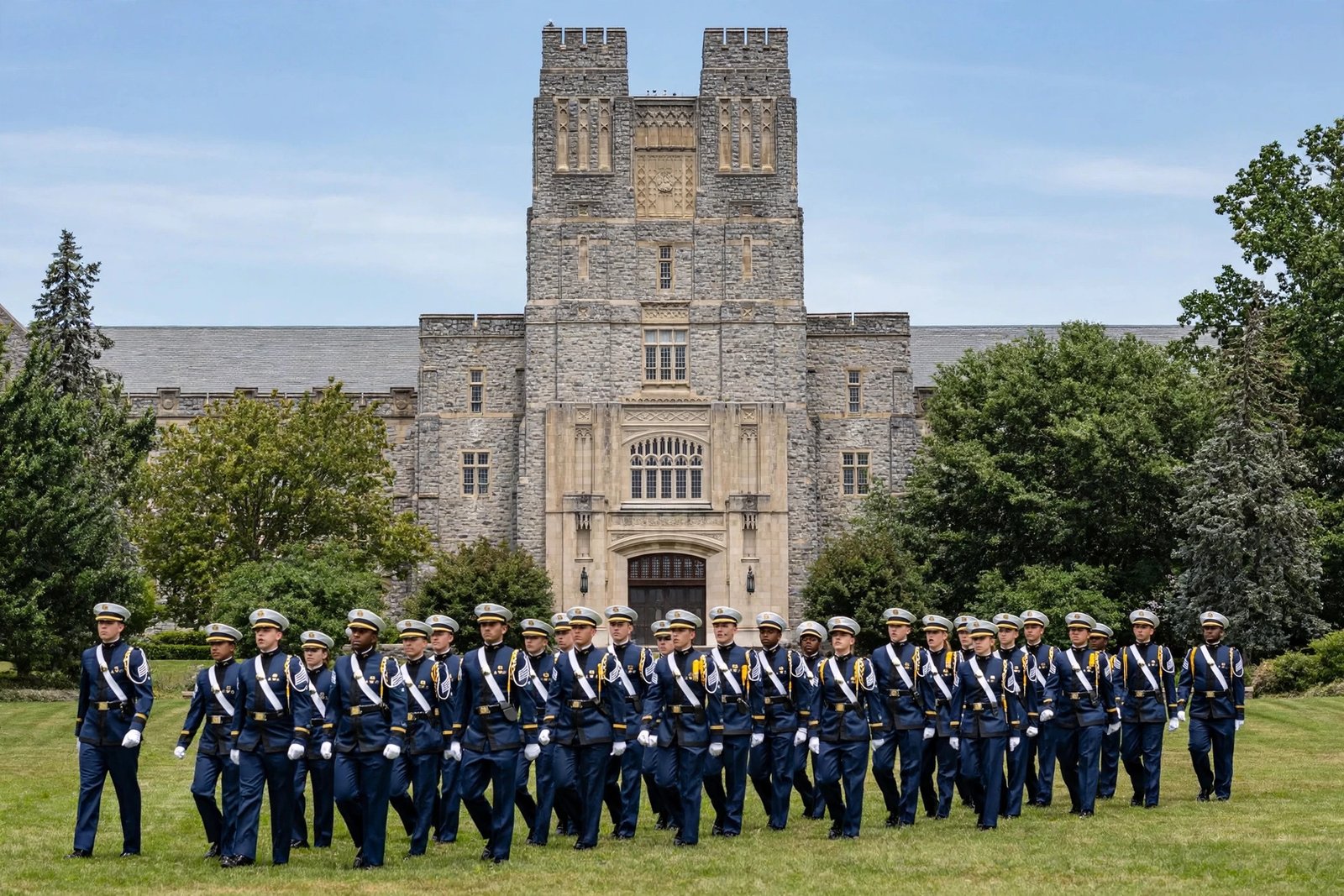
At Virginia Tech, the Corps of Cadets is a 24/7 leadership laboratory woven into one of America’s great public research universities. Founded with the university in 1872, it is one of only six senior military colleges in the United States — a place where more than a thousand cadets live a military lifestyle while earning degrees across 110-plus academic programmes. This complete guide covers how to join, admission requirements, tuition costs, commissioning paths and answers to the questions prospective cadets ask most.
Directory Information
| Full name | Virginia Tech Corps of Cadets (VTCC), part of Virginia Polytechnic Institute and State University |
| Location | Blacksburg, Virginia, United States |
| Official address | Commandant’s Office, Corps Leadership and Military Science Building (0213), Suite 144, 355 Old Turner Street, Blacksburg, VA 24061 |
| Main phone | 540-231-6413 (Front Desk) · 540-231-6858 (Recruiting) |
| Official website | vtcc.vt.edu |
| Founded | 1872 |
| Type | Public land-grant university; one of six US senior military colleges |
| Motto | Ut Prosim — “That I May Serve” (university motto) |
| Cadet strength | More than 1,200 cadets (nearly 1,300 reported in 2025) |
About the Corps and Its History
The Virginia Tech Corps of Cadets is the military component of the student body at Virginia Tech, and it has existed from the university’s very first day. When the Virginia Agricultural and Mechanical College opened its doors in 1872, every one of its 132 students was required to be a cadet, organised into a military battalion under the first Commandant of Cadets, General James H. Lane. The Corps is therefore not an add-on to Virginia Tech — it is part of the institution’s founding identity.
Across more than 150 years, the Corps has produced leaders for the military services, industry, engineering, commerce, science and agriculture. Its alumni include seven recipients of the Medal of Honor, and its graduates have gone on to lead major companies and serve at the highest levels of national life. The regiment today stands at more than a thousand cadets strong, and the incoming Class of 2030 was the second largest first-year cadet class since 1965, with 494 new cadets checking in.
Cadet life is immersive. Cadets live together in Corps residence halls on Upper Quad — currently Pearson Hall East, Pearson Hall West and Upper Quad Hall North — and all cadets are required to live on campus. They wear a distinctive uniform, march in formation, and take part in the Corps’ round-the-clock leader development programme while pursuing full academic degrees. Traditions run deep: each year new cadets take part in the Caldwell March, a two-part march honouring Addison Caldwell, the first cadet to officially enrol, and in New Cadet Week each August the incoming class begins its training on the Drillfield and Upper Quad.
Uniquely among senior military colleges, joining the Corps carries no military service obligation in itself. Cadets choose one of two tracks: the Military-Leader Track, which leads toward a commission through ROTC, or the Citizen-Leader Track (the VPI Battalion), which applies the Corps’ military-structure leadership training to civilian careers with no obligation to serve.
Programmes Offered
Cadets are full Virginia Tech students first: they may enrol in any of Virginia Tech’s 110-plus bachelor’s degree programmes, spread across every college of the university. The five colleges most represented in the Corps’ Class of 2030 were the College of Engineering, the College of Liberal Arts and Human Sciences, the College of Science, the Pamplin College of Business, and the College of Agriculture and Life Sciences — but every Virginia Tech college is represented in the regiment.
Alongside their degree, cadets take part in the Corps’ own leader development curriculum. Highlights include:
- Minor in Leadership Studies — offered through the Major General W. Thomas Rice Center for Leader Development, open to cadets studying any major.
- Corps leadership labs and Corps Lab training — weekly practical leadership instruction woven into the Corps’ 24/7 programme.
- Cutchins Leadership Lecture Series — bringing recognised leaders to campus to speak with cadets.
- Global Scholars programmes — immersive study experiences that connect leadership lessons from the world wars with current events.
- The Highty-Tighties — the Corps’ regimental band, one of the most recognisable traditions in college marching music.
The Military-Leader Track pairs the Corps experience with one of Virginia Tech’s three ROTC programmes: Army ROTC, Naval ROTC (including the Marine Corps option) and Air Force ROTC (including the Space Force). Virginia Tech requires membership in the Corps of Cadets to enrol in ROTC, and enrolling in ROTC as a first-year cadet is a matter of registering for the appropriate first-year ROTC classes. In the Class of 2030, roughly four in five cadets were on the Military-Leader Track.
The Citizen-Leader Track, organised as the VPI Battalion, is for cadets not seeking a military career. They follow the same military lifestyle and training as ROTC cadets while focusing on leadership for civilian industry, and the Corps notes this option is genuinely distinctive among senior military colleges. Cadets may switch from one track to another at any point during their four years.
Admission Requirements
Joining the Corps means being admitted to Virginia Tech itself — there is no separate academic bar for the Corps. Virginia Tech reviews applicants holistically, considering course rigour, grades, test scores (if the applicant chooses to have them reviewed — Virginia Tech is test-optional for students entering through Fall 2028), intended major, four required personal statements and personal qualities.
To be considered as a cadet, you simply indicate on your Virginia Tech application that you wish to enrol as a cadet in the Corps of Cadets. Incoming students can even join the Corps as late as Summer Orientation, and the recruiting office encourages prospective cadets to contact them early at corps@vt.edu or on 540-231-6858.
What the latest cadet class looked like
The Class of 2030 profile shows the academic calibre of the Corps: an average high school GPA of 3.97 and an average SAT score of 1276. The class was 81 per cent Military-Leader Track (Army, Navy/Marine and Air Force ROTC) and 19 per cent Citizen-Leader Track.
Emerging Leader Scholarships
Every student who applies to Virginia Tech as a cadet applicant is automatically considered for the Corps’ Emerging Leader Scholarships — merit-based awards that help offset the cost of education, with recent award letters showing amounts such as $3,000 per year ($12,000 over four years). To keep a scholarship in force, recipients must file the FAFSA each year (Virginia Tech’s federal school code is 003754). Awardees are typically notified by mid-April and tend to have strong grades and records of leadership in activities such as student government, athletics, scouting, JROTC or work experience.
How to Apply: Step by Step
Submit the university application — Early Decision by 1 November or Regular Decision by 15 January — and indicate that you wish to enrol as a cadet in the Corps of Cadets. This single application puts you in line for both university admission and automatic consideration for Emerging Leader Scholarships.
Complete the Free Application for Federal Student Aid with Virginia Tech (school code 003754) as a recipient. It is required to keep an Emerging Leader Scholarship in force and unlocks the full range of federal and university aid.
Once offered admission, follow the Corps’ new-cadet checklist: create your Virginia Tech username and email, enrol in two-factor authentication, and complete your housing and dining contracts. The Corps must receive your positive intent to enrol as a cadet by 1 July, or you risk losing your place in the Corps.
If you are pursuing a commission, register for the first-year ROTC classes for the service of your choice — Army, Navy (with the Marine option) or Air Force. If you are on the Citizen-Leader Track, you simply continue with the Corps programme without ROTC enrolment.
Arrive in Blacksburg in August for New Cadet Week — the Corps’ orientation and initial training period — where you will receive your company and roommate assignments, complete paperwork and screenings, and begin the first phase of cadet training before classes start.
Tuition and Costs
Cadets pay the same tuition and fees as any other Virginia Tech student — the Corps does not add a separate programme fee. Virginia Tech’s Office of University Scholarships and Financial Aid publishes the estimated annual cost of attendance. For the 2025–26 academic year, the figures for an on-campus undergraduate were:
| Cost component | In-state | Out-of-state |
|---|---|---|
| Tuition | $13,548 | $35,408 |
| Fees | $2,902 | $3,506 |
| Housing | $9,626 | $9,626 |
| Food | $6,420 | $6,420 |
| Total estimated cost of attendance | $40,624 | $63,624 |
Beyond the published figures, several funding sources can bring these costs down:
- Emerging Leader Scholarships — automatic merit-based consideration for every cadet applicant (see above).
- ROTC scholarships — four-, three- and two-year merit-based scholarships from the Army, Navy and Air Force; most cover tuition, books and approved fees, and contracted cadets receive a tax-free monthly stipend. High school seniors apply for national ROTC scholarships during their senior year.
- Corps scholarships — additional need- and merit-based awards from the Corps of Cadets itself, plus special uniform allowances for ROTC cadets that offset the cost of cadet uniforms.
- Standard federal and state aid — Virginia Tech participates in all federal aid programmes; file the FAFSA by the university’s priority deadline.
Service and Career Outcomes
The Corps is deliberately a two-destination programme, and both outcomes are strong.
Commissioning. Cadets on the Military-Leader Track work toward a commission through Army, Naval or Air Force ROTC and graduate as officers in the US Army, the US Navy or Marine Corps, or the US Air Force and Space Force. The Corps reported a 78 per cent commissioning rate for its 2021 graduates, and university figures note that more than 70 per cent of Military-Leader Track cadets go on to commission as officers in the armed forces. Military service is never compulsory — the obligation comes only from accepting an ROTC contract or scholarship, not from Corps membership.
Civilian careers. Cadets on the Citizen-Leader Track carry their leadership experience straight into the job market: more than 90 per cent have a career-starting job or graduate school acceptance before they graduate. The Corps’ military-structure leadership training is unusual in American higher education, and employers actively recruit from it — the Corps notes alumni who have become chief executives of major companies including Exxon, American Electric Power, Raytheon, Timex and Hercules.
Whatever the track, every cadet graduates with a Virginia Tech degree, four years of practical leadership experience, and a lifelong alumni network that has been building since 1872.
Frequently Asked Questions
Do I have to join the military if I join the Corps of Cadets?
No. Joining the Corps of Cadets carries no military service obligation. Only cadets who enrol in ROTC and accept a contract or scholarship take on a service commitment. The Citizen-Leader Track exists specifically for cadets who want the leadership experience without serving in the armed forces.
Do I have to be in ROTC to join the Corps?
No — but the reverse is true: Virginia Tech requires membership in the Corps of Cadets to enrol in ROTC. Roughly one in five cadets is on the Citizen-Leader Track with no ROTC enrolment at all.
How do I apply to join the Corps?
Apply to Virginia Tech (Early Decision by 1 November or Regular Decision by 15 January) and indicate on the application that you wish to enrol as a cadet. That single step also gives you automatic consideration for Emerging Leader Scholarships. You must confirm your intent to join by 1 July and report for New Cadet Week in August.
What does it cost to be a cadet?
The same as any Virginia Tech student — there is no separate Corps fee. For 2025–26 the estimated annual cost of attendance was $40,624 in-state and $63,624 out-of-state, covering tuition, fees, housing and food. Emerging Leader Scholarships, ROTC scholarships and Corps need- and merit-based awards can reduce this substantially.
How many cadets are in the Corps, and where do they live?
More than 1,200 cadets — nearly 1,300 was reported in 2025, and the incoming Class of 2030 numbered 494, the second largest first-year class since 1965. All cadets live on campus in Corps residence halls on Upper Quad: Pearson Hall East, Pearson Hall West and Upper Quad Hall North.
Can I switch between the Military-Leader and Citizen-Leader tracks?
Yes. Cadets can move from one track to the other at any time during their four years, so you are not locked into a commissioning path — or a civilian one — when you arrive.
Ready to take the next step?
Visit the official Corps site at vtcc.vt.edu or contact the recruiting office on 540-231-6858 (or corps@vt.edu) to arrange a visit or information session. Facts in this guide were verified against the official Virginia Tech and Corps of Cadets websites; always confirm current deadlines and costs directly before applying.