
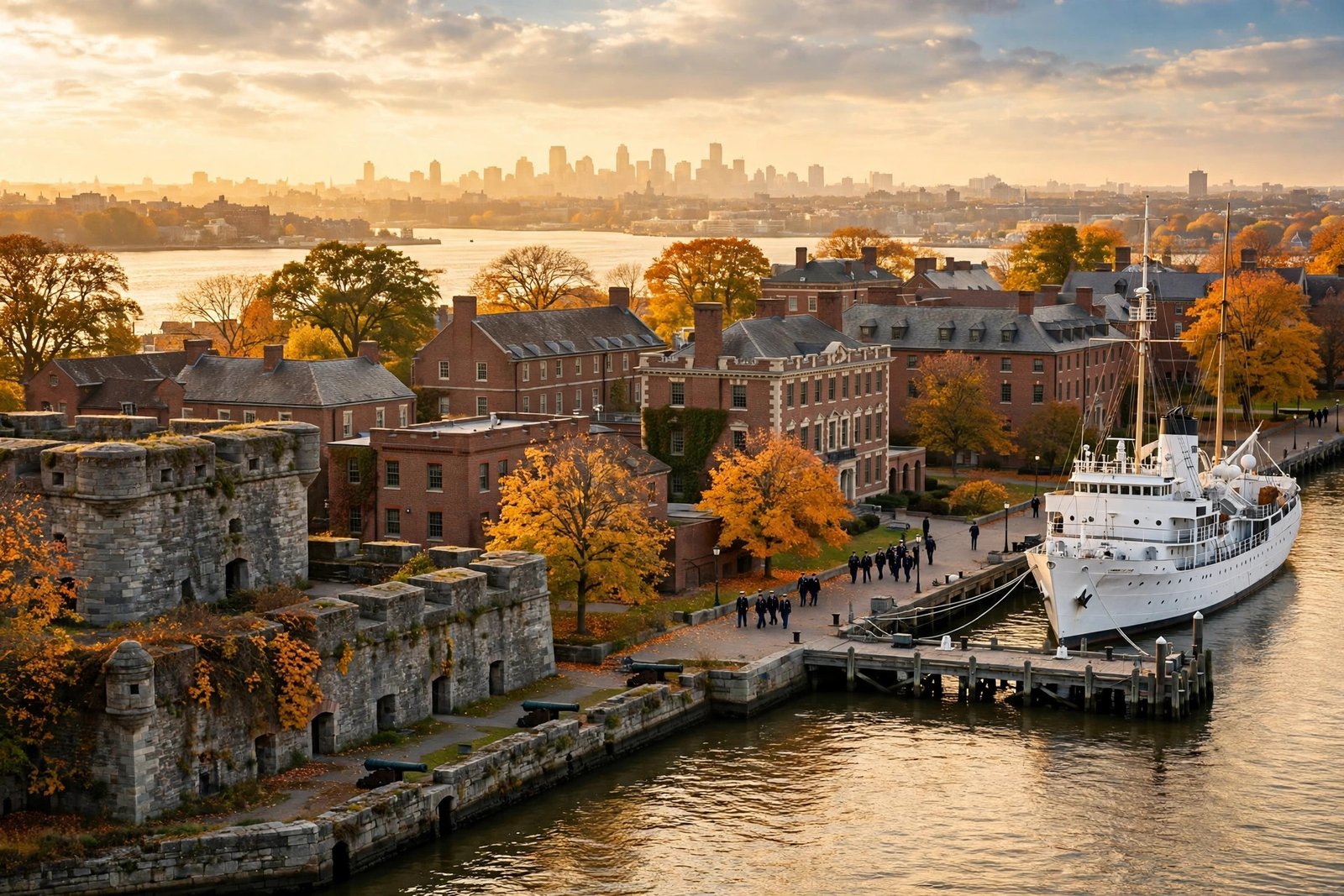
SUNY Maritime College — The Bronx, New York
Founded in 1874 and settled on the ramparts of historic Fort Schuyler, the State University of New York Maritime College is the oldest college of its kind in America — a public, degree-granting maritime academy where students earn both a university degree and a United States Coast Guard licence. This directory guide covers the College’s 150-year history, its degree programmes, the Regiment of Cadets, admission requirements, step-by-step application guidance, official tuition figures, Navy commissioning routes and the careers its graduates sail into.
Directory Information
| Full name | State University of New York Maritime College (SUNY Maritime College) |
|---|---|
| Location | Fort Schuyler, Throggs Neck, the Bronx, New York City, New York, United States — at the meeting of the East River and Long Island Sound |
| Official address | 6 Pennyfield Avenue, Bronx, NY 10465 |
| Phone | Main: 1-718-409-7200 |
| Official website | https://www.sunymaritime.edu/ |
| Founded | 1874, as the New York Nautical School (sesquicentennial observed 2023–2024); one of the 29 original institutions incorporated into SUNY in 1948 |
| Type | Public state maritime college, part of the State University of New York system; one of seven degree-granting maritime academies in the United States |
| Motto | Not published on the College’s official site — omitted (traditionally rendered “Loyalty, Valor” in third-party references) |
| Cadet strength | Approximately 1,400 undergraduates (about 1,550 students in total, fall 2025); the Regiment of Cadets numbers roughly 1,150 cadets |
About & History
The story of SUNY Maritime College begins on the water — literally. In 1874 the New York State Legislature created the New York Nautical School, and the school’s first training vessel, the St. Mary’s, sailed into New York harbour. In January 1875 the first twenty-six students boarded her and departed on the school’s first training cruise. For its first decades the school had no shore campus at all: classes, drills and seamanship instruction happened entirely aboard a succession of ships anchored in the city’s harbour and waterways.
As sail gave way to steam, the curriculum evolved with the ships. The St. Mary’s was eventually replaced by the Newport, a sail-steam hybrid, and later by the first of a long line of training vessels bearing the name Empire State. In 1913 the State of New York took the school over from the city’s Board of Education, enlarging enrolment and funding; the school became the New York State Nautical School, then the New York State Merchant Marine Academy in 1929, and the New York State Maritime Academy in 1941. Each renaming reflected its growing standing as America’s pre-eminent school for the merchant marine.
The College needed a permanent home, and found one in a decommissioned coastal fortress. Fort Schuyler — built by the United States Army between 1833 and 1856 to guard the approach to New York harbour — was turned over to the State of New York in 1934, rehabilitated by the Works Progress Administration, and formally dedicated to the school in 1938. It is still the heart of the 55-acre campus, and it has been listed on the National Register of Historic Places since 1976. In 1948 the school became one of the twenty-nine founding institutions of the newly formed State University of New York, taking the name it carries today: the State University of New York Maritime College.
The sesquicentennial was observed in 2023–2024 — “150 years of learning at sea” — and it arrived with a symbol of the next 150: the Empire State VII, the lead ship of a new class of purpose-built National Security Multi-Mission Vessels. The vessel is both a state-of-the-art training platform for future merchant marine officers and a federal disaster-response asset. The College is today led by Rear Admiral John A. Okon, and its stated ambition remains what it has always been: to turn students into leaders of the global maritime industry, the military and government service.
Programmes Offered
SUNY Maritime offers bachelor’s and master’s degrees, plus a two-year associate’s programme — and many can be combined with professional training for a United States Coast Guard licence. Licence-seeking students join the Regiment of Cadets; students who prefer a conventional college experience can enrol in the Traditional Students programme, where a credit-bearing professional internship or study-abroad placement is built into the degree.
Bachelor of Engineering (B.E.)
- Electrical Engineering (deck licence, engine licence or professional internship option)
- Facilities Engineering (engine licence or internship)
- Marine Engineering (engine licence)
- Mechanical Engineering — Mechanical Design and Thermal Fluids tracks (engine licence or internship)
- Naval Architecture (deck licence, engine licence or internship)
Bachelor of Science (B.S.)
- Data Science & Machine Learning (professional internship)
- International Transportation and Trade (deck licence or internship)
- Marine Environmental Science (deck licence or internship)
- Marine Operations (deck or engine licence)
- Marine Transportation (deck licence)
- Maritime Studies (deck licence or internship)
Associate of Applied Science (A.A.S.)
- Maritime Technology (engine or deck licence)
Graduate programmes
- Master of Science in Shipping and Logistics
- Master of Science in Maritime and Naval Studies
- Advanced Certificate in Supply Chain Management
The College offers two Coast Guard licence tracks: an unlimited Third Mate (deck) licence upon oceans, or an unlimited Third Assistant Engineer (engine) licence in steam, motor and gas turbine — “unlimited” meaning the holder is qualified to serve aboard ships of any horsepower or tonnage. Members of the Regiment take part in three annual training cruises as part of the Summer Sea Term, standing watches, managing day-to-day shipboard operations and making port calls across Europe and the Caribbean. The College also runs the only Navy/Marine Corps NROTC programme in the New York City metropolitan area.
Admission Requirements
SUNY Maritime’s freshman admissions are test-flexible: the SAT and ACT are considered if submitted, not required. What is required is a high-school GPA and an official high-school record. Successful applicants typically show an average SAT score near 1,200 and an ACT composite near 27, and the College’s own acceptance rate sits around seventy-two per cent. The essential requirements, drawn from the College’s official admissions pages, are:
- High-school GPA and transcript: both are required; the College reviews course rigour alongside the grade itself.
- Standardised testing (optional): SAT or ACT scores are considered if submitted. The College’s SAT code is 2536 and its ACT code is 2954.
- Essay: applicants must complete the essay portion of either the Common Application or the College’s own online application — SUNY Maritime requires an admissions essay, unlike many other SUNY schools.
- One letter of recommendation: required, from an academic source, a coach or another mentor, sent through the admissions office.
- Maths placement: every entering freshman sits a mandatory maths placement examination in the summer before enrolment, separate from any SAT or ACT scores submitted.
- Regiment expectations: students pursuing a Coast Guard licence must join the Regiment of Cadets, with its leadership training, drill and sea terms; Traditional Students follow the same academics with a standard campus lifestyle instead.
How to Apply: Step by Step
- Choose your track. Decide whether you want the licence route (Regiment of Cadets, with three Summer Sea Terms aboard the training ship) or the Traditional Students programme (civilian college life plus a professional internship or study abroad). Your degree choice narrows the options — Marine Transportation, for example, is a licence-track degree.
- Start your application. Apply through the Common Application or the College’s own online application. There is a $50 application fee, and the published deadlines are 1 December for Early Decision and 31 January for regular decision — confirm the current year’s dates with the admissions office before you file.
- Write the required essay. Complete the essay portion of whichever application you choose; the College weighs this part of the file directly.
- Arrange your recommendation. Ask an academic referee, coach or mentor for one letter of recommendation, and have it sent to the Office of Admissions, SUNY Maritime College, 6 Pennyfield Avenue, Throggs Neck, NY 10465.
- Send scores only if you wish. Testing is optional. If you choose to submit, send SAT scores to code 2536 or ACT scores to code 2954.
- Complete maths placement in summer. After acceptance, every entering freshman must sit the College’s mandatory maths placement examination before enrolment.
- Plan your financing. File the FAFSA and explore College aid, NROTC scholarships and the Strategic Sealift Midshipman Program’s Student Incentive Pay (up to $64,000 towards tuition, books and other college expenses for eligible licence-track midshipmen).
Tuition & Costs
The College publishes a full cost of attendance each year. The official 2026–27 undergraduate figures for a resident student living on campus are:
| 2026–27 expense | Resident / in-state | Out-of-state / international |
|---|---|---|
| Total cost of attendance | $31,315 | Tuition $17,970 (in-region $10,610) |
| Tuition | $7,070 | $17,970 (in-region: $10,610) |
| Fees (including loan fees) | $1,579 | $1,579 |
| Food and housing | $17,320 | $17,320 |
| Books and supplies | $1,500 | $1,500 |
| Transportation | $1,300 | $1,300 |
| Miscellaneous expenses | $2,546 | $2,546 |
Members of the Regiment should budget separately for regimental uniform expenses of about $4,384, which is included in the cost of attendance but paid directly to the Ship’s Store. Students living with parents or commuting receive a lower housing allowance in their aid budget. The College notes that its tuition and fees are among the most affordable of any maritime academy in the country, and its graduates are consistently ranked among the top schools nationally for return on investment.
Service & Career Outcomes
SUNY Maritime’s graduates carry two credentials: a university degree and, for licence-track students, an unlimited Coast Guard licence. That combination puts them at the front of the queue for officer posts aboard merchant vessels — container ships, tankers, cruise ships, research vessels and offshore platforms — and the College reports that licence graduates benefit from near-total job placement. The engineering, naval architecture, environmental science and business degrees also open shore-side careers in port operations, marine insurance, brokering and chartering, logistics, naval architecture firms and government agencies, all within reach of the College’s deep ties to the New York port community.
The military route runs through two doors. The College’s NROTC programme — the only Navy and Marine Corps ROTC in the New York City metropolitan area — can lead to a commission as an officer in the United States Navy or Marine Corps; scholarship midshipmen receive full tuition, a book stipend and a monthly stipend. In addition, licence-seeking students may join the Strategic Sealift Midshipman Program, which commissions graduates as Strategic Sealift Officers in the United States Navy Reserve and can unlock up to $64,000 in Student Incentive Pay towards college expenses. Around one in five cadets aboard the training ship is already in ROTC and preparing for commissioning after graduation.
The signature career credential is the sea term itself. Three summer cruises aboard the Empire State VII give licence-track cadets the accredited sea time, watch-standing experience and practical shipboard leadership the Coast Guard requires for the unlimited licence — the same hands-on preparation that has made SUNY Maritime, in industry’s own rankings, one of the nation’s largest producers of licensed mariners.
Frequently Asked Questions
Is SUNY Maritime a military school?
Not in the federal-service-academy sense. It is a public college in the SUNY system. Only students pursuing a Coast Guard licence must join the Regiment of Cadets; Traditional Students follow the same degrees with a normal civilian campus lifestyle, and there is no post-graduation service obligation for the licence track — though ROTC and the Strategic Sealift programmes carry their own commitments.
Do I have to join the Regiment of Cadets?
Only if you want a Coast Guard licence. Licence-track students must belong to the Regiment, with its uniforms, drill and three Summer Sea Terms. Traditional Students study the same subjects without the regimental requirements, complete a professional internship or study abroad instead, and may still apply to NROTC.
What is the Summer Sea Term?
The annual training cruise aboard the College’s training ship, the Empire State VII. Licence-track cadets must take part in three of these voyages, running the ship’s daily operations — navigation, engine watches, maintenance — while making port calls in Europe and the Caribbean. The sea time earned counts toward the Coast Guard licence.
What does SUNY Maritime cost?
The official 2026–27 cost of attendance for a resident student is $31,315 per year, built from $7,070 tuition, $1,579 in fees, $17,320 in food and housing, plus books, transport and miscellaneous expenses. Out-of-state tuition is $17,970 ($10,610 for in-region students), and regimental uniforms cost roughly $4,384 on top. Always confirm current figures with the College.
Can I become a Navy officer through SUNY Maritime?
Yes. The College runs the only Navy/Marine Corps NROTC programme in the New York City metropolitan area, leading to commissions in the U.S. Navy or Marine Corps. Alternatively, licence-track students can enter the Strategic Sealift Midshipman Program and commission as Strategic Sealift Officers in the Navy Reserve, with up to $64,000 in Student Incentive Pay available.
How old is the College, and is it the oldest?
SUNY Maritime traces its founding to 1874, when the New York Nautical School was created by the state legislature — making it the oldest federally approved school of commercial nautical instruction in the United States. Its sesquicentennial, “150 years of learning at sea,” was observed in 2023–2024.
Ready to chart your course?
Start at sunymaritime.edu or call the College on 1-718-409-7200. Admission correspondence goes to the Office of Admissions, SUNY Maritime College, 6 Pennyfield Avenue, Throggs Neck, NY 10465.
Facts in this guide were verified against SUNY Maritime College’s official website (sunymaritime.edu), the College’s official 2026–27 cost of attendance page and 2026–27 undergraduate degree curricula, plus SUNY’s official announcements, in October 2026. Always confirm current deadlines, costs and programmes with the College directly before applying.