
Massachusetts Maritime Academy (Mass Maritime)
On the banks of the Cape Cod Canal in Buzzards Bay sits the oldest continuously operating maritime academy in the United States — a public university where more than 1,500 cadets earn degrees in deck, engineering, business and emergency-management fields inside a disciplined Regiment of Cadets. This directory guide covers the Academy’s 1891 origins, its seven undergraduate and three graduate programmes, the new training ship TS Patriot State, admission requirements and steps, published tuition and fees, and the careers its graduates sail toward.
Directory Information
| Full name | Massachusetts Maritime Academy |
|---|---|
| Location | Buzzards Bay (village of Bourne), Massachusetts, on the Cape Cod Canal |
| Official address | 101 Academy Drive, Buzzards Bay, MA 02532 |
| Phone | Main: (508) 830-5000 | Admissions: (800) 544-3411 |
| Official website | https://www.maritime.edu/ |
| Founded | 1891 (as the Massachusetts Nautical Training School) |
| Type | Public state maritime academy — one of nine Massachusetts state universities |
| Motto | “Discipline, Knowledge, Leadership” |
| Cadet strength | Over 1,500 students — the largest uniformed maritime academy in America (per the Academy’s own catalog) |
About & History
The Academy’s story begins with an act of the Massachusetts legislature in 1891, which created the Massachusetts Nautical Training School — a floating maritime trade school designed to train young men as officers for the merchant service. Its first school ship, the USS Enterprise, was berthed in Boston Harbor next to the USS Constitution, and the very first class of cadets graduated in the mid-1890s. Because it has operated continuously ever since, the Academy describes itself as the oldest continuously operating maritime academy in the nation.
The school took on new names as it grew. In 1913 it became the Massachusetts Nautical School, and in 1942 — amid the federal reorganisation of the state maritime schools during the Second World War — it moved to Hyannis on Cape Cod and assumed its present name, Massachusetts Maritime Academy. A few years later, in the late 1940s, it relocated once more to its current waterfront home at Taylor’s Point in Buzzards Bay, at the southern end of the Cape Cod Canal, where the water was deep enough for larger training ships. The state authorised the Academy to grant the Bachelor of Science degree in 1946, and in 1964 it joined the Massachusetts state college system. The Academy became fully co-educational in the late 1970s and has admitted women as cadets ever since.
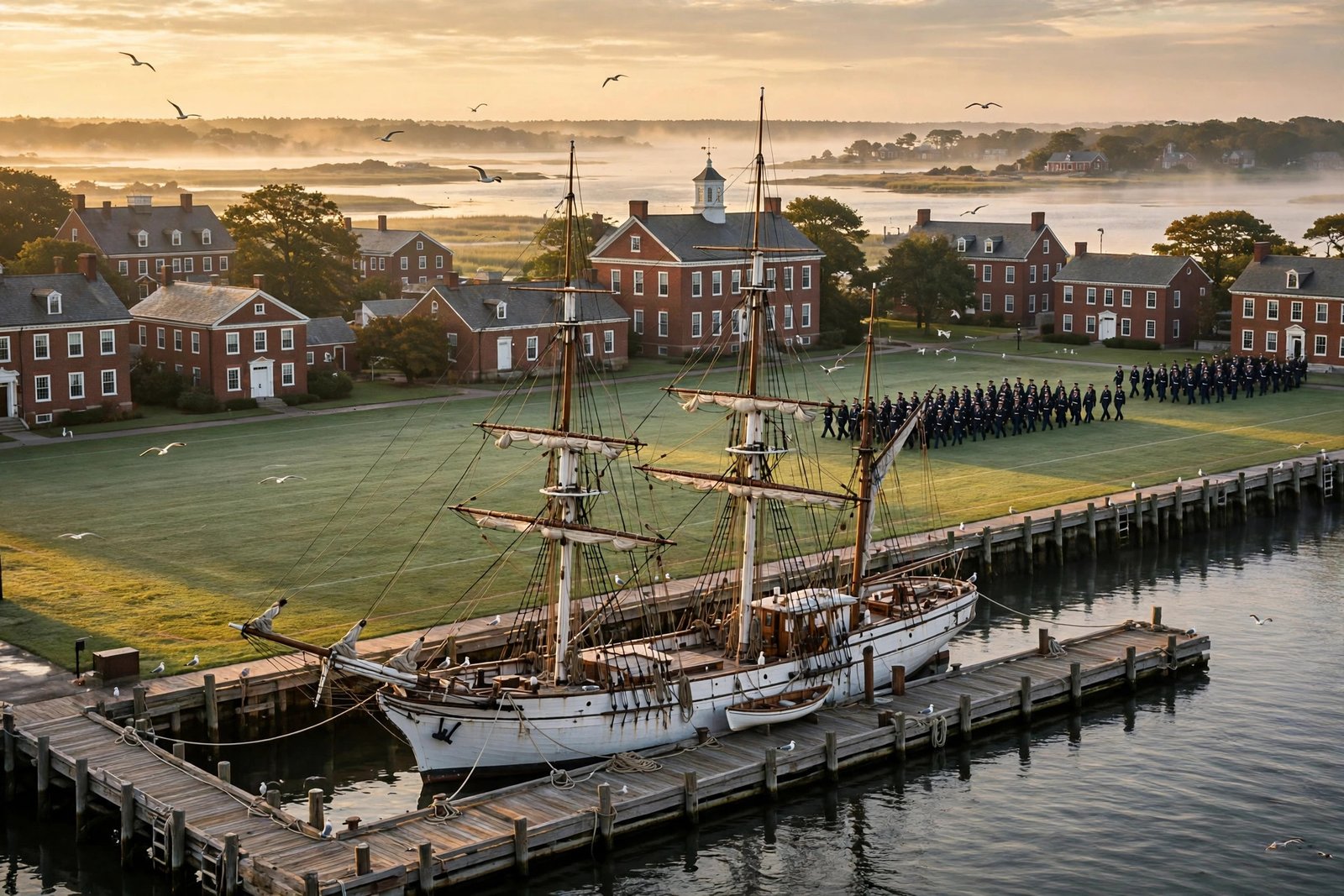
Today the 54-acre campus is built around the regimented life of its Corps of Cadets. All residential students wear the uniform, stand formations and inspections, and progress through a cadet chain of command that runs from “youngie” freshmen to senior cadet officers. The most visible symbol of the modern Academy is its training ship, the TS Patriot State — the second of five purpose-built National Security Multi-Mission Vessels delivered under a U.S. Maritime Administration programme. The Academy formally took custody of the ship in a handover ceremony on 11 October 2024; she can embark up to 600 cadets and now carries the Academy’s winter Sea Term. Alongside her, the Academy keeps the historic gaff-rigged schooner Ernestina-Morrissey, launched in 1894 and now fully restored, for sail training, leadership exercises and STEM outreach. A new $61 million Science and Technology building is scheduled to open on campus in the autumn of 2026.
Programmes Offered
The Academy offers seven undergraduate majors — all Bachelor of Science degrees — and three graduate programmes, alongside professional and continuing-education courses for working mariners:
Undergraduate majors (B.S.)
- Marine Transportation (MTRA) — prepares cadets as licensed deck officers for the U.S. Merchant Marine, with a foundation for management and operations roles across the transportation, intermodal and petroleum industries.
- Marine Engineering (MENG) — prepares graduates as licensed engineering officers, alongside engineering careers in associated shoreside industries.
- Facilities Engineering (FENG) — prepares cadets for careers in facilities engineering, management and operations across large plants, hospitals, power plants and office buildings.
- Energy Systems Engineering (ESEN) — focuses on engineering planning, design and installation for power generation and energy management systems.
- International Maritime Business (IMBU) — develops business professionals for the global supply chain, with skills in accounting, economics, finance and negotiation.
- Emergency Management (EMHS) — prepares graduates for careers in emergency management and disaster-related fields in both the private and public sectors.
- Marine Science, Safety, and Environmental Protection (MSSEP) — tackles environmental safety, marine science and public-health challenges such as climate change.
Graduate programmes (M.S.)
- Master of Science in Maritime Business Management (MSMB)
- Master of Science in Facilities Management (MSFM)
- Master of Science in Emergency Management (MSEM)
The two oldest programmes, Marine Transportation and Marine Engineering, are the Academy’s U.S. Coast Guard license tracks: cadets who complete them earn both the accredited bachelor’s degree and a professional merchant-mariner credential — as Third Mate or Third Assistant Engineer, both unlimited as to waters and vessel size. Roughly half to three-fifths of undergraduates are enrolled in these license-track programmes. License-track cadets put to sea each winter on the annual Sea Term aboard the training ship, accumulating the sea service the Coast Guard requires; cadets in other majors complete experiential-learning voyages, internships and six-credit co-ops in their junior and senior years.
Admission Requirements
The Academy looks for candidates capable of college-level study who can meet its minimum high-school coursework requirements, published for every major:
- English: four years, including grammar, composition, writing skills and literature.
- Mathematics: four years (Algebra I, Algebra II, Geometry, and Precalculus/Trigonometry strongly recommended), including mathematics taken during the final year of high school. Energy Systems Engineering requires Calculus.
- Science: three years of laboratory science at minimum — four years strongly recommended — to include biology, chemistry and physics where possible.
- Social science: two years, including one course in United States history.
- Foreign language: two sequential one-year courses in a classical or modern language (waivers may be available for vocational-technical school students).
- Electives: at least two additional courses from the subjects above, the arts and humanities, or computer science.
Beyond coursework, the application needs a personal essay of at least 300 words explaining why the candidate wants to attend the Academy, and one letter of recommendation (up to three may be submitted). SAT or ACT scores are optional — the Academy runs a test-optional policy and superscores the SAT for those who do submit (average submitted scores run roughly 1050–1100 SAT / 22–23 ACT). There is no physical-ability test and no admissions interview (interviews are available on request). Note, however, that license-track majors (Marine Transportation and Marine Engineering) require a U.S. Coast Guard medical certificate to graduate — certain medical conditions can prevent the Coast Guard from granting one, so candidates should review the requirements early. Applicants cannot apply undecided: the application requires a first- and second-choice major, and candidates are reviewed for the first choice first. Published federal data shows an acceptance rate of roughly 95% for the most recent reported year.
How to Apply: Step by Step
- Identify your applicant type. The Academy admits five student types: First Year (straight from high school), Transfer (anyone with prior college enrolment, a gap year, a GED or completed military service), International, Returning and Military (veterans, reservists and National Guard members). First-year fall applicants may use either the Academy’s institutional application or the Common App; transfer applicants use the institutional application.
- Decide on test scores. Applying test-optional is completely acceptable. If you choose to submit scores, send them officially from the College Board or ACT (score delivery can take two to four weeks) — the Academy will superscore your SAT.
- Complete the application. Fill out the online application and select a first-choice and a second-choice major — you cannot apply undecided. Early Action applicants receive their decision by the holiday break; others typically hear within about two weeks of completing their file.
- Submit your supporting documents. Upload your personal essay (minimum 300 words) through the application portal after submitting, and have your high school send official transcripts and your letter(s) of recommendation directly — via Common App, Parchment, Naviance or Scoir, or by email or post.
- Ask about fee waivers if you need one. The Academy offers fee-waiver codes for the application — contact Admissions at (800) 544-3411 or admissions@maritime.edu to request one.
- Track your status. The application portal shows in real time when each document arrives; once everything is received, the file is marked complete and moves to an admissions counsellor for review.
- Secure your place. Admitted students submit a $400 refundable enrolment deposit through the portal — it is refundable only before 1 May (National Decision Day). Merit and need-based scholarships are awarded automatically as part of the application review, with no separate application.
Tuition & Costs
The Academy publishes per-major cost sheets for full-time students (12+ credits). Below are the tuition and fee components from the Academy’s official degree-cost pages (fees are the same for all majors), followed by housing and the Academy-specific charges:
| Annual tuition & fees (full-time) | In-state | New England Regional | Out-of-state / International |
|---|---|---|---|
| Tuition | $2,246 | $8,472 | $15,296 |
| General fee | $6,986 | $6,986 | $6,986 |
| Technology fee | $2,588 | $2,588 | $2,588 |
| SGA fee (fall only) | $185 | $185 | $185 |
| Health services fee | $146 | $146 | $146 |
| Total tuition & fees | $12,151 | $18,377 | $25,201 |
| Housing & meals (per year) | Amount |
|---|---|
| Room (on campus) | $9,336 |
| Board (food) | $6,350 |
| Total room & board | $15,686 |
On top of the annual figures, the Academy charges several one-time or year-specific items: first-year students pay Orientation ($1,972) and a sea-bag issue ($3,059); second-year students pay an Experiential Learning charge ($6,104); and junior and senior years each carry a six-credit co-op charge ($3,676 per year). Cadets without an outside health-insurance plan are billed $4,962.44 for the Academy’s plan, and regimental commuters pay a board charge of $2,232. All told, a first-year Massachusetts resident’s published annual cost lands around $27,800 before orientation and sea-bag charges, while an out-of-state cadet’s lands around $40,900 — always confirm the current year’s rates on maritime.edu before applying.
Service & Career Outcomes
The Academy is a civilian institution: there is no mandatory military-service obligation. Cadets live a regimented military-style life — uniforms, formations, room inspections, morning formation and a cadet chain of command — but only those who volunteer for commissioning programmes take on military obligations during and after their time at the Academy.
For most graduates, the payoff is direct entry into maritime and related industries. License-track graduates leave with two credentials at once — the Bachelor of Science degree and the U.S. Coast Guard unlimited license as Third Mate or Third Assistant Engineer — and step straight into officer roles aboard merchant vessels, or into management and operations posts in the intermodal, transportation and petroleum industries. Graduates of the engineering, business, emergency-management and environmental majors move into facilities engineering and operations, energy and power systems, the global supply chain, emergency management and environmental protection.
The commissioning route stays open for those who want it: volunteer cadets can pursue commissions in the Navy, Coast Guard and other armed-forces branches (the Academy hosts both Army and Navy ROTC opportunities), and the Strategic Sealift Officer programme keeps a path to a Navy Reserve commission for licensed mariners. The Academy’s own catalog notes that its graduates rank among the very best in the country for return on investment — a consistent theme of independent “best ROI” rankings over the years — and the combination of a degree, a license and four years of practiced leadership is what employers are buying.
Frequently Asked Questions
Is Massachusetts Maritime Academy a military school?
No. It is a public state university with a regimented cadet culture — uniforms, formations and a chain of command — modelled on military and merchant-marine traditions. There is no required military service; only cadets who volunteer for commissioning programmes incur a service obligation. Most graduates go straight into civilian maritime and shoreside careers.
What is the training ship TS Patriot State?
The Patriot State is the Academy’s purpose-built training ship, the second of five National Security Multi-Mission Vessels built under a U.S. Maritime Administration programme. Delivered by Philly Shipyard and formally accepted by the Academy on 11 October 2024, she can embark up to 600 cadets and carries the annual winter Sea Term, replacing the former training ship Kennedy.
Do women attend the Academy?
Yes. The Academy is fully co-educational and has admitted women as cadets since the late 1970s. Cadet status, leadership positions and licence programmes are open to all cadets on the same terms.
Can I attend as a non-uniformed commuter?
The Academy offers limited non-uniformed commuter status in certain programmes, such as Facilities Engineering and Emergency Management, for students who do not join the Regiment of Cadets. Commuter places are restricted, so ask the Admissions Office whether your chosen major qualifies before applying.
What does Massachusetts Maritime Academy cost?
For full-time students, the Academy’s published tuition and fees are $12,151 per year for Massachusetts residents, $18,377 under the New England Regional programme, and $25,201 for out-of-state and international students. On-campus room and board add $15,686, plus year-specific charges such as first-year Orientation ($1,972) and the sea-bag issue ($3,059). Merit and need-based scholarships are awarded automatically with admission.
How hard is it to get in?
The Academy publishes test-optional admissions and accepts roughly 95% of applicants in the most recently reported federal data — it is genuinely accessible to strong B-average high-school students. What matters most is meeting the required coursework (four years each of English and mathematics, three years of lab science, two years of social science and foreign language), a solid personal essay and the recommendation letter.
Ready to take the next step?
Start at maritime.edu, email admissions@maritime.edu or call the Admissions Office on (800) 544-3411. The Academy’s main switchboard is (508) 830-5000, and written enquiries can go to Attn: Admissions, 101 Academy Drive, Buzzards Bay, MA 02532.
Facts in this guide were verified against Massachusetts Maritime Academy’s official website (maritime.edu), its official 2026–2027 catalog and U.S. Maritime Administration announcements in October 2026. Always confirm current deadlines, costs and programme details with the Academy directly before applying.