
Federal Service Academy Directory
United States Coast Guard Academy
On the banks of the Thames River in New London, Connecticut, the United States Coast Guard Academy is the smallest of America’s five federal service academies — and the only one that asks for no congressional nomination. Founded in 1876, it educates the future officers of the United States Coast Guard entirely at federal expense. This complete guide covers admissions requirements, the application process step by step, the ten majors, costs, the service commitment and answers to frequently asked questions.
Directory Information
| Full name | United States Coast Guard Academy |
| Commonly known as | USCGA — the Coast Guard Academy |
| Location | New London, Connecticut, United States — on the Thames River |
| Official address | 31 Mohegan Avenue, New London, CT 06320 |
| Admissions phone | 800-883-USCG (8724) |
| Official website | uscga.edu |
| Founded | 1876 |
| Branch of service | United States Coast Guard |
| Mission | “In Service of Country and Humanity” |
| Cadet strength | Approximately 1,000 cadets |
| Campus | Waterfront campus on the Thames River in New London, Connecticut |
About the Academy
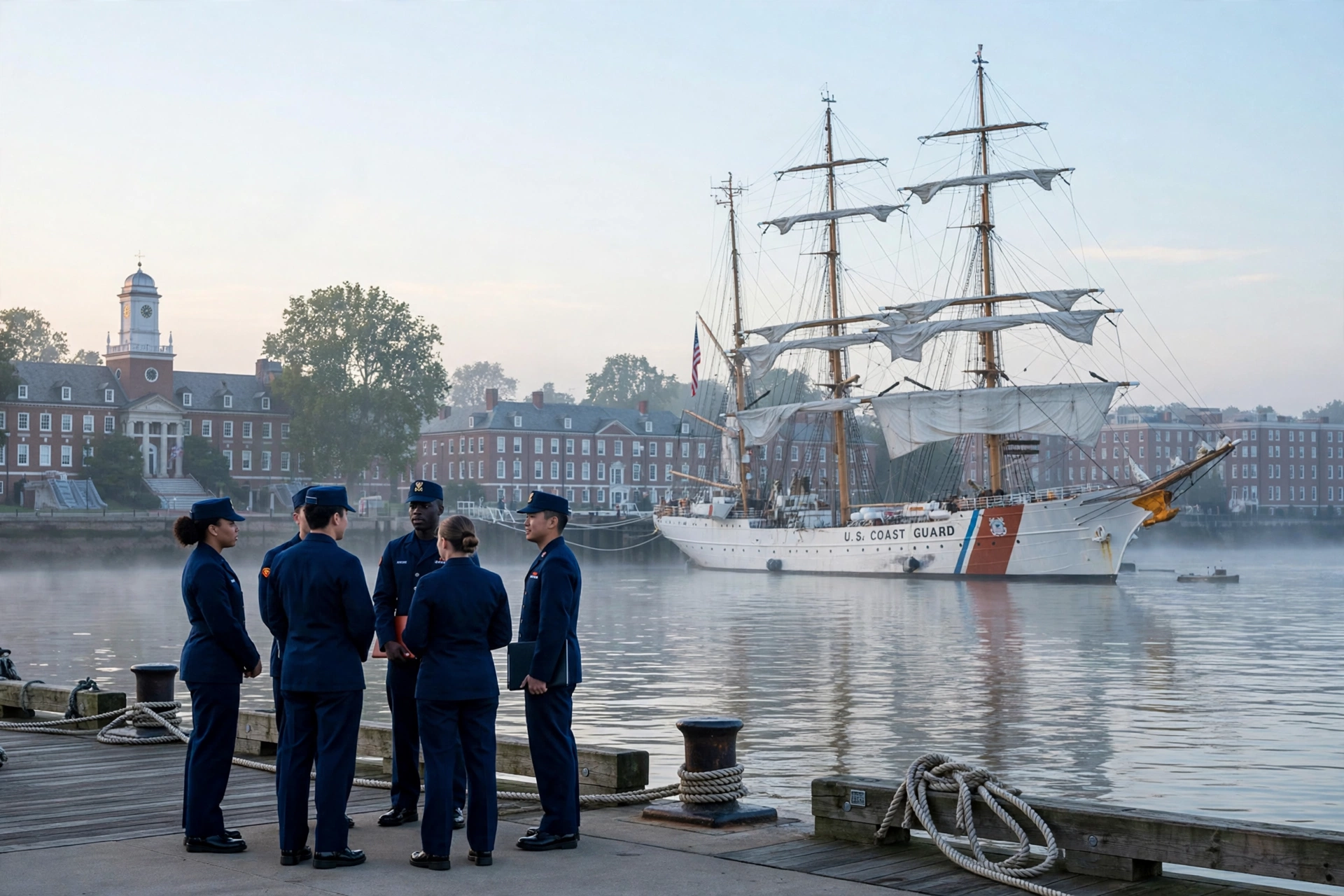
Founded in 1876, the United States Coast Guard Academy began life as the Revenue Cutter School of Instruction, created to train officers for the Revenue Cutter Service — the seagoing service from which the modern Coast Guard grew. The Academy has called New London, Connecticut home for well over a century, and its waterfront campus on the Thames River remains steeped in that maritime heritage. Cadets still take to sea aboard the Academy’s famous square-rigged training barque, EAGLE, learning the sailor’s arts of navigation, seamanship and leadership the way generations of Coast Guard officers have before them.
With roughly 1,000 cadets, USCGA is the smallest of the five federal service academies, and that intimacy is its strength: classes are small, instructors know their cadets, and leadership opportunities come early and often. The Academy’s mission — service of country and humanity — reflects the Coast Guard’s unique character as both an armed force and a humanitarian service, whose officers rescue mariners, protect fisheries and the marine environment, secure ports and respond to disasters at home and abroad. Admission is by merit alone: uniquely among the service academies, no congressional nomination is required.
What It Offers: Majors and Programmes
Cadets choose from ten majors: Civil Engineering; Cyber Systems; Electrical Engineering; Government; Interdisciplinary Engineering; Management; Marine and Environmental Sciences; Mechanical Engineering; Naval Architecture and Marine Engineering; and Operations Research and Data Analytics. Every graduate earns a Bachelor of Science degree and a commission as an ensign in the United States Coast Guard.
The four-year programme blends academic study with professional maritime training. Alongside their majors, cadets learn navigation, seamanship, damage control and leadership, and they spend summers gaining hands-on experience aboard Coast Guard cutters and the barque EAGLE, at air stations and in operational units. On graduation, new ensigns report to the fleet — to cutters at sea, to sector commands ashore or to flight training — ready to lead from day one.
Admission Requirements
Admission to the Coast Guard Academy is highly competitive and assessed purely on merit — no nomination is needed. The essential requirements are:
- Citizenship: you must be a United States citizen of sound moral character.
- Age: you must be 17 to 22 years of age on the last Monday in June of the year you would enter.
- Family and financial status: you must be unmarried, have no dependents and carry no financial debt.
- Education: you must be a high-school graduate or hold a GED, with a strong record — particularly in mathematics and science.
- Standardised tests: the SAT or ACT is required, and your scores must be sent to the Academy.
- Recommendations: three letters of recommendation are required — from a mathematics instructor, an English instructor and your high-school counsellor.
- Fitness: every candidate must pass the Physical Fitness Examination (PFE), which measures strength, endurance and aerobic capacity through push-ups, sit-ups and a timed run.
- Medical: candidates must meet the medical standards for a commissioning programme, assessed through the Department of Defense Medical Examination Review Board (DoDMERB).
- Interview: selected candidates may be asked to attend an interview with an Academy representative.
How to Apply: Step by Step
The Academy admits about 300 cadets each year, with applications for the Class of 2031 currently open. There are two rounds: Early Action, with a deadline of 15 October, and Regular Admission, with a deadline of 15 January for US citizens — note that all supplemental forms and test scores are also due by 15 January.
- Confirm your eligibility. Check the citizenship, age, family-status and education conditions above before you begin.
- Start your online application. Apply at uscga.edu and complete the essays that form part of the application.
- Request your recommendations. Ask your mathematics instructor, your English instructor and your school counsellor for their letters of recommendation early.
- Take the SAT or ACT. Sit the examination and have your scores sent directly to the Academy.
- Pass the Physical Fitness Examination. Arrange the PFE with a qualified administrator and submit your results.
- Complete the medical examination. DoDMERB will schedule your medical and vision examinations as your file progresses.
- Attend an interview if requested. Some candidates are invited to interview with an Academy representative.
- Await the admissions decision. Completed files are reviewed by the admissions board, and appointments are offered to the strongest candidates — no nomination paperwork required at any stage.
Tuition and Costs
There is no tuition at the United States Coast Guard Academy. Like every federal service academy, it charges cadets nothing for their education, room, board, or medical and dental care.
A Coast Guard Academy education is entirely government funded. In exchange, graduates give back through commissioned service — a bargain that makes the Academy one of the best-value educations anywhere, provided you are ready to serve.
Service Commitment After Graduation
Every graduate is commissioned as an ensign in the United States Coast Guard and is obligated to serve a minimum of five years. The Academy notes that most officers stay far longer — about 85% remain in service beyond their initial obligation. New ensigns go on to lead crews aboard cutters at sea, serve at sector commands ashore, fly as naval aviators or train for specialised careers in fields such as marine safety, intelligence and law enforcement. The Coast Guard’s missions are unusually varied: one career can take you from rescuing mariners in a hurricane to commanding a cutter on counter-narcotics patrol.
Famous Graduates
The Coast Guard Academy’s alumni include three former Commandants of the Coast Guard and some of the most decorated officers in the service’s history.
Admiral Thad W. Allen
Class of 1971. The 23rd Commandant of the Coast Guard, who led the federal response to Hurricane Katrina and the Deepwater Horizon oil spill.
Admiral Karl L. Schultz
Class of 1983. The 26th Commandant of the Coast Guard, who led the service through major modernisation and expansion of its fleet.
Admiral Linda L. Fagan
Class of 1985. The 27th Commandant of the Coast Guard — the first woman to lead the Coast Guard, and the first woman to lead any US armed service branch.
Frequently Asked Questions
How much does it cost to attend the Coast Guard Academy?
Nothing. There is no tuition, and room, board and medical and dental care are covered as well. The entire four-year education is government funded, and graduates repay it with five years of commissioned service.
Do I need a nomination from Congress?
No — this is what makes the Coast Guard Academy unique among the federal service academies. Admission is by competitive merit alone, so you never need to seek a nomination from a Member of Congress or any other source.
What are the age and eligibility rules?
You must be a US citizen of sound moral character, 17 to 22 on the last Monday in June of your entry year, unmarried, with no dependents and no financial debt, and a high-school graduate or GED holder. The SAT or ACT is required.
What are the application deadlines?
Early Action applications are due by 15 October; Regular Admission applications (for US citizens) are due by 15 January, with all supplemental forms and test scores due by 15 January as well. Applying Early Action can give you a decision sooner.
How many majors does the Academy offer?
Ten majors, from Civil and Mechanical Engineering and Naval Architecture and Marine Engineering to Cyber Systems, Government and Operations Research and Data Analytics. Every graduate earns a Bachelor of Science degree and a commission as an ensign.
What happens after graduation?
Graduates are commissioned as ensigns in the Coast Guard and serve a minimum of five years. Most stay much longer — about 85% remain beyond their obligation — serving aboard cutters, at sector commands, in aviation and across the Coast Guard’s many missions.
Ready to take the next step?
Visit the academy’s official admissions site at uscga.edu or call the admissions office on 800-883-USCG (8724). Facts in this guide were verified against the academy’s official website.