
Federal Service Academy Directory
United States Air Force Academy
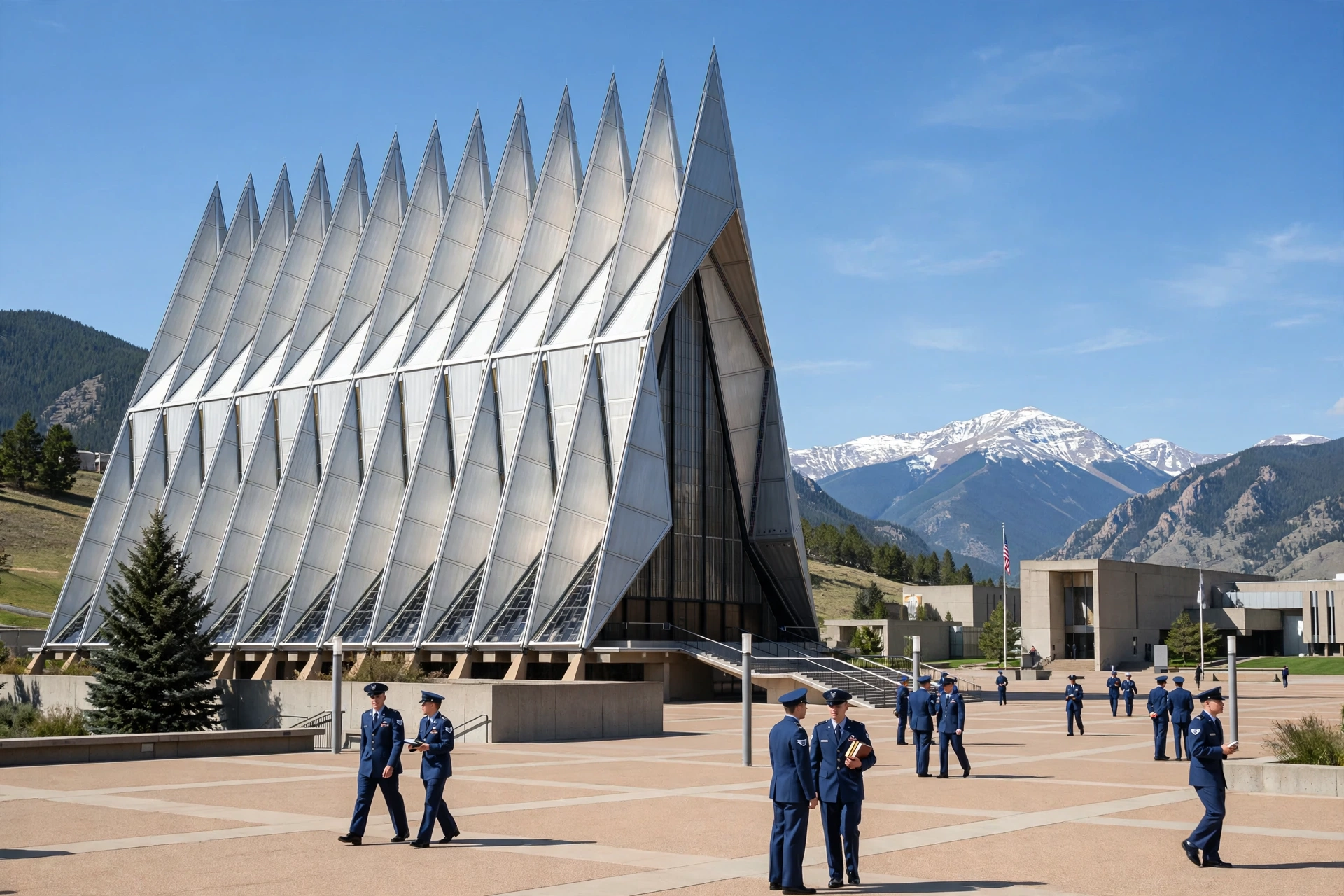
Set against the Rampart Range of the Rocky Mountains just north of Colorado Springs, the United States Air Force Academy trains the future officers of the United States Air Force and the United States Space Force. Founded in 1954, it pairs a rigorous university education with full military training — and charges no tuition. This complete guide covers admissions requirements, the application process step by step, academic programmes, costs, the service commitment and answers to frequently asked questions.
Directory Information
| Full name | United States Air Force Academy |
| Commonly known as | USAFA — the Air Force Academy |
| Location | Colorado Springs, Colorado, United States — at the foot of the Rocky Mountains |
| Official address | 2304 Cadet Drive, USAF Academy, CO 80840 |
| Admissions office | 2304 Cadet Drive, Suite 2400 (mailing: Suite 3100, USAF Academy, CO 80840-5002) |
| Admissions phone | 1 (800) 443-9266 |
| Official website | usafa.edu |
| Founded | 1954 |
| Branch of service | United States Air Force and United States Space Force |
| Core values | Integrity First · Service Before Self · Excellence in All We Do |
| Honour Code | “We Will Not Lie, Steal or Cheat, Nor Tolerate Among Us Anyone Who Does” |
| Cadet strength | More than 4,000 cadets |
| Campus size | More than 16,000 acres of natural open land |
About the Academy
Founded in 1954, the United States Air Force Academy is the youngest of America’s five federal service academies. Its first class of 306 cadets was sworn in at Lowry Air Force Base in Denver, Colorado, while the permanent campus — a striking work of modernist architecture beneath the Front Range of the Rockies, north of Colorado Springs — was still under construction. When the cadets marched into their new home, the Academy settled into the landscape it still occupies today, and it has grown into one of the most selective universities in the United States.
The Academy states its mission plainly: to forge leaders of character, motivated to a lifetime of service, and developed to lead the Air Force and Space Force. Everything about life at USAFA is arranged around that purpose. Cadets live, study and train together as members of the Cadet Wing; they are taught by an outstanding faculty at an 8:1 cadet-to-faculty ratio; and they can work in 24 research centres that tackle real problems for the armed forces. Academic study, military training and athletic development run side by side from the first day to the last — the Academy leaves no part of a young officer’s character undeveloped.
What It Offers: Majors and Programmes
Cadets choose from 31 programmes of study across engineering, the natural sciences, mathematics, computer and data science, the humanities and the social sciences. Whatever their major, every graduate leaves with a Bachelor of Science degree and a commission as a second lieutenant in the United States Air Force or the United States Space Force. The curriculum rests on a broad core in science, technology, engineering and mathematics, balanced by leadership, ethics, military strategy and foreign languages — the foundations an officer needs to lead in air, space and cyberspace.
Beyond the classroom, the Academy is famous for its airmanship programmes, through which cadets can take to the skies in powered flight, soaring and parachute training. Research matters here too: the Academy’s 24 research centres give undergraduates hands-on experience that few universities can match, from aeronautics to space operations. Add intercollegiate and intramural sport, character and leadership laboratories, and a campus set in more than 16,000 acres of mountain foothills, and USAFA offers one of the most distinctive undergraduate experiences in the world.
Admission Requirements
Admission to the Air Force Academy is highly competitive, and every candidate is assessed across academics, leadership, character and fitness. The essential requirements are:
- Citizenship: you must be a United States citizen to apply.
- Age: you must be at least 17 but not yet 23 on 1 July of the year you would enter.
- Family status: you must be unmarried and have no dependents or legal obligation to support children.
- Academics: the Academy conducts a careful academic review of your school record and standardised test scores (SAT or ACT) — a strong background in mathematics and science is essential.
- Fitness: every candidate must pass the Candidate Fitness Assessment (CFA), a six-event test of strength, speed and endurance: the basketball throw, pull-ups (or the flexed-arm hang), the shuttle run, modified sit-ups, push-ups and the one-mile run.
- Medical: candidates must meet the medical standards for a commissioning programme, assessed through the Department of Defense Medical Examination Review Board (DoDMERB).
- Character: a character evaluation and an interview form part of every application, and a nomination from an authorised source — most commonly a Member of Congress — is required for appointment.
How to Apply: Step by Step
- Confirm your eligibility. Check the citizenship, age and family-status conditions above before you invest time in an application.
- Open your application online. Start at usafa.edu, where the admissions site guides you from a preliminary application into a full candidate file.
- Apply for a nomination. Write to both of your United States Senators and your Representative in the House of Representatives, and check the other nomination sources for which you may be eligible. Begin early — nominations have their own deadlines.
- Take your entrance examinations. Sit the SAT or ACT and have your scores sent directly to the Academy.
- Complete your candidate file. Submit your school transcript, teacher evaluations, essays and a record of your activities and leadership experience.
- Pass the Candidate Fitness Assessment. Arrange the six-event CFA with a qualified administrator, such as a coach or physical education teacher, and submit your results.
- Complete the medical examination. DoDMERB will schedule your medical and vision examinations as your file progresses.
- Complete your interview. An admissions representative will assess your character, motivation and suitability for military life.
- Await the admissions decision. Completed files are reviewed as a whole, and appointments are offered to the strongest candidates.
Tuition and Costs
There is no tuition at the United States Air Force Academy. An appointment is a fully funded scholarship: the Academy values the education it provides at more than $416,000, and the cadet pays none of it.
Tuition, room and board, and medical and dental care are all provided at no cost to the cadet. In exchange, graduates serve as commissioned officers — that bargain, a world-class education repaid with military service, is the foundation on which every federal service academy stands.
Service Commitment After Graduation
Every graduate is commissioned as a second lieutenant in the United States Air Force or the United States Space Force, and owes a minimum of eight years of service as a commissioned officer, including five years on active duty. Cadets take the Oath of Allegiance when they arrive at the Academy; graduates who complete their five years of active duty may request separation, while pilots and some other specialists — whose training costs the service far more — incur longer commitments. For most graduates, the commitment is the beginning rather than the end of a career: new lieutenants go on to fly aircraft and spacecraft, lead cyber and intelligence teams, manage space operations and command units around the world.
Famous Graduates
The Academy’s alumni include Medal of Honor recipients, astronauts and some of the most admired aviators of the modern age.
Captain Lance P. Sijan
Class of 1965. Fighter pilot who was posthumously awarded the Medal of Honor for his extraordinary heroism and endurance as a prisoner of war in Southeast Asia.
Lieutenant General Susan Helms
Class of 1980. A member of the first Academy class to include women, she became a NASA astronaut, flew on five Space Shuttle missions and lived aboard the International Space Station.
Captain Chesley “Sully” Sullenberger III
Air Force fighter pilot turned airline captain who safely landed US Airways Flight 1549 on the Hudson River in 2009 — the “Miracle on the Hudson” that saved all 155 people aboard.
Colonel Raja Chari
Test pilot and NASA astronaut who has flown to the International Space Station, continuing the Academy’s long tradition of producing America’s spacefarers.
Frequently Asked Questions
How much does it cost to attend the Air Force Academy?
Nothing. There is no tuition, and room, board and medical and dental care are covered as well. The Academy values the education at more than $416,000, provided at no cost in return for service as a commissioned officer after graduation.
Do I need a nomination from Congress to apply?
Yes — most candidates need a nomination from an authorised source, most commonly a Member of Congress. Apply to both of your United States Senators and your Representative, ideally during your junior year of high school, and check whether you qualify for other nomination categories as well.
What are the age and eligibility rules?
You must be a United States citizen, at least 17 but not yet 23 on 1 July of your entry year, unmarried, and have no dependents or legal obligation to support children. You must also pass the academic review, the Candidate Fitness Assessment and the DoDMERB medical examination.
What is the Candidate Fitness Assessment?
The CFA is a six-event physical test used across the service academies: a basketball throw, pull-ups (or the flexed-arm hang), a shuttle run, modified sit-ups, push-ups and a one-mile run. Train for it well in advance — your scores form part of your whole-person evaluation.
How many majors does the Academy offer?
Cadets choose from 31 programmes of study across engineering, science, mathematics, the humanities and the social sciences. Every graduate earns a Bachelor of Science degree and a commission in the Air Force or the Space Force, with teaching at an 8:1 cadet-to-faculty ratio and access to 24 research centres.
What happens after graduation?
Graduates are commissioned as second lieutenants and serve at least eight years as commissioned officers, five of them on active duty. Pilots and some specialists serve longer. Officers go on to careers in flying, space operations, cyber, intelligence, engineering and command.
Ready to take the next step?
Visit the academy’s official admissions site at usafa.edu or speak to the admissions team on 1 (800) 443-9266. Facts in this guide were verified against the academy’s official website.