
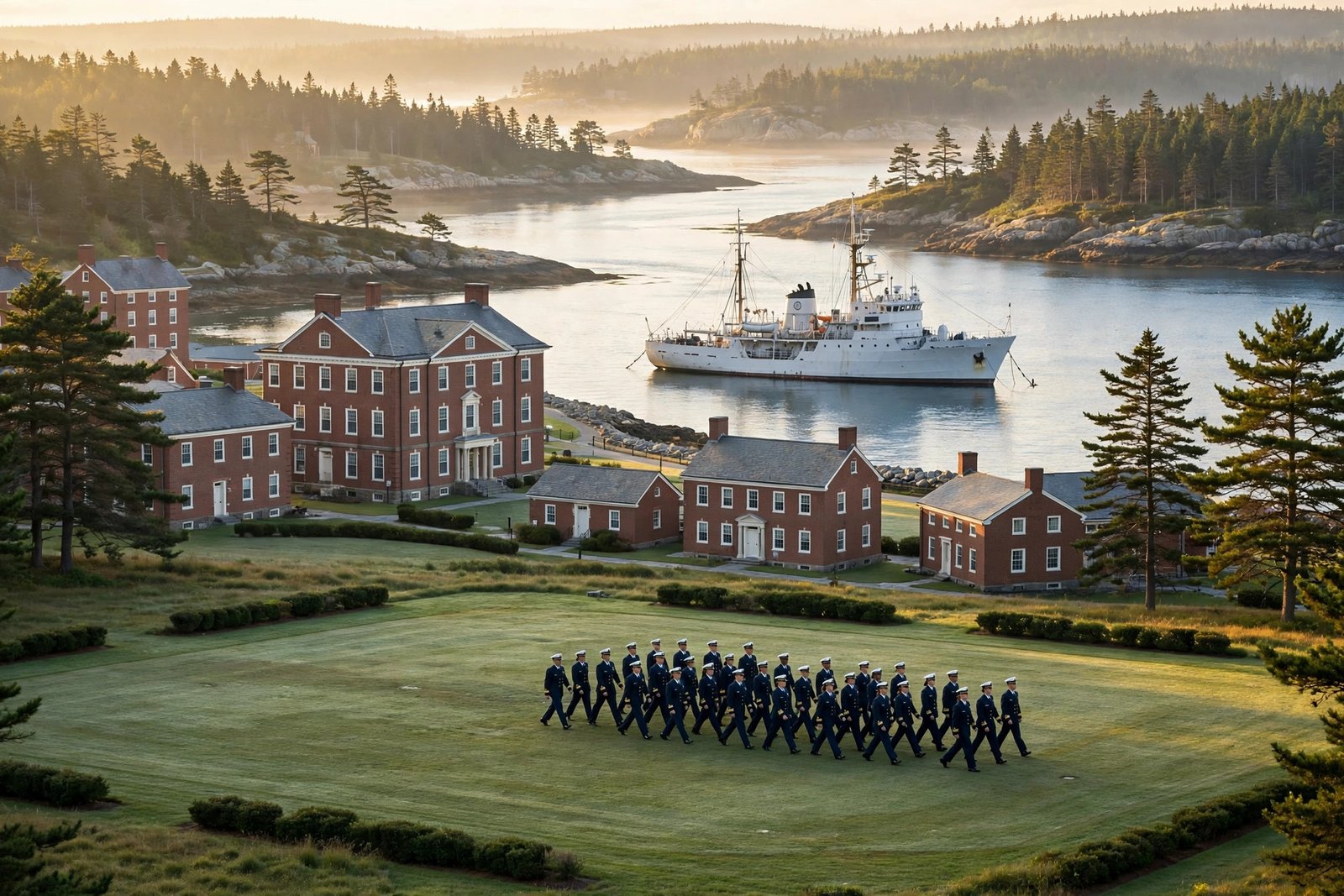
Maine Maritime Academy (MMA)
On the waterfront of Castine, Maine, one of America’s six state maritime academies has been turning students into licensed ship officers, engineers, scientists and logistics leaders since 1941. This directory guide covers Maine Maritime Academy’s history, its degree programmes, the Regiment of Midshipmen, admission steps, tuition costs, the brand-new training ship State of Maine, and the graduate careers that make MMA famous for job placement.
Directory Information
| Full name | Maine Maritime Academy (MMA) |
|---|---|
| Location | Castine, Maine, United States — on Penobscot Bay |
| Official address | 1 Pleasant Street, Castine, ME 04420 |
| Phone | 207-326-4311 (main) — admissions: admissions@mma.edu |
| Official website | https://mainemaritime.edu/ |
| Founded | 21 March 1941, by act of the 90th Maine Legislature |
| Type | Public, co-educational college — one of six state (non-federal) maritime academies in the United States |
| Approx. student strength | About 950 students |
| Leadership | President: Rear Admiral Craig Johnson, USMS |
| Training vessels | Training Ship State of Maine (new NSMV, delivered 2026); Schooner Bowdoin |
About & History
Maine has owned a worldwide reputation for shipbuilders and sea captains for centuries — it was in Maine that the first English ship built in America, the Virginia, was launched in 1607, and Mainers have built and sailed everything from windjammers and fishing fleets to America’s Cup defenders ever since. It was against this seafaring tradition that civic and educational leaders in the 1930s, led by Senator Ralph Leavitt of Portland, proposed an institution devoted to nautical training in the state.
Their campaign succeeded when the 90th Maine Legislature created Maine Maritime Academy by act on 21 March 1941. The original class of just 29 students reported on 9 October that year to Rear Admiral Douglas Dismukes, USN, a First World War veteran who came out of retirement to lead the fledgling school. Classes met on the campus of the Eastern State Normal School, students were lodged at Castine’s Pentagöet Inn, and the Mattie, a schooner out of Camden, Maine, served as the first training ship.
War accelerated everything. The Second World War demanded a rapid build-up of the United States Merchant Marine and a critical need for trained deck and engineering officers. The Academy graduated its first class in 1943 and ultimately produced more than 300 officers who served at sea during the war, in every theatre of operations — three gave their lives in service to the nation, and many others were wounded. By war’s end, Maine Maritime had graduated 384 men.
In the post-war era the programme expanded from its original concept into a three-year course of study, and in 1960 into a full four-year Bachelor of Science degree. Through the 1960s and 1970s, Rear Admiral Edward Rodgers, USMS, led a multi-million-dollar development programme that culminated in full membership in the New England Association of Schools and Colleges. Today the Academy is a public, co-educational college of about 950 students offering associate, bachelor’s and master’s degrees across engineering, management, science and transportation — ranked the number-one best public college on Money magazine’s Best Colleges list in both 2014 and 2015.
MMA is one of six non-federal maritime training colleges in the United States and one of only two that fields a Naval Reserve Officers Training Corps (NROTC) unit. Unlike the federal service academies, no congressional recommendation is required for admission — it is a state institution, and any qualified student may apply.
Programmes Offered
Maine Maritime Academy offers bachelor’s degrees in 14 majors and an associate degree, plus online graduate programmes. Several majors lead to a United States Coast Guard unlimited licence and require participation in the Regiment of Midshipmen — the structured, uniformed cadet organisation that is the heart of academy life. Non-licence majors follow a traditional college experience, with optional Regiment participation.
Unlimited-licence majors (Regiment required)
- Marine Transportation Operations (MTO) — prepares cadets to sail as navigation officers on vessels of any size, on any ocean. Qualified graduates may sit the federal examination for the U.S. Coast Guard 3rd Mate Unlimited Tonnage Licence. MTO majors complete 365 days of training at sea through three distinct at-sea experiences, laboratories and simulation.
- Marine Engineering Operations (MEO) — the operating-engineer track toward the USCG 3rd Assistant Engineer Licence, Unlimited.
- Marine Engineering Technology (MET) — a technology-focused engineering track, also leading to the USCG 3rd Assistant Engineer Licence.
- Marine Systems Engineering — Licence Track (5-year) — a math-intensive naval-architecture and engineering programme leading to the USCG 3rd Assistant Engineer Licence, Unlimited.
Bachelor’s degrees (non-licence tracks)
- Marine Systems Engineering — Non-License Track (4-year), accredited by ABET’s Engineering Technology Accreditation Commission
- Power Engineering Technology
- Vessel Operations and Technology
- Marine Biology and Marine Biology / Small Vessel Operations
- Coastal and Marine Environmental Science and Coastal and Marine Environmental Science / Small Vessel Operations
- International Business and Logistics
- Interdisciplinary Studies
Associate degree and graduate study
- Associate of Science in Small Vessel Operations
- Online Master of Science and graduate programmes in maritime management and international logistics
- The Center for Professional Mariner Development (CPMD) offers more than 30 USCG-approved STCW courses plus vocational credentials for working mariners
Admission Requirements
Admission to MMA is competitive but broadly accessible: recent classes show an acceptance rate around the mid-fifties, an average high-school GPA near 3.5, and, among applicants who chose to submit scores, an SAT middle range of roughly 1070–1270 and an ACT middle range of roughly 23–30. The Academy is test-optional — SAT and ACT scores are not required, and merit-aid decisions do not depend on them — though submitted scores are considered and the Academy superscores both exams.
- High-school record: secondary-school GPA and full transcript are required. Strong preparation in mathematics and lab science is especially valued for the engineering and licence-track majors.
- Personal essay: a written statement on the application is required.
- Recommendation: at least one letter of recommendation is required.
- Standardised tests (optional): SAT or ACT scores may be submitted to strengthen an application. For international applicants, a qualifying SAT/ACT score can also serve as proof of English proficiency.
- English proficiency: TOEFL or equivalent is required for non-native speakers of English.
- Application fee: a modest application fee applies; waivers are available for those who qualify.
Because licence-track majors carry Coast Guard and medical fitness standards, admitted cadets should expect health and fitness requirements before reporting, particularly before the training cruises.
How to Apply: Step by Step
- Choose your major — and your track. Decide whether you want a licence-track programme (Marine Transportation Operations, Marine Engineering Operations, Marine Engineering Technology, or Marine Systems Engineering Licence Track, all requiring the Regiment of Midshipmen) or a non-licence degree. Your choice shapes your daily life at Castine.
- Start the application. Complete the online application through the Academy’s admissions portal at mainemaritime.edu. Applications are reviewed on an ongoing basis, so earlier is better.
- Send your records. Ask your high school to send your official transcript, and arrange your letter of recommendation and personal essay. Review the programme-specific preparation guidance for engineering majors.
- Decide on test scores. MMA is test-optional. If your SAT or ACT results fall inside or above the published ranges, submit them — the Academy superscores. If not, lean on your transcript; it will not count against you.
- File the FAFSA. Submit the Free Application for Federal Student Aid as early as possible. FAFSA data for Maine residents is forwarded automatically to the FAME/Maine grant programme, and qualifying MMA students receive the Maine Grant.
- Watch for your decision, then prepare to report. Once admitted, pay the enrolment deposit, confirm housing, and complete the medical and fitness documentation — especially if you are entering the Regiment or a licence-track major ahead of training cruise.
Tuition & Costs
As a public college, MMA charges Maine residents the lowest rate, with a reduced New England Regional rate (under the New England Regional Student Program, or NERSP) for students from qualifying states — Connecticut, Massachusetts, New Hampshire, Rhode Island, Vermont and Puerto Rico, depending on the major — and a full out-of-state rate for everyone else. Official 2026–27 undergraduate tuition from the Academy catalog is:
| 2026–27 tuition | Per semester | Per year |
|---|---|---|
| In-State | $6,268 | $12,536 |
| New England Regional | $9,402 | $18,804 |
| Out-of-State | $14,420 | $28,840 |
Beyond tuition, budget for room and board, general fees (around $3,340 a year in the most recently reported IPEDS data), medical insurance, a one-time unlimited-licence programme participation fee, cruise/co-op fees, and first-year regimental uniforms (roughly $3,700 for a first-year regimental student, part payable directly to the Academy bookstore). Per-credit-hour rates are $418 in-state, $627 regional and $961 out-of-state for part-time students. The published total cost of attendance for 2024–25 was about $31,940 for in-state students and about $47,884 for out-of-state students living on campus — always confirm the current year’s official cost-of-attendance worksheet before applying, as licence-track majors carry extra cruise and programme fees.
Service & Career Outcomes
Maine Maritime Academy’s reputation rests on one striking number: a job-placement rate in excess of 90 percent within 90 days of graduation, well above national averages, with persistence and retention rates to match. Alumni work across the world in maritime, engineering, business and scientific fields, and the alumni network feeds graduates directly into career openings in the industries the Academy serves.
Licence-track graduates earn eligibility to sit for the USCG 3rd Mate or 3rd Assistant Engineer unlimited licences, opening careers sailing as officers aboard commercial vessels worldwide. Graduates of the licence programmes may also commission into the U.S. Navy Reserve’s Strategic Sealift Officer programme, and the on-campus NROTC unit offers a parallel commissioning path for those who choose it. Crucially, there is no military service obligation attached to an MMA degree — unlike the federal service academies, graduates choose their own path: sea-going careers, shore-side roles in ports, logistics, shipbuilding and power generation, or graduate school.
The practical engine behind these outcomes is the Academy’s hands-on training. Licence majors log 365 days of sea time across three at-sea training experiences; marine transportation students learn navigation, cargo operations, ship handling and watchkeeping on simulators and at sea; and in 2026 the Academy took delivery of its first purpose-built training vessel, the new State of Maine (NSMV III), handed over in Portland on 30 March 2026 and the fifth ship to carry the name for the Academy. The historic Schooner Bowdoin continues in service as well, giving cadets experience aboard a working sailing vessel.
Frequently Asked Questions
Do I need a congressional nomination to attend Maine Maritime Academy?
No. MMA is a state institution, not a federal service academy, so no congressional recommendation or nomination is required. Admission is by application, transcript, essay and recommendation.
Will I have to join the military after graduating?
No. MMA graduates are not obligated to pursue sea-going or military careers. Many choose shore-side employment in maritime, engineering, logistics or power generation. Commissioning options exist — NROTC and the Navy Reserve Strategic Sealift Officer programme — but they are voluntary, not required.
What is the Regiment of Midshipmen?
The Regiment is MMA’s structured, uniformed cadet organisation, required for all unlimited-licence majors and optional for everyone else. Regimental students follow formation, discipline and leadership traditions alongside their academics and shipboard training, while non-regimental students live a more conventional college lifestyle.
How much does Maine Maritime Academy cost?
Official 2026–27 tuition is $12,536 per year in-state, $18,804 per year at the New England Regional rate, and $28,840 per year out-of-state, before room, board, fees, uniforms and cruise costs. The published 2024–25 total cost of attendance was about $31,940 in-state and about $47,884 out-of-state, on campus. Most students receive grants or scholarships that lower the net price.
What is the new training ship State of Maine?
The new State of Maine is the third of five National Security Multi-Mission Vessels (NSMVs) built for the state maritime academies — the first purpose-built training vessel in MMA’s history, delivered on 30 March 2026 in Portland and christened in August 2025. It replaces the previous State of Maine, which served the Academy from 1997 to 2024, and can train several hundred cadets at sea while also serving federal disaster-relief missions.
How hard is it to get into Maine Maritime Academy?
Recent classes show an acceptance rate in the mid-fifties — selective but attainable. Admitted students typically present a high-school GPA around 3.5; submitters’ SAT scores fall roughly in the 1070–1270 range and ACT scores in the 23–30 range. The Academy is test-optional and evaluates applications holistically, weighing preparation for a structured, hands-on maritime environment alongside grades.
Ready to take the next step?
Start at mainemaritime.edu or contact the Admissions Office at admissions@mma.edu or 207-326-4311. Review the official cost-of-attendance worksheet and your major’s cruise requirements before you apply.
Facts in this guide were verified against Maine Maritime Academy’s official website (mainemaritime.edu), its undergraduate catalog, and its official 2026–27 cost-of-attendance worksheet in October 2026. Always confirm current deadlines, costs and enrolment status with the Academy directly before applying.