
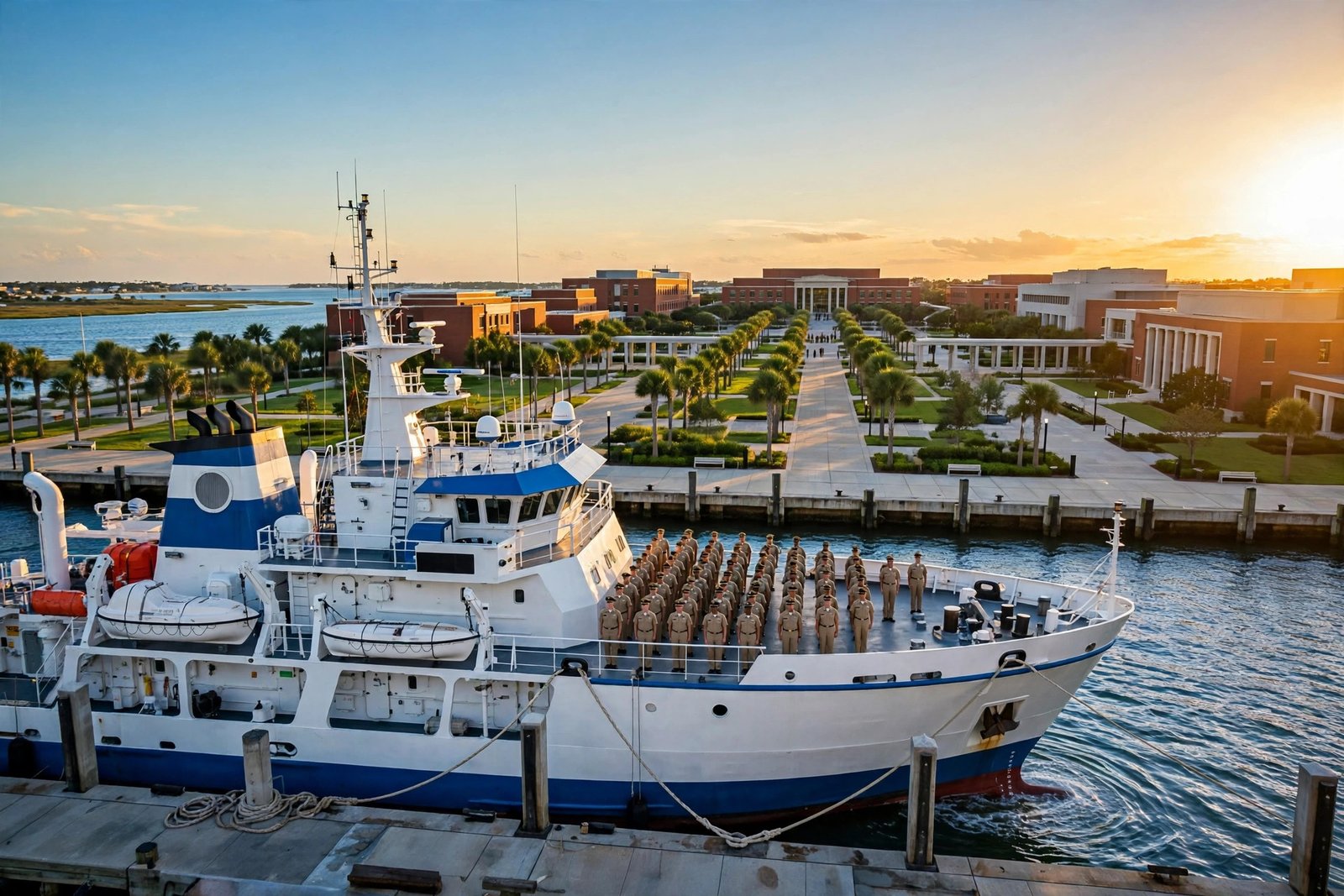
Texas A&M Maritime Academy (Galveston, Texas)
The only maritime academy on the Gulf Coast, Texas A&M Maritime Academy has trained licensed Merchant Marine officers since 1962. Set on the Pelican Island waterfront in Galveston, it is one of only six maritime academies in the United States designated by the U.S. Maritime Administration. This directory guide covers its history and brand-new training ship, its licence-option degree programmes, the Corps of Cadets, admission steps, tuition and the career paths its graduates take at sea and ashore.
Directory Information
| Full name | Texas A&M Maritime Academy (at Texas A&M University at Galveston) |
|---|---|
| Location | Pelican Island, Galveston, Texas, United States |
| Official address | 200 Seawolf Parkway, Galveston, TX 77554 (mailing: P.O. Box 1675, Galveston, TX 77553) |
| Phone | Academy office: +1 (409) 740-4715 | Campus switchboard: (409) 740-4400 |
| Official website | https://maritime.tamu.edu/ |
| Founded | 1962 (first class of 23 cadets enrolled 17 September 1962) |
| Type | Public state maritime academy; one of six U.S. maritime academies designated by the U.S. Maritime Administration; part of the Texas A&M University System |
| Motto / guiding purpose | No formal motto is published. The stated purpose of the Corps of Cadets is: “To develop leaders of character dedicated to serving the greater good.” |
| Cadet strength | Over 400 cadets trained annually (Texas A&M release); the Galveston campus enrols roughly 2,300 undergraduate and graduate students |
About & History
The idea of a maritime academy on the Gulf Coast began with a group of Galveston civic leaders in the late 1950s. A state law authorising a nautical school had lain dormant since 1931 because a budget rider blocked the use of state funds; in 1959 the rider was lifted, and in 1961 the Texas Legislature approved a small appropriation for the school. On 26 January 1962, Texas Governor Price Daniel and Texas A&M President Earl Rudder signed the contract with the U.S. Maritime Administration supporting a Texas maritime academy in Galveston, and on 24 February the Board of Directors of the Texas Agricultural and Mechanical College System formally established it.
Retired U.S. Navy Captain Bennett M. Dodson was named the academy’s first superintendent, and on 17 September 1962 he welcomed the first class of 23 cadets — the first “Saltwater Aggies.” Those early cadets spent their freshman year at the main campus in College Station, where they formed the first Marine Corps company in Texas A&M’s Corps of Cadets — Superintendent Dodson wanted his students to absorb Marine Corps discipline and naval tradition from the start — and completed their remaining three years in Galveston, at first in buildings on the old Fort Crockett military reservation. That two-campus pattern lasted eight years, until 1971.
The academy’s first training vessel was the 15,000-ton Texas Clipper (the former USS Queens), acquired in 1965. She carried cadets on some 30 annual summer voyages between 1965 and 1994 as a floating classroom. She was followed by the Texas Clipper II, the SS Cape Gibson, the small training vessel TS General Rudder, and — from April 2023 until September 2025 — the steamship TS Kennedy on interim loan from the Maritime Administration.
The great milestone of recent years is the National Security Multi-Mission Vessel. Congress funded the new ship in December 2020, and on 8 September 2026 the 524-foot TS Lone Star State — a $325 million purpose-built training ship with berths for 600 cadets at sea — arrived in Galveston to begin a new era as the academy’s primary training vessel, with her first sea term scheduled for April 2027. Along the way the academy grew with the campus: the first licence ceremony was held on 26 May 1966 for 13 seniors, and today the academy sits on the dedicated Pelican Island campus as the maritime heart of Texas A&M University at Galveston — the only academy of its kind integrated into a Tier 1 research institution.
Programmes Offered
Cadets at the academy take part in one of three programmes — the U.S. Coast Guard License Program, Navy ROTC, or Drill & Ceremonies — all within the structured Corps of Cadets. The licence programme is the academy’s core and makes up the majority of its cadets; licence-option cadets take part in musters, watch-standing, ship maintenance, small-boat handling and three summer sea terms aboard the training ship.
U.S. Coast Guard License Program
- Deck track: cadets majoring in Marine Transportation (and optionally Marine Biology, Marine Sciences, or graduate programmes) work toward the U.S. Coast Guard Third Mate licence, oceans, unlimited tonnage — the entry-level deck officer credential in the U.S. Merchant Marine.
- Engineering track: cadets majoring in Marine Engineering Technology work toward the Third Assistant Engineer licence, steam and/or motor vessels, unlimited horsepower.
- Licence-option cadets must complete three summer sea terms, meet the International Convention on Standards of Training, Certification and Watchkeeping (STCW) competencies, and pass the professional examination administered by the U.S. Coast Guard.
Strategic Sealift Officer Program (SSO)
Licence-option cadets can also train for a commission in the U.S. Navy Reserve as a Strategic Sealift Officer (166x designator), taking additional naval science courses alongside NROTC training. The programme offers a competitive, incentive-based student payment of $8,000 per year for up to four years. Cadets may also request active-duty service in the U.S. Navy, enter the Marine Corps through the Platoon Leaders Course (PLC), or seek a direct commission in the U.S. Coast Guard.
Navy ROTC
NROTC midshipmen train for a commission as a naval officer without earning a merchant mariner licence. They participate in the Corps of Cadets but take part in little of the licence training, and they may major in any degree offered on the campus.
Drill & Ceremonies
This option lets cadets experience the Corps of Cadets — its leadership laboratory, musters and ceremonies — with no obligation to a licence or military programme. Like NROTC midshipmen, they may pursue any major offered.
Degree programmes on the Galveston campus
- Licence-designated bachelor’s degrees: B.S. in Marine Transportation, B.S. in Marine Engineering Technology, B.S. in Marine Biology, B.S. in Marine Sciences, and graduate programmes.
- Other bachelor’s degrees: Maritime Business Administration, Maritime Studies, Ocean Engineering, Offshore and Coastal Systems Engineering, Marine Fisheries, and University Studies concentrations (including Marine Environmental Law and Policy, Oceans and One Health, and Tourism & Coastal Community Development).
- Graduate degrees: M.S. and Ph.D. in Marine Biology, M.S. in Marine and Coastal Management and Science, and the Master of Maritime Business Administration and Logistics.
Admission Requirements
Admission to the academy runs in two stages: first you must be admitted to Texas A&M University at Galveston as a degree-seeking student, and then you apply separately to the Texas A&M Maritime Academy. Key requirements include:
- University admission: freshman applicants apply through ApplyTexas or the Common Application (transfers use ApplyTexas), and submit high school transcripts — electronically via TREx for Texas schools, uploaded through the Applicant Information System (AIS), or by post. Texas private-school applicants must meet the State of Texas Uniform Admission Policy or file Exemption Form 3; permanent residents submit their card (or an SB 1528 affidavit if applicable).
- Academy application: every cadet must complete the Texas A&M Maritime Academy application at tx.ag/TAMMAApp after receiving the university email confirmation and student ID number.
- Licence-option entry: the licence track is fall-admission only, with applications completed by 15 July each year. Licence-option applicants must major in Marine Transportation, Marine Biology, Marine Engineering Technology, or Marine Sciences (or a graduate programme).
- NROTC / SSO applicants: additionally submit the Authorization for the Release of Records and Information Form and the NROTC College Program Application, emailed to admissions@tamug.edu.
- Medical fitness for sea duty: licence cadets must meet U.S. Coast Guard medical standards for sea service, including a physical examination and up-to-date immunisations, and should arrange a valid passport and a Transportation Worker Identification Credential (TWIC) as part of sea-term paperwork.
- Citizenship note: international students may enrol in degree programmes, but they cannot obtain a U.S. merchant mariner licence.
How to Apply: Step by Step
- Apply to the university. Submit your freshman application to Texas A&M University at Galveston through ApplyTexas or the Common Application (transfers through ApplyTexas). Send or upload your high school transcript through the Applicant Information System as instructed.
- Get your student ID. Once the university processes your application you will receive an email confirmation and a student ID number — you need this before the academy application can be considered.
- Complete the academy application. File the Texas A&M Maritime Academy application at tx.ag/TAMMAApp. If you are applying for the Licence Option, remember it is fall-admission only and your completed application is due by 15 July.
- NROTC / SSO applicants: file the extras. Email the Authorization for the Release of Records and Information Form and your NROTC College Program Application to admissions@tamug.edu.
- Clear the licence requirements. Book your Coast Guard medical/physical examination, update your immunisations, and begin the paperwork for your passport and TWIC so sea-term documents are ready in good time.
- Ask questions early. Contact the academy at tamma@tamug.edu about licence-option requirements and the application process, or the Admissions Office on (409) 740-4400 for general university admission queries.
Tuition & Costs
Texas A&M University at Galveston charges standard Texas A&M tuition. Published third-party estimates put annual undergraduate tuition at roughly $12,160 for Texas residents and about $39,956 for non-residents — always confirm current figures on the university’s official tuition pages before applying. What is confirmed from the university itself is that the academy has been made dramatically more affordable for licence-track cadets:
| Regional licence tuition discount (from 1 Sept 2024) | Saving per credit hour |
|---|---|
| Tier 1: Louisiana, Mississippi, Alabama, Florida, Puerto Rico, Panama | $300 — charged at the in-state classification |
| Tier 2: Arkansas, New Mexico, South Carolina, North Carolina, Georgia, Oklahoma | $150 — in-region classification |
| Tier 3: all other states and regions | Standard out-of-state rate |
From the fall 2025 intake, the university has also extended in-state tuition to all incoming U.S. undergraduate students who enrol in one of the designated licence degree programmes at the Galveston campus. The Strategic Sealift Officer Program additionally offers eligible cadets an incentive payment of $8,000 per year for up to four years. Room, board and other cost-of-attendance figures vary by year and were not published in the sources consulted — check the university’s official cost-of-attendance pages for the current breakdown.
Service & Career Outcomes
The academy’s signature outcome is a U.S. Coast Guard merchant mariner licence. Deck graduates leave with the Third Mate credential (oceans, unlimited tonnage) and engineering graduates with the Third Assistant Engineer credential (steam and/or motor, unlimited horsepower), and sail as licensed officers in the U.S. Merchant Marine — on ocean-going vessels, inland waterways and government sealift ships — or step into management roles in the maritime industry ashore. Because the STCW competencies and sea terms are built into the degree, graduates are ready for professional watch-standing from day one.
Uniformed service is the second great pathway. Strategic Sealift Officer Program cadets commission into the U.S. Navy Reserve as Strategic Sealift Officers, with the option to request active-duty Navy service; others take the Marine Corps Platoon Leaders Course or direct commissions in the U.S. Coast Guard. NROTC midshipmen commission as naval officers across warfare communities.
Ashore, graduates move into maritime business and logistics, port and terminal operations, shipyard engineering, offshore energy and marine surveying — and the Texas A&M degree is identical to the one earned in College Station, keeping graduate school and federal service doors open. Drill & Ceremonies cadets carry the same Corps leadership training into civilian professions with no service obligation. It is worth remembering that this is a growing enterprise: the 524-foot TS Lone Star State, arriving in Galveston in September 2026, is the first purpose-built training ship in the academy’s history and signals how much the institution is investing in the next generation of American mariners.
Frequently Asked Questions
Is Texas A&M Maritime Academy part of Texas A&M University?
Yes. It is the maritime academy of the Galveston Campus of Texas A&M University, and cadets earn accredited Texas A&M bachelor’s degrees. It is one of only six maritime academies in the United States designated by the U.S. Maritime Administration, and the only one on the Gulf Coast.
Do I have to join the Corps of Cadets?
Every academy cadet participates in the Corps of Cadets, but you choose your commitment level: the U.S. Coast Guard License Program, Navy ROTC, or Drill & Ceremonies. The Drill & Ceremonies option carries no military or licence obligation.
What merchant mariner licences can I earn?
Deck-track graduates can earn the U.S. Coast Guard Third Mate licence (oceans, unlimited tonnage); engineering-track graduates can earn the Third Assistant Engineer licence (steam and/or motor vessels, unlimited horsepower) — after completing three summer sea terms, the STCW competencies and the Coast Guard professional examination.
Can international students attend the academy?
International students may enrol in the campus’s degree programmes, but they cannot obtain a U.S. merchant mariner licence — the licence track is effectively open only to U.S. citizens and permanent residents who meet Coast Guard requirements.
What is the current training ship?
The TS Lone Star State, a $325 million, 524-foot National Security Multi-Mission Vessel, arrived in Galveston in September 2026 and is now the academy’s primary training ship, berthing 600 cadets at sea. Her first sea term is scheduled for April 2027. She replaced the interim training ship TS Kennedy.
What does it cost to attend?
Undergraduate tuition is estimated at roughly $12,160 per year for Texas residents and about $39,956 for non-residents. However, from fall 2025 all incoming U.S. undergraduates in the designated licence degree programmes pay in-state tuition, and a three-tiered regional discount (from 1 September 2024) gives students from neighbouring Gulf states further per-credit-hour savings.
Ready to take the next step?
Start at maritime.tamu.edu, email the academy at tamma@tamug.edu, or call the Academy Office on +1 (409) 740-4715 (campus switchboard: (409) 740-4400). Licence Option applications are due completed by 15 July for fall admission.
Facts in this guide were verified against Texas A&M University at Galveston’s official websites (maritime.tamu.edu, tamug.edu), the Texas A&M University catalog and official Texas A&M releases in October 2026. Always confirm current deadlines, costs and enrolment status with the academy directly before applying.