
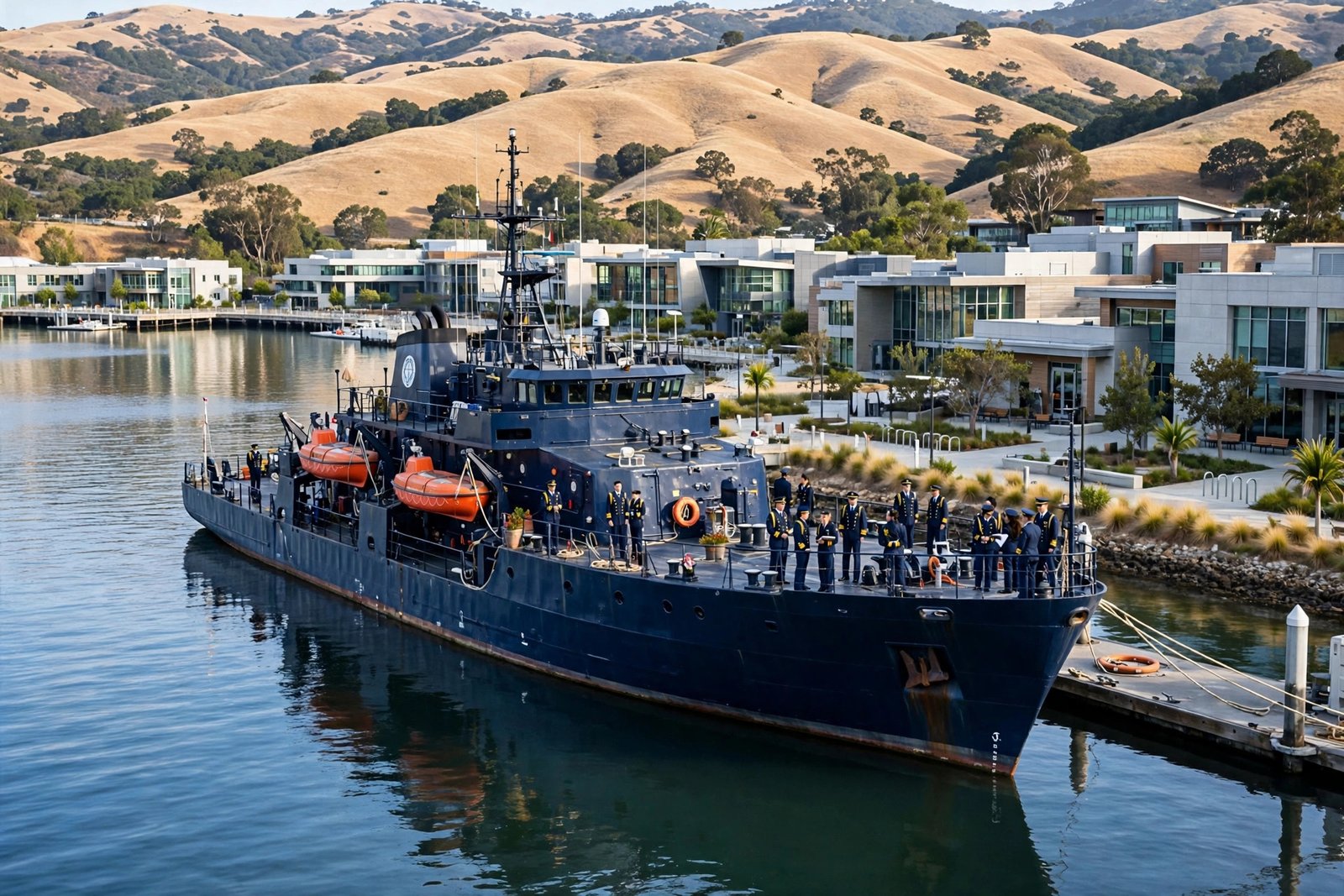
Cal Poly Maritime Academy (Cal Maritime) — Vallejo, California
The only degree-granting maritime academy on the West Coast of the United States sits on a waterfront campus in Vallejo, California. Now operating as Cal Poly Maritime Academy — a satellite campus of Cal Poly San Luis Obispo — it still carries the spirit of the California Nautical School founded in 1929. This directory guide covers its history, the Corps of Cadets, degree programmes, admission steps, costs, the Training Ship Golden Bear, U.S. Coast Guard licensing, Navy Reserve pathways and the questions families ask most.
Directory Information
| Full name | Cal Poly Maritime Academy (formerly California State University Maritime Academy / Cal Maritime; a satellite campus of California Polytechnic State University, San Luis Obispo) |
|---|---|
| Location | Vallejo, California, United States — about 30 miles north-east of San Francisco |
| Official address | 200 Maritime Academy Drive, Vallejo, CA 94590 |
| Phone | 707-654-1000 |
| Official website | https://maritime.calpoly.edu/ (csum.edu redirects to the new site) |
| Founded | 1929 (as the California Nautical School) |
| Type | Public, four-year university — satellite campus of Cal Poly San Luis Obispo since 1 July 2025 |
| Motto | “Laborare Pugnare Parati Sumus” — “To work, to fight, we are ready” |
| Cadet strength | Approximately 800–850 undergraduates plus a small graduate cohort (fall 2024) |
About & History
The academy’s story begins in 1929, when California Assembly Bill 253 — signed into law by Governor C. C. Young — created the California Nautical School, charged with giving practical and theoretical instruction in navigation, seamanship, engines and electricity to prepare young men as officers in the American Merchant Marine. The first campus stood in Tiburon on the Marin Peninsula, and in the depths of the Great Depression cadets and instructors lived and held classes aboard the training vessel itself to keep the school alive.
Stability arrived with the U.S. Merchant Marine Act of 1936, which directed the nation to build and maintain an adequate merchant marine. In 1939 the school became the California Maritime Academy; as war loomed in 1940 it relocated to San Francisco, and with the start of World War II the course of study was accelerated to just 17 months. Many graduates served in the war — some as prisoners of war, and eleven died in the line of duty. In 1943 the academy established its permanent home on a site at Morrow Cove in Vallejo, where the campus stands today.
The modern academy took shape in the 1970s: it became a four-year college in 1974, laid the foundation for accreditation by the Western Association of Schools and Colleges, and — in 1973 — became the first maritime academy in the nation to admit women into its licensed maritime programme, a milestone that opened deck-officer and engineering careers to generations of female mariners.
The biggest recent chapter is the 2025 transition. On 1 July 2025, the California State University Maritime Academy was absorbed as a satellite campus of California Polytechnic State University, San Luis Obispo, and renamed Cal Poly Maritime Academy, with the Vallejo site known as the Cal Poly Solano Campus. It remains one of only seven degree-granting maritime academies in the United States — and the only one on the West Coast.
The colours are navy and gold, the teams and students are nicknamed the Keelhaulers, and the seal bears two seahorses alongside the Latin motto “Laborare Pugnare Parati Sumus.”
The Corps of Cadets
The Corps of Cadets is what sets the academy apart. Every undergraduate is part of the Corps (unless enrolled in an exempt programme), and all new students in licence-track majors are enrolled automatically — any student in any major can choose to join. Cadets wear merchant-marine-style uniforms, muster in formations, stand watches on campus and aboard the training ship, and are organised into squads, sections, divisions and companies based on their academic majors.
The Corps is student-led and built around responsibility: about twenty cadet leaders are appointed through a rigorous interview process by the Office of Cadet Leadership and Development, with the Corps Commander as the highest-ranking cadet. Its stated purpose is developing leadership, accountability, teamwork and professional readiness — the habits expected aboard a commercial vessel, where mariners answer for the safety of shipmates and passengers, stand watch, fight fires and handle emergencies far from shore.
Important for applicants: the Corps is not a branch of the military, and participation creates no military service obligation. Military pathways such as the Navy’s Strategic Sealift Officer Program are optional add-ons with their own commitments, described below.
Programmes Offered
The academy offers seven bachelor’s degrees built on its Learn by Doing philosophy — hands-on experience, training cruises, internships and co-ops are part of the curriculum, not extras.
Undergraduate degrees
- Marine Transportation — the deck-officer pathway; prepares cadets to pass the U.S. Coast Guard STCW licensing exam and earn a Third Mate licence, or to work shoreside in vessel operations, ship’s agency, marine insurance and charter brokering. The academy reports near-100% job placement for this programme.
- Marine Engineering Technology — operation and maintenance of marine propulsion plants (steam, motor and gas turbine), with multiple at-sea training experiences; graduates can pursue licensing or engineering roles in the maritime industry.
- Mechanical Engineering — with three options: Energy Design, Mechanical Design, or the U.S. Coast Guard Third Assistant Engineer licence track.
- Facilities Engineering Technology — managing large commercial, industrial and power facilities, including a training cruise and two industry co-ops, leading to Certified Plant Engineer-in-Training (CPE-IT) standing.
- Business Administration — international trade, logistics, supply chain management and maritime transportation alongside core business subjects.
- International Strategy and Security — politics, trade, security and maritime law; preparation for government agencies, military service, international organisations and maritime firms.
- Oceanography — ocean science with faculty-mentored research, study-abroad opportunities and preparation for ocean-science careers and graduate study.
Graduate programmes
- M.S. in Transportation and Engineering Management — built for mid-career professionals, focusing on maritime transportation, infrastructure and sustainability.
- Graduate Certificate in Emergency Management — climate change, disaster response, policy and community resilience.
Summer Sea Term — the floating classroom
The defining experience of the academy is Summer Sea Term aboard the 500-foot Training Ship Golden Bear: a 65-day Pacific training voyage where cadets stand watches, hold shipboard leadership billets and experience international maritime operations first-hand. The ship has served the academy for three decades and is being replaced under the U.S. Maritime Administration’s National Security Multi-Mission Vessel programme — a new state-of-the-art training ship for future classes.
Admission Requirements
Cal Poly Maritime Academy accepts applications from first-year and transfer students. Applications are submitted online through the Cal State Apply system (search for “Cal Poly and Cal Poly Maritime Academy”). Key published requirements:
- High-school record: secondary-school transcript and GPA are required, along with completion of a college-preparatory programme.
- Standardised tests: SAT/ACT scores are not required or recommended for general admission.
- Essays and references: neither personal statements nor recommendation letters are required for general admission.
- International applicants: an English-proficiency test (such as TOEFL or IELTS) is required.
- Transfer students: an overall college GPA of at least 2.00 and good standing at the last institution attended are required. Lower-division transfers must also have completed a college-level mathematics course and a college-level English composition course with a C-minus or better; upper-division transfer applicants generally need 60 or more transferable semester units.
- Selectivity: the academy is classified as least selective, with an acceptance rate around 95% — but applicants should still prepare a complete application.
How to Apply: Step by Step
- Research your major and the Corps. Review the seven undergraduate programmes at maritime.calpoly.edu and read the Corps of Cadets pages — life here includes uniforms, formations, watchstanding and sea terms, so make sure the lifestyle fits before you commit.
- Start a Cal State Apply account. Create your account on the Cal State Apply portal, complete your profile as a first-time bachelor’s applicant, and add the programme by searching for “Cal Poly and Cal Poly Maritime Academy.”
- Enter your academic record accurately. Enter your high-school (and any college) coursework and grades exactly as they appear on your transcripts; do not send official transcripts unless the academy requests them.
- Submit the application. Complete all sections and submit by the published deadline; fall-term applications typically open in October.
- Watch for follow-ups. If the admissions office requests transcripts or other documents, respond promptly — your file cannot be decided until it is complete.
- Plan your transition. New students in licence-track majors are enrolled in the Corps of Cadets on arrival, and first-year students generally live on campus, so begin housing arrangements as soon as you accept an offer.
Tuition & Costs
Cal Maritime is a public university, so California residents pay significantly less than out-of-state students. The 2025 integration into Cal Poly changed the fee structure, so always confirm the current year’s rates with the academy before applying:
| 2026–27 published registration, per semester (Solano campus, new in-state undergraduates) | Amount |
|---|---|
| Engineering, Architecture or Agriculture colleges | $8,590 per semester |
| Science and Math, Business or Liberal Arts colleges | $8,071 per semester |
Published third-party data (from federal IPEDS records) for 2024–25 listed tuition and fees of about $9,559 for in-state and $22,159 for out-of-state undergraduates per year. On top of registration costs, cadets should budget for books and materials (around $1,100–$1,300 per year), on-campus housing and a residential dining plan (first-year students generally live on campus), transportation and personal expenses. Use the academy’s net price calculator and talk to the financial aid office for a personalised estimate — about half of students receive financial aid, and veterans’ benefits, scholarships and the Navy’s Strategic Sealift Student Incentive Payment (below) can reduce costs.
Service & Career Outcomes
There is no military service obligation attached to graduation — but the outcomes are strongly service-flavoured, and several optional military programmes add aid and careers:
- Licensed merchant-marine officers: Marine Transportation graduates earn a U.S. Coast Guard Third Mate licence and sail as deck officers; engineering graduates can earn a Third Assistant Engineer licence. Graduates work across the U.S. Merchant Marine and the global maritime industry.
- Shoreside maritime careers: vessel operations, ship’s agency, marine insurance, charter brokering, port operations, logistics and supply-chain management — particularly for Business Administration and International Strategy and Security graduates.
- Strategic Sealift Officer Program (SSMP): cadets in licence-track majors can apply in their first year to be appointed Midshipmen in the U.S. Navy Reserve. Midshipmen receive a Student Incentive Payment totalling $64,000 over four years from the federal Maritime Administration, complete Naval Science courses plus weekly leadership and physical training, and are commissioned as Ensigns in the Navy Reserve on graduation — with an eight-year reserve commitment, two weeks of active duty per year, and a requirement to work in the maritime industry for three years.
- ROTC and Coast Guard programmes: the campus also hosts Navy, Marine Corps and Air Force ROTC units and Coast Guard programmes for interested cadets.
- Energy and facilities careers: Facilities Engineering Technology and Mechanical Engineering graduates move into power generation, facilities operations and mechanical design, while Oceanography graduates head into ocean science, resource management and research.
The academy’s placement record is a point of pride: the Marine Transportation programme reports near-100% job placement, and graduates are known for being “ready day one” — the practical consequence of standing real watches aboard a real training ship before ever starting a career.
Frequently Asked Questions
Is Cal Maritime still a separate university?
No — with one important qualification. On 1 July 2025 the California State University Maritime Academy was absorbed as a satellite campus of Cal Poly San Luis Obispo and renamed Cal Poly Maritime Academy, operating from the Cal Poly Solano Campus in Vallejo. Its maritime mission, Corps of Cadets, licence programmes and training ship all continue unchanged.
Do I have to serve in the military after graduating?
No. There is no armed-service obligation attached to graduation, and the Corps of Cadets itself is not a military branch. Only cadets who voluntarily join programmes like the Strategic Sealift Officer Program or ROTC take on service commitments — and those come with benefits such as the $64,000 Student Incentive Payment and a Navy Reserve commission.
What is the Training Ship Golden Bear?
The Training Ship Golden Bear is the academy’s 500-foot training vessel and floating classroom. Each summer, more than 300 cadets embark on a roughly 65-day Summer Sea Term — a Pacific training voyage where they stand watches, hold shipboard leadership billets and learn international maritime operations first-hand. A new training ship is being built for the academy under the federal National Security Multi-Mission Vessel programme.
Which majors lead to a U.S. Coast Guard licence?
Marine Transportation leads to a Third Mate (deck officer) licence; Mechanical Engineering offers a Third Assistant Engineer licence option; and Marine Engineering Technology provides intensive shipboard engineering training with licensing pathways. All licence-track students are enrolled in the Corps of Cadets automatically.
How much does Cal Poly Maritime Academy cost?
Published 2026–27 figures for the Solano campus show registration of $8,590 or $8,071 per semester for new in-state undergraduates, depending on the college of the major. Pre-merger 2024–25 federal data listed annual tuition and fees of about $9,559 in-state and $22,159 out-of-state. Add housing, dining, books and personal costs, and confirm the current schedule directly with the academy before applying.
Is it hard to get in?
Admission is broadly accessible — the acceptance rate sits around 95%, and SAT/ACT scores, essays and recommendation letters are not required. Applicants still need a complete high-school record with a college-preparatory programme, and transfer applicants need a 2.00 college GPA with required math and English coursework completed.
Ready to take the next step?
Start at maritime.calpoly.edu, explore the admissions pages, or call the academy at 707-654-1000. Apply online through the Cal State Apply system.
Facts in this guide were verified against Cal Poly Maritime Academy’s official websites (maritime.calpoly.edu and csum.edu), the Cal Poly academic catalog and official Cal Poly cost-of-attendance pages in October 2026. Always confirm current deadlines, costs and enrolment status with the academy directly before applying.