
Evolution of the US Space Force Enlisted Rank Insignia and Uniforms
The United States Space Force is developing a distinctive military identity through its uniforms, rank insignia, and organizational traditions. Established in December 2019 as America's newest military branch, the Space Force inherited much of its early structure from the United States Air Force while introducing symbols and designs that reflect its unique mission in space.
Its enlisted rank insignia development represents an important step in building a service culture that combines traditional military heritage with modern space operations.
1. The Beginning of a New Military Identity
When the US Space Force was established, it initially relied heavily on existing Air Force systems, including personnel structures, uniforms, and many organizational practices. However, creating a separate military service also required developing an identity that personnel could recognize as uniquely their own.
Uniforms and rank insignia play an important role in military culture. They identify a service member's position, experience, authority, and responsibilities. For the Space Force, the challenge was to create designs that honored its Air Force heritage while representing the increasingly important role of space in national defense.
The development of new enlisted insignia therefore became more than a cosmetic exercise. It was part of a broader effort to establish the traditions, visual identity, and professional culture of a new military service.
2. From Air Force Traditions to Space-Focused Designs
The Space Force has maintained important connections with the Air Force, particularly in its early personnel and organizational systems. This historical relationship influenced the development of its enlisted rank insignia.
Rather than abandoning traditional military design completely, the new concepts adapted familiar elements such as chevrons, stars, and geometric shapes. These features were redesigned to create a recognizable identity associated with space operations.
The resulting concepts introduced a more modern appearance, including hexagonal borders, delta symbols, and orbital-inspired patterns. These elements helped distinguish Space Force personnel while maintaining a connection to established military traditions.
3. Understanding the Space Force Enlisted Rank Structure
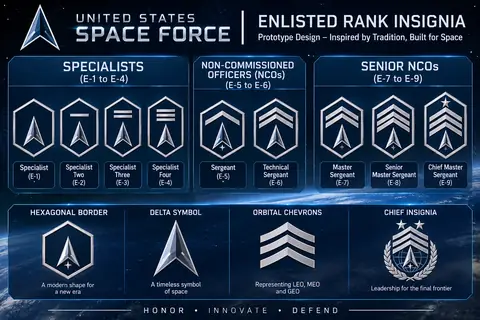
One of the most interesting aspects of the proposed Space Force enlisted insignia system is its three-tier structure. The concept organizes enlisted personnel into specialists, non-commissioned officers, and senior non-commissioned officers.
Specialists – E-1 to E-4
Specialists form the junior enlisted tier. Their rank insignia concepts use simple horizontal bars and geometric elements to distinguish different experience levels. The specialist structure reflects the importance of technical knowledge and specialized skills in modern space operations.
Non-Commissioned Officers – E-5 to E-6
Non-commissioned officers represent an important leadership level within the enlisted force. Their responsibilities include supervising personnel, maintaining operational standards, and supporting mission execution. Sergeant-level ranks introduce more recognizable traditional military insignia features.
Senior Non-Commissioned Officers – E-7 to E-9
Senior NCOs represent experienced enlisted leaders who guide teams, advise commanders, and contribute to the professional development of personnel. Their insignia concepts incorporate more elaborate chevrons and orbital-inspired design elements.
4. Three Distinctive Design Elements
Hexagonal Borders
The hexagon is one of the most recognizable features of the proposed designs. Its geometric appearance gives the insignia a modern identity while distinguishing it from traditional Air Force rank markings.
Delta Symbols
The delta symbol has a long association with military space operations and the heritage of Air Force Space Command. Its use connects the Space Force's enlisted identity with the history of American military activities in space.
Orbital Motifs
Orbital-inspired patterns add another layer of meaning to the designs. They represent the different operational environments in which the Space Force performs its missions and help create a visual connection between rank and space operations.





5. Historical Inspiration Behind the Insignia
Although the Space Force is a relatively new military service, some of its enlisted insignia concepts draw inspiration from much older military design ideas.
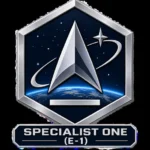
One notable example is the use of horizontal bars for junior specialist ranks. This approach resembles a historical proposal considered by the US Air Force during the 1950s. Although that earlier concept was never fully implemented, its design principles found new relevance during the development of the Space Force identity.
This connection demonstrates how military organizations can revisit historical ideas and adapt them to meet the requirements of a new generation.
6. Orbital Chevrons and Their Space Symbolism
Among the most distinctive elements of the proposed senior enlisted insignia is the use of upward-facing orbital chevrons. These designs connect rank progression with different orbital environments surrounding Earth.
Low Earth Orbit (LEO)
Low Earth Orbit is the region relatively close to Earth where many satellites operate. It is particularly important for communications, Earth observation, and other space-based services.
Medium Earth Orbit (MEO)
Medium Earth Orbit is located above Low Earth Orbit and supports several important satellite applications, including navigation and positioning systems.
Geosynchronous Earth Orbit (GEO)
Geosynchronous Earth Orbit allows satellites to maintain an orbital period matching Earth's rotation. This makes it valuable for communications, weather monitoring, and other strategic applications.
By incorporating orbital concepts into rank insignia, the design creates a visual relationship between the Space Force's organizational hierarchy and its operational environment.
7. Science Fiction Influence and Modern Military Design
The futuristic appearance of the proposed insignia has also drawn comparisons with science fiction franchises such as Star Trek and Battlestar Galactica. Their influence can be seen in the broader visual language of space-themed military design, including geometric shapes, streamlined symbols, and futuristic aesthetics.
These comparisons reflect how popular culture has influenced public expectations of what a modern space-focused military organization might look like. However, the insignia also serves a practical purpose: providing clear rank identification within a professional military environment.
8. Community Participation in the Design Process
Another interesting aspect of the Space Force insignia development is the role of community participation. The design process attracted attention because a concept associated with a Reddit user reportedly helped inspire the development of the new enlisted rank insignia.
This approach highlights an unusual aspect of the Space Force's identity-building process. By considering ideas beyond traditional military design channels, the service demonstrated an interest in public engagement and creative contributions.
Community involvement also helped generate discussion about how the newest US military branch should represent its personnel and mission through visual symbols.
9. Chief Master Sergeant of the Space Force Insignia
The highest enlisted leadership position in the Space Force is the Chief Master Sergeant of the Space Force. This position represents the most senior enlisted leadership role within the service and carries significant responsibility for advising senior military leadership on enlisted personnel matters.
Distinctive Leadership Symbols
The described insignia concept features several prominent visual elements:
- Multiple chevrons representing senior enlisted leadership.
- A delta globe symbol connected to the Space Force identity.
- A hexagonal wreath surrounding the central design.
- Two stars adding a distinctive senior leadership element.
These features combine traditional senior enlisted insignia conventions with symbols associated with space operations. The result is a design intended to distinguish the service's highest enlisted leader while reinforcing the Space Force's unique identity.
10. The Future of Space Force Uniforms and Rank Insignia
The evolution of US Space Force uniforms and enlisted rank insignia represents a broader effort to establish a distinct military culture. As the service continues to develop, its visual identity will remain an important part of how personnel recognize their roles, responsibilities, and connection to the organization.
The combination of historical Air Force influences, geometric insignia, delta symbols, and orbital-inspired elements demonstrates an effort to balance tradition with innovation.
Conclusion
The development of Space Force enlisted rank insignia illustrates how a modern military organization can create its own identity while respecting its historical roots. From specialist rank concepts to orbital-inspired senior NCO designs, the proposed visual elements reflect the service's connection to space operations and its ambition to build a distinctive military culture.
As the United States Space Force continues to evolve, its uniforms, insignia, and traditions will remain important symbols of its mission and place within the US Armed Forces.