The United States military is one of the world’s most powerful and technologically advanced defense forces. It consists of six armed services, each with specialized responsibilities and capabilities that contribute to the nation’s defense and national security.
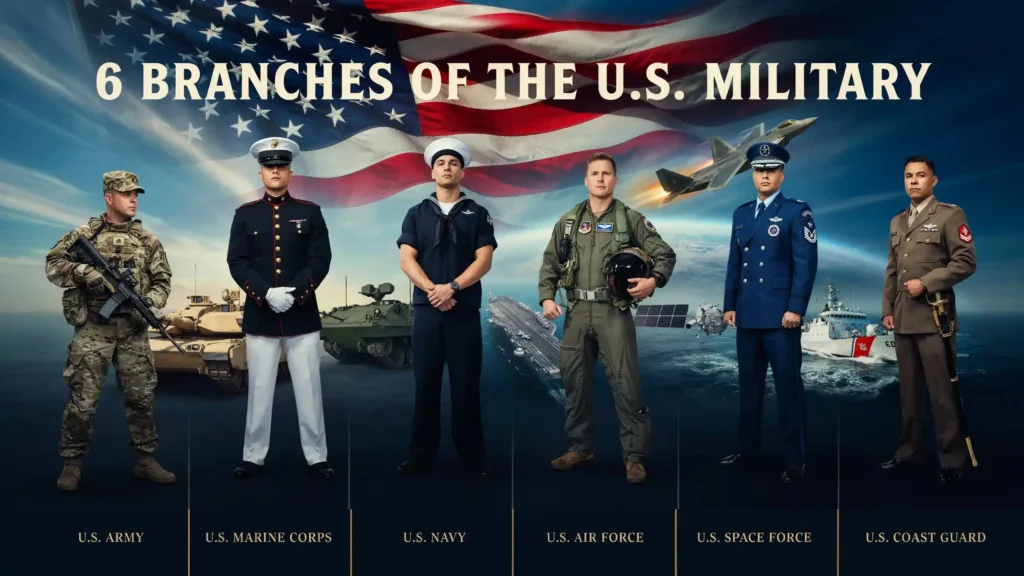
These six services are the U.S. Army, Marine Corps, Navy, Air Force, Space Force, and Coast Guard. Together, they operate across land, sea, air, and space, carrying out missions ranging from ground combat and maritime security to aerial warfare and space-based defense operations.
Each service has a distinct mission. The Army focuses primarily on land-based military operations, while the Marine Corps specializes in expeditionary warfare and rapid-response missions. The Navy protects maritime interests and maintains naval power around the world. The Air Force conducts air operations and provides global airpower, while the Space Force protects U.S. interests in space. The Coast Guard is responsible for maritime safety, security, and law enforcement.
In addition to these six services, the United States maintains National Guard and Reserve components that strengthen military readiness and provide support during national emergencies.
Understanding the responsibilities of each service helps explain how the U.S. military operates as an integrated defense organization.
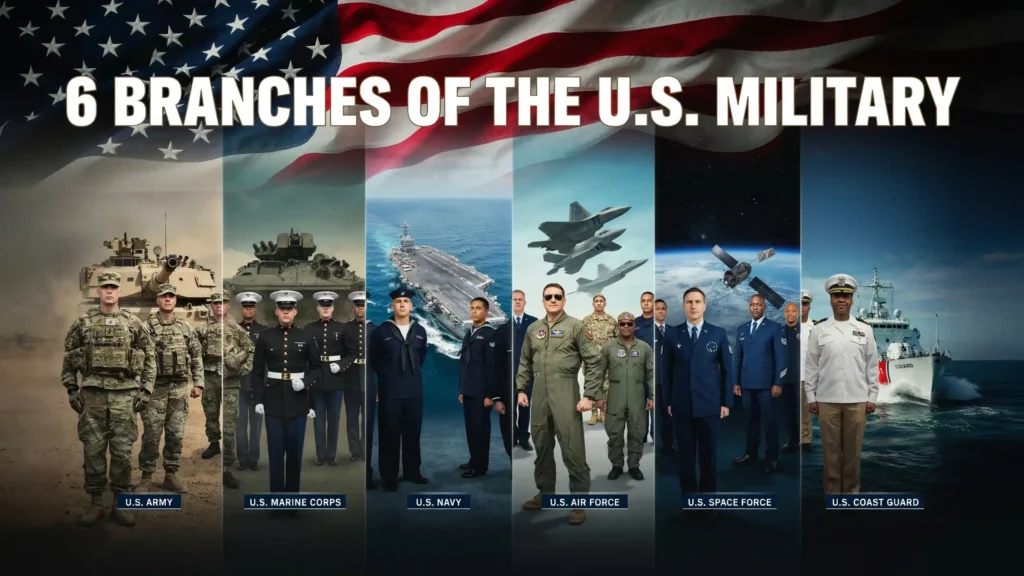
6 Branches of the U.S. Military
Explore the six armed services of the United States and their distinct military responsibilities.
U.S. Army
Land warfare, ground combat and territorial defense.
U.S. Marine Corps
Expeditionary warfare and amphibious operations.
U.S. Navy
Naval warfare and maritime security.
U.S. Air Force
Airpower, aviation and aerial defense.
U.S. Space Force
Military space operations and satellite protection.
U.S. Coast Guard
Maritime safety, security and law enforcement.
Other U.S. Military Components
These components support the six armed services but are not separate armed services.
United States Army
The United States Army is the principal land warfare service of the U.S. military and one of its largest components. Established in 1775, it has played a central role in American military history and national defense.
The Army is responsible for conducting sustained land-based military operations. Its forces include infantry, armored units, artillery, military aviation, engineers, intelligence personnel, and logistics specialists.
These capabilities allow the Army to deploy troops, secure territory, conduct ground combat, and maintain military operations over extended periods.
Major Responsibilities of the U.S. Army
Conducting ground combat and land-based military operations.
Deploying infantry, armored vehicles, and artillery units.
Defending and securing important strategic locations.
Supporting joint military operations with other armed services.
Providing logistical, engineering, and medical support.
Responding to national emergencies when directed.
The Army also operates advanced military equipment, including tanks, helicopters, missile systems, and unmanned aircraft.
Its ability to conduct large-scale and sustained ground operations makes it an essential part of U.S. national defense.
United States Marine Corps
United States Marine Corps
The United States Marine Corps (USMC) is a naval expeditionary force specializing in rapid deployment, amphibious warfare, and crisis response.
Established in 1775, the Marine Corps operates as part of the Department of the Navy. Its forces are organized to deploy quickly, particularly when military operations require a rapid response in coastal areas or overseas locations.
The Marine Corps combines ground troops, aviation units, artillery, and logistical support to conduct a wide range of military missions.
One of its most distinctive capabilities is amphibious warfare, which involves military operations launched from the sea onto land.
Major Responsibilities of the U.S. Marine Corps
Conducting amphibious assaults and expeditionary operations.
Responding rapidly to international military crises.
Supporting naval operations and securing coastal areas.
Conducting ground combat operations.
Providing aviation support through fighter aircraft, helicopters, and transport aircraft.
Protecting U.S. embassies and supporting overseas security missions.
The Marine Corps is particularly important for operations that require rapidly deployable forces. Its close relationship with the Navy allows Marines to deploy aboard amphibious assault ships and other naval vessels.
United States Navy
United States Navy
The United States Navy (USN) is responsible for maintaining American naval power and protecting the country’s maritime interests around the world.
Established in 1775, the Navy operates a large fleet of aircraft carriers, submarines, destroyers, cruisers, amphibious ships, and other naval vessels.
Its primary mission is to maintain maritime security, protect international sea routes, deter potential threats, and project military power across the world’s oceans.
Aircraft carriers are among the Navy’s most important assets. They serve as mobile airbases, allowing naval aircraft to operate far from U.S. territory without depending on foreign airfields.
Major Responsibilities of United States Navy
Major Responsibilities of the U.S. Navy
Protecting maritime trade routes and international waterways.
Conducting naval warfare and maritime security operations.
Operating aircraft carriers, submarines, and surface combat ships.
Supporting Marine Corps expeditionary operations.
Conducting anti-submarine and missile defense operations.
Providing strategic deterrence through nuclear-powered ballistic missile submarines.
Supporting humanitarian assistance and disaster relief missions.
The Navy plays a critical role in maintaining U.S. military presence across the world’s oceans and supporting joint operations with other military services.
United States Air Force
United States Air Force
The United States Air Force (USAF) is the primary military service responsible for conducting air operations and providing airpower in support of national defense.
Established as an independent military service in 1947, the Air Force operates advanced fighter aircraft, strategic bombers, transport aircraft, surveillance platforms, and aerial refueling tankers.
Its capabilities allow the United States to conduct military operations over long distances, support ground and naval forces, and respond rapidly to threats around the world.
The Air Force also provides important capabilities in intelligence, surveillance, reconnaissance, and global mobility.
Major Responsibilities of the U.S. Air Force
Maintaining air superiority and defending U.S. airspace.
Conducting strategic and tactical air operations.
Operating fighter jets, bombers, and transport aircraft.
Providing aerial refueling and strategic airlift.
Conducting intelligence, surveillance, and reconnaissance missions.
Supporting military operations through advanced communication and command systems.
Providing missile warning and other specialized capabilities.
Although the Air Force historically managed many military space operations, the establishment of the Space Force transferred many dedicated space responsibilities to the new service.
The Air Force remains a central part of America’s global military capabilities.
United States Space Force
United States Space Force
The United States Space Force (USSF) is the newest branch of the U.S. armed services. It was officially established on December 20, 2019, as a separate military service within the Department of the Air Force.
Its primary mission is to organize, train, and equip military forces to protect American interests in space.
Modern military operations depend heavily on satellites and space-based technologies for navigation, communication, surveillance, and missile warning. The Space Force helps protect these essential systems and ensures their availability during military operations.
Major Responsibilities of the U.S. Space Force
Protecting U.S. military and national security interests in space.
Operating and supporting military satellite systems.
Providing space-based missile warning capabilities.
Supporting satellite communications and navigation.
Monitoring activities and potential threats in space.
Developing advanced space-related military technologies.
Supporting joint military operations through space capabilities.
The Space Force represents the growing importance of space in modern warfare and national security.
Although it works closely with the Air Force, it has its own leadership, organizational structure, and specialized responsibilities.
United States Coast Guard
United States Coast Guard
The United States Coast Guard (USCG) is a unique armed service that combines military responsibilities with federal law enforcement and maritime safety duties.
Established in 1790 as the Revenue-Marine, it operates primarily under the Department of Homeland Security during peacetime.
Unlike the other armed services, the Coast Guard performs extensive law enforcement and regulatory missions in addition to its national defense responsibilities.
Its operations help protect American coastlines, ports, waterways, and maritime interests.
Major Responsibilities of the U.S. Coast Guard
Conducting maritime search and rescue operations.
Protecting U.S. ports and coastal areas.
Enforcing maritime laws and regulations.
Preventing drug trafficking and illegal maritime activities.
Conducting environmental protection operations.
Supporting maritime security and national defense.
Assisting ships and people in distress at sea.
During wartime, or when directed by the President, the Coast Guard can operate as a service in the Navy. This arrangement allows it to contribute directly to naval operations when national defense requirements demand it.
Its combination of military, law enforcement, and humanitarian responsibilities makes the Coast Guard different from the other U.S. armed services.
United States National Guard
United States National Guard
The United States National Guard is an important military reserve component with a unique dual federal and state mission.
It consists of two main components: the Army National Guard and the Air National Guard.
National Guard personnel generally serve part-time while maintaining civilian careers, education, or other responsibilities. However, they receive military training and can be activated when required.
The National Guard can operate under state authority, usually through a governor, or under federal authority when mobilized for national military missions.
Major Responsibilities of the National Guard
Responding to natural disasters such as floods, hurricanes, and wildfires.
Supporting state emergency response operations.
Assisting civil authorities when legally authorized.
Supporting national defense missions when federally activated.
Participating in overseas military deployments.
Providing emergency medical, logistical, and engineering support.
The National Guard plays an important role in connecting state-level emergency response capabilities with the broader national defense system.
United States Military Reserve Components
U.S. Military Reserve Components
In addition to the National Guard, the United States maintains Reserve components across its armed services.
These components provide trained personnel who can be mobilized to support active-duty forces during military operations, national emergencies, or periods of increased military demand.
The Army, Navy, Marine Corps, Air Force, and Coast Guard all have reserve components, although their organizational structures and responsibilities differ.
The Space Force does not currently have a separate traditional reserve component.
Major Responsibilities of Military Reserve Components
Providing additional personnel during military operations.
Supporting active-duty military units.
Maintaining specialized technical and professional skills.
Strengthening national military readiness.
Assisting during national emergencies.
Supporting overseas deployments when mobilized.
Reserve personnel are an important part of the U.S. military structure because they provide additional capabilities without requiring every service member to remain on full-time active duty.
Conclusion
The six U.S. armed services perform different but interconnected missions that support America’s national defense and security.
The Army provides ground combat capabilities, while the Marine Corps specializes in expeditionary and amphibious warfare. The Navy maintains maritime power, and the Air Force provides airpower and global aviation capabilities. The Space Force protects American interests in space, while the Coast Guard focuses on maritime safety, security, and law enforcement.
The National Guard and Reserve components further strengthen this structure by providing additional personnel and responding to both domestic emergencies and federal military requirements.
Together, these services create a comprehensive defense system capable of operating across land, sea, air, and space.
Understanding the distinct roles of each U.S. military service provides valuable insight into how the United States organizes its armed forces to address modern security challenges.