Nepal’s military looks different from almost any other country’s — and the first thing to know is what it does not have. Nepal is landlocked, so it has no navy at all. Its entire armed force is the Nepalese Army, which includes a small aviation wing, the Nepalese Army Air Service. This guide covers every Nepalese military rank with its insignia, from Sipahi (Private) to the Chief of Army Staff, a General — including the Nepali names, the English equivalents, and how to read the shoulder boards and chevrons.
Nepalese ranks are a blend of two traditions. The framework is British and Indian in origin — Second Lieutenant up to General, with Sergeants, Corporals and Warrant Officers below the commissioned ranks — but the names are Nepal’s own. A Lieutenant General is a Rathi, a Colonel is a Mahasenani, and a Sergeant is a Hudda. Rank is read from shoulder boards for officers and warrant officers and from chevrons on the sleeve for junior non-commissioned officers, with the crossed kukri — Nepal’s famous curved knife — appearing in the senior insignia.
Key facts
- Country: Nepal
- Branches: Nepalese Army and Nepalese Army Air Service only — Nepal has no navy (landlocked) and no independent air force
- Commissioned officers: 10 ranks, Second Lieutenant (Sahayak Senani) to General (Maharathi)
- Other ranks: 8 ranks, Followers to Chief Warrant Officer (Pramukh Subedar)
- Highest rank: General (Maharathi, Pradhan Senapati), held by the Chief of Army Staff
- Total ranks: 18 — ten officers and eight other ranks
- Notable fact: The crossed kukri — Nepal’s curved national knife — marks field and general officers, and the Air Service uses exactly the same ranks as the rest of the Army
Nepalese Military Ranks at a Glance
The Nepalese Army divides its ranks into two great groups: commissioned officers, who hold the King’s — today the President’s — commission and command units, and other ranks, which cover warrant officers, non-commissioned officers (NCOs) and enlisted soldiers. The Air Service uses exactly the same rank titles as the rest of the Army: there is no separate set of air-force ranks, because the Air Service is a wing of the Army, not an independent service.
| Group | Ranks (lowest to highest) | How Rank Is Shown |
|---|---|---|
| Enlisted | Followers, Sipahi (Private), Piyuth (Lance Corporal) | No insignia (Followers, Sipahi); one chevron (Lance Corporal) |
| Junior NCOs | Amaldar (Corporal), Hudda (Sergeant) | Two and three chevrons |
| Warrant officers | Jamadar (Warrant Officer Second Class), Subedar (Warrant Officer First Class), Pramukh Subedar (Chief Warrant Officer) | Shoulder boards with sun and crescent devices |
| Junior officers | Sahayak Senani (Second Lieutenant), Upasenani (Lieutenant), Sahasenani (Captain) | Shoulder boards with pips |
| Senior officers | Senani (Major), Pramukh Senani (Lieutenant Colonel), Mahasenani (Colonel) | Shoulder boards with pips and crossed kukris |
| General officers | Sahayak Rathi (Brigadier General), Uparathi (Major General), Rathi (Lieutenant General), Maharathi (General, Chief of Army Staff) | Shoulder boards with stars, crossed kukris and wreath |
Two spellings you will meet often are worth knowing. The rank usually written Jamadar also appears as Jamedar, and Hudda is the Nepali form of the better-known Hawaldar. They are the same ranks. Likewise Piyuth is sometimes written Pyuth, and Sipahi is the same word as the Indian Sepoy — the ordinary soldier.
Nepalese Army Other Ranks: Followers, Sipahi, NCOs and Warrant Officers
The other ranks are the bulk of the Nepalese Army — roughly 96,500 active personnel serve in the Army and Air Service combined. They begin as Followers and Sipahi, rise through the NCO chevrons, and may reach the senior warrant-officer grades that carry real authority in a battalion.
| Rank (English) | Nepali Name | Insignia | Typical Role |
|---|---|---|---|
| Followers | फलोअर्स (Phaloars) | No insignia | Support and follower trades; the most junior grade in the Army |
| Private | सिपाही (Sipahi) | No insignia | The ordinary soldier; the backbone of every infantry section |
| Lance Corporal | प्यूठ (Piyuth) | One chevron | Second-in-command of a section; first step on the NCO ladder |
| Corporal | अमल्दार (Amaldar) | Two chevrons | Section commander; leads around ten soldiers |
| Sergeant | हुद्दा (Hudda) | Three chevrons | Senior NCO; platoon sergeant and trainer of junior soldiers |
| Warrant Officer Second Class | जमदार (Jamadar) | Shoulder board with sun device | Company-level warrant officer; adviser to the company commander |
| Warrant Officer First Class | सुवेदार (Subedar) | Shoulder board with sun and crescent devices | Senior company or battalion warrant officer |
| Chief Warrant Officer | प्रमुख सुवेदार (Pramukh Subedar) | Shoulder board with sun, crescent and wreath devices | The most senior other rank; also styled Subedar Major; right hand of the commanding officer |
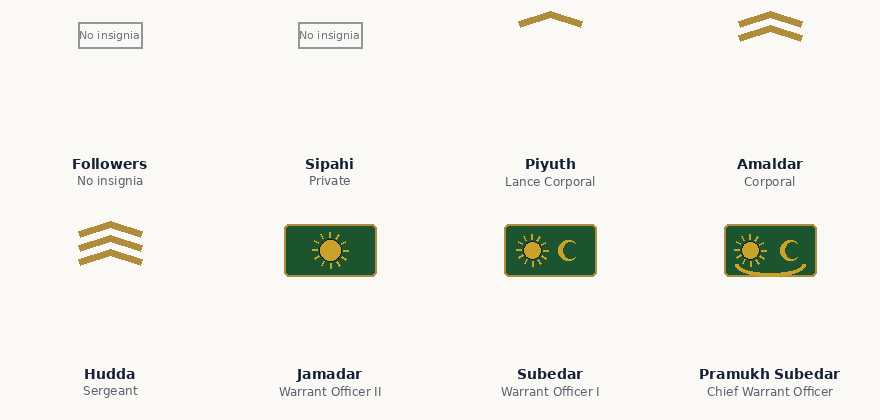
Did you know? A Sipahi (Private) wears no rank insignia at all — just like a Follower, the most junior grade in the Army. And the top other rank, the Pramukh Subedar, is also styled Subedar Major, the commanding officer’s right hand.
How to Read Nepalese Enlisted and NCO Insignia
Other-rank insignia in the Nepalese Army follows a simple visual code, and once you know it you can read any soldier’s rank at a glance:
- No insignia at all — a Sipahi (Private) and a Follower wear no rank insignia. They are the only ranks with nothing to show, so a bare sleeve or shoulder means the most junior soldier.
- Chevrons — the V-shaped stripes on the sleeve mark the junior NCOs. One chevron is a Lance Corporal (Piyuth), two chevrons a Corporal (Amaldar), and three chevrons a Sergeant (Hudda). Count the chevrons and you have the rank.
- Shoulder boards, not chevrons — from Jamadar upward, rank moves from the sleeve to the shoulder board. Warrant officers wear dark-green shoulder boards carrying gold devices, and the devices grow more elaborate with seniority: a sun for Jamadar, sun and crescent for Subedar, and the fullest arrangement for the Pramukh Subedar (Subedar Major).
- The sun and crescent — these gold emblems are the signature of Nepalese warrant-officer insignia. They are national symbols as much as military ones, and they are what set a warrant officer apart from an NCO at a distance.
Nepalese Army Commissioned Officer Ranks
Commissioned officers of the Nepalese Army hold ten ranks, from Second Lieutenant to General. The top rank is held by a single officer at a time — the Chief of Army Staff (COAS), titled Maharathi (Pradhan Senapati). There is no higher active rank; the old honorary rank of Field Marshal (Atirathi) belongs to history, not to the current structure.
| Rank (English) | Nepali Name | Insignia | Typical Role |
|---|---|---|---|
| Second Lieutenant | सहायक सेनानी (Sahayak Senani) | Shoulder board, one pip | Platoon commander; entry-level commissioned officer |
| Lieutenant | उपसेनानी (Upasenani) | Shoulder board, two pips | Platoon commander or staff officer |
| Captain | सहसेनानी (Sahasenani) | Shoulder board, three pips | Company second-in-command, then company commander |
| Major | सेनानी (Senani) | Shoulder board with pips and crossed kukris | Company commander or battalion staff officer |
| Lieutenant Colonel | प्रमुख सेनानी (Pramukh Senani) | Shoulder board with pips and crossed kukris | Battalion commander (around 700–800 soldiers) |
| Colonel | महासेनानी (Mahasenani) | Shoulder board with pips and crossed kukris | Brigade staff officer or senior staff appointment |
| Brigadier General | सहायक रथी (Sahayak Rathi) | Shoulder board with one star, crossed kukris and wreath | Brigade commander |
| Major General | उपरथी (Uparathi) | Shoulder board with two stars, crossed kukris and wreath | Division commander or director at Army headquarters |
| Lieutenant General | रथी (Rathi) | Shoulder board with three stars, crossed kukris and wreath | Senior command or principal staff officer at Army headquarters |
| General (Chief of Army Staff) | महारथी (प्रधानसेनापती) (Maharathi, Pradhan Senapati) | Shoulder board with four stars, crossed kukris, wreath and national emblem | Chief of Army Staff; commands the entire Nepalese Army |
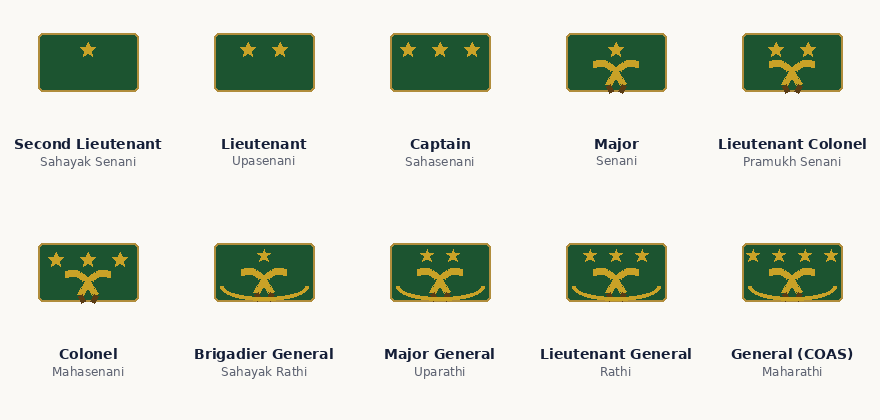
Key point: the Nepali names tell the story — they are built from senani (commander) for the regimental officers and rathi (charioteer) for the generals. A Sahayak Senani is literally an “assistant commander” and a Maharathi a “great charioteer”.
How to Read Nepalese Officer Insignia
Officer rank in the Nepalese Army is read from the shoulder board (epaulette) on the dark-green service uniform. The pattern is a ladder of pips, crossed kukris and stars:
- Pips — the small five-pointed stars on the shoulder board mark the junior officers. One pip is a Second Lieutenant, two a Lieutenant, three a Captain. Count the pips first.
- Crossed kukris — from Major upward, the shoulder board adds a pair of crossed kukris, the curved national blade of Nepal. The crossed kukris are the clearest sign that you are looking at a field officer (Major, Lieutenant Colonel or Colonel) rather than a junior officer.
- Stars and wreath — general officers add stars above the crossed kukris, set within a laurel wreath: one star for a Brigadier General, two for a Major General, three for a Lieutenant General, and four for the General who serves as Chief of Army Staff.
- The COAS board — the Chief of Army Staff’s shoulder board is the most elaborate in the Army, carrying the national emblem alongside the stars, crossed kukris and wreath. It is unmistakable — and it is worn by one officer only.
- The names tell the story — the Nepali names are built from senani (commander) for the regimental officers and rathi (charioteer) for the generals. A Sahayak Senani is literally an “assistant commander” and a Maharathi a “great charioteer” — the commander of the whole army’s chariot, in the old sense.
One rank to watch for is the honorary officer. Senior warrant officers of long and distinguished service may be granted the honorary rank of Lieutenant or Captain — sometimes called Honourable Lieutenant or Honourable Captain — as a mark of respect on or near retirement. These are honorary titles rather than steps on the commissioned ladder, and they are not part of the ten-rank officer table above.
Nepalese Army Air Service Ranks
Nepal has no independent air force. All military flying is done by the Nepalese Army Air Service, a wing of the Army of around 500 personnel, organised as No. 11 Brigade and based at Tribhuvan International Airport in Kathmandu. It flies transport helicopters such as the Mi-17 and light helicopters and fixed-wing aircraft used for troop transport, medical evacuation, search and rescue, disaster relief and VIP flights — vital work in a mountainous country where roads often cannot reach.
Air Service personnel wear the same ranks as the rest of the Army. A pilot is an Army officer holding an Army rank — Second Lieutenant, Captain, Major, and so on — and ground crew hold the same other ranks, from Sipahi to Pramukh Subedar. There are no separate air-force titles such as Flight Lieutenant or Air Commodore, and no separate Air Service rank table. What sets aircrew apart is not a different rank but a pilot’s wings badge worn on the chest, awarded after training at the Army’s pilot training school, which has operated within No. 11 Brigade since 2004 and is Nepal’s only helicopter pilot training school.
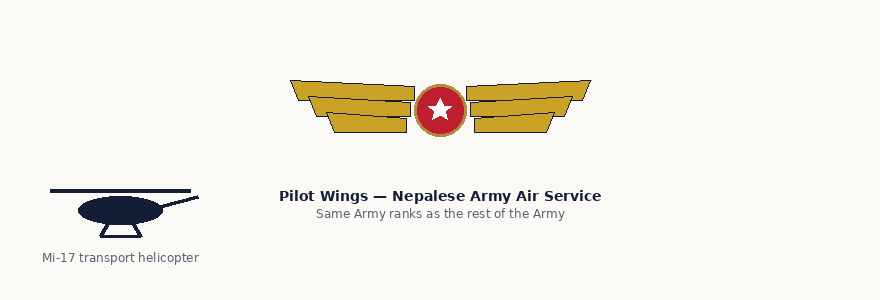
Did you know? Nepal’s first Army pilot, Lieutenant Tejendra Jung Thapa, received his wings from King Mahendra himself in the 1960s — and in the 2015 earthquake, Army helicopters were among the first aircraft reaching cut-off mountain villages.
The Air Service’s history goes back to the 1960s, when the Army first acquired aircraft, and it became a distinct air unit in 1979 before returning to its present place inside the Army. Its small size — roughly twenty aircraft — reflects its role: it exists to support the Army and the country in emergencies, not to fight an air war. In the 2015 earthquake, Army helicopters were among the first aircraft reaching cut-off mountain villages, and disaster relief remains one of the Air Service’s defining missions.
Nepalese Military Badges and Emblems
Rank insignia shows a soldier’s grade. Badges show what a soldier is qualified to do, and which unit he belongs to. The most important badges and emblems in the Nepalese Army are:
- The kukri — the curved national knife of Nepal, worn as crossed kukris in officer insignia and carried by every Gurkha soldier. It is both a weapon and the symbol of the Nepalese soldier worldwide, and it is the single most recognisable emblem of the Army.
- Pilot’s wings — the badge of a qualified Army Air Service pilot, worn on the chest. Nepal’s first Army pilot, Lieutenant Tejendra Jung Thapa, received his wings from King Mahendra himself in the 1960s.
- Parachute wings — worn by soldiers of the parachute battalion and others qualified in military parachuting, including the Army’s special forces.
- The crossed kukri and the national emblem — the crossed kukris on general officers’ shoulder boards, and the national emblem on the Chief of Army Staff’s board, tie the rank system to Nepal’s national symbols rather than to any foreign pattern.
- UN peacekeeping insignia — Nepal is one of the largest contributors of troops to United Nations peacekeeping missions, and Nepalese soldiers on UN duty wear the UN blue beret and mission insignia alongside their national rank.
How Promotion Works in the Nepalese Army
The Nepalese Army is an all-volunteer force, and entry is by open competition. Officer cadets train at the Nepal Military Academy at Kharipati, and other ranks enlist through regional recruiting, with the long Gurkha tradition meaning that soldiering runs in families across the hills of Nepal. Promotion then follows the familiar pattern of most Commonwealth-style armies: time in service, qualifying courses, and selection boards.
Junior soldiers advance from Sipahi to Lance Corporal and Corporal as they gain experience and pass the required courses, and the step to Sergeant (Hudda) marks a soldier out as a future leader. Promotion to the warrant-officer grades — Jamadar, Subedar and Pramukh Subedar — is selective and carries great prestige. Officers are promoted by central boards, with command as the defining test: command of a company as a Major, of a battalion as a Lieutenant Colonel, and of a brigade as a Brigadier General. The very top — Major General, Lieutenant General and the Chief of Army Staff — is reached by only a handful of officers in each generation.
A Note on Nepalese Military Tradition
Two things explain almost everything about Nepalese military ranks. The first is the Gurkha heritage. The Nepalese Army descends from the Gorkhali Army that unified Nepal in the eighteenth century, and its soldiers — the Gurkhas — are famed worldwide for courage and discipline, serving both in Nepal’s own Army and, under long-standing agreements, in the British and Indian armies. The kukri in the insignia, the Subedar Major’s authority, and the emphasis on the regiment all come from this tradition.
The second is geography. Nepal is a landlocked Himalayan country, and its Army is built for mountains, not for the sea or the air. That is why there is no navy, why the Air Service is a small transport and rescue wing rather than a fighting air force, and why the rank structure is a compact one — eighteen ranks in total, from Follower to General, with no separate naval or air-force ladders to learn.
Read next
US Navy Ranks · US Military Branches · US Military Uniform · Indian Army Ranks · Bangladesh Military Ranks
FAQs
What is the highest rank in the Nepalese military?
General — titled Maharathi (Pradhan Senapati) — held by the Chief of Army Staff (COAS), who commands the entire Nepalese Army. The highest other rank is Chief Warrant Officer (Pramukh Subedar), also styled Subedar Major.
Does Nepal have a navy or an air force?
No. Nepal is landlocked and has no navy. It also has no independent air force: all military flying is done by the Nepalese Army Air Service, a wing of the Army of around 500 personnel, which uses the same Army ranks as everyone else.
What is a Sipahi in the Nepal Army?
A Sipahi is a Private — the ordinary soldier and the backbone of the Nepalese Army. The word is the same as the Indian “Sepoy”. A Sipahi wears no rank insignia.
What is the difference between a Subedar and a Jamadar?
Both are warrant officers, but a Subedar (Warrant Officer First Class) is senior to a Jamadar (Warrant Officer Second Class). Above them both is the Pramukh Subedar (Chief Warrant Officer), also called the Subedar Major.
What do the crossed kukris on Nepalese officer insignia mean?
The crossed kukris are the curved national blade of Nepal, and they mark field officers (Major, Lieutenant Colonel and Colonel) and general officers on their shoulder boards. They are the most distinctive feature of Nepalese officer rank insignia.
How many ranks are there in the Nepalese Army?
Eighteen in the current structure: ten commissioned officer ranks, from Second Lieutenant to General, and eight other ranks, from Followers up to Chief Warrant Officer. The Army Air Service uses the same eighteen ranks.
What is a Rathi?
Rathi is the Nepali name for Lieutenant General — literally “charioteer”. The generals’ names form a set: Sahayak Rathi (Brigadier General), Uparathi (Major General), Rathi (Lieutenant General) and Maharathi (General).
All insignia diagrams and images in this article are original graphics created for Forces Guide.