The Israel Defense Forces (IDF) have one of the most unusual rank systems in the world. A soldier’s rank is read from chevrons on the sleeve, or from bars, oak leaves and sword-and-olive-branch emblems on the shoulder straps — and the same rank names are used in the Ground Forces, the Air Force and the Navy alike. This guide covers every Israel military rank, from Turai (Private) to Rav Aluf (Lieutenant General), plus NCO ranks, academic officers and promotion.
There are just 18 ranks in the IDF: nine enlisted and NCO ranks and nine officer ranks. That is a deliberately compact ladder, and it works differently from the American system in two important ways. First, the IDF is an integrated force: there is no separate army, navy and air force rank list, and a Seren (Captain) in the Air Force holds exactly the same rank as a Seren in the Ground Forces. Second, there is no sharp officer-versus-enlisted divide in the way the United States has one. The Hebrew names tell the story — rav means “chief”, samal is short for “supernumerary lieutenant”, and aluf means “champion”.
Key facts
- Country: Israel
- Force: Israel Defense Forces (IDF) — Ground Forces, Air Force, Navy
- Enlisted ranks: Turai to Samal Rishon (OR-1 to OR-4)
- NCO ranks: Rav Samal to Rav Nagad (OR-5 to OR-9)
- Officer ranks: Segen Mishne to Rav Aluf (OF-1 to OF-8)
- Highest rank: Rav Aluf (Lieutenant General) — Chief of the General Staff (Ramatkal)
- Notable fact: One rank list for all three services; generals wear a sword and olive branch, not stars
How the IDF Rank System Works
The IDF has three rank groups. The enlisted ranks (hogrim) — Turai, Rav Turai, Samal and Samal Rishon — are held by conscripts. The professional NCO ranks (nagadim) — from Rav Samal to Rav Nagad — are held by career soldiers who signed on after conscription. And the officer ranks (ktzinim) — from Segen Mishne to Rav Aluf — are held by officers’ course graduates.
Where the insignia is worn is the first clue to which group a soldier belongs to. Enlisted insignia are worn on the arm, between the elbow and the shoulder. NCO and officer insignia are worn on the shoulder epaulettes of the shirt. The metal and colour then tell you the service: army officers wear bronze (subdued black since 2002), navy officers gold, air force officers silver. Enlisted stripes are olive green, blue and golden respectively.
The ranks come from the Haganah, the paramilitary force that protected Jewish settlements during the British Mandate, before the IDF was founded in 1948. Early insignia followed the British and Commonwealth model, because so many of Israel’s first soldiers had served in Commonwealth forces in the Second World War. Reforms in the 1970s and 1990s moved it closer to the United States model, but the Hebrew names, single ladder and sword-and-olive-branch emblem stayed.
Israel Enlisted Ranks (Turai to Samal Rishon)
Almost every Israeli soldier starts here: most Jewish, Druze and Circassian citizens are conscripted at 18 and begin as a Turai (Private). Men serve 32 months and women 24 months, and enlisted ranks are earned by time in service (pazam) rather than by post.
The timing is fixed: Rav Turai after 4 to 12 months, Samal after 18 to 20 months, and Samal Rishon after 24 to 32 months. Women serve 24 months, so a female conscript in a non-combat role generally reaches no higher than Samal.
| Rank (Hebrew) | English Equivalent | NATO Code | Insignia | Typical Role |
|---|---|---|---|---|
| Turai (טוראי) | Private | OR-1 | No insignia | New recruit in basic training (tironut) |
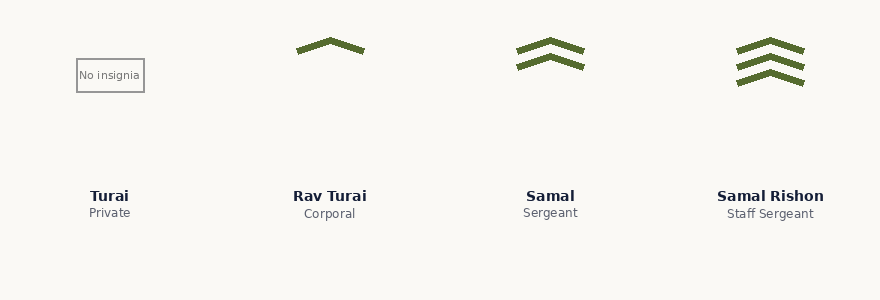
| Rav Turai (רב טוראי) | Corporal | OR-2 | One chevron on the sleeve | Experienced conscript with added responsibility |
| Samal (סמל) | Sergeant | OR-3 | Two chevrons on the sleeve | Fire-team leader; first field NCO rank |
| Samal Rishon (סמל ראשון) | Staff Sergeant | OR-4 | Three chevrons on the sleeve | Squad leader; senior conscript rank |
Did you know? A soldier in basic training is called a tiron (recruit), but tiron is not a rank — recruits hold the rank of Turai, the same as a newly trained conscript.
Samal and Samal Rishon are field NCO ranks even though they sit in the enlisted group: one commanding a sub-unit is called a mashak, a title of respect roughly equivalent to the French Army’s chef (“chief”).
How to Read IDF Enlisted Insignia
Enlisted insignia are read by counting chevrons on the sleeve:
- No insignia at all — a Turai (Private) wears nothing, including during basic training.
- One chevron — a Rav Turai (Corporal). Corporals in combat units traditionally wear no insignia until promoted to Samal.
- Two chevrons — a Samal (Sergeant), the first rank that commands a fire team.
- Three chevrons — a Samal Rishon (Staff Sergeant), who typically leads a squad.
- Colour tells you the service — olive green (Ground Forces), blue (Air Force), golden (Navy). The rank name is the same in all three.
Israel NCO Ranks (Rav Samal to Rav Nagad)
Above the conscript ranks sit the professional NCOs, the nagadim: career soldiers who signed on after conscription and usually head up a unit’s headquarters staff. Where conscript ranks are built on the word samal, the professional ranks are built on rav samal — “chief sergeant” — with a new qualifier at each step, topping out at Rav Nagad.
Nagad comes from the biblical nagid, “ruler” or “leader”, and Rav Nagad is the IDF’s senior staff NCO rank, comparable to an American Sergeant Major.
| Rank (Hebrew) | English Equivalent | NATO Code | Insignia | Typical Role |
|---|---|---|---|---|
| Rav Samal (רב-סמל) | Sergeant First Class | OR-5 | Chevron with oak-leaf device on the shoulder strap | Career NCO; staff and training roles |
| Rav Samal Rishon (רב-סמל ראשון) | Master Sergeant | OR-6 | Chevron with oak leaf over a sword on the shoulder strap | Senior NCO, company or battalion staff |
| Rav Samal Mitkadem (רב-סמל מתקדם) | Sergeant Major | OR-7 | Chevrons with oak-leaf-and-sword device on the shoulder strap | Senior soldier of a battalion or regiment |
| Rav Samal Bakhir (רב-סמל בכיר) | Warrant Officer | OR-8 | Chevrons with oak-leaf-and-sword device on the shoulder strap | Senior NCO of a large formation |
| Rav Nagad (רב-נגד) | Chief Warrant Officer | OR-9 | Oak leaf in a laurel wreath with sword on the shoulder strap | Senior specialist professional in the IDF |
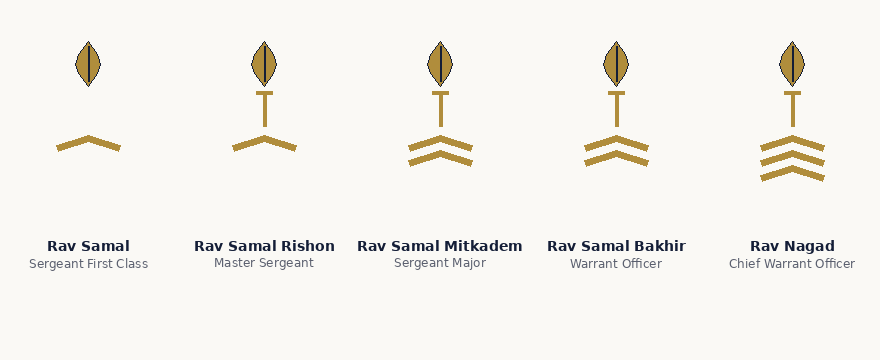
Did you know? The oak leaf has marked senior IDF NCOs since 1948. Read the oak leaf first, then the chevrons beneath it — the leaf says “career NCO”, and the chevrons say how senior.
Israel Officer Ranks (Segen Mishne to Rav Aluf)
Officers — ktzinim — are officers’ course volunteers, serving at least 44 months (men) or 36 months (women in non-combat positions); pilots serve seven years. Promotion rests on ability and time served: about a year from Second Lieutenant to Lieutenant, and about three years from Lieutenant to Captain.
Without a university education, Rav Seren (Major) is the ceiling.
| Rank (Hebrew) | English Equivalent | NATO Code | Insignia | Typical Role |
|---|---|---|---|---|
| Segen Mishne (סגן-משנה) | Second Lieutenant | OF-1 | One bar on the shoulder strap | Platoon leader |
| Segen (סגן) | Lieutenant | OF-1 | Two bars on the shoulder strap | Platoon leader; deputy company commander |
| Seren (סרן) | Captain | OF-2 | Three bars on the shoulder strap | Company or battery commander |
| Rav Seren (רב סרן) | Major | OF-3 | One oak leaf on the shoulder strap | Senior staff officer; deputy battalion commander |
| Sgan Aluf (סגן-אלוף) | Lieutenant Colonel | OF-4 | Two oak leaves on the shoulder strap | Battalion commander |
| Aluf Mishne (אלוף משנה) | Colonel | OF-5 | Three oak leaves on the shoulder strap | Brigade commander; division executive officer |
| Tat Aluf (תת-אלוף) | Brigadier General | OF-6 | One sword-and-olive-branch emblem | Division commander; corps or directorate head |
| Aluf (אלוף) | Major General | OF-7 | Two sword-and-olive-branch emblems | Commander of a regional command, branch or corps |
| Rav Aluf (רב-אלוף) | Lieutenant General | OF-8 | Three sword-and-olive-branch emblems | Chief of the General Staff (Ramatkal); one officer only |
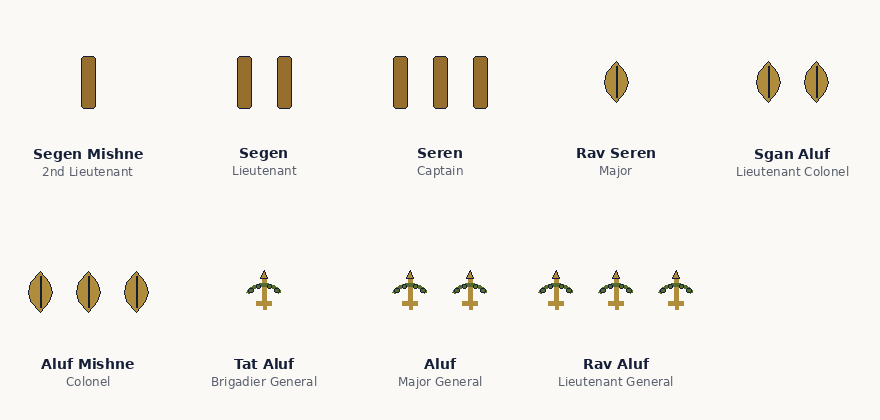
Key point: The Chief of the General Staff — the Ramatkal — holds Rav Aluf, officially Lieutenant General. There is no Israeli four-star or five-star rank, so the most senior officer in Israel holds a rank that in most armies would be two steps below the top.
The compact ladder is an inheritance from the Haganah, where aluf (“champion”) was already the highest title, and rav aluf (“chief champion”) was created to sit above it for the Chief of Staff alone.
How to Read IDF Officer Insignia
Officer insignia follow three steps — bars, leaves, then the sword and olive branch:
- Bars (junior officers) — one bar for Segen Mishne (Second Lieutenant), two for Segen (Lieutenant), three for Seren (Captain). The bars are embossed with a laurel branch (aronot).
- Oak leaves (senior officers) — one oak leaf for Rav Seren (Major), two for Sgan Aluf (Lieutenant Colonel), three for Aluf Mishne (Colonel). These replace the bars entirely — a Colonel’s three leaves are not three bars.
- Sword and olive branch (general officers) — one emblem for Tat Aluf (Brigadier General), two for Aluf (Major General), three for Rav Aluf (Lieutenant General). The emblem is a sword entwined with an olive branch, symbolising defence and peace; there are no stars in the IDF officer system.
- Metal tells you the service — bronze (subdued black since 2002) for the Ground Forces, silver for the Air Force, gold for the Navy; navy officers also wear gold braid bars on the sleeve.
Academic Officers and Special Ranks
Not every IDF officer takes the normal path. Academic officers (ktzinim akademaim) completed a professional education — usually in engineering, medicine or law — and returned to service before finishing officers’ training. They hold special ranks matching junior officers: a kama to a Lieutenant, a ka’ab to a Captain, and a ka’am to a Major.
They rarely take posts of command, and on completing officers’ training they immediately receive the corresponding “real” rank. Their bars are embossed with scrolls (megilot), not the laurel branches of regular officers.
Some ranks have disappeared: the memale makom katzin (“acting officer”, 1960s–1994), Turai Rishon (Private First Class, in the reserves until 1999) and Rav Turai Rishon (First Corporal, 1972–1982). From 1948 to 1951 each service had its own titles — a Navy private was a malakh (“crewman”), an Air Force private an avirai (“airman”) — before the single ladder was adopted.
IDF Badges and Aiguillettes
Rank insignia show a soldier’s grade. Two other things show what a soldier does. The first is the IDF emblem itself: a sword entwined with an olive branch, the same device that marks the general officers.
The second is the aiguillette (srochim) — the coloured cord worn on the left shoulder to indicate a soldier’s specific role: green for section and squad commanders, black for instructors at the officers’ school (Bahad 1) and the flight and naval academies, blue and red for the Military Police, red for Navy instructors, and orange and azure for search and rescue. There are dozens of combinations. Qualification badges such as paratrooper wings are worn separately, and beret colours mark the corps.
How Promotion Works in the IDF
Promotion runs on two logics. For conscripts it is essentially automatic on time served: serve the months, stay out of trouble, and Rav Turai, Samal and Samal Rishon follow in order. There is no promotion board and no exam.
For everyone else, promotion is competitive, based on ability and time served. Officers are promoted on their record and their commanders’ recommendations: about a year from Second Lieutenant to Lieutenant, about three years from Lieutenant to Captain, then longer, more selective steps. The jump from Rav Seren (Major) upward is where careers are made or capped — without a university education, Major is the ceiling.
Professional NCOs advance by signing on for further service and proving themselves in staff and training roles, with Rav Nagad as the summit. The Chief of the General Staff is appointed by the government, normally for three years, holding Rav Aluf for the duration. Officers and enlisted personnel also serve in the Reserves afterwards — men until 41 to 51, women until 24 — keeping the ranks they earned.
A Note on IDF Tradition
Two traditions explain almost everything about Israel’s military ranks. The first is unity: one force, one ladder, one set of names for the Ground Forces, the Air Force and the Navy. The IDF was built as one integrated force under a single General Staff, and the shared rank system shows it.
The second is modesty of title. The highest rank is a Lieutenant General, generals wear a sword and an olive branch instead of stars, and NCOs carry a title — nagad, “leader” — that reaches back to the Bible. Its designers had fought as guerrillas in the Haganah and as soldiers in Commonwealth armies, and wanted ranks that sounded Hebrew, meant something, and did not inflate. That is why the ladder has only 18 rungs, and why the man at the top is called, simply, the chief champion.
Read next
US Navy Ranks · US Military Branches · US Military Uniform · Saudi Arabian Military Ranks · Egyptian Military Ranks
FAQs
What is the highest rank in the Israel Defense Forces?
Rav Aluf (Lieutenant General), with three sword-and-olive-branch emblems, held by only one officer at a time: the Chief of the General Staff (Ramatkal). The highest NCO rank is Rav Nagad (Chief Warrant Officer).
Do the Israeli Army, Navy and Air Force have different ranks?
No — the same rank names are used in all three services. Only the insignia change: army officers wear bronze (subdued black since 2002), navy officers gold, air force officers silver; enlisted stripes are green, golden and blue.
What does Rav Aluf mean?
Literally “chief champion” — rav means chief or master, aluf means champion. Tat aluf means “sub-champion” and aluf mishne means “second champion”.
How long does it take to become a Sergeant in the IDF?
On time served: Rav Turai (Corporal) after 4 to 12 months, Samal (Sergeant) after 18 to 20 months, Samal Rishon (Staff Sergeant) after 24 to 32 months.
What is the difference between Samal and Rav Samal?
Samal (Sergeant) is a conscript field NCO rank, earned on time served, usually commanding a fire team. Rav Samal (Sergeant First Class) is the first professional career NCO rank, held by a soldier who signed on after conscription. The insignia move from the sleeve to the shoulder strap.
Why do IDF generals not wear stars?
One, two or three sword-and-olive-branch emblems: one for Tat Aluf, two for Aluf and three for Rav Aluf. The sword entwined with an olive branch symbolises defence and peace.
All insignia diagrams and images in this article are original graphics created for Forces Guide.