
Jordan’s armed forces wear their history on their shoulders. A Jordanian officer’s rank is read from seven-pointed stars, the Hashemite crown and crossed Arab swords on the shoulder strap, while a soldier’s rank is read from chevrons on the upper sleeve — a system inherited from the British Army and reshaped with Arab and Hashemite symbols. This guide covers every Jordan military rank, from Jundiun (Private) to Mushir (Field Marshal), across the Royal Jordanian Army, the Royal Jordanian Navy and the Royal Jordanian Air Force.
The Jordanian Armed Forces — known in Arabic as the Arab Army (Al-Jaysh al-Arabi) — use one rank ladder for all three services. The same titles appear in the army, the navy and the air force, which is unusual: Jordan’s navy has no admiral titles and its air force has no separate air-rank titles. What changes between the branches is the colour of the metal and the uniform it sits on, not the name of the rank. There are 11 commissioned officer ranks and 7 other ranks in each service.
Key facts
- Country: Jordan
- Branches: Royal Jordanian Army, Royal Jordanian Navy and Royal Jordanian Air Force — one rank ladder for all three services
- Other ranks: OR-1 to OR-9 (Jundiun to Wakil Awwal)
- Commissioned officers: OF-1 to OF-10 (Mulazim to Mushir)
- Highest rank: Mushir (Field Marshal), reserved for the King as Supreme Commander
- Insignia: Seven-pointed stars, the Hashemite crown and crossed Arab swords on shoulder straps; chevrons on the sleeve for other ranks
- Branch clue: Army insignia are gold, air force insignia are silver
Jordan Military Enlisted and Warrant Ranks (OR-1 to OR-9)
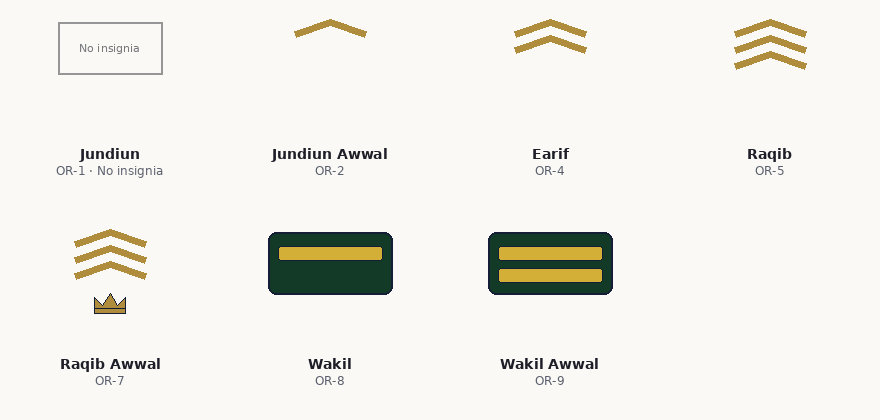
Enlisted soldiers and non-commissioned officers (NCOs) are the backbone of the Jordanian Armed Forces. Their rank is worn as chevrons — stripes that point upward — on the upper sleeves, a British tradition Jordan has kept since the days of the Arab Legion. The two most senior other ranks, the Warrants, break the pattern: they wear bars on the shoulder straps, like officers.
| Rank | NATO Code | Insignia | Typical Role |
|---|---|---|---|
| Jundiun (Private) | OR-1 | No insignia | New recruit in basic training; entry-level soldier |
| Jundiun Awwal (Private First Class) | OR-2 | One chevron | Trained soldier serving in a section; first step up from recruit |
| Earif (Corporal) | OR-4 | Two chevrons | Deputy leader of a squad; first junior NCO rank |
| Raqib (Sergeant) | OR-5 | Three chevrons | Leader of a squad; takes charge of a unit when no officer is present |
| Raqib Awwal (Sergeant First Class) | OR-7 | Three chevrons topped by the Hashemite crown | Senior sergeant; the most experienced NCO in a platoon or company |
| Wakil (Warrant Officer) | OR-8 | One bar on each shoulder strap | Senior technical and administrative specialist; advisor to officers |
| Wakil Awwal (Warrant Officer First Class) | OR-9 | Two parallel bars on each shoulder strap | Most senior warrant officer; the highest other rank |
Did you know? Jordan’s other-ranks ladder has gaps: there is no Jordanian equivalent of NATO OR-3 or OR-6. It jumps from OR-2 straight to OR-4, and from OR-5 straight to OR-7.
How to Read Jordanian Enlisted Insignia
Jordanian enlisted insignia are built from a small set of pieces, so once you know the code you can read any sleeve at a glance:
- Chevrons — the upward-pointing stripes on the upper sleeve. One chevron means Jundiun Awwal (OR-2), two means Earif (OR-4) and three means Raqib (OR-5). Count the stripes and you have the rank.
- The crown — a Raqib Awwal (OR-7) wears three chevrons with the Hashemite crown above them. The crown is the mark of the senior sergeant grades, and it is the same crown that appears on officers’ shoulder straps.
- Shoulder bars — the two Wakil grades wear no chevrons at all. A Wakil (OR-8) wears one bar on each shoulder strap and a Wakil Awwal (OR-9) wears two parallel bars, placed after the “Arab Army” shoulder title. The bars mark them out as warrant officers rather than sergeants.
- No insignia at all — a Jundiun (OR-1) wears no rank insignia. Like a private in many armies, the newest soldier has nothing to show yet.
- The missing grades — there is no Jordanian equivalent of NATO OR-3 or OR-6. The ladder jumps from OR-2 straight to OR-4, and from OR-5 straight to OR-7.
Some older English-language descriptions say a Jordanian private wears one chevron. The Jordanian Armed Forces’ own rank tables show otherwise: the single chevron belongs to Jundiun Awwal (Private First Class), and the plain Jundiun wears nothing. This guide follows the official Jordanian tables.
Jordan Military Commissioned Officer Ranks (OF-1 to OF-10)
Commissioned officers in Jordan lead at every level, from a platoon of around thirty soldiers to the entire armed forces. Junior officers (OF-1 to OF-2) lead platoons and serve as company officers; field officers (OF-3 to OF-5) command companies and battalions and fill senior staff posts; general officers (OF-6 to OF-10) command brigades, divisions and the armed forces themselves.
| Rank | NATO Code | Insignia | Typical Role |
|---|---|---|---|
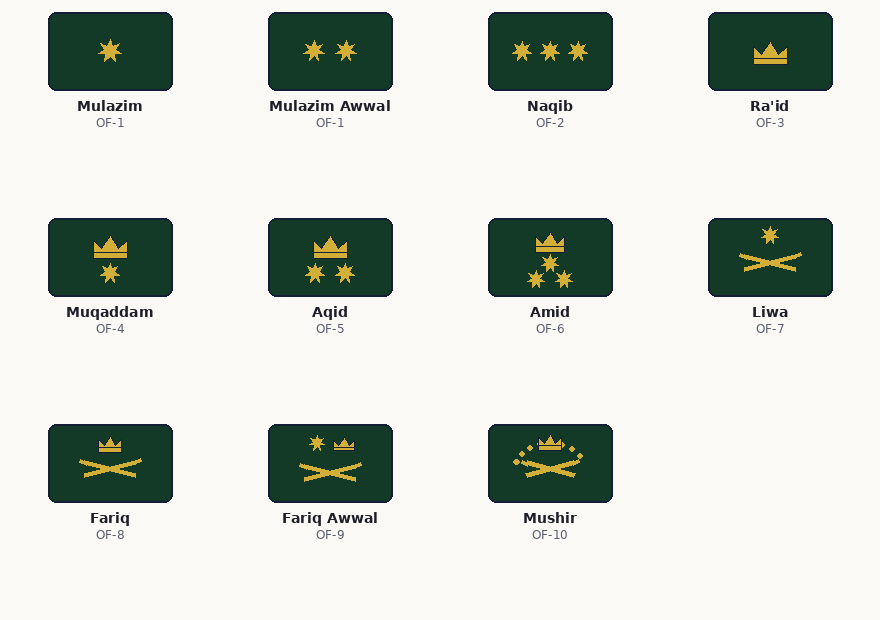
| Mulazim (Second Lieutenant) | OF-1 | One seven-pointed star | Platoon commander; entry-level commissioned officer |
| Mulazim Awwal (First Lieutenant) | OF-1 | Two seven-pointed stars in a row | Platoon commander or company second-in-command |
| Naqib (Captain) | OF-2 | Three seven-pointed stars in a row | Company commander (around 100 soldiers) |
| Ra’id (Major) | OF-3 | The Hashemite crown alone | Battalion second-in-command or senior staff officer |
| Muqaddam (Lieutenant Colonel) | OF-4 | One star topped by the crown | Battalion commander (several hundred soldiers) |
| Aqid (Colonel) | OF-5 | Two stars topped by the crown | Brigade staff officer or senior commander; the senior field officer rank |
| Amid (Brigadier) | OF-6 | Three stars in a triangle, topped by the crown | Brigade commander; lowest general rank |
| Liwa (Major General) | OF-7 | Two crossed Arab swords topped by a star | Division commander or senior headquarters appointment |
| Fariq (Lieutenant General) | OF-8 | Two crossed Arab swords topped by the crown | Senior commander; deputy to the Chairman of the Joint Chiefs of Staff |
| Fariq Awwal (General) | OF-9 | Two crossed Arab swords topped by a star and the crown | Chairman of the Joint Chiefs of Staff |
| Mushir (Field Marshal) | OF-10 | Two crossed Arab swords, crown above, surrounded by a laurel wreath | Highest rank in the Jordanian forces; reserved for the King as Supreme Commander |
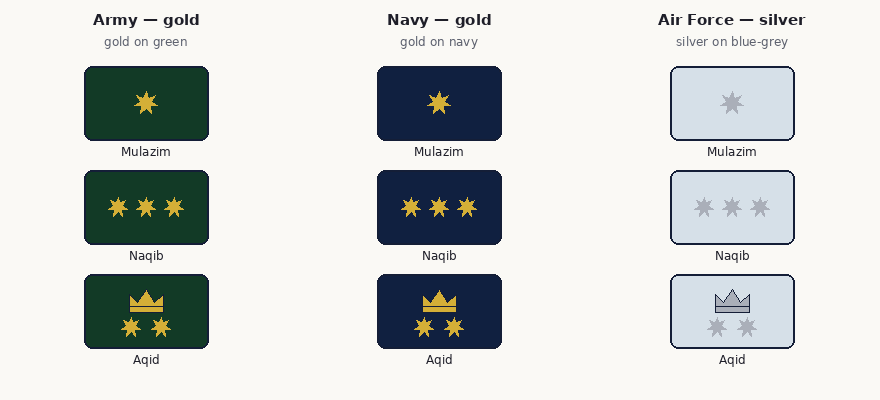
Key point: the metal tells you the service. The army’s insignia and buttons are gold, while the air force wears silver — the same stars, crown and crossed swords, in a different metal.
How to Read Jordanian Officer Insignia
Jordanian officer insignia are worn on shoulder straps, above the stylised Arabic title “Arab Army” (Al-Jaysh al-Arabi). The order in which the pieces appear tells you the rank:
- Stars — the seven-pointed stars, sometimes called pips, mark the junior officers. One star is a Mulazim (OF-1), two stars a Mulazim Awwal (OF-1), and three stars in a row a Naqib (OF-2). The seven points echo the seven-pointed star on the Jordanian flag.
- The crown — the Hashemite crown marks the field officers. A Ra’id (OF-3) wears the crown alone, a Muqaddam (OF-4) wears one star beneath the crown, and an Aqid (OF-5) wears two stars beneath it. When you see a crown, you are looking at a major or above.
- Three stars in a triangle — the Amid (OF-6) is the one rank that breaks the row pattern: three stars arranged in a triangle, one at the top and two at the base, with the crown above. It is the only general’s insignia built from stars rather than swords, and it is the easiest way to spot a brigadier.
- Crossed swords — two crossed Arab swords mark the senior generals. A Liwa (OF-7) has a star above the swords, a Fariq (OF-8) has the crown above them, and a Fariq Awwal (OF-9) has both a star and the crown. The Mushir (OF-10) adds a laurel wreath around the swords, with the crown above — the fullest insignia in the Jordanian forces.
- Red collar flashes — general officers also wear red collar patches and other decorative distinctions on ceremonial and service dress, a further mark of flag rank.
One detail catches out readers used to the British system: in the British Army a major wears a crown, but Jordan gives the crown alone to the Ra’id (Major) and adds stars above it for the higher field ranks. The metal also differs by service: the army’s insignia and buttons are gold, while the air force wears silver.
Jordan Military Ranks by Branch
Royal Jordanian Army
The army is by far the largest service, with around 86,000 active soldiers and a further 60,000 in reserve. Organised into four regional commands — Northern, Central, Eastern and Southern — it handles land defence and border security, and includes the Special Royal Guard Command, the Quick Reaction Force Brigade and the King Abdullah II Special Forces Group. Army officers wear gold insignia on their shoulder straps.
Royal Jordanian Navy
Jordan’s navy is small, as befits a country with only a short coastline on the Gulf of Aqaba. Based at Aqaba, it patrols Jordan’s territorial waters, guards the port and counters smuggling, with patrol craft, rescue boats and landing craft, plus the Royal Boats Command and maritime special forces divers. Unusually for a navy, its officers carry the same army-style titles — Mushir to Mulazim — rather than admiral and captain titles, and wear the same star, crown and crossed-sword devices. A Jordanian naval officer’s rank is read exactly like an army officer’s.
Royal Jordanian Air Force
The air force, headquartered at Tabarbour in Amman, handles air defence, close air support and tactical transport, flying F-16 multirole fighters, AH-1 Cobra attack helicopters and C-130 transport aircraft alongside surface-to-air missile batteries. Its officers use the same eleven titles as the army and navy, but their insignia are silver rather than gold — the one quick visual clue that separates an air force officer from an army officer at a glance.
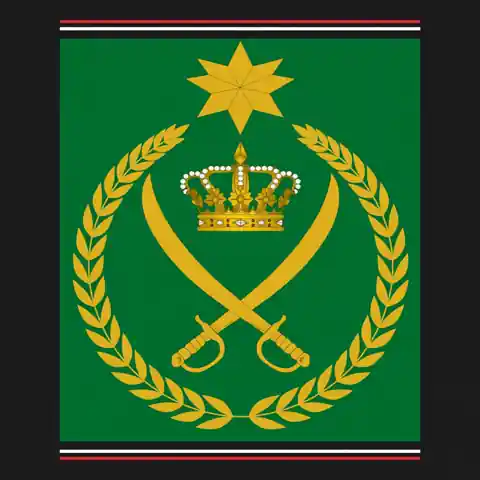
Jordanian Military Badges
Rank insignia shows a Jordanian service member’s grade. Badges show what they are qualified to do, and the most important are worn alongside the rank:
- The Hashemite crown — the emblem of the Hashemite monarchy, appearing across Jordanian military dress and in the insignia of every field officer and general.
- Parachutist wings — worn by soldiers qualified in military parachuting, including the special forces and the Quick Reaction Force.
- Pilot wings — worn by Royal Jordanian Air Force pilots, who fly the F-16 and the air force’s helicopter fleet.
- Special forces insignia — members of the King Abdullah II Special Forces Group wear the unit’s distinctive badges, marking them out as Jordan’s elite counter-terrorism and special operations troops.
- Officer cadet insignia — officer candidates, known as student cadets (Tilmith Murashah), wear their own distinctive insignia while training. They hold no commission yet, and cadet rank is not part of the commissioned ladder above.
How Promotion Works in the Jordanian Armed Forces
Promotion in the Jordanian Armed Forces is based on a mix of time in rank, performance, professional courses and selection. Junior soldiers advance through the enlisted grades as they complete training and gain experience. The two Wakil grades are a separate track: they are reached by senior NCOs selected for warrant appointment, and carry the shoulder bars and advisory role that go with it rather than a command appointment.
Officers are commissioned after training at the Royal Military Academy or, for specialist officers, through university routes such as Mutah University’s military wing. Junior officers are promoted on time and merit through Mulazim, Mulazim Awwal and Naqib, while promotion to Ra’id and above depends on staff courses, command appointments and selection boards. The general ranks are few and highly selective: Amid is the first flag rank, and only a handful of officers ever reach Fariq Awwal. Mushir is not a career goal at all — it is reserved for the King, and has only rarely been held by anyone else.
Jordan does not publish a detailed public timetable of time-in-grade for each rank, so the exact years between promotions vary by branch, corps and the needs of the service. What is certain is the shape of the ladder: it is narrow at the top, and the crown and crossed swords are earned slowly.
A Note on Jordanian Military Tradition
Two traditions explain almost everything about Jordanian ranks. The first is the British inheritance. Jordan’s armed forces descend from the Arab Legion, the force raised under British command in the 1920s, and they kept the British pattern of shoulder-strap stars and sleeve chevrons, the seven-pointed pip, and the crossed-swords badge of a general. The second is the Hashemite identity: the crown on the shoulder strap, the “Arab Army” title, and the crossed Arab swords all declare that this is an Arab army under a Hashemite king, not a copy of a foreign force. The seven-pointed star carries the same meaning as the star on the national flag.
That combination — a British frame filled with Arab and Hashemite symbols — is what makes Jordanian insignia distinctive among Arab armies. Saudi Arabia, Egypt and Iraq share the same Arabic rank names and crown-and-star vocabulary, but each country arranges the devices differently.
Read next
US Navy Ranks · Saudi Arabian Military Ranks · Egyptian Military Ranks · US Military Uniform · US Military Branches
FAQs
What is the highest rank in the Jordanian military?
Mushir (Field Marshal), OF-10, with crossed Arab swords, the Hashemite crown above and a laurel wreath around them. It is reserved for the King as Supreme Commander. The most senior serving general is normally the Fariq Awwal (General, OF-9), who chairs the Joint Chiefs of Staff.
What are Jordanian military ranks called in Arabic?
From the bottom: Jundiun (جندي, Private), Jundiun Awwal (جندي أول, Private First Class), Earif (عريف, Corporal), Raqib (رقيب, Sergeant), Raqib Awwal (رقيب أول, Sergeant First Class), Wakil (وكيل, Warrant Officer), Wakil Awwal (وكيل أول, Warrant Officer First Class), then Mulazim (ملازم, Second Lieutenant), Mulazim Awwal (ملازم أول, First Lieutenant), Naqib (نقيب, Captain), Ra’id (رائد, Major), Muqaddam (مقدم, Lieutenant Colonel), Aqid (عقيد, Colonel), Amid (عميد, Brigadier), Liwa (لواء, Major General), Fariq (فريق, Lieutenant General), Fariq Awwal (فريق أول, General) and Mushir (مشير, Field Marshal).
Do Jordanian navy officers have admiral ranks?
No. Jordan’s navy uses the same rank titles as the army and air force — Mushir down to Mulazim — rather than admiral, captain and commander titles. A naval Fariq is the equivalent of a vice admiral in NATO terms (OF-8), but the title itself is the same as in the army.
What is the difference between a Raqib and a Raqib Awwal?
Both are sergeants, but Raqib Awwal (OR-7) is senior to Raqib (OR-5). A Raqib wears three chevrons; a Raqib Awwal wears three chevrons topped by the Hashemite crown. There is no OR-6 rank in between them.
Why do Jordanian officers wear a crown on their shoulder straps?
The Hashemite crown marks the field officer grades — Ra’id wears the crown alone, Muqaddam one star beneath it and Aqid two stars beneath it — and it also appears in the insignia of every general, above the crossed swords. It is the emblem of the Hashemite monarchy, to which the armed forces owe their allegiance.
How can you tell a Jordanian air force officer from an army officer?
By the colour of the metal. Both wear the same stars, crown and crossed swords, but the army’s insignia are gold and the air force’s are silver.
Does Jordan have a rank between Corporal and Sergeant?
No. The ladder jumps from Earif (Corporal, OR-4) straight to Raqib (Sergeant, OR-5), and there is no Jordanian equivalent of NATO OR-3 or OR-6 either. Jordan’s other-ranks ladder has seven grades where many NATO armies have nine.
All insignia diagrams and images in this article are original graphics created for Forces Guide.