
The Mexican military ranks system is one of the most distinctive in the Americas. It was inherited from Spain, so its titles are Spanish, its generals wear a gold eagle on their shoulders, and its naval officers wear gold sleeve stripes with a braided loop — yet the whole structure is unmistakably Mexican, from the eagle-and-cactus emblem to the coloured branch bands on every shoulder board. This guide covers every rank of the Mexican Army, Navy and Air Force, with its insignia, from Soldado (private) to the Secretary of National Defense.
Mexico’s armed forces are run by two ministries. The Secretariat of National Defense (SEDENA) commands the Mexican Army (Ejército Mexicano) and the Mexican Air Force (Fuerza Aérea Mexicana), while the Secretariat of the Navy (SEMAR) commands the Mexican Navy (Armada de México), including its naval infantry.
The National Guard, created in 2019, now also sits under SEDENA, but it uses its own police-style titles, which we cover briefly at the end. Mexico is not a NATO member, so the OF and OR grades in the tables below are NATO-style equivalents, given to help readers compare Mexican ranks with American and European ones.
Three things make the Mexican system easy to read once you know them. First, army and air force officers wear their rank on shoulder boards (epaulettes) as gold stars or gold bars — generals add a gold eagle and switch to silver stars. Second, naval officers wear their rank as gold stripes on the sleeve, with a loop in the top stripe. Third, enlisted soldiers and airmen wear red bars on green shoulder boards, while enlisted sailors wear white stripes on the sleeve.
Key facts
- Country: Mexico
- Branches: Mexican Army and Mexican Air Force (under SEDENA); Mexican Navy (under SEMAR)
- Officer ranks: Eleven ranks in the Army and Navy, ten in the Air Force — from Subteniente / Teniente de corbeta to Secretary (OF-9)
- Enlisted ranks: Four in the Army and Air Force, four in the Navy (OR-1 to OR-7)
- Highest rank: Secretary of National Defense (OF-9) in the Army and Air Force; Secretary of the Navy (OF-9) in the Navy
- No five-star rank: The highest rank in ordinary service is General de división (OF-8) / Almirante (OF-8)
- Signature marks: A gold eagle for generals, a braided loop on naval sleeve stripes, and coloured branch bands on shoulder boards
Mexican Army Officer Ranks
The Mexican Army has eleven officer ranks. At the top sits the Secretario de la defensa nacional — the Secretary of National Defense himself, always a serving army general, whose rank is the equivalent of a four-star general (OF-9).
Below him come three grades of general, three field-grade ranks and four junior officer ranks. There is no five-star rank in Mexico: the highest rank an officer can hold in ordinary service is General de división, equivalent to a lieutenant general (OF-8).
| Rank (Spanish) | English Equivalent | NATO Grade | Insignia | Typical Role |
|---|---|---|---|---|
| Secretario de la defensa nacional | Secretary of National Defense | OF-9 | Gold eagle with four silver stars on the epaulette | Head of SEDENA and the Army and Air Force; always a serving general |
| General de división | Division General (Lieutenant General) | OF-8 | Gold eagle with three silver stars | Commands a military region or a major formation |
| General de brigada | Brigade General (Major General) | OF-7 | Gold eagle with two silver stars | Commands a brigade or a military zone |
| General brigadier | Brigadier General | OF-6 | Gold eagle with one silver star | Commands a brigade or serves as a senior staff officer |
| Coronel | Colonel | OF-5 | Three gold stars arranged in a triangle | Commands a regiment or brigade; chief of staff of a military zone |
| Teniente coronel | Lieutenant Colonel | OF-4 | Two gold stars | Commands a battalion; senior instructor or staff officer |
| Mayor | Major | OF-3 | One gold star | Second-in-command of a battalion; personnel and training staff |
| Capitán primero | First Captain | OF-2 | Three gold bars, the middle bar shorter | Commands a company, squadron or battery |
| Capitán segundo | Second Captain | OF-2 | Two-and-a-half gold bars | Commands a company, squadron or battery |
| Teniente | Lieutenant | OF-1 | Two gold bars | Platoon commander or junior staff officer |
| Subteniente | Second Lieutenant | OF-1 | One gold bar | Platoon commander; entry-level commissioned officer |
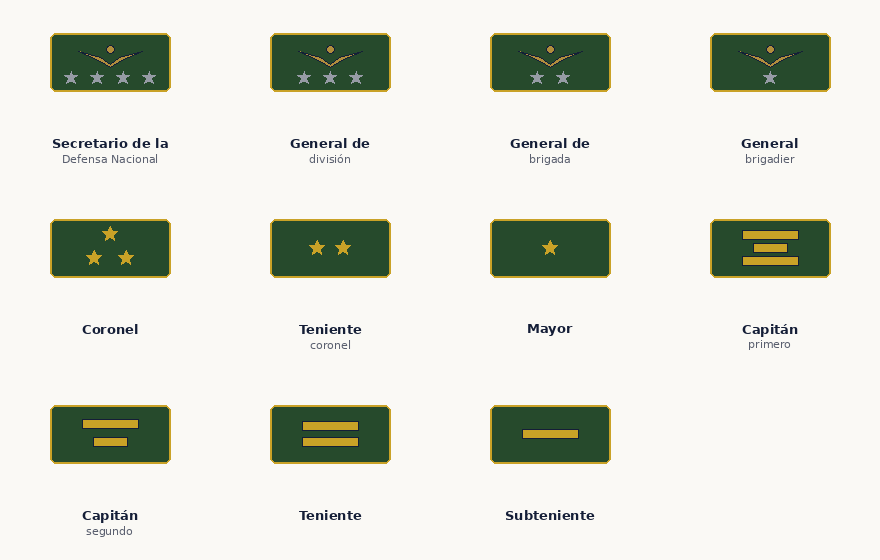
The two captain ranks catch out almost every newcomer. Mexico has no single rank of captain: instead it splits the grade in two.
A Capitán primero (first captain) wears three gold bars, with the middle bar cut short, while a Capitán segundo (second captain) wears two full bars plus a half bar. Both are roughly equivalent to a captain in the US Army, and both command companies — the first captain is simply the senior of the two.
Did you know? Mexico has no single rank of captain. Instead it splits the grade in two — Capitán primero (three gold bars, the middle bar shorter) and Capitán segundo (two-and-a-half gold bars) — and both command companies.
Mexican Navy Officer Ranks
The Mexican Navy’s eleven officer ranks follow a different tradition. Instead of shoulder boards, naval officers wear their rank as gold stripes above the sleeve cuff, in a pattern very close to that of the United States Navy — with one unmistakable Mexican touch: the uppermost stripe carries a braided loop, sometimes called an executive curl.
Admirals add a broad gold stripe to the pattern, and the number of stripes grows as the rank rises.
| Rank (Spanish) | English Equivalent | NATO Grade | Insignia | Typical Role |
|---|---|---|---|---|
| Secretario de Marina | Secretary of the Navy | OF-9 | Broad gold stripe with additional stripes and a looped top stripe | Head of SEMAR and the Navy; always a serving admiral |
| Almirante | Admiral | OF-8 | Broad gold stripe plus three stripes, looped top stripe | Commands a naval region or the naval staff |
| Vicealmirante | Vice Admiral | OF-7 | Broad gold stripe plus two stripes, looped top stripe | Commands a naval zone or a major command |
| Contraalmirante | Rear Admiral | OF-6 | Broad gold stripe plus one stripe, looped top stripe | Commands a naval sector or flotilla |
| Capitán de navío | Ship-of-the-Line Captain (Captain) | OF-5 | Four gold sleeve stripes, looped top stripe | Commands a large warship or a naval base |
| Capitán de fragata | Frigate Captain (Commander) | OF-4 | Three gold sleeve stripes, looped top stripe | Commands a frigate or patrol vessel; senior staff officer |
| Capitán de corbeta | Corvette Captain (Lieutenant Commander) | OF-3 | Two gold sleeve stripes, looped top stripe | Commands a corvette or patrol boat |
| Teniente de navío | Ship Lieutenant (Lieutenant) | OF-2 | Two gold stripes and a narrow stripe, looped top stripe | Department head aboard ship; watch officer |
| Teniente de fragata | Frigate Lieutenant (Lieutenant Junior Grade) | OF-1 | One gold stripe and a narrow stripe, looped top stripe | Division officer aboard ship |
| Teniente de corbeta | Corvette Lieutenant (Ensign) | OF-1 | One gold sleeve stripe, looped top stripe | Junior officer aboard ship; entry-level commissioned officer |
| Guardiamarina | Midshipman | OF-D | One narrow gold stripe, looped | Officer cadet in the final stage of naval training |
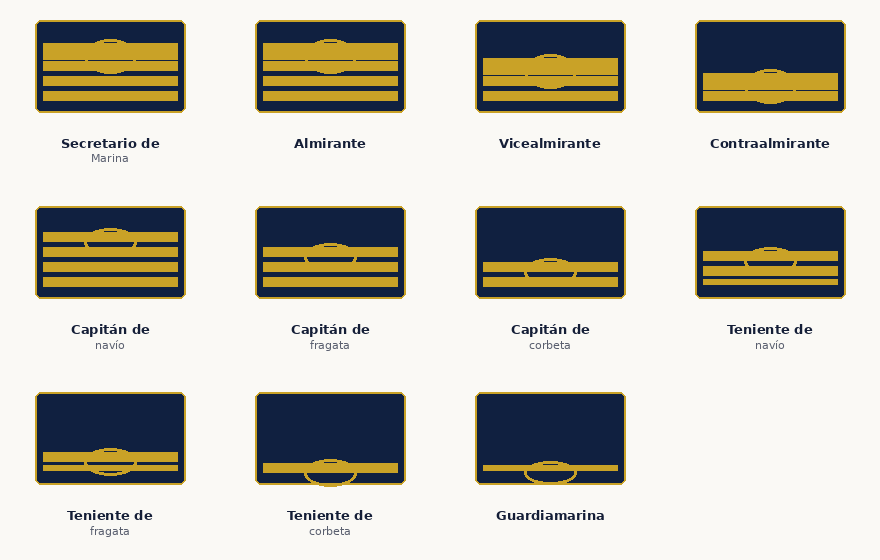
The naval rank names themselves tell a story. Capitán de navío, Capitán de fragata and Capitán de corbeta literally mean “captain of a ship of the line”, “captain of a frigate” and “captain of a corvette” — the size of warship the officer was once expected to command. The same naming runs through the lieutenants.
Officers of the Naval Infantry Corps (Infantería de Marina), the Navy’s marines, wear the same stripes but are marked out by red piping on their rank insignia.
Key point: the braided loop in the top sleeve stripe is the mark of a commissioned naval officer in Mexico. It appears at every officer grade, from Guardiamarina to admiral — and only flag officers add a broad gold stripe.
Mexican Air Force Officer Ranks
The Mexican Air Force shares the Army’s rank structure almost exactly — the two services are administered together by SEDENA and their officers train side by side. There are two differences, both at the top.
The Air Force has no secretary of its own, so its ladder starts one step lower, and its two junior general ranks have their own names: General de ala (wing general) and General de grupo (group general) replace the Army’s General de brigada and General brigadier. From Colonel down, every rank and every insignia is identical to the Army’s, and air force personnel are identified by the purple branch colour on their insignia.
| Rank (Spanish) | English Equivalent | NATO Grade | Insignia | Typical Role |
|---|---|---|---|---|
| General de división | Division General (Lieutenant General) | OF-8 | Gold eagle with three silver stars | Commands the Air Force |
| General de ala | Wing General (Major General) | OF-7 | Gold eagle with two silver stars | Commands an air wing or air region |
| General de grupo | Group General (Brigadier General) | OF-6 | Gold eagle with one silver star | Commands an air group or air base |
| Coronel | Colonel | OF-5 | Three gold stars arranged in a triangle | Commands an air base or a flying group |
| Teniente coronel | Lieutenant Colonel | OF-4 | Two gold stars | Commands a squadron; senior staff officer |
| Mayor | Major | OF-3 | One gold star | Second-in-command of a squadron; staff officer |
| Capitán primero | First Captain | OF-2 | Three gold bars, the middle bar shorter | Flight commander; aircraft captain |
| Capitán segundo | Second Captain | OF-2 | Two-and-a-half gold bars | Flight commander; aircraft captain |
| Teniente | Lieutenant | OF-1 | Two gold bars | Junior pilot or staff officer |
| Subteniente | Second Lieutenant | OF-1 | One gold bar | Junior pilot; entry-level commissioned officer |
Mexican Enlisted and NCO Ranks
Where many armies have a long ladder of enlisted ranks, Mexico keeps the ladder short. The Army and the Air Force have just four enlisted ranks between them, and the Navy has four of its own.
The highest enlisted rank, Sargento primero, is roughly equivalent to a sergeant first class in the US Army, and there is no separate rank of warrant officer in the Mexican system.
| Rank (Spanish) | English Equivalent | NATO Grade | Branch | Insignia |
|---|---|---|---|---|
| Sargento primero | First Sergeant (Sergeant First Class) | OR-7 | Army / Air Force | Three horizontal red bars on a green epaulette |
| Sargento segundo | Second Sergeant (Sergeant) | OR-5 | Army / Air Force | Two horizontal red bars on a green epaulette |
| Cabo | Corporal | OR-3 | Army / Air Force | One horizontal red bar on a green epaulette |
| Soldado | Private (Airman Basic) | OR-1 | Army / Air Force | Plain green epaulette, no bars |
| Segundo maestre | Second Master (Chief Petty Officer) | OR-7 | Navy | Three white stripes on the sleeve |
| Tercer maestre | Third Master (Petty Officer) | OR-5 | Navy | Two white stripes on the sleeve |
| Cabo | Corporal (Seaman) | OR-3 | Navy | One white V-shaped stripe on the sleeve |
| Marinero | Sailor (Seaman Recruit) | OR-1 | Navy | Plain sleeve, no stripes |
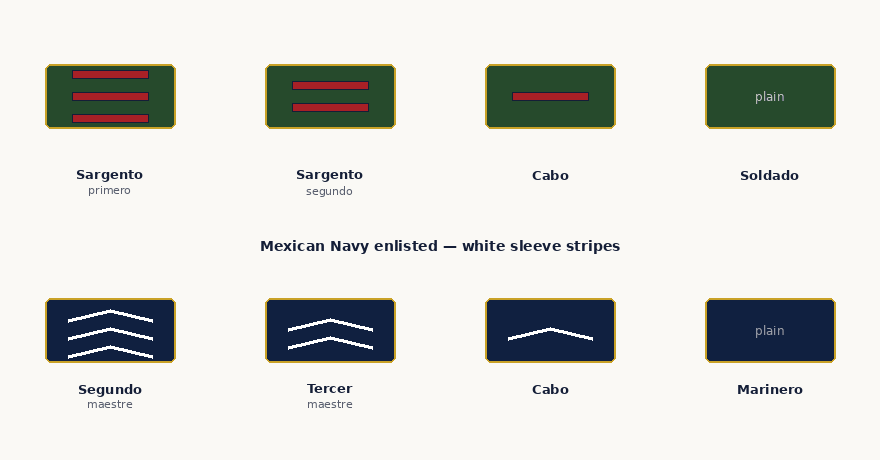
Did you know? Mexico keeps its enlisted ladder short — just four ranks per service — and there is no separate rank of warrant officer in the Mexican system at all.
Older references list one more Army rank, Soldado de primera (private first class), between Cabo and Soldado, marked by two short vertical red bars. It appears in the 1990s country studies of Mexico but not in the current official rank tables, so it is best treated as a historical rank.
Officer cadets also carry their own titles while they train — Sargento 1º de cadetes, Sargento 2º de cadetes and Cabo de cadetes — which mark seniority inside the military colleges rather than ranks in the wider forces.
How to Read Mexican Officer Insignia
Army and Air Force officer insignia are read from the shoulder board, and the code is a ladder of eagles, stars and bars:
- The gold eagle — every general wears a gold eagle on the epaulette. Count the silver stars beneath it: four for the Secretary of National Defense, three for a General de división, two for a General de brigada (or General de ala in the Air Force), and one for a General brigadier (or General de grupo).
- Gold stars — field-grade officers wear gold stars and no eagle: three in a triangle for a Coronel, two for a Teniente coronel, and one for a Mayor.
- Gold bars — junior officers wear gold bars: three for a Capitán primero (the middle bar is shorter, which is the giveaway), two-and-a-half for a Capitán segundo, two for a Teniente, and one for a Subteniente.
- Silver outranks gold — among generals the stars are silver, while field officers wear gold stars. As in several other armies, the colour change marks the step from field grade to general, not a lower value of metal.
Naval officer insignia are read from the sleeve instead. Look first for the braided loop in the top stripe: it is the mark of a commissioned naval officer, and it appears at every grade from Guardiamarina to admiral.
Then look for the broad stripe: only flag officers — admirals and the Secretary of the Navy — wear one. Below that, simply count the stripes: four for a Capitán de navío, three for a Capitán de fragata, two for a Capitán de corbeta, and one, with or without a narrow stripe, for the three grades of lieutenant.
How to Read Mexican Enlisted Insignia
Enlisted insignia are simpler still, and they work by counting bars or stripes. On the green shoulder boards of the Army and Air Force, red horizontal bars do all the work: three bars mark a Sargento primero, two a Sargento segundo, one a Cabo, and a plain board with no bars at all marks a Soldado.
In the Navy, white sleeve stripes play the same role: three for a Segundo maestre, two for a Tercer maestre, one V-shaped stripe for a Cabo, and a plain sleeve for a Marinero.
There is one more thing to look for on an enlisted shoulder board: a band of colour that shows the wearer’s branch of service. The colour system is one of the most detailed of any army in the world, and it applies to officers and enlisted personnel alike.
Red means infantry, crimson means artillery, light blue means cavalry, cobalt blue means engineers and signals, purple means army aviation, the Air Force and the parachute fusiliers, yellow means medical services, green means the judicial corps and military police, grey means military bands, light grey means armoured units, and gold is reserved for general officers themselves. A soldier’s branch can therefore be read from the shoulder at the same moment as their rank.
Mexican Military Badges and Emblems
Rank insignia shows a Mexican service member’s grade. Badges and emblems show what they are and what they are qualified to do. The most important are:
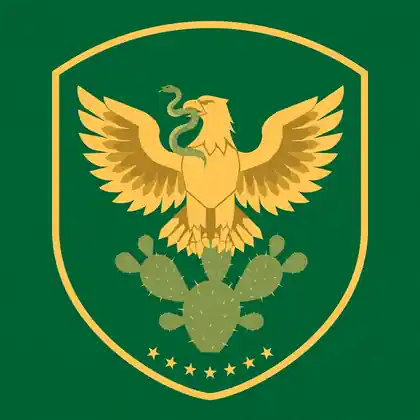
- The national emblem — the eagle perched on a prickly pear cactus, holding a snake in its beak, from the Mexican flag and the legend of Tenochtitlan. It appears on cap badges across the armed forces, and a gold version of the eagle is the centrepiece of every general’s shoulder board.
- Collar patches — the small patches worn on the collar show the wearer’s arm or service. For generals they are diamond-shaped, framed by an embroidered laurel wreath; for officers, cadets and troops they are triangular, carrying the shield of the branch or service.
- Pilot wings — worn by Air Force pilots and by naval aviators, who fly transport, patrol and helicopter aircraft in support of the fleet and the Army.
- Parachutist badge — worn by members of the Parachute Fusilier Brigade (Brigada de Fusileros Paracaidistas), Mexico’s elite airborne unit, whose members are also recognised by their purple berets.
- Naval Infantry insignia — the marines of the Infantería de Marina wear the Navy’s rank stripes with red piping, and their own anchor-and-rifle emblem marks them as the Navy’s amphibious and expeditionary force.
- Service and campaign ribbons — Mexico awards decorations for long service, merit and participation in operations, disaster relief and peacekeeping, worn as ribbon bars on the chest.
How Promotion Works in the Mexican Military
Officers begin their careers in the military colleges. Army and Air Force officers are commissioned from the Heroico Colegio Militar, the Heroic Military College, and naval officers from the Heroica Escuela Naval Militar, the Heroic Naval Military School.
Cadets graduate as Subteniente or Teniente de corbeta and then climb the ladder through a combination of time in grade, professional courses, examinations and selection boards, with command of a company, battalion, ship or squadron as the defining test at each stage.
Enlisted personnel enlist as Soldado or Marinero and are promoted on merit, time in service and qualification courses, with sergeants selected from experienced corporals. Promotion to the most senior ranks is competitive and slow: the pyramid narrows sharply above colonel, and the step to general is a selection, not a matter of waiting one’s turn.
The two secretaries, who head SEDENA and SEMAR, are appointed by the President of Mexico from among serving generals and admirals.
The National Guard, which became a permanent branch of the armed forces under SEDENA, follows a different ladder with police-style titles rather than military ranks: Comisario General, Comisario Jefe and Comisario at the top, then Inspector General, Inspector Jefe and Inspector, followed by Subinspector Primero, Subinspector Segundo, Oficial and Suboficial, with Agente Mayor, Agente, Subagente and Guardia Nacional as its enlisted ranks.
A Note on Mexican Military Tradition
Two threads run through everything about Mexican military ranks. The first is the Spanish inheritance: Mexico adopted its officer ranks from the Spanish military in the nineteenth century and has kept them, with modifications, ever since — which is why its generals, colonels and captains look familiar to anyone who knows the Spanish system, while remaining distinctively Mexican in their insignia.
The second is the Heroico Colegio Militar and its most famous moment, the defence of Chapultepec Castle against the United States invasion in 1847, when six cadets — remembered ever since as the Niños Héroes, the Boy Heroes — died rather than surrender the college. That memory is why the college carries the title “Heroic”, why the Mexican Army celebrates its anniversary every 19 February, and why the eagle, the symbol of the nation itself, sits at the centre of a Mexican general’s rank.
Read next
US Navy Ranks · US Military Branches · US Military Uniform · Brazilian Military Ranks · Peruvian Military Ranks
FAQs
What is the highest rank in the Mexican military?
The Secretary of National Defense (Secretario de la defensa nacional), equivalent to a four-star general (OF-9), is the highest rank in the Army and Air Force, and the Secretary of the Navy (Secretario de Marina) holds the equivalent position in the Navy. Both posts are always held by serving generals or admirals. The highest rank in ordinary service is General de división (OF-8) in the Army and Air Force, and Almirante (OF-8) in the Navy. Mexico has no five-star rank.
What is the difference between a General de brigada and a General brigadier?
Both are general officers, but the General de brigada (OF-7, equivalent to a major general) is senior to the General brigadier (OF-6, equivalent to a brigadier general). Both wear the gold eagle on their shoulder boards; the difference is the number of silver stars beneath it — two for a General de brigada and one for a General brigadier. In the Air Force the same two grades are called General de ala and General de grupo.
Why do Mexican naval officers have a loop on their sleeve stripes?
The braided loop in the top sleeve stripe is the mark of a commissioned naval officer, inherited from the British Royal Navy tradition that spread through the world’s navies. In Mexico it appears on the top stripe at every officer grade, from Guardiamarina to admiral, and it is the quickest way to tell a naval officer’s stripes apart from an enlisted sailor’s white sleeve stripes.
What do the colours on Mexican rank badges mean?
A band of colour on the shoulder board or insignia shows the wearer’s branch of service. Red is infantry, crimson is artillery, light blue is cavalry, cobalt blue is engineers and signals, purple is army aviation, the Air Force and parachute fusiliers, yellow is medical, green is the judicial corps and military police, grey is military bands, light grey is armoured units, and gold is reserved for general officers.
Are Mexican Air Force ranks the same as Army ranks?
Almost. From Colonel down, every Air Force rank and insignia is identical to the Army’s, and the enlisted ranks are exactly the same. The only difference is at the top: the Air Force has no secretary of its own, and its two junior general ranks are called General de ala and General de grupo instead of General de brigada and General brigadier. Air Force personnel are identified by the purple branch colour.
How do you become an officer in the Mexican military?
Through the military colleges: the Heroico Colegio Militar for the Army and Air Force, and the Heroica Escuela Naval Militar for the Navy. Cadets graduate as Subteniente (Army and Air Force) or Teniente de corbeta (Navy) and are then promoted on time in grade, courses, examinations and selection boards.
All insignia diagrams and images in this article are original graphics created for Forces Guide.