
Polish shoulder boards are a small puzzle: gold bars, chevrons and stars that, once you know the pattern, tell you a soldier’s whole career at a glance. Poland’s rank system is one of the oldest in Europe, and it is also one of the most logical — privates wear bars, sergeants wear chevrons, and officers wear stars above bars. This guide goes through every Polish military rank in plain language: the Polish name, the English equivalent, the NATO code, the insignia on the shoulder board, and the job that goes with the rank. The system it describes is the current one, set by the Homeland Defence Act of 11 March 2022, and it covers 24 titles, from Szeregowy to Marszałek Polski.
Those ranks belong to the Armed Forces of the Republic of Poland (Siły Zbrojne Rzeczypospolitej Polskiej), and the Land Forces are its main fighting arm. The Land Forces and the Air Force use the same army ranks; the Navy alone has its own set of naval titles, which this guide lists separately so you are not caught out by them. Poland has been a NATO member since 1999, so the OF and OR codes below are real NATO grades — a Polish Kapitan really is an OF-2. Count the bars, then the chevrons, then the stars, and you will know exactly where any Polish soldier stands.
Key facts
- Country: Poland
- Force: Armed Forces of the Republic of Poland — Land Forces, Air Force, Navy, Special Forces and Territorial Defence Force; the Land Forces and Air Force share one army rank system, the Navy uses naval ranks
- Other ranks: OR-1 to OR-9 (Szeregowy to Starszy chorąży sztabowy), plus the specialist private, Starszy szeregowy specjalista, which has no NATO code
- Commissioned officers: OF(D) to OF-10, from the cadet Podchorąży to Marszałek Polski (Podporucznik to Generał)
- Highest rank in use: Generał (OF-9); Marszałek Polski (OF-10) is a ceremonial wartime rank held by only six officers in Polish history and by nobody today
- Total army titles: 24 — 12 other ranks including the specialist private, and 12 officer titles including the cadet and the Marshal
- Notable fact: the current system is set by the Homeland Defence Act of 11 March 2022, and Polish soldiers salute with two fingers — a custom found nowhere else
From Szeregowy to Senior Staff Warrant Officer: The Enlisted Ladder (OR-1 to OR-9)
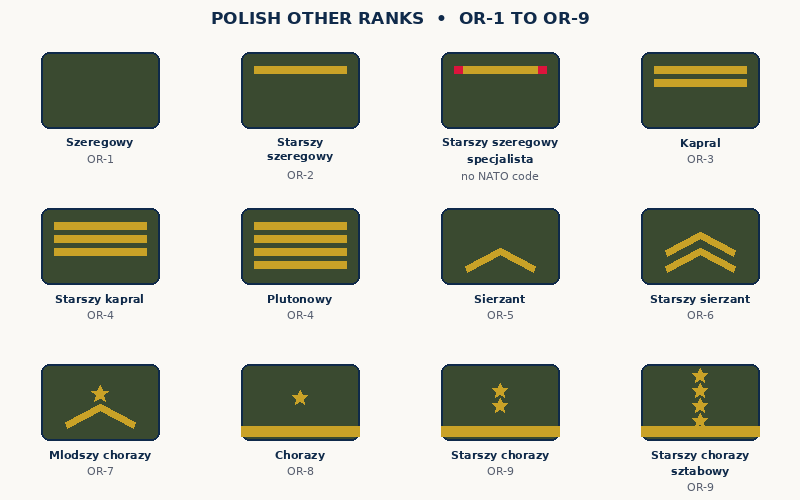
Every Polish soldier begins as a Szeregowy, and the board gives that away at once: it carries nothing at all — a bare shoulder board is the mark of a new soldier on first joining. One step up, a Starszy szeregowy (Senior Private) wears a single horizontal gold bar — a small mark that says this soldier has finished basic training and has some experience. Beside them sits the newest rank in the whole system, the Starszy szeregowy specjalista (Senior Private Specialist), created by the 2022 defence law for experienced specialist soldiers rather than leaders: one bar with two red stripes, and no NATO code, because no other NATO army has a rank quite like it.
From there the ladder climbs through the corporals, who wear bars, and the sergeants, who wear chevrons. A Kapral wears two bars, a Starszy kapral three, and a Plutonowy four — Plutonowy — literally “platoon man” — is one of two ranks graded OR-4, the other being Starszy kapral. Then the marks change shape: a Sierżant wears one chevron, a Starszy sierżant two, and a Młodszy chorąży one chevron with a star set between its arms. At the very top sit the three senior warrant-officer ranks — Chorąży, Starszy chorąży and Starszy chorąży sztabowy — who wear stars on a board edged with a distinguishing braid: the most experienced enlisted soldiers in the force, and the top rank is graded OR-9, the highest any enlisted soldier can reach.
| Rank (Polish) | English Equivalent | NATO Code | Insignia | Typical Role |
|---|---|---|---|---|
| Szeregowy | Private | OR-1 | Plain shoulder board, no device | New soldier in basic training |
| Starszy szeregowy | Senior Private (Private First Class) | OR-2 | One horizontal gold bar | Trained soldier |
| Starszy szeregowy specjalista | Senior Private Specialist | — (no NATO code) | One bar with two red stripes | Experienced specialist soldier |
| Kapral | Corporal | OR-3 | Two horizontal gold bars | Team leader; most junior NCO |
| Starszy kapral | Senior Corporal | OR-4 | Three horizontal gold bars | Senior team leader |
| Plutonowy | Platoon Sergeant (Master Corporal) | OR-4 | Four horizontal gold bars | Squad leader |
| Sierżant | Sergeant | OR-5 | One gold chevron | Platoon sergeant |
| Starszy sierżant | Senior Sergeant (Staff Sergeant) | OR-6 | Two gold chevrons | Company sergeant |
| Młodszy chorąży | Junior Warrant Officer | OR-7 | One chevron with a star between its arms | Senior NCO and technical specialist |
| Chorąży | Warrant Officer | OR-8 | One star on a board edged with distinguishing braid | Senior technical adviser |
| Starszy chorąży | Senior Warrant Officer | OR-9 | Two stars on a board edged with distinguishing braid | Senior adviser at battalion or brigade level |
| Starszy chorąży sztabowy | Senior Staff Warrant Officer | OR-9 | Four stars on a board edged with distinguishing braid | Most senior warrant officer; adviser to senior commanders |
Did you know? The word chorąży literally means a flag-bearer — it goes back to the Middle Ages, when the man who carried the unit’s banner was one of its most trusted soldiers. And the two-finger salute is just as distinctive: Polish soldiers salute with the index and middle fingers only, a custom no other army shares, and they never salute bare-headed.
How to Read a Polish Uniform
A Polish uniform is not hard to read once you know the three marks it uses. Everything sits on shoulder boards on the Land Forces and Air Force uniforms, and the whole system is built from just three devices: bars, chevrons and stars. Match the device to its group and the ladder falls into place.
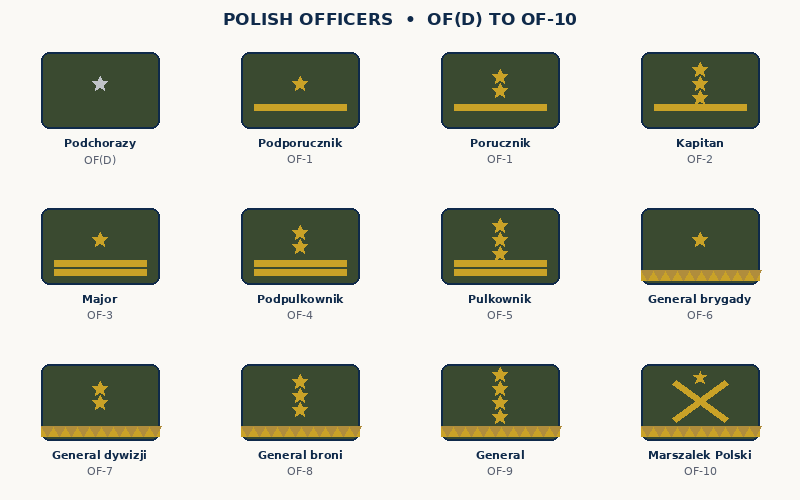
The first rule is to look at the shape. Horizontal bars mean a private or a corporal: one bar for a senior private, two for a corporal, three for a senior corporal, four for a platoon sergeant. Chevrons mean a sergeant: one for a sergeant, two for a senior sergeant, and one chevron with a star for a junior warrant officer. Stars mean an officer or a senior warrant officer. Junior officers wear one to three stars above a single bar, senior officers one to three stars above two bars, and generals one to four stars above a wavy gold braid, the wężyk generalski. The senior warrant officers are the one exception to the shape rule: their stars sit on a board edged with a distinguishing braid instead of bars, which is how you tell a Chorąży from a junior officer at a glance.
The second rule is to look at the colour. Land Forces boards are green, Air Force boards are steel-blue, and the same rank marks appear on both. The Navy is different again: its boards are black, and its officers are recognised by a loop on the shoulder board and by gold stripes on the sleeve. Most uniforms also carry the white-and-red flag on the sleeve, and officers are addressed with a polite form before the rank — Panie Kapitanie, “Sir Captain” — a habit dropped under communist rule and then brought back.
Officers: From Cadet to Marshal of Poland (OF(D) to OF-10)
Anyone who knows a Western army will recognise this ladder. A new Podporucznik, fresh from the academy, takes command of a platoon; a Porucznik does the same job with more years behind him; and a Kapitan leads a company of about a hundred soldiers. Above them come the senior officers — Major, Podpułkownik and Pułkownik — who run battalions and regiments and hold the staff posts that keep a formation moving. The names carry their history: Kapral comes from the Italian caporale, and Pułkownik literally means “regimental leader”.
Below the lieutenants sits the Podchorąży, an officer cadet still in training. His grade is OF(D) — the “D” for a student officer, since a cadet does not yet hold a commission. At the very top sit the four generals — Generał brygady, Generał dywizji, Generał broni and Generał — one to four stars above the wavy braid. Above even that stands the Marszałek Polski, Marshal of Poland, graded OF-10: a ceremonial rank given only in wartime for exceptional service, whose board carries the general’s braid with two crossed marshal’s batons. Only six officers have ever held it, and nobody holds it today. The top general rank was titled Generał armii, General of the Army, until 2004, when it became simply Generał.
| Rank (Polish) | English Equivalent | NATO Code | Insignia | Typical Role |
|---|---|---|---|---|
| Podchorąży | Officer Cadet | OF(D) | Cadet board with white edging and school badge | Officer cadet at a military academy |
| Podporucznik | Second Lieutenant | OF-1 | One star above a single bar | Platoon leader, newly commissioned |
| Porucznik | Lieutenant (First Lieutenant) | OF-1 | Two stars above a single bar | Platoon leader |
| Kapitan | Captain | OF-2 | Three stars above a single bar | Company commander |
| Major | Major | OF-3 | One star above two bars | Battalion executive officer or staff officer |
| Podpułkownik | Lieutenant Colonel | OF-4 | Two stars above two bars | Battalion commander |
| Pułkownik | Colonel | OF-5 | Three stars above two bars | Regiment or brigade commander |
| Generał brygady | Brigadier General | OF-6 | One star above the wavy generals’ braid | Brigade commander; first general officer rank |
| Generał dywizji | Major General | OF-7 | Two stars above the wavy generals’ braid | Division commander |
| Generał broni | Lieutenant General | OF-8 | Three stars above the wavy generals’ braid | Corps commander or senior staff officer |
| Generał | General | OF-9 | Four stars above the wavy generals’ braid | Chief of the General Staff; highest rank in use |
| Marszałek Polski | Marshal of Poland | OF-10 | Wavy braid with two crossed marshal’s batons | Ceremonial wartime rank; not currently held |
Key point: Poland joined NATO in 1999, so the OF and OR codes here are official NATO grades, not estimates — a Polish Pułkownik really is an OF-5. Two ranks can share one code without being the same rank: both lieutenants sit at OF-1, and both top warrant officers at OR-9, because a code marks roughly where a rank stands in the ladder, not what the job is. The Navy follows the same pattern, with Admirał (OF-9) at the top and its own titles all the way down, from Marynarz (OR-1) to Starszy chorąży sztabowy marynarki (OR-9).
The 2022 Reform: A New Defence Law, A New Rank, A Simpler NCO Corps
Polish ranks are old — the modern army was founded in 1918, when Poland returned to the map after more than a century of partition, and its first officers were veterans of the German, Russian and Austro-Hungarian armies. Before the Second World War each arm even had its own names for the same grades: a sergeant was a sierżant in the infantry, an ogniomistrz, “master of fire”, in the artillery, and a wachmistrz in the cavalry. The war, the communist decades, and the return to democracy in 1989 each left their mark, and the rank of Chorąży only took its modern shape in the 1960s.
The biggest recent change came with the Homeland Defence Act of 11 March 2022, which now governs the whole rank system by law. Three things happened at once. First, a new rank was created: Starszy szeregowy specjalista, the senior private specialist, for experienced soldiers who are experts rather than commanders. Second, the NCO corps was simplified: where it used to be split into three groups — junior NCOs, NCOs and senior NCOs — it now has just two, junior NCOs and senior NCOs, Third, the law set out the whole structure in three corps of personnel — the privates’ corps, the NCO corps and the officers’ corps — so that every soldier belongs to one corps by rank, from Szeregowy to Marszałek Polski.
The reform was part of a bigger decision: to grow the armed forces sharply towards a target of 300,000 soldiers, and to pay for it — Poland spent the largest share of its economy on defence of any NATO member in 2024, at over four per cent of GDP. A bigger army needs more sergeants, more warrant officers and more officers, and the 2022 law was written to make room for all of them.
Poland Today: NATO’s Eastern Flank
Poland joined NATO on 12 March 1999, together with Czechia and Hungary, as the first former Warsaw Pact members to enter the alliance. The codes in this guide are the NATO standard, and Polish soldiers have served alongside allies in Iraq and Afghanistan ever since. Today Poland hosts a NATO multinational division headquarters and a corps-level headquarters, Multinational Corps Northeast, and since 2017 a multinational NATO battlegroup as part of the alliance’s Enhanced Forward Presence. The Land Forces, at roughly 110,000 soldiers, are the largest branch, and the whole force now numbers well over 200,000 active personnel.
The newest branch shows how fast the force is changing. The Territorial Defence Force, created in 2017, is a part-time volunteer force raised to defend Poland’s own territory, town by town, and now tens of thousands strong. It wears the same army ranks as the Land Forces, so a Territorial Defence sergeant’s chevrons mean exactly the same as a regular army sergeant’s. From the Baltic coast to the border with Belarus, the ranks on Polish shoulders are the ranks of an army that has spent a quarter of a century inside NATO — and that is now growing faster than any other in the alliance.
How Promotion Actually Works
Climbing the Polish ladder is not just a matter of waiting. Polish law lays down what each step demands: enough service in the rank you hold, the right training courses passed, and a vacant post to step into. Those three conditions run from Starszy szeregowy all the way to Generał. The first step that changes a soldier’s life is becoming a corporal — passing the NCO examination or finishing an NCO course — because from that day on you are responsible for other people, not just yourself.
Future officers study at a military academy, where they hold the rank of Podchorąży and graduate as podporuczniks — and the appointment to that first officer rank is made by the President of Poland, on the request of the Minister of Defence, in a solemn ceremony reaching back to Poland’s chivalric tradition. Ranks in Poland are held for life, and a soldier can only lose one through a military court’s punishment of degradation — a reminder that a Polish rank is treated as something earned, kept, and very hard to take away.
One thing that surprises outsiders is how much a Polish rank can say about a soldier’s whole career. Because the ladder is split into three corps — privates, NCOs and officers — crossing from one corps to the next is a real step, not a routine promotion, and each corps has its own schools and courses. The specialist private created in 2022 is the exception that proves the rule: it gives an experienced soldier a way to be recognised without having to become a commander.
To set Poland beside its neighbours and allies, see our guides to US Army ranks, British military ranks, German Army ranks and Ukrainian military ranks, or the military ranks and insignia overview, which lines all of them up together.
Read next
US Army Ranks · Military Ranks and Insignia Overview · British Military Ranks · German Army Ranks · Ukrainian Military Ranks
FAQs
What is the highest rank in the Polish army?
Generał, graded OF-9, is the highest rank in everyday use. Above it stands Marszałek Polski, Marshal of Poland, graded OF-10 — but it is a ceremonial wartime rank, held by only six officers in Polish history and by nobody today.
How many ranks are there in the Polish army?
There are 24 titles in total: 12 other ranks, from Szeregowy up to Starszy chorąży sztabowy including the specialist private, and 12 officer titles, from the cadet Podchorąży up to Marszałek Polski. Only the Navy uses a separate set of titles.
What is a Chorąży?
Chorąży — literally “flag-bearer” — is the middle rank of Poland’s warrant-officer group, graded OR-8. The group runs from Młodszy chorąży (OR-7) through Chorąży (OR-8) and Starszy chorąży (OR-9) to Starszy chorąży sztabowy (OR-9): senior NCOs who are technical experts and advisers, wearing stars on a braided shoulder board.
Are Polish ranks the same as NATO ranks?
Yes — Poland has been a NATO member since 1999, so the OF and OR codes are official NATO grades. A Polish Kapitan is an OF-2 and a Polish Generał is an OF-9, the same grades as their counterparts in any allied army. The one exception is the specialist private, which has no NATO code.
What is Starszy szeregowy specjalista?
It is the senior private specialist, a rank created by the Homeland Defence Act of 11 March 2022 for experienced soldiers who are specialists rather than leaders. Its insignia is one bar with two red stripes, and it has no NATO code because no other NATO army has a rank quite like it.
Does the Polish Navy use the same ranks?
No — the Navy has its own naval titles. Its officers run from Podporucznik marynarki (OF-1) to Admirał (OF-9), and its other ranks from Marynarz (OR-1) to Starszy chorąży sztabowy marynarki (OR-9). Navy officers are recognised by sleeve stripes and a loop on the shoulder board rather than by stars alone.
All images in this article are original graphics drawn for Forces Guide. The charts are simplified, stylised versions of Land Forces shoulder boards — diagrams, not photographs of real insignia.