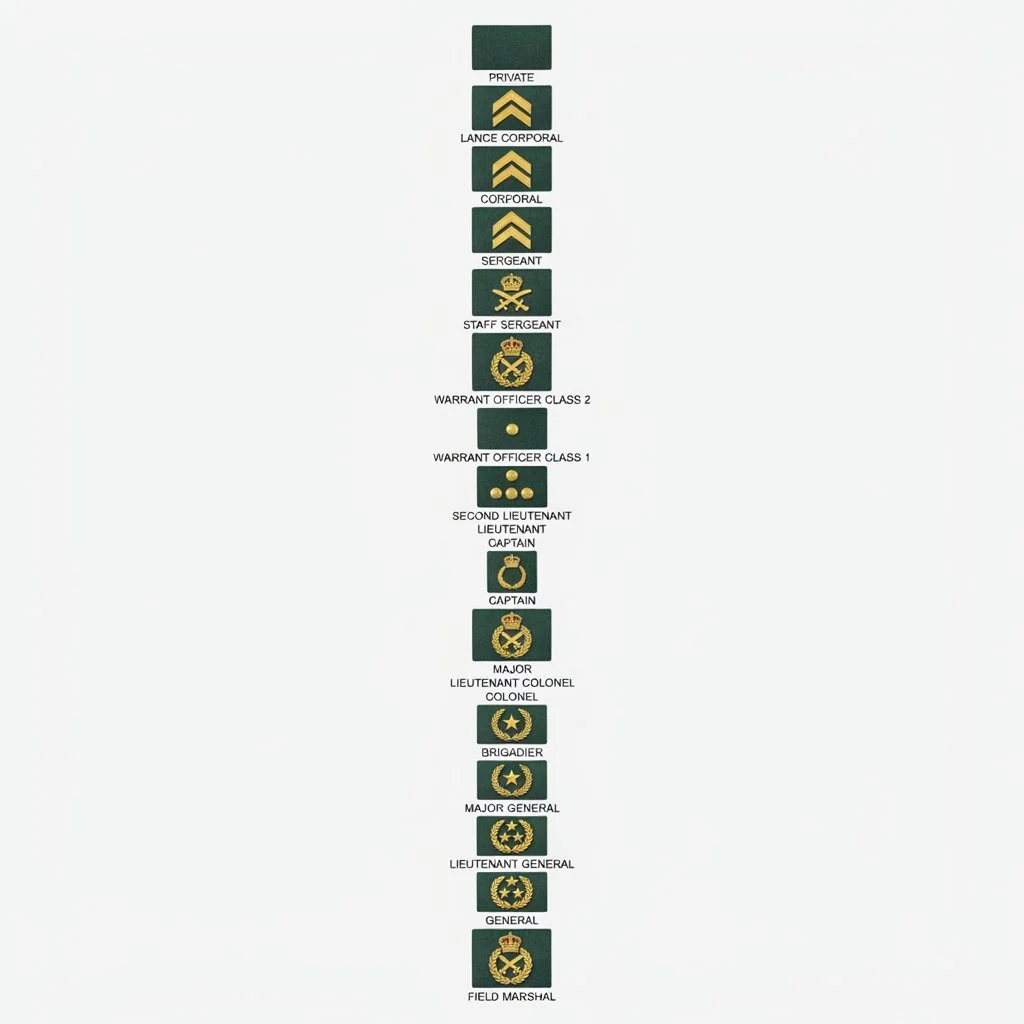
Explore the structure of British Military Ranks and insignia here. United Kingdom Armed Forces are counted among the most disciplined and professional military forces in the world. The rank structure and Insignia of the UK Army are provided here in Detail with high-res images, which show the rank insignia of the UK Defence Forces. All Ranks are in sequence from lowest to highest military rank. After reading this complete article, your interest in knowing about the Defence Forces of the United Kingdom will increase further.
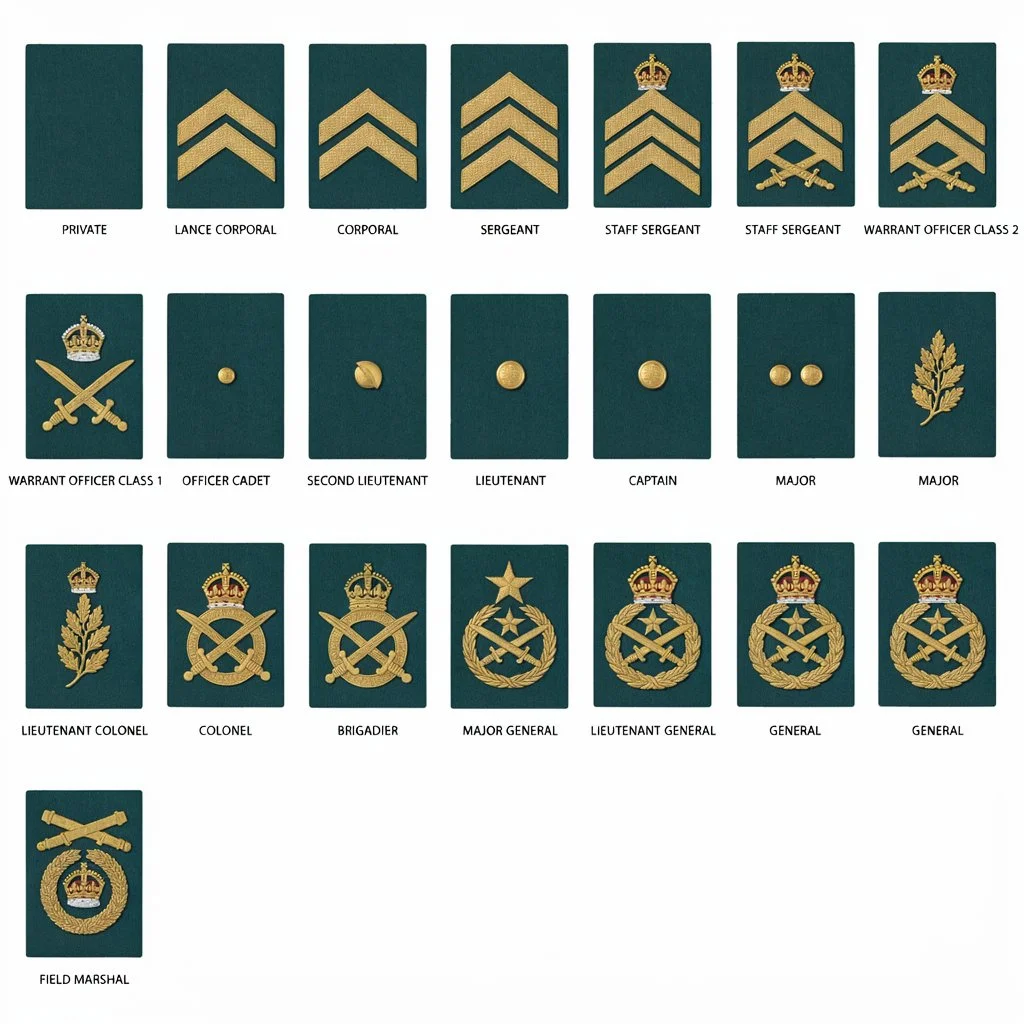
British Military Rank Structure
List of the British Military Ranks
- Private
- Lance Corporal
- Corporal
- Sergeant
- Staff Sergeant
- Warrant Officer Class 2
- Warrant Officer Class 1
- Officer Cadet
- Second Lieutenant
- Lieutenant
- Captain
- Major
- Lieutenant Colonel
- Colonel
- Brigadier
- Major General
- Lieutenant General
- General
- Field Marshal
Rank Insignia No 1 of British Military
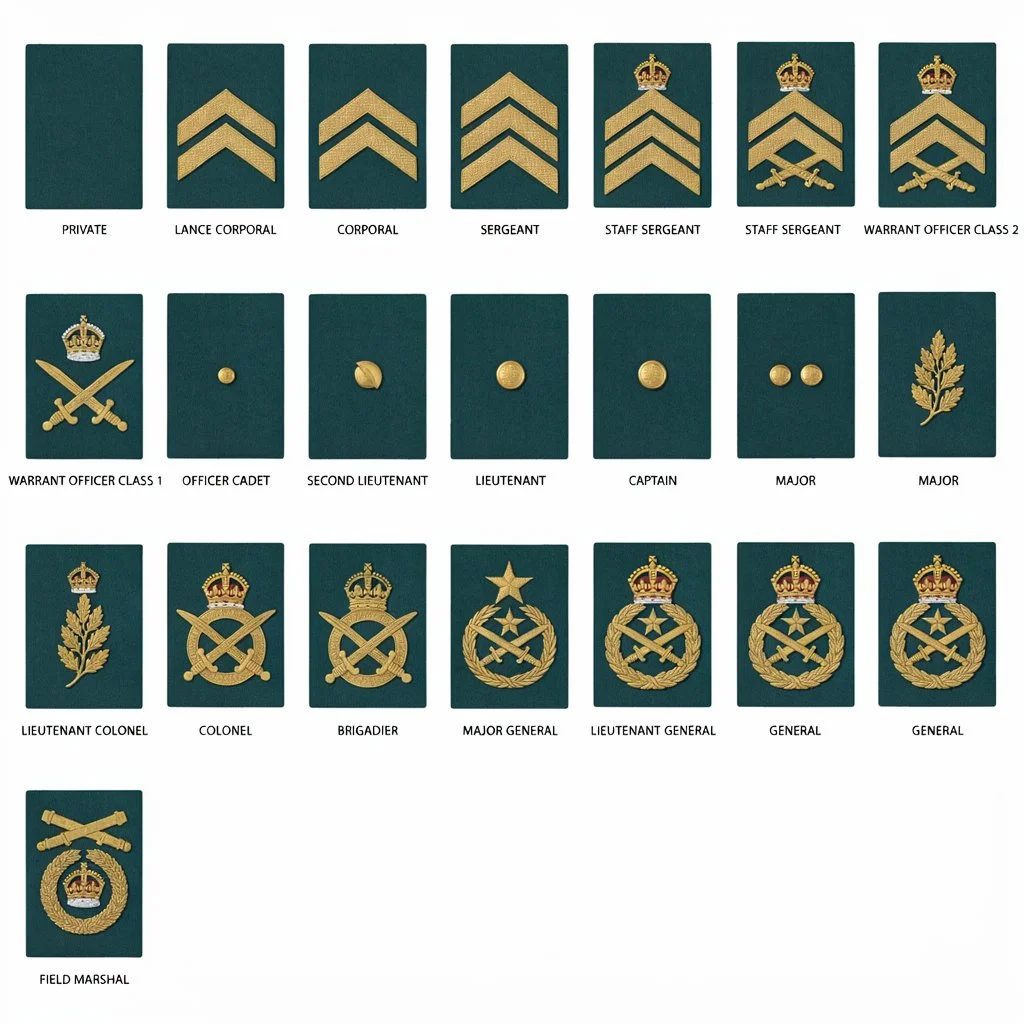
Role and Duties of the British Military Ranks
Private
Private. Private is the starting rank for soldiers in the British Army. It is the lowest enlisted rank and sits at the bottom of the rank structure. Privates wear no rank badges, which makes them easy to spot. While the standard name is private, many regiments and core use their own special titles, some of which have been around for hundreds of years. For example, infantry soldiers may be called fuseliers, riflemen, or guardsmen depending on their regiment. These names may sound different, but they all mean the same thing, lance corporal.
Lance Corporal
Lance Corporal. The next step above private is lance corporal. This is the lowest non-commissioned officer rank, meaning the soldier is beginning to take on leadership duties. A lance corporal often helps lead a section of soldiers, especially during operations, and is normally in charge of one fire team. In specialist roles like drivers, clerks, machine gunners, or signalers, lance corporals take responsibility for their small teams. In the Royal Artillery, the equivalent rank is called Lance Bombardier.
Originally, Lance Corporal wasn't a permanent rank. It was just an appointment that could be removed at any time. In 1961, it was officially made a full rank. The title itself has been in use for over 200 years. During the Napoleonic Wars, a similar role was called chosen man. In some modern corps, such as the intelligence corps or royal military police, all soldiers are promoted to lance corporal after finishing training.
Corporal
Corporal. Corporal is the next step up above lance corporal and below sergeant. A corporal is an important junior leader. In infantry units, they command a section of soldiers with a lance corporal as their second in command. If the section splits into fire teams, one is led by the corporal and the other by the lance corporal. In the armored corps, a corporal typically commands a tank. Corporals carry major responsibility and because of this they are often called the backbone of the army. Some regiments use different traditions. In the Royal Artillery, corporals are called bombarders while in the foots and honorable artillery company every corporal is appointed as a lance sergeant and wear three stripes instead of two. In the household cavalry, there is no rank of corporal at all and different titles are used. A common nickname for a corporal is full screw, while lance corporals are often called lance jacks.
Sergeant
Sergeant. Sergeant is a non-commissioned officer rank. A sergeant is usually the platoon sergeant acting as the second in command of a platoon and supporting the platoon commander. In addition to this role, sergeants often serve in specialist positions depending on their unit.
Staff Sergeant
Much like the tradition in foot guards and honorable artillery company where corporals may be promoted to lance sergeant, the same idea exists in the household cavalry under the title lance corporal of horse staff sergeant. Staff sergeant is a senior non-commissioned rank. In infantry regiments, the same rank is called color sergeant while in the household cavalry it is called staff corporal. A staff sergeant often holds additional appointments such as company quartermaster sergeant which puts them in charge of supplies and logistics for a company. In some cavalry regiments they may also be called sergeant major as a traditional form of address although this is not their official rank. One important note is that staff sergeants are never addressed simply as sergeant as this would be seen as lowering their status. Instead, they are addressed as staff sergeant, staff, or by their appointment, for example, staff Jones or Q Smith. This rank is often a stepping stone for soldiers moving toward the highest non-commissioned ranks, and it represents long service and high responsibility within the army.
Warrant officers
Warrant officers. The two highest non-commissioned ranks in the British Army are warrant officer class 2 and warrant officer class one. Warrant officer class one is senior. Both sit above staff sergeant or color sergeant and are essential for leadership, discipline and administration. Warrant officer class 2s usually hold posts like company sergeant major, squadron sergeant major, battery sergeant major, drill sergeant or quartermaster roles. Warrant officer class ones hold the most important appointments in the army such as regimental sergeant major, academy sergeant major, garrison sergeant major, and the army sergeant major. The highest appointment for a non-commissioned soldier. While customs vary between regiments, warrant officers are the trusted link between officers and soldiers, making sure standards are kept and the army runs smoothly.
Officer cadet
Officer cadet. Officer cadet is the title given to people in the British Army who are training to become officers. This training happens either at the Royal Military Academy Sandhurst or through the University Officers Training Corps. It is the very first step on the ladder for future officers and the rank is the lowest they will ever hold. At this stage, officer cadetses don't have official command authority, though some may be given special roles like senior under officer, which gives them a little extra responsibility over their fellow trainees. Even then, their official rank stays officer cadet because they are not yet commissioned officers. They are not saluted and are not called sir or ma'am.
Second left tenant
Second left tenant. Second left tenant is the entry-level officer rank in the British army sitting below left tenant. It officially replaced the short-lived rank of sublieutenant in 1877 though some units like the Royal Artillery and Royal Engineers had already used it. At first second left tenants wore no insignia, but in 1902 the single bath star or PIP was introduced and it remains their badge today. Most officers are commissioned as second lieutenants after completing training at the Royal Military Academy Sandhurst. Promotion usually comes after about one year when they advance to lieutenant. While it is an official rank, officers are not normally addressed as second lieutenant. Instead, they are simply called Mr. or Ms. In some traditional regiments, old names survive. In the foots, the role is still called Enen. And in some cavalry regiments like the Blues and Royals or Queen's Royal Husars, it is known as Cornet.
Lieutenant
Lieutenant. Lieutenant is the next step above second lieutenant and below captain. It is the senior subalton rank and is usually held for up to 3 years. Lieutenants often command a platoon or troop of about 30 soldiers, giving them a vital leadership role in small unit operations. Before 1871, the Royal Artillery, Royal Engineers, and Fuseliers used the ranks first left tenant and second lieutenant until the entire British army adopted the single rank of left tenant. Although it is a formal rank, left tenants are usually not addressed as left tenant followed by their name. Instead, they are simply called Mr. or Ms. by their soldiers, keeping the formality mainly for official writing.
Captain
Captain. Captain is a junior officer ranked above lieutenant and below major. The rank of captain is typically held for 5 to 10 years. Captains normally serve as the second in command of a company which may have up to 120 soldiers and officers. They often support the company commander by handling planning, training, and administration, making the role central to the smooth running of a unit. The rank of captain has existed in the British army since at least the 19th century.
Major
Major. Major is a mid-ranking officer rank sitting above captain and below left tenant colonel. Majors usually command a company squadron or battery. Subunits of about 120 soldiers and several junior officers. In larger formations, a major may also serve as the second in command of a battalion or regiment up to 650 soldiers. Historically, during the Napoleonic Wars, a battalion often had two majors, a senior and a junior, who could each command detachments of troops. After World War II, the rank of major became firmly established as the standard officer rank for leading companies. Today officers normally reach the rank of major after 8 to 10 years of service. It marks the point where officers move from small unit leadership into more complex command and staff roles.
Left tenant colonel
Left tenant colonel. Left tenant colonel is a senior officer rank above major and below colonel. It is the standard rank for the commanding officer of a battalion or regiment, making it one of the most important leadership roles in the army. A left tenant colonel's badge shows a crown above a single bath star, also called a pip. The crown design changes depending on the monarch with the tudtor crown currently in use. Most lieutenant colonels focus on operational command leading several hundred soldiers in complex missions. However, some ceremonial positions also exist. In certain regiments, honorary roles such as regimental lieutenant colonel or deputy regimental lieutenant colonel are appointed. These positions are symbolic and fall below the more senior colonel of the regiment.
Colonel
Colonel. Colonel sits above lieutenant colonel and below brigadier. The role of colonel has deep historical roots. In the 1600s, colonels were often noblemen granted permission by the crown to raise and fund regiments. They were the regiment's namesake, but the day-to-day leadership was usually handled by a lieutenant colonel or major. By the 1700s, colonels were often more symbolic leaders than battlefield commanders. During the Napoleonic Wars, the title colonel of a regiment was frequently honorary, given to senior generals or royalty. This allowed them to control regimental funds and draw income even without serving actively. Later reforms in the 19th century, such as the Cardwell and Childers reforms, professionalized the role. From then on, colonels became full-time officers responsible for senior administration and leadership.
Brigadier
Brigadier. Brigadier ranks above colonel and below major general. The title was originally an appointment, not a permanent rank. Colonels were temporarily made brigaders to command brigades. For many years, the army instead used the rank of brigadier general introduced in the 1600s under James II. That rank lasted until 1921 when it was abolished. For a short period, the army experimented with titles such as colonel commandant and colonel on the staff, but these were unpopular. Finally, in 1928, the army settled on brigadier, which became a full rank in 1947. Today it is considered the highest field officer rank in the British Army.
Major General
Major General. Major General is a two-star rank above Brigadier and below left tenant general. Officers at this level usually command a division, a very large unit made up of several brigades. Major generals often take on highlevel administrative roles such as the commonant of Sandhurst, the army's main officer training academy. In special cases, senior figures in non-combat roles like the chaplain general may be granted the honorary rank of major general. This gives them status and privileges but not the full command responsibilities of the rank.
Lieutenant general
Lieutenant general. Lieutenant general is a senior rank in the British army sitting above major general and just below general. The style of crown in the insignia has changed over time. The St. Edward's crown or the queen's crown was used during Elizabeth II's reign while the Tudtor crown or king's crown has returned under Charles III. In the army, a left tenant general typically commands a battlefield corps, a large group of divisions.
General
General. A general, sometimes called a full general to avoid confusion with lower ranks, is the highest rank an actively serving officer can reach in the British Army today. While the honorary rank of field marshal is technically higher, it is no longer awarded in regular service. Generals hold the most senior appointments such as chief of the general staff and deputy supreme allied commander Europe.
Field marshal
Field marshal. Field marshal is the highest rank in the British Army. First created in 1736, it is a rare and prestigious title. Field marshals are traditionally appointed for life, keeping their rank even after retirement. In the past, it was common for the army's top general to be promoted to field marshal when they stepped down. This practice stopped in 1995, partly to save costs and because the size of the modern army no longer matched the tradition. Since then, only a few honorary field marshals have been appointed, usually members of the royal family or highly distinguished leaders. 143 officers have held the rank, including famous figures like Arthur Welssley, the Duke of Wellington, who became Field Marshall at just 44 before serving as prime minister. Some, like Sir William Robertson, made history by rising all the way from private soldier to field marshal, the only man ever to do so. A handful of field marshals were awarded the Victoria Cross for bravery, the highest award for gallantry. The title has also been given to foreign rulers or allied generals as a sign of friendship. Today, while no longer a routine promotion, Field Marshall remains one of the greatest honors in the British Army.
Rank Insignia No 2 of British Military
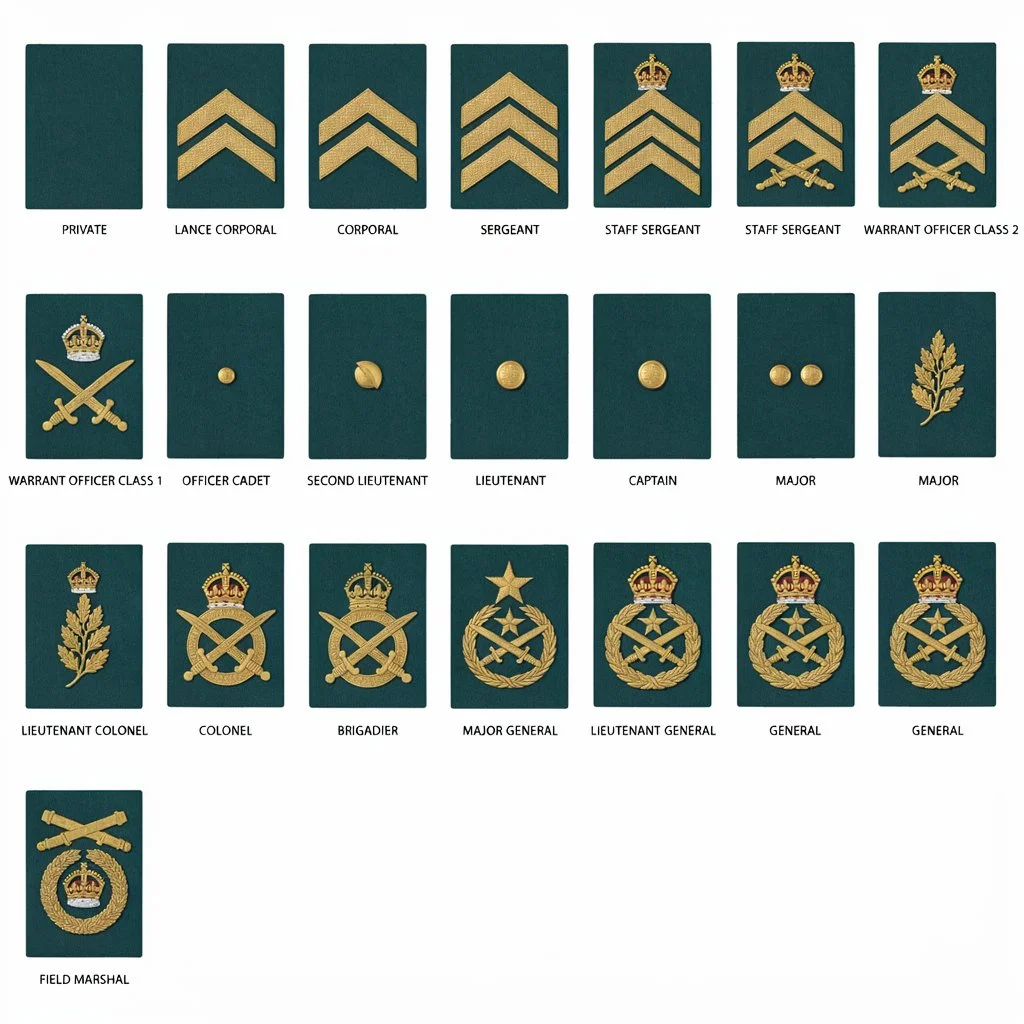
Rank Insignia No 3 of British Military
1 thought on “British Military Ranks & Insignia (from lowest to Highest)”