
Spain runs one of the tidiest rank systems in Europe. The Army, the Navy and the Air and Space Force all climb the same ladder, from Soldado (Private) to Capitán General (Captain General), and the same Spanish titles follow a soldier, sailor or airman from the bottom of the ladder to the top. Only the names change at the edges: admirals at the top of the Navy, a different top title in the Air and Space Force, and sailors instead of soldiers at the bottom. This guide goes through every Spanish military rank in plain language: the Spanish name, the English equivalent, the NATO code, the insignia, and the job that goes with the rank.
The force behind them is the Spanish Armed Forces (Fuerzas Armadas de España), about 120,000 strong across its three services. Spain has been a NATO member since 1982, so the OF and OR codes in the tables below are official NATO grades under the alliance’s standard rank scale, STANAG 2116 — not rough equivalents. The pattern is easy once you see it: gold bars mean a corporal or sergeant, gold stars mean an officer, and the more of either, the higher the rank.
Key facts
- Country: Spain
- Force: Spanish Armed Forces — Army (Ejército de Tierra), Navy (Armada, including the Marine Infantry) and Air and Space Force (Ejército del Aire y del Espacio) share one rank ladder
- Other ranks: OR-1 to OR-9 (Soldado to Suboficial mayor) — 10 titles
- Commissioned officers: OF(D) to OF-10 (officer cadet to Capitán general) — 12 titles including the cadet
- Highest rank: Capitán general (OF-10), held by King Felipe VI as commander-in-chief
- Total ranks: 22 — 10 other ranks and 12 officer ranks including the cadet
- Notable fact: the Air Force was renamed the Air and Space Force in 2022, and conscription ended in 2001 — Spain’s forces are fully professional
From Soldado to Suboficial Mayor: The Other Ranks (OR-1 to OR-9)
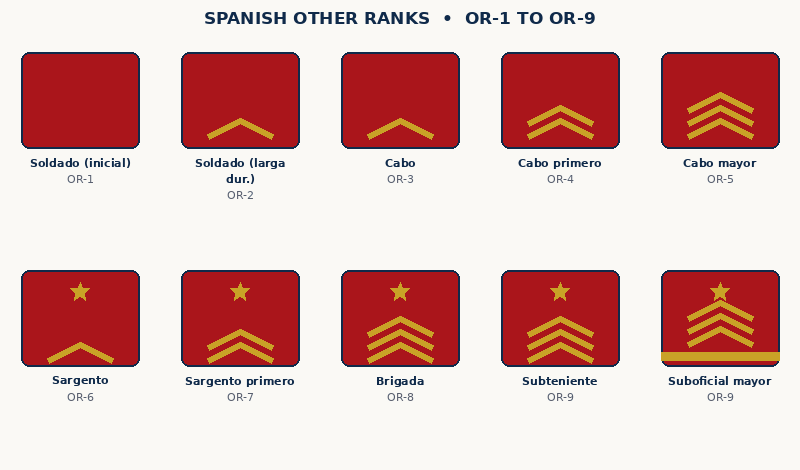
Every Spanish service member starts as a Soldado, and the rank shows it: the shoulder board is plain, with no device at all. There are two Soldado grades, and the difference between them is the length of the commitment, not a mark on the uniform — a Soldado (inicial) is on an initial short commitment, while a Soldado (larga duración) has signed on for longer service, and both wear the same plain board. Older lists call the second grade Soldado de primera, a name the Air and Space Force and the Marine Infantry still use. From there the ladder climbs through the corporals: Cabo, Cabo primero and Cabo mayor, the three steps of the corporal ladder, each one a more experienced soldier leading a bigger team.
The real turning point is Sargento. It is the first career rank in the non-commissioned officer scale — the point where a soldier stops being a trained pair of hands and becomes a professional leader, usually in charge of a squad. Above it sit Sargento primero and Brigada, the senior sergeants who run companies alongside their officers. At the very top are two ranks that share the same NATO grade: Subteniente and Suboficial mayor are both OR-9, the most senior enlisted soldiers in a formation. The Suboficial mayor outranks the Subteniente, and holds the most senior enlisted post in a regiment or larger formation — the person a commanding officer turns to when something has to be done properly.
| Rank (Spanish) | English Equivalent | NATO Code | Insignia | Typical Role |
|---|---|---|---|---|
| Soldado (inicial) | Private (initial commitment) | OR-1 | Plain board, no device | New soldier in basic training |
| Soldado (larga duración) | Private (long-service) | OR-2 | Plain board, same as Soldado (inicial) | Trained soldier on a longer commitment |
| Cabo | Corporal | OR-3 | Gold bars (galones) on a red backing | Team leader |
| Cabo primero | First Corporal | OR-4 | Gold bars (galones) on a red backing | Senior corporal; leads a team |
| Cabo mayor | Corporal Major | OR-5 | Gold bars (galones) on a red backing | Most senior corporal; mentors junior soldiers |
| Sargento | Sergeant | OR-6 | Gold bars with a star device | Squad leader; first career NCO rank |
| Sargento primero | First Sergeant | OR-7 | Gold bars with a star device | Senior squad leader; platoon sergeant |
| Brigada | Brigadier | OR-8 | Gold bars with a star device | Company senior NCO |
| Subteniente | Sub-lieutenant | OR-9 | Gold bars with a star device | Senior NCO of a battalion-level unit |
| Suboficial mayor | Sub-officer Major | OR-9 | Gold bars with a star device | Most senior enlisted soldier of a formation |
Did you know? Two ranks sharing one NATO code is normal in the Spanish system, not a mistake. Subteniente and Suboficial mayor are both graded OR-9, just as both lieutenants are OF-1 — a NATO code shows roughly where a rank sits, not exactly what it is. And the ladder is the same in every service: a Navy Brigada and an Air Force Brigada hold the same grade. Only the bottom two ranks change their names at sea, where a sailor is a Marinero and a first-class sailor a Marinero de primera.
How to Read a Spanish Uniform
Reading a Spanish uniform is a matter of knowing where to look. Rank is worn on the shoulders, the sleeves and the cuffs, and the exact place depends on the uniform: shoulder boards on service dress, sleeve stripes on naval uniforms, and cuff marks on some dress uniforms. The first thing to check is whether the marks are bars or stars. Bars mean an other rank — the angled gold stripes the Spanish call galones — and stars mean an officer. Once you know which family you are looking at, you count.
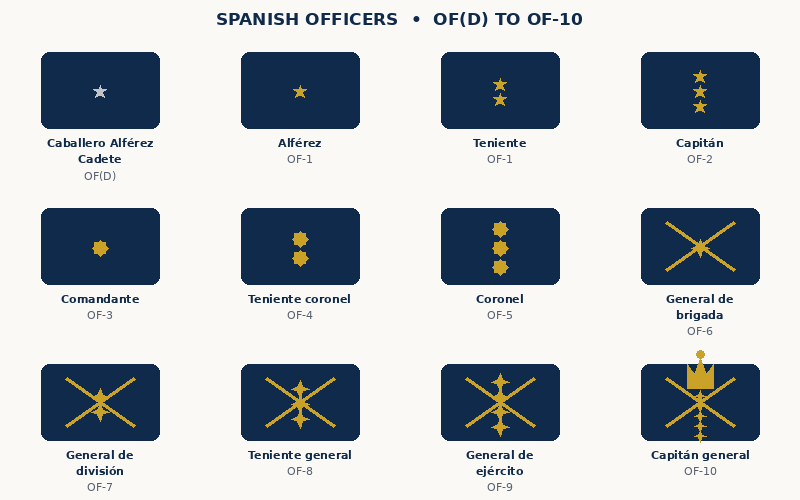
For officers, the count runs in three groups. Junior officers wear small gold stars: one for an Alférez, two for a Teniente, three for a Capitán. Field officers wear larger stars in the same count: one large star for a Comandante, two for a Teniente coronel, three for a Coronel. Generals wear four-pointed stars over a crossed baton and sword: one for a General de brigada, two for a General de división, three for a Teniente general and four for a General de ejército. At the very top, a Capitán general wears five four-pointed stars under the Royal Crown, over two crossed batons — the only rank in the system that carries the crown.
The service is shown by colour and by stripes rather than by rank. On service dress, the backing behind an Army rank is red, a Navy backing is blue, and an Air and Space Force backing is green. Naval officers are the exception to the star rule altogether: their rank is read from gold stripes on the sleeve or shoulder board, in the classic naval style, with more stripes for higher rank. Most uniforms also carry the red-and-yellow flag of Spain on the sleeve, and the branch badge on the collar tells you whether you are looking at infantry, artillery, engineers or one of the other arms.
Officers: From Cadet to Capitán General (OF(D) to OF-10)
The officer ladder starts before the commission. A Caballero Alférez Cadete is an officer cadet still training at a military academy, graded OF(D) because a cadet is not yet a commissioned officer. On graduation the cadet becomes an Alférez, the most junior officer rank, and then a Teniente; both lead platoons. A Capitán commands a company, roughly a hundred soldiers, and is the last of the junior officers. Above them sit the field officers — Comandante, Teniente coronel and Coronel — who run battalions and regiments and hold the staff posts that keep a formation moving.
The top of the ladder has four general ranks: General de brigada, General de división, Teniente general and General de ejército. Above them all sits the Capitán general, a five-star rank held by the King as commander-in-chief. The Navy and the Air and Space Force use the same ladder with their own titles at the top: the Navy’s highest serving rank is Almirante general (OF-9), below the Capitán general, and the Air and Space Force’s is General del Aire (OF-9). The Navy’s junior officers are Alférez de fragata and Alférez de navío, and its captains are Capitán de corbeta, Capitán de fragata and Capitán de navío.
| Rank (Spanish) | English Equivalent | NATO Code | Insignia | Typical Role |
|---|---|---|---|---|
| Caballero Alférez Cadete | Officer Cadet | OF(D) | Cadet shoulder board with a small star | Officer cadet at a military academy |
| Alférez | Second Lieutenant | OF-1 | One small gold star | Platoon leader, newly commissioned |
| Teniente | Lieutenant | OF-1 | Two small gold stars | Platoon leader |
| Capitán | Captain | OF-2 | Three small gold stars | Company commander |
| Comandante | Major | OF-3 | One large gold star | Battalion executive officer or staff officer |
| Teniente coronel | Lieutenant Colonel | OF-4 | Two large gold stars | Battalion commander |
| Coronel | Colonel | OF-5 | Three large gold stars | Regiment or brigade commander |
| General de brigada | Brigadier General | OF-6 | One four-pointed star over crossed baton and sword | Brigade commander; first general officer rank |
| General de división | Major General | OF-7 | Two four-pointed stars over crossed baton and sword | Division commander or senior staff officer |
| Teniente general | Lieutenant General | OF-8 | Three four-pointed stars over crossed baton and sword | Corps commander or deputy chief of staff |
| General de ejército | General of the Army | OF-9 | Four four-pointed stars over crossed baton and sword | Chief of Staff of the Army; highest serving Army rank |
| Capitán general | Captain General | OF-10 | Five four-pointed stars under the Royal Crown, over two crossed batons | King Felipe VI, commander-in-chief; highest rank in Spain |
Key point: Because Spain is a NATO member, the OF and OR codes here are official NATO grades under STANAG 2116 — a Spanish Coronel really is OF-5 in NATO’s own tables, and a Spanish Brigada really is OR-8. Sharing a code is normal: both lieutenants are OF-1, and both top non-commissioned officers are OR-9, because a code shows roughly where a rank sits, not exactly what it is. The same ladder also runs through the Civil Guard, Spain’s gendarmerie, although the Guard is a police force under the interior and defence ministries rather than part of the Armed Forces.
A Ladder With Deep Roots: History of the Spanish Ranks
The Spanish rank ladder is one of the oldest in Europe, and its top rank shows it. Capitán general has been the highest rank in the Spanish Army since the 18th century, when it was created as a personal rank for the monarch and the great commanders of the day — a rank above the generals, in the style of a field marshal. The Army itself traces its traditions back further still, to the tercios of the Habsburg era, and the Marine Infantry, founded in 1537, is the oldest marine corps in the world. The Army also counts an infantry regiment formed in the 13th century among its units, reckoned the oldest still-active military unit in the western world.
The modern shape of the system comes from Spain’s return to democracy and its turn towards the Atlantic alliance. Spain joined NATO in 1982, and its ranks were lined up with the alliance’s standard scale, so that a Spanish officer or sergeant now has a clear equivalent in every allied army. The biggest change to who serves came later: conscription was abolished in 2001, and the Armed Forces became fully professional, recruiting volunteers aged 18 to 26 on contracts of two to three years. The career that followed was set out in law — the military career act of 2007 governs promotion, training and the three categories of service: officers, non-commissioned officers and troops.
The newest change is in the sky. The Air Force was renamed the Air and Space Force in 2022, to take in the space work the branch had picked up, and a space command followed. The ranks did not change with the name — a General del Aire is still OF-9 and a Cabo is still OR-3 — but the branch’s badge and its mission did. It is a reminder of how the Spanish system works: the titles are old, some of them centuries old, and the force around them keeps moving.
Spain’s Armed Forces Today
Today’s Spanish Armed Forces number about 120,000 active personnel: roughly 75,000 in the Army, 25,000 in the Navy including about 5,000 marines, and 20,000 in the Air and Space Force. Alongside them stand the 80,000-strong Civil Guard and the Military Emergencies Unit, the Unidad Militar de Emergencias, which is called out for wildfires, floods and other disasters at home. Women serve in all branches, including combat units, and the forces also recruit foreign nationals resident in Spain from countries of its former empire across Latin America.
Spain’s forces deploy widely for a country of its size. Its air, ground and naval forces take part in European Union, NATO and United Nations missions, from the Balkans to Lebanon and Afghanistan, and Spain hosts one of NATO’s two combined air operations centres, at Torrejón near Madrid. The same rank ladder runs through all of it: the corporal leading a patrol abroad, the sergeant running a company, and the general commanding a division all wear the titles set out in the tables above.
How Promotion Actually Works
Moving up the Spanish ladder takes more than time in grade. Promotion depends on the time served in the current rank, the training courses passed, merit, and an open post to move into — the same mix of seniority and selection used by most professional armies. The first big step is becoming a sergeant: it means leaving the troops’ scale and entering the non-commissioned officer scale, through training at the Basic General Academy of Non-Commissioned Officers, and from that day on you answer for other people, not just yourself.
Officers study for years. A career officer’s route runs through one of the three service academies: the General Military Academy at Zaragoza for the Army, the Naval Military School at Marín for the Navy, and the General Air Academy at San Javier for the Air and Space Force. Cadets hold the rank of Caballero Alférez Cadete while they train and graduate as Alférez. The three-academy route is the one the heir to the throne follows: Princess Leonor spent her first year at Zaragoza, her second at Marín and her third at San Javier, training in each service in turn.
There is also a route up from the ranks. An enlisted soldier who shows leadership can rise through the Cabo grades, and a Cabo mayor who qualifies can go on to non-commissioned officer training and become a Sargento. It is a long road — from Soldado to Suboficial mayor is nine steps — but it is the same road for everyone, in all three services, and the insignia on the shoulder board shows exactly how far along it a person has come.
If you want to compare Spain with its neighbours and allies, our guides to US Army ranks, British military ranks, German Army ranks and Ukrainian military ranks cover the same ground, and the military ranks and insignia overview puts all of them side by side.
Read next
US Army Ranks · Military Ranks and Insignia Overview · British Military Ranks · German Army Ranks · Ukrainian Military Ranks
FAQs
What is the highest rank in the Spanish military?
Capitán general, graded OF-10, held by King Felipe VI as commander-in-chief. It is a five-star rank, and its insignia is five four-pointed stars under the Royal Crown, over two crossed batons. The highest rank a serving officer can actually reach is OF-9 — General de ejército in the Army, Almirante general in the Navy, or General del Aire in the Air and Space Force.
How many ranks are there in Spain’s armed forces?
There are 22 ranks in total: 10 other ranks (Soldado up to Suboficial mayor) and 12 officer ranks, including the cadet Caballero Alférez Cadete. The Army, the Navy and the Air and Space Force all use the same 22 ranks, with different titles only for the admirals and generals at the top and for sailors at the bottom.
What is the difference between Subteniente and Suboficial mayor?
Both are graded OR-9, the top of the other-ranks ladder, but Suboficial mayor is the senior of the two. A Subteniente is the senior non-commissioned officer of a battalion-level unit, while a Suboficial mayor holds the most senior enlisted post in a regiment or larger formation.
Are Spanish ranks the same as NATO ranks?
Yes — Spain is a NATO member, so the OF and OR codes are official NATO grades under the alliance’s standard rank scale, STANAG 2116. A Spanish Coronel is OF-5 and a Spanish Brigada is OR-8 in NATO’s own tables, which is why the codes line up so neatly with other allied armies.
What is a Cabo mayor?
Cabo mayor — Corporal Major — is the top rank of the corporal ladder, graded OR-5. It sits above Cabo primero and below Sargento, and a Cabo mayor is the most experienced corporal in a unit, mentoring junior soldiers and corporals rather than commanding a squad of their own.
Do the Army, Navy and Air Force use the same ranks?
Almost entirely, yes. All three services share the same ladder of titles from Soldado to Coronel, and the same other-ranks ladder from Soldado to Suboficial mayor. The differences are at the top — admirals in the Navy, General del Aire in the Air and Space Force — and at the bottom, where sailors are Marinero and Marinero de primera instead of Soldado.
Every image in this article is an original graphic made for Forces Guide. The charts are simplified stylised diagrams of shoulder boards — not photographs of real insignia.