
If you have ever looked at a Dutch soldier’s sleeve and wondered what the gold chevrons mean, or tried to tell a Sergeant from a Sergeant-majoor, you are in the right place. The Netherlands has one of the oldest standing armies in Europe, yet its rank system is one of the easiest to read once you know the pattern. There are 20 ranks in the Royal Netherlands Army, from Soldaat der 3e klasse (Private, 3rd class) to Generaal (General), and the Royal Netherlands Air and Space Force uses the same ladder. This guide goes through every Dutch military rank in plain language: the Dutch name, the English equivalent, the NATO code, the insignia, and the job that goes with the rank.
The force behind them is the Netherlands Armed Forces (Nederlandse krijgsmacht), with four branches: the Royal Netherlands Army (Koninklijke Landmacht), the Royal Netherlands Navy (Koninklijke Marine), the Royal Netherlands Air and Space Force (Koninklijke Luchtmacht) and the Royal Marechaussee (Koninklijke Marechaussee), the gendarmerie. The Army and the Air Force share one rank ladder. The Navy and the Netherlands Marine Corps use different, naval titles, and the Marechaussee has its own small variations — all explained in this guide, so you can line up any Dutch rank against the army you already know.
Key facts
- Country: Netherlands
- Force: Netherlands Armed Forces — Army, Navy, Air and Space Force and Marechaussee
- Other ranks: OR-1 to OR-9 (Soldaat der 3e klasse to Adjudant-onderofficier) — with no rank at OR-8
- Commissioned officers: OF(D) to OF-9, plus the cadet Vaandrig (Tweede luitenant to Generaal)
- Highest rank: Generaal (OF-9), held by the Chief of Defence
- Total Army and Air Force ranks: 20 — 9 other ranks and 11 officer ranks including the cadet
- Notable fact: the same rank can have a different name depending on the arm — a private is a Huzaar in the cavalry and a Kanonier in the artillery, and a cavalry captain is a Ritmeester
From Soldaat to Adjudant: The Enlisted Ladder (OR-1 to OR-9)
Every Dutch soldier begins as a Soldaat der 3e klasse, and the rank shows it: the sleeve is completely plain, with no device at all. The next two steps up are still privates — Soldaat der 2e klasse and Soldaat der 1e klasse — and both sit at the same NATO grade, OR-2, because the classes mark experience, not a new job. In the cavalry the same three ranks are called Huzaar der 3e, 2e and 1e klasse, and in the artillery Kanonier der 3e, 2e and 1e klasse, but the grades are the same.
The first real step up is Korporaal, the lowest non-commissioned rank, followed by Korporaal der 1e klasse, a senior corporal who has proved themselves in the job. Then come the sergeants, the backbone of any Dutch unit: Sergeant, who leads a squad, and Sergeant der 1e klasse, who often runs a platoon alongside its lieutenant. In the cavalry and artillery these two ranks are called Wachtmeester and Wachtmeester der 1e klasse. Above them sit the two senior NCOs, Sergeant-majoor — Opperwachtmeester in the cavalry and artillery — and, at the very top, the Adjudant-onderofficier, the most senior enlisted soldier in a battalion or brigade. Notice the gap: there is no Dutch rank at OR-8. The system jumps straight from Sergeant-majoor at OR-7 to Adjudant-onderofficier at OR-9, a quirk that catches out almost everyone who first reads a Dutch rank chart.
| Rank (Dutch) | English Equivalent | NATO Code | Insignia | Typical Role |
|---|---|---|---|---|
| Soldaat der 3e klasse | Private, 3rd class | OR-1 | Plain sleeve, no device | New soldier in basic training |
| Soldaat der 2e klasse | Private, 2nd class | OR-2 | One narrow stripe on the sleeve | Trained soldier |
| Soldaat der 1e klasse | Private, 1st class | OR-2 | Two narrow stripes on the sleeve | Experienced private |
| Korporaal | Corporal | OR-3 | One gold chevron on the sleeve | Junior NCO; leads a small team |
| Korporaal der 1e klasse | Corporal, 1st class | OR-4 | One gold chevron with a stripe below | Senior corporal |
| Sergeant | Sergeant | OR-5 | Two gold chevrons on the sleeve | Squad leader |
| Sergeant der 1e klasse | Sergeant, 1st class | OR-6 | Three gold chevrons on the sleeve | Senior squad leader; platoon sergeant |
| Sergeant-majoor | Sergeant Major | OR-7 | Three gold chevrons with a crown above | Company sergeant major |
| Adjudant-onderofficier | Warrant Officer | OR-9 | Crown-and-chevron badge of the senior NCO | Most senior NCO of a battalion or brigade |
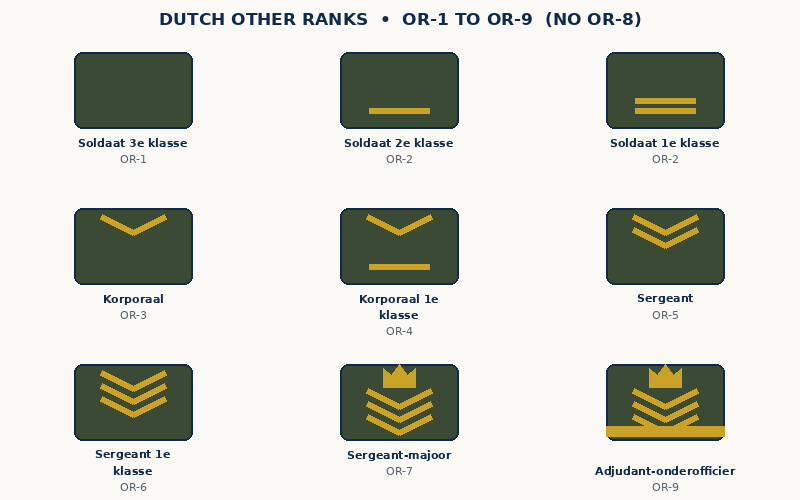
Did you know? A Dutch private can answer to half a dozen different names, and they are all the same rank. Infantry regiments call their privates Grenadier, Jager, Fusilier or Commando, depending on the regiment, and the artillery has Rijder as well as Kanonier. The name tells you which regiment the soldier belongs to, not how senior they are.
How to Read a Dutch Uniform
Reading a Dutch uniform is easier than it looks, because the insignia follow a few simple rules. On the combat uniform the marks sit on the sleeves, with the Dutch flag and the wearer’s regiment on the left arm and the unit insignia on the right. On the dress uniform the same marks appear on dark-green shoulder boards.
The first rule is to count the marks. A soldier’s mark is the stripe, a plain bar, while an NCO’s mark is the chevron, a V-shaped stripe: one stripe for a second-class soldier, two for a first-class soldier, one chevron for a corporal, two for a sergeant and three for a first-class sergeant, with a crown above the chevrons for a senior NCO. The second rule is the colour of the metal: most of the Army wears gold, but in the cavalry and the military administration the marks from Korporaal up to Sergeant-majoor are silver instead. Officers are read by stars: one to three gold stars for a junior officer, the same stars with a gold bar underneath for a field officer, and one to four stars on gold-braided boards for a general. The Navy breaks the pattern: naval officers wear gold rings on their sleeves, and Marine chevrons carry a red border.
Officers: From Vaandrig to Four-Star Generaal (OF(D) to OF-9)
The officer ladder will look familiar if you know any Western army. A Tweede luitenant just out of the academy takes charge of a platoon; an Eerste luitenant does the same with a little more experience; and a Kapitein commands a company, roughly a hundred soldiers. In the cavalry a captain is called a Ritmeester — same rank, different name. Above them sit the field officers — Majoor, Luitenant-kolonel and Kolonel — who run battalions and brigades and hold the staff posts that keep a formation moving.
Below the lieutenants sits the Vaandrig: an officer cadet still in training at the Royal Military Academy. A Vaandrig is graded OF(D) rather than OF-1, because a cadet is not yet a commissioned officer — the single small silver star marks that, and a new second lieutenant’s gold star replaces it at graduation. In the cavalry and the Marechaussee the cadet is called a Kornet. At the very top is the Generaal, a four-star rank held by the Chief of Defence. There is no five-star rank in the Dutch system, so OF-9 is as high as any Dutch officer can go. The Air and Space Force has one difference of its own: its one-star rank is Commodore, not Brigadegeneraal.
| Rank (Dutch) | English Equivalent | NATO Code | Insignia | Typical Role |
|---|---|---|---|---|
| Vaandrig / Kornet | Officer Cadet | OF(D) | One small silver star | Officer cadet at the Royal Military Academy |
| Tweede luitenant | Second Lieutenant | OF-1 | One gold star | Platoon leader, newly commissioned |
| Eerste luitenant | First Lieutenant | OF-1 | Two gold stars | Platoon leader |
| Kapitein / Ritmeester | Captain | OF-2 | Three gold stars | Company commander |
| Majoor | Major | OF-3 | One gold star with a gold bar | Battalion second-in-command or staff officer |
| Luitenant-kolonel | Lieutenant Colonel | OF-4 | Two gold stars with a gold bar | Battalion commander |
| Kolonel | Colonel | OF-5 | Three gold stars with a gold bar | Regiment or brigade staff commander |
| Brigadegeneraal | Brigadier General | OF-6 | One gold star on a gold-braided board | Brigade commander; first general officer rank |
| Generaal-majoor | Major General | OF-7 | Two gold stars on a gold-braided board | Division commander or senior staff officer |
| Luitenant-generaal | Lieutenant General | OF-8 | Three gold stars on a gold-braided board | Corps commander or deputy chief of staff |
| Generaal | General | OF-9 | Four gold stars on a gold-braided board | Chief of Defence; highest rank in the Netherlands |
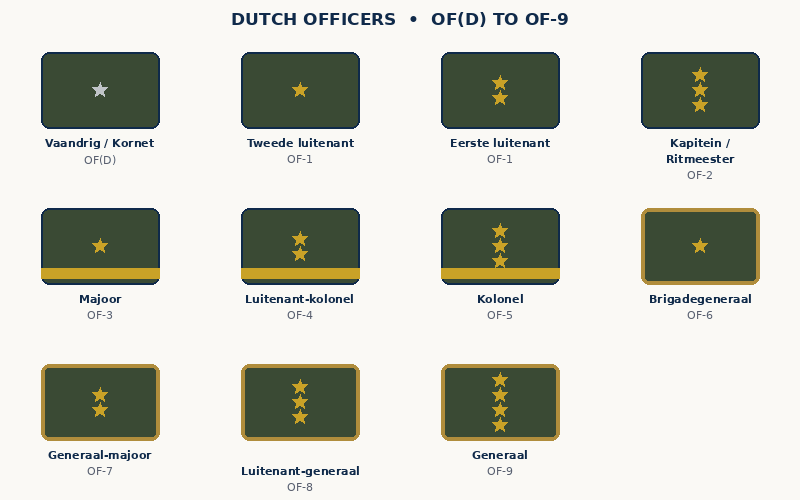
Key point: Sharing a NATO code is normal in the Dutch system, because a code shows roughly where a rank sits, not exactly what it is. Both lieutenants are OF-1, and both classes of first-class soldier are OR-2. The Netherlands is a founding member of NATO, so these are official NATO grades, and a Dutch Kolonel lines up directly against a colonel in any allied army.
The Navy and the Marine Corps Use Different Titles
The Royal Netherlands Navy keeps the old seafaring titles, so its officers sound nothing like their Army counterparts even when they hold the same grade. At the top is the Luitenant-Admiraal (OF-9), followed by Vice-Admiraal (OF-8), Schout-bij-Nacht (OF-7) and Commandeur (OF-6). Below them come Kapitein ter zee (OF-5) and Kapitein-luitenant ter zee (OF-4), and then the three grades of sea lieutenant: Luitenant ter zee der 1ste klasse (OF-3), Luitenant ter zee der 2de klasse oudste categorie (OF-2) and Luitenant ter zee der 2de klasse (OF-1), with Luitenant ter zee der 3de klasse (OF-1) as the most junior officer of all. Naval cadets are Adelborst.
The Navy’s other ranks follow the same shape as the Army’s, with naval names. The top is Adjudant-onderofficier, also called Opperschipper (OR-9), then Sergeant-majoor or Schipper (OR-7) and Sergeant or Bootsman (OR-6). A naval corporal is Korporaal or Kwartiermeester (OR-4) — and in the Navy a corporal counts as an NCO, unlike in the Army. The sailors are Matroos der 1e and der 2e klasse (both OR-2) and Matroos der 3e klasse (OR-1), who wears no insignia at all. The Marine Corps, which serves within the Navy, uses Army-style general ranks — Generaal down to Brigade-generaal — but keeps its own enlisted titles: Marinier der 1e, 2e and 3e klasse, with Korporaal, Sergeant and Sergeant-majoor above them. The Marechaussee tops out at Luitenant-generaal (OF-8), uses the cavalry NCO titles Wachtmeester and Opperwachtmeester, and has four classes of private — Marechaussee der 4e klasse up to der 1e klasse — where the Army has three. Its cadet is a Kornet, the same title the cavalry uses.
A Short History: From 1572 to the Royal Decree of 1956
The Dutch Army is one of the oldest in the world. Its origins go back to 1572, when the Staatse Leger — the Army of the Dutch States — was raised during the struggle against Spanish rule. The Royal Netherlands Army as it exists today was raised on 9 January 1814, after the end of French rule, and it has fought in the Napoleonic Wars, the Second World War, Korea and Afghanistan.
The rank system itself is much younger than the army. The ranks of the Netherlands were established by a royal decree of Queen Juliana in 1956, which fixed the titles and insignia still in use today. The same names — Soldaat, Korporaal, Sergeant, Adjudant, Kapitein, Generaal — have been worn for nearly seventy years. The Netherlands had already helped to found NATO in 1949, so the 1956 ranks were built from the start to line up with allied grades, and they still do.
One change shaped the modern force: in 1996 conscription was suspended and the Dutch military became fully professional, so the rank ladder has had to keep experienced volunteers in uniform and give them a reason to stay. In 2003 the appointments of Stafadjudant-onderofficier were introduced, putting a named senior warrant officer at the side of the Army commander (the Landmachtadjudant), each brigade commander (the Brigadeadjudant) and each battalion commander (the Bataljonsadjudant). These are appointments, not separate ranks: the soldier holding one is still an Adjudant-onderofficier, with a named job at the top of the enlisted ladder.
The Dutch Armed Forces Today
Today the Netherlands Armed Forces number around 44,000 active personnel, with roughly 8,500 reservists behind them, and supreme authority over them rests with the government under the constitution — soldiers swear allegiance to the monarch, but there is no constitutional commander-in-chief. The Chief of Defence, a four-star Generaal or Luitenant-Admiraal, is the country’s most senior officer. The national motto, Je maintiendrai — “I will maintain” — dates back centuries and still appears on the arms of the state the soldiers serve.
The most striking feature of the modern Dutch Army is how closely it works with Germany. Dutch doctrine puts international cooperation first, and the partnership has gone further than any other in Europe: the 11 Airmobile Brigade was integrated into Germany’s Rapid Forces Division, a joint Dutch-German tank battalion was formed, and by March 2023 all three Dutch combat brigades had been fully integrated into German divisions. When ranks line up exactly, two armies can fight as one.
The King, too, has his own link to the ranks: in 2013 the monarch was given special insignia showing the orb, sceptre and sword, marking his connection to the armed forces without indicating any rank.
How Promotion Actually Works
Moving up the Dutch ladder takes more than time in grade. Promotion depends on three things: the required service in the current rank, the right training courses passed, and an open post to move into. The first step that changes a soldier’s life is becoming a corporal: it means leaving the ranks of the privates, taking responsibility for other people, and wearing the first chevron — in the Navy, the step matters even more, because a corporal there is already counted as an NCO.
Officers study for years. A career officer’s route runs through the Royal Military Academy in Breda, where cadets hold the rank of Vaandrig — or Kornet, for cavalry and Marechaussee cadets — and graduate as second lieutenants. Naval officers train at the Royal Naval College in Den Helder, where cadets are Adelborst. The cadet ranks climb year by year: a first-year cadet is a Soldaat der 3e klasse, a second-year cadet is a Korporaal, a third-year cadet is a Korporaal der 1e klasse, a fourth-year cadet is a Sergeant or Wachtmeester, and in the final year the cadet becomes a Vaandrig or Kornet. The route from Sergeant to Sergeant-majoor to Adjudant-onderofficier is how an experienced soldier can reach the top of the enlisted ladder without ever becoming an officer.
One thing that surprises outsiders is how short the Dutch ladder is at the top. There are only four general ranks — Brigadegeneraal, Generaal-majoor, Luitenant-generaal and Generaal — and no five-star rank above them, so the step from colonel to the Chief of Defence is just four promotions. With the missing OR-8, it is one of the most compact ladders in NATO.
If you want to compare the Netherlands with its neighbours and allies, our guides to US Army ranks, British military ranks, German Army ranks and Ukrainian military ranks cover the same ground, and the military ranks and insignia overview puts them side by side.
Read next
US Army Ranks · Military Ranks and Insignia Overview · British Military Ranks · German Army Ranks · Ukrainian Military Ranks
FAQs
What is the highest rank in the Dutch military?
Generaal, graded OF-9, held by the Chief of Defence. It is the top of the whole system: the Netherlands has no five-star rank and no field marshal. In the Navy the equivalent rank is Luitenant-Admiraal, also OF-9.
Why is there no OR-8 rank in the Dutch Army?
The Dutch ladder simply skips it. Sergeant-majoor sits at OR-7 and the next rank, Adjudant-onderofficier, sits at OR-9, so the OR-8 grade is empty in the Army, the Navy and the Air Force alike. It is a quirk of the 1956 rank system, not a mistake in the chart.
What is the difference between a Kapitein and a Ritmeester?
Nothing in grade — both are OF-2, and both command a company. Ritmeester is simply the title used for a captain in the cavalry, a survival from the days of mounted squadrons.
What does the Dutch Navy call a sergeant?
A naval sergeant is a Sergeant, or Bootsman, graded OR-6. Above them are Sergeant-majoor or Schipper (OR-7) and Adjudant-onderofficier or Opperschipper (OR-9).
What is a Vaandrig in the Dutch Army?
A Vaandrig is an officer cadet in the final year at the Royal Military Academy in Breda, graded OF(D). Cadets in the cavalry and the Marechaussee are called Kornet instead. A Vaandrig wears a single small silver star and becomes a Tweede luitenant on graduation.
Are Dutch ranks the same as NATO ranks?
Yes — the Netherlands is a founding member of NATO, so the OF and OR codes in this guide are official NATO grades, not just comparisons. A Dutch Kolonel is a NATO OF-5 in the same way a British colonel or an American colonel is.
Every image in this article is an original graphic made for Forces Guide. The charts are simplified stylised diagrams of sleeve badges and shoulder boards — not photographs of real insignia.