If you have ever looked at a Philippine Army uniform and wondered why a colonel wears suns where an American colonel wears an eagle, you are looking at one of Asia’s most distinctive rank systems. The Philippines runs a ladder of 19 Army ranks, from Private to General, that looks American at first glance: the titles are the same, the chevrons are familiar, the generals wear stars. Look closer, though, and the system tells a Filipino story: field officers wear golden suns borrowed from the generals of the 1896 Revolution, junior officers wear silver triangles, and each badge carries a single old letter in the middle. This guide walks through every Philippine military rank in plain language: name, NATO-style code, badge, and the job that goes with it.
The force behind the ranks is the Armed Forces of the Philippines (AFP): the Philippine Army, the Philippine Navy — which includes the Marine Corps — and the Philippine Air Force. The Army, the Air Force and the Marines share the same officer and enlisted titles; only the Navy uses a separate set of seagoing titles, from Ensign to Admiral. The codes in the tables below are NATO-style equivalents, not official NATO grades, because the Philippines is not a NATO member — they let you match a Filipino rank against the army you already know. The pattern is simple: chevrons mean an enlisted soldier, triangles and suns mean an officer, and stars mean a general.
Key facts
- Country: Philippines
- Force: Armed Forces of the Philippines (AFP) — Army, Navy (including the Marine Corps) and Air Force
- Other ranks: OR-1 to OR-9 (Private to Chief Master Sergeant)
- Commissioned officers: OF-1 to OF-9 (Second Lieutenant to General)
- Highest rank: General (OF-9), held only by the Chief of Staff of the Armed Forces
- Total Army ranks: 19 — 9 other ranks and 10 officer ranks
- Notable fact: field officers wear gold suns and company officers silver triangles, both carrying the baybayin letter “ka” — a link to the Revolution of 1896

From Private to Chief Master Sergeant: The Enlisted Ladder (OR-1 to OR-9)
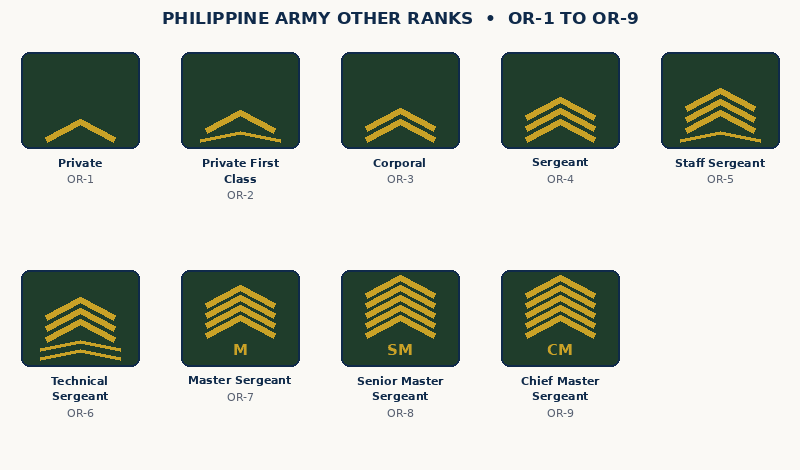
Every Filipino soldier starts as a Private, and the badge shows it: a single chevron on the sleeve. One step up, a Private First Class adds a rocker beneath that chevron, and a Corporal wears two chevrons — the first rank that carries real authority over other soldiers. From Corporal the ladder runs through the sergeants, and the sergeants are the backbone of every Filipino unit: they train new soldiers, run the daily routine, and keep the small teams working.
There are six sergeant grades in the system. Sergeant, Staff Sergeant and Technical Sergeant lead squads and sections, with extra rockers marking each step up. Then come the three senior grades — Master Sergeant, Senior Master Sergeant and Chief Master Sergeant — the most senior enlisted advisers in battalions, brigades and higher headquarters, whose badges carry the letters M, SM and CM in the centre. Above them all sits a single appointment, not a rank: First Chief Master Sergeant, the most senior enlisted post in the force, held by a handful of soldiers at a time.
| Rank | Abbreviation | NATO Code | Insignia | Typical Role |
|---|---|---|---|---|
| Private | PVT | OR-1 | One chevron | New soldier in basic training |
| Private First Class | PFC | OR-2 | One chevron with a rocker beneath | Trained soldier |
| Corporal | CPL | OR-3 | Two chevrons | Team leader |
| Sergeant | SGT | OR-4 | Three chevrons | Squad leader |
| Staff Sergeant | SSGT | OR-5 | Three chevrons with one rocker beneath | Senior squad leader |
| Technical Sergeant | TSGT | OR-6 | Three chevrons with two rockers beneath | Platoon sergeant or section chief |
| Master Sergeant | MSGT | OR-7 | Four chevrons with the letter “M” | Senior enlisted adviser of a company |
| Senior Master Sergeant | SMSGT | OR-8 | Five chevrons with the letters “SM” | Senior enlisted adviser of a battalion |
| Chief Master Sergeant | CMSGT | OR-9 | Five chevrons with the letters “CM” and a laurel wreath | Senior enlisted adviser of a brigade or higher |
Did you know? First Chief Master Sergeant is an appointment, not a tenth enlisted rank — created by a bill filed in the Senate in 2004 to give the most experienced soldiers a career summit without becoming officers. Its holders serve as the sergeants major of the whole armed forces and of each major service — the enlisted voice at the very top of the chain of command. The Navy has its own versions of the post — First Command Master Chief Petty Officer — and the Marines have First Command Sergeant Major.
How to Read a Philippine Uniform
Reading a Filipino uniform is mostly a matter of knowing which shape to look for. On the Army’s camouflage uniform the enlisted badges sit on the sleeves, while officers wear theirs on the collar — small metal pins on a dark green tab. On service dress the same badges move to the shoulder boards. Learn the shapes once and the whole ladder opens up.
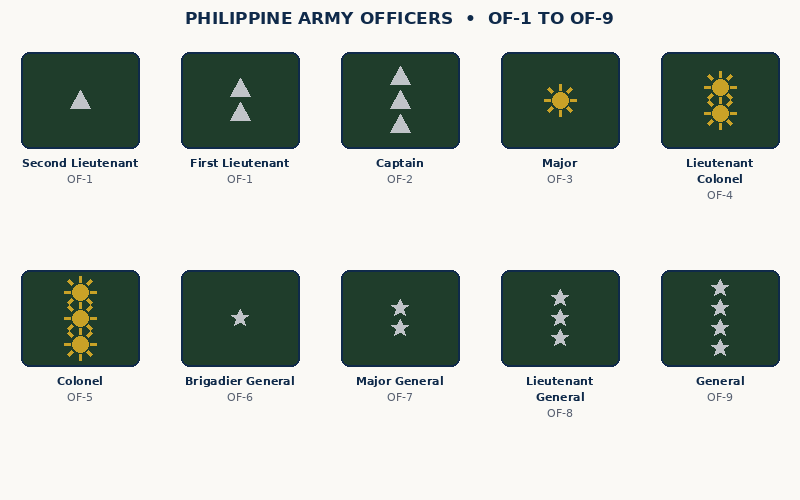
The first rule is to count the chevrons. An enlisted badge is built from V-shaped stripes: one for a Private, two for a Corporal, three for a Sergeant, with rockers — curved bars underneath — marking the steps above that. The senior grades add a letter in the middle of the badge: M for Master Sergeant, SM for Senior Master Sergeant and CM for Chief Master Sergeant, sometimes ringed by a laurel wreath at the very top. Officers wear a different family of shapes: silver triangles for the company grades, gold suns for the field grades, silver stars for the generals.
The second rule is to look at the middle of the badge. Both the suns and the triangles carry the baybayin letter ka — the old Filipino script’s K — in the centre, a deliberate link to the Katipunan, the revolutionary movement of 1896, which used the same letter on its own emblems. The third rule is the service: the Army and the Air Force share officer titles, the Marines wear the same Army titles, and the Navy is the odd one out, with stripes on the sleeve instead of suns and triangles, and with Petty Officers instead of Sergeants. The Air Force’s enlisted badges are the one exception: they follow the American Air Force pattern, with a diamond roundel in the centre, rather than the Army’s chevrons.
Officers: From Second Lieutenant to Four-Star General (OF-1 to OF-9)
The officer ladder will look familiar if you know the American system, because the titles are the same from Second Lieutenant to General. A Second Lieutenant fresh from the academy takes charge of a platoon; a First Lieutenant does the same with more experience; a Captain commands a company, roughly a hundred soldiers. Above them sit the field officers — Major, Lieutenant Colonel and Colonel — who run battalions and brigades and hold the staff posts that keep a formation moving.
At the top sit the four general ranks. A Brigadier General wears one star and usually commands a brigade; a Major General wears two and commands a division or a major headquarters; a Lieutenant General wears three and commands one of the major services; and a General wears four stars — a rank held only by the Chief of Staff, the single most senior officer in the country. There is no five-star rank in peacetime: the old rank of Field Marshal belongs to history, and the four-star ceiling is one of the things that makes the Filipino ladder easy to read.
| Rank | Abbreviation | NATO Code | Insignia | Typical Role |
|---|---|---|---|---|
| Second Lieutenant | 2LT | OF-1 | One silver triangle | Platoon leader, newly commissioned |
| First Lieutenant | 1LT | OF-1 | Two silver triangles | Platoon leader |
| Captain | CPT | OF-2 | Three silver triangles | Company commander |
| Major | MAJ | OF-3 | One gold sun | Battalion executive officer or staff officer |
| Lieutenant Colonel | LTCOL | OF-4 | Two gold suns | Battalion commander |
| Colonel | COL | OF-5 | Three gold suns | Brigade commander |
| Brigadier General | BGEN | OF-6 | One silver star | Brigade commander; first general officer rank |
| Major General | MAJGEN | OF-7 | Two silver stars | Division commander |
| Lieutenant General | LTGEN | OF-8 | Three silver stars | Service commander |
| General | GEN | OF-9 | Four silver stars | Chief of Staff; highest rank in the force |
Key point: The Philippines is not a NATO member, so the OF and OR codes in these tables are reference equivalents, not official NATO grades. They sit alongside a second numbering system the Filipinos use themselves: the American-style pay grades, in which officers run O-1 to O-10 and enlisted soldiers E-1 to E-9. That is why a Filipino General is OF-9 in NATO terms but O-10 in the armed forces’ own law — the two scales count the same ten officer ranks from different starting points. Sharing a code is normal: both lieutenants are OF-1, because a code shows roughly where a rank sits, not exactly what it is.
From the Revolution to Filipinization: How the System Took Shape
The Filipino rank system is older than the republic it serves. Its first badges were made in the last months of 1896, for the army of the Revolution against Spain, and worn on the sleeve: marks that mixed Spanish military fashion with the symbols of the Katipunan, the secret society that launched the uprising. After independence was declared in 1898, shoulder insignia appeared as well — and a quirk of that early system survives today: in the Revolutionary Army, the silver stars we now connect with generals were worn by field-grade officers, while the generals wore suns. When the modern system was built, the suns stayed with the field officers, which is why a Filipino colonel wears three gold suns instead of an eagle.
For most of the twentieth century the system looked American, because for a long time it was. Under the Commonwealth and in the first years after independence, the Army and the new Air Force wore what were, in effect, United States Army badges, with two Filipino additions: a junior rank called Third Lieutenant and a five-star rank of Field Marshal — a rank held by Douglas MacArthur, who had been appointed to command the Philippine forces in the years before the Second World War. That American period ended in the mid-1950s, when President Ramon Magsaysay, a former Secretary of National Defense, ordered the Filipinization of the armed forces. The badges in use today are a reworking of the system first worn in 1954–55: the American titles stayed, but the devices became Filipino — the suns of the Revolutionary generals, and later the silver triangles for company officers, a newer addition carrying the same baybayin ka.
Two threads run through the whole story. The first is the letter ka itself, on the field officers’ suns and the company officers’ triangles, reaching back to the Katipunan’s emblems and the revolutionary badges of 1896. The second is the habit of borrowing and then making the borrowed thing Filipino: the chevrons, stars and titles all arrived from elsewhere — Spain, then America — and each time they were reshaped until they belonged to the Philippines.
The Modern AFP: Fixed Terms and the Turn to Territorial Defence
The rank titles have barely moved in seventy years, but the rules around the top of the ladder have changed a great deal. A law passed in 2023 set fixed terms for the most senior posts — three years for a General, Lieutenant General or Major General — and capped the time any officer may spend in each senior grade, so the top of the force keeps turning over. The same law set the retirement rule for officers up to Lieutenant General: age fifty-seven, or thirty years of service, whichever comes later — so senior leadership changes on a timetable, not on a whim.
The force itself is changing shape at the same time. The AFP’s modernization programme, now in its third horizon, has shifted the emphasis from internal security — the counter-insurgency campaigns of most of the last fifty years — toward territorial defence: protecting the country’s seas and skies, and building the ships, aircraft and radar to do it. The ranks have not changed with that shift: a soldier’s chevrons mean the same thing on a patrol boat as they did on a jungle patrol, even as the missions change. The four-star ceiling has held too — the Chief of Staff remains the only General in the force, and Lieutenant General belongs to the commanders of the Army, the Navy and the Air Force.
How Promotion Actually Works
Moving up the Filipino ladder takes more than time in grade. Each enlisted step needs the required service in the current rank, the right training courses passed, and an open post to move into — plus a merit board weighing the record against the other soldiers competing for the same vacancy. The first step that changes a soldier’s life is becoming a Corporal: it means taking charge of other people for the first time, and from that day on the soldier answers for a team, not just for themselves.
Officers start in one of three ways. Most career officers come through the Philippine Military Academy in Baguio, where cadets train for four years and graduate as Second Lieutenants — or Ensigns, in the Navy. Others join through the Officer Candidate Course, which turns graduates and serving enlisted soldiers into officers in about a year, or through the reserve officers’ training programme at civilian universities. Once commissioned, an officer climbs by the same mix of time, courses and vacancies — and the last steps, to the general ranks, are made by the President, on the armed forces’ recommendation.
One thing that surprises outsiders is how much the senior enlisted ranks matter in the Filipino system. The senior enlisted advisers sit beside their commanders at every level, from battalion to general headquarters, and the First Chief Master Sergeant speaks for the enlisted force as a whole. It gives a soldier who never becomes an officer a career that can still reach the very top of the force — exactly what the rank’s creators had in mind.
To compare the Philippines with the armies it borrowed from and the neighbours it serves beside, our guides to US Army ranks, British military ranks, German Army ranks and Ukrainian military ranks cover the same ground, and the military ranks and insignia overview puts them side by side.
Read next
US Army Ranks · British Military Ranks · German Army Ranks · Ukrainian Military Ranks · Military Ranks and Insignia Overview
FAQs
What is the highest rank in the Philippine Army?
General, graded OF-9, held only by the Chief of Staff of the Armed Forces. It is the top of the whole system: the Philippines has no five-star rank in peacetime and no field marshal — the four-star rank is the ceiling, and only one officer holds it at a time.
How many ranks are there in the Philippine Army?
There are 19 ranks in total: 9 other ranks, from Private to Chief Master Sergeant, and 10 officer ranks, from Second Lieutenant to General. The Air Force and the Marine Corps use the same 19 titles; only the Navy uses a separate, seagoing set — and First Chief Master Sergeant is an appointment on top of the ladder, not a twentieth rank.
What is a First Chief Master Sergeant?
The most senior enlisted appointment in the Armed Forces of the Philippines, graded OR-9, created by a bill filed in the Senate in 2004. Its holders serve as the sergeants major of the whole armed forces and of each major service — the enlisted voice at the very top. The Navy’s equivalent post is First Command Master Chief Petty Officer, and the Marines’ is First Command Sergeant Major.
Why do Philippine officers wear suns and triangles?
The gold suns worn by field officers — Major, Lieutenant Colonel and Colonel — come from the generals of the Revolutionary Army of 1896, whose badges were suns. The silver triangles worn by company officers — Second Lieutenant, First Lieutenant and Captain — are a newer addition to the same idea. Both carry the baybayin letter ka in the middle, a link to the Katipunan movement.
Are Philippine ranks the same as NATO ranks?
No — the codes are reference equivalents only. The Philippines is not a NATO member, so the OF and OR codes are published comparisons, not official NATO grades. The armed forces also use American-style pay grades, O-1 to O-10 for officers and E-1 to E-9 for enlisted soldiers — which is why a General is OF-9 in NATO terms but O-10 in Filipino law.
What ranks does the Philippine Navy use?
The Navy uses seagoing titles: Ensign, Lieutenant Junior Grade, Lieutenant, Lieutenant Commander, Commander, Captain, Commodore, Rear Admiral, Vice Admiral and Admiral for officers, and Apprentice Seaman up to Master Chief Petty Officer for enlisted sailors. Commodore, the one-star rank, is the equivalent of a Brigadier General in the Army, and the Navy’s senior enlisted post is First Command Master Chief Petty Officer.
Every image in this article is an original graphic made for Forces Guide. The charts are simplified stylised diagrams of sleeve and collar badges — not photographs of real insignia.