North Korea’s army is the hardest in the world to read at a glance. Its soldiers rarely appear in close-up outside tightly controlled parades, no official rank manual is published for outsiders, and the grades themselves mix an old Soviet pattern with a layer of marshal ranks that no other army has. This guide works through all 24 army ranks of the Korean People’s Army (KPA), from Chonsa (Private) to Tae wonsu (Grand Marshal), in plain language: the Korean name, the nearest English equivalent, a reference NATO-style code, the insignia, and the job that goes with the rank. Where published sources disagree — and on this army they disagree a lot — this guide says so in the text itself, instead of picking one version and pretending it is settled.
The force behind the ranks is the Korean People’s Army, the combined armed forces of North Korea and the armed wing of the ruling Workers’ Party of Korea. It has five branches — the Ground Force, the Naval Force, the Air Force, the Strategic Force and the Special Operations Forces — and the Ground Force is by far the largest. The Navy and the Air Force use the same rank titles as the army; only the insignia colours and, for naval officers, the sleeve stripes differ. The codes in the tables below are reference equivalents only, because North Korea is not a NATO member, and two published rank lists can put the same North Korean grade a whole code apart.
Key facts
- Country: North Korea (Democratic People’s Republic of Korea)
- Force: Korean People’s Army (KPA) — Ground Force, Naval Force, Air Force, Strategic Force and Special Operations Forces
- Other ranks: OR-1 to OR-8 (Chonsa to T’ukmu-sangsa) — some published lists grade the top other rank OR-9 instead; see the note in the enlisted table
- Commissioned officers: OF-1 to OF-10 (Sowi to Tae wonsu), including four marshal grades at the top
- Highest rank: Tae wonsu (Grand Marshal), an honorary rank held only by the Kim family leaders
- Total army ranks: 24 — 8 other ranks and 16 officer ranks
- Notable fact: the KPA has no warrant officer rank, and its marshal ranks are political honours handed to leaders and loyal senior figures
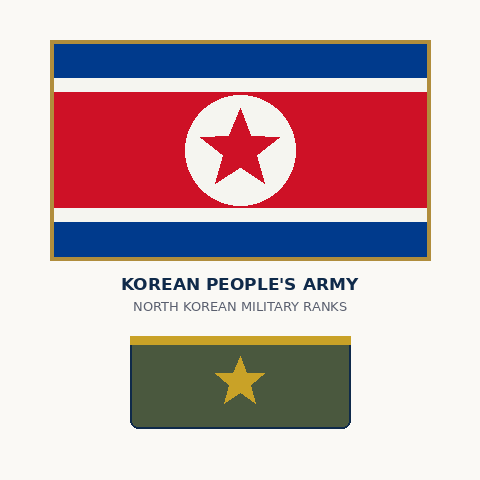
From Chonsa to Special Sergeant: The Enlisted Ladder (OR-1 to OR-8)
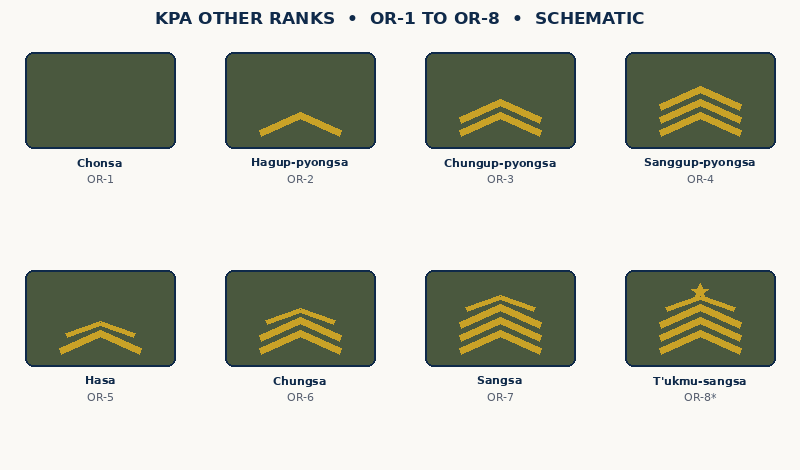
Every North Korean soldier begins as a Chonsa, a private whose sleeve carries no device at all. Above that sit three grades of pyongsa — soldier — that mark time served rather than a new job: Hagup-pyongsa (Junior Soldier), Chungup-pyongsa (Middle Soldier) and Sanggup-pyongsa (Senior Soldier). These are the ranks most of the army’s roughly 1.3 million active personnel hold, because North Korea conscripts its young men at 18 for long service — about ten years by outside accounts — and most conscripts climb no higher than the pyongsa grades before they leave.
The sergeants are where leadership starts. Hasa (Junior Sergeant), Chungsa (Sergeant) and Sangsa (Senior Sergeant) lead squads and sections, the way sergeants do in most armies. At the very top of the other ranks sits T’ukmu-sangsa, usually translated as Sergeant Major — but that translation is disputed, and so is the grade. Some lists translate it as Warrant Officer and grade it OR-9; this guide uses OR-8. The KPA has no warrant officer rank, so the “Warrant Officer” label is best treated as an old English name for the top sergeant, not a separate grade.
| Rank (Korean) | English Equivalent | NATO Code | Insignia | Typical Role |
|---|---|---|---|---|
| Chonsa (전사) | Private | OR-1 | Plain sleeve, no device | New soldier |
| Hagup-pyongsa (하급병사) | Junior Private | OR-2 | One chevron (schematic) | Junior soldier |
| Chungup-pyongsa (중급병사) | Private First Class | OR-3 | Two chevrons (schematic) | Soldier with some service |
| Sanggup-pyongsa (상급병사) | Corporal | OR-4 | Three chevrons (schematic) | Senior soldier |
| Hasa (하사) | Sergeant | OR-5 | Chevron with arc below (schematic) | Squad leader |
| Chungsa (중사) | Staff Sergeant | OR-6 | Two chevrons with arc below (schematic) | Senior squad leader |
| Sangsa (상사) | Master Sergeant | OR-7 | Three chevrons with arc below (schematic) | Platoon sergeant |
| T’ukmu-sangsa (특무상사) | Sergeant Major | OR-8* | Chevrons with arc and small star (schematic) | Most senior other rank; *some lists grade OR-9 |
Did you know? South Korea’s armed forces have a single warrant officer rank, Junwi, sitting between the sergeants and the lieutenants. North Korea has no equivalent at all — the KPA ladder jumps straight from its top sergeant, T’ukmu-sangsa, to its lowest lieutenant, Sowi. That gap is one of the clearest signs of how different the two Korean systems are, even though most of their rank names are the same: the South’s ladder is American-inspired, while the North’s follows the old Soviet pattern.
How to Read a North Korean Uniform
Reading a North Korean uniform comes down to two places: the shoulder boards for officers and the sleeves for soldiers and sergeants. Officers wear their rank on shoulder boards; other ranks wear theirs as chevrons on the sleeve. That split is itself a Soviet habit, carried over from the advisers who helped build the KPA after the Second World War. Naval officers also wear sleeve stripes on their service dress, alongside the shoulder boards.
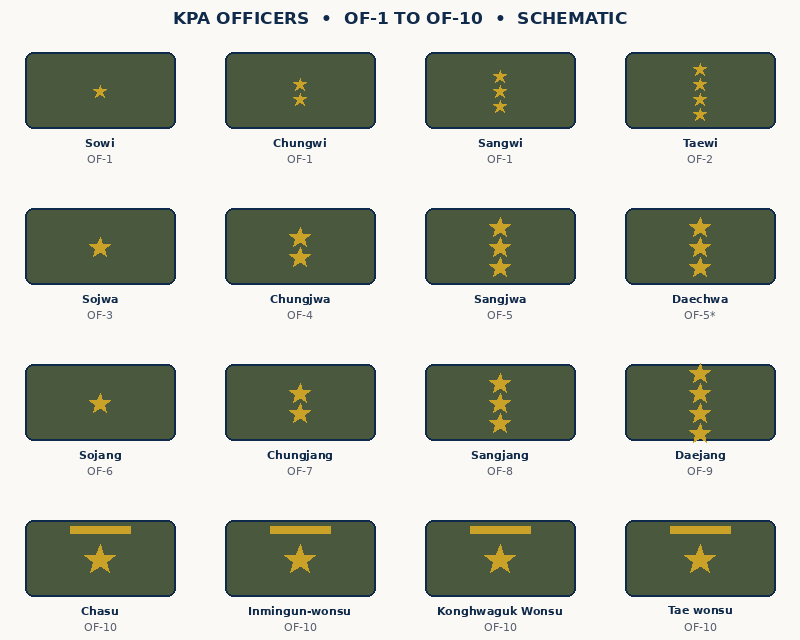
The first rule is to count the stars. North Korean officers wear large five-pointed gold stars, in the Soviet style: junior officers carry small stars — one for a junior lieutenant, two for a lieutenant, three for a senior lieutenant and four for a captain — while senior officers and generals carry large stars, one to three for a major to a colonel and one to four for a major general to a general of the army. A marshal carries a single very large star. These counts follow the Soviet pattern as shown in published rank drawings, but no official KPA source confirms them grade by grade, so treat every star count in this guide as schematic, not photographed fact.
The second rule is that colour schemes change but the design does not. Published rank tables show the army’s field-uniform shoulder boards, while parade uniforms and the other branches use alternative colour schemes with the same basic design.
Officers: From Junior Lieutenant to Grand Marshal (OF-1 to OF-10)
The officer ladder will look familiar if you know any Soviet-style army: three lieutenants, a captain, four grades of field officer, four generals — and then, where most armies stop, a whole extra tier of marshals. A Sowi (Junior Lieutenant) fresh from training takes charge of a platoon; a Chungwi (Lieutenant) and a Sangwi (Senior Lieutenant) do the same work with more experience; and a Taewi (Captain) commands a company. Above them sit the field officers — Sojwa (Major), Chungjwa (Lieutenant Colonel), Sangjwa (Colonel) and Daechwa (Senior Colonel) — who run battalions and regiments. Daechwa is the awkward grade in the ladder: a senior colonel with no direct equivalent in a Western army, graded OF-5, OF-6 or OF-7 by different published lists. This guide uses OF-5, alongside Sangjwa, and marks the grade with an asterisk.
The generals are Sojang (Major General), Chungjang (Lieutenant General), Sangjang (Colonel General) and Daejang (General of the Army), and Daejang is the highest rank a career officer can normally reach. Above Daejang sit the marshals: Chasu (Vice Marshal), Inmingun-wonsu (Marshal of the Korean People’s Army), Konghwaguk Wonsu (Marshal of the Republic) and Tae wonsu (Grand Marshal). These are not working ranks but honours for the country’s leaders and a small circle of loyal senior figures, announced in state media as political events. Kim Jong Un was made Marshal of the Republic in July 2012, months after taking power; Tae wonsu has belonged only to Kim Il Sung, and to Kim Jong Il after his death.
| Rank (Korean) | English Equivalent | NATO Code | Insignia | Typical Role |
|---|---|---|---|---|
| Sowi (소위) | Junior Lieutenant | OF-1 | One small gold star (schematic) | Platoon leader, newly commissioned |
| Chungwi (중위) | Lieutenant | OF-1 | Two small gold stars (schematic) | Platoon leader |
| Sangwi (상위) | Senior Lieutenant | OF-1 | Three small gold stars (schematic) | Platoon leader or company second-in-command |
| Taewi (대위) | Captain | OF-2 | Four small gold stars (schematic) | Company commander |
| Sojwa (소좌) | Major | OF-3 | One large gold star (schematic) | Battalion executive officer or staff officer |
| Chungjwa (중좌) | Lieutenant Colonel | OF-4 | Two large gold stars (schematic) | Battalion commander |
| Sangjwa (상좌) | Colonel | OF-5 | Three large gold stars (schematic) | Regiment or brigade commander |
| Daechwa (대좌) | Senior Colonel | OF-5* | Large stars — published drawings differ; exact device not verified | Senior regimental commander; *some lists grade OF-6 or OF-7 |
| Sojang (소장) | Major General | OF-6 | One large gold star (schematic) | Division commander or senior staff officer |
| Chungjang (중장) | Lieutenant General | OF-7 | Two large gold stars (schematic) | Corps commander or deputy chief of staff |
| Sangjang (상장) | Colonel General | OF-8 | Three large gold stars (schematic) | Senior formation commander |
| Daejang (대장) | General of the Army | OF-9 | Four large gold stars (schematic) | Chief of the General Staff or minister-level commander |
| Chasu (차수) | Vice Marshal | OF-10 | One very large star with crest (schematic) | Marshal grade for senior loyal figures |
| Inmingun-wonsu (인민군원수) | Marshal of the KPA | OF-10 | One very large star with crest (schematic) | Marshal grade; held by senior leaders |
| Konghwaguk Wonsu (공화국원수) | Marshal of the Republic | OF-10 | One very large star with crest (schematic) | Marshal grade reserved for the Supreme Leader |
| Tae wonsu (대원수) | Grand Marshal | OF-10 | One very large star with added crest (schematic) | Honorary supreme rank; Kim family leaders only |
Key point: Because North Korea is not a NATO member, the OF and OR codes in this guide are reference equivalents, not official NATO grades — and on this army the references themselves disagree. One published list grades T’ukmu-sangsa OR-8 and Daechwa OF-5; another grades them OR-9 and OF-7. This guide uses the lower numbering throughout and flags the alternative wherever it matters.
A Soviet Pattern, Frozen in Place: How the System Grew
The Korean People’s Army was formally created on 8 February 1948, seven months before the state itself was proclaimed — although Pyongyang claims a guerrilla origin dated 25 April 1932, a claim outside historians do not accept. The new force was built under Soviet occupation, with Soviet advisers, Soviet weapons and Soviet manuals, and its ranks followed the Soviet pattern from the start: stars for officers and chevrons for soldiers. The rank titles in use today were formally set by a decision of the Supreme People’s Assembly on 31 December 1952, during the Korean War.
The marshal tier came later, and it came as politics, not as reform. The rank of Chasu (Vice Marshal) was first conferred in February 1953, just before the armistice. Then, in 1992, the top of the ladder was rebuilt in a single burst: Kim Jong Il was made Marshal, his father Kim Il Sung became Grand Marshal, and eight generals were promoted to Vice Marshal at the same time. Kim Il Sung died two years later, and Kim Jong Il was made Grand Marshal after his death in turn. The pattern repeated a generation later: Kim Jong Un was made a four-star general in September 2010 as heir apparent, then Marshal of the Republic in July 2012, and in April 2016 two more serving officers, Kim Yong-chun and Hyon Chol-hae, were promoted to Marshal of the KPA — the first such promotions of active officers in more than twenty years.
What has not happened is just as telling. No published overhaul of the KPA rank system has been reported since — no new grades added, no grades abolished, no NATO-style rebuild of the kind Ukraine carried out in 2020. The ladder in use today is essentially the one set in the 1950s, with the marshal tier added at the top in 1992. That frozen quality is the point: in an army where the same family has ruled for three generations, the ranks are part of the regime’s furniture.
The KPA Today: A Closed System
Today the KPA is one of the largest standing forces in the world, with about 1.32 million active personnel plus large reserves. The Ground Force holds the bulk of that strength, facing South Korea and the US forces in Korea across the Demilitarised Zone under an armistice that has held since July 1953. Alongside it sit the Naval Force and the Air Force, the Strategic Force that controls the missile arm, and the Special Operations Forces, which include the amphibious units that stand in for the marine corps North Korea does not have.
The ranks are still learned the hard way: from parade photographs, defector accounts and published rank tables, because North Korea publishes no rank manual for outsiders. The Ground Force’s flag and emblem were redesigned in 2023, and the new emblem appears on the rank tables published since then. State media reported in July 2022 that Kim Jong Un appeared wearing the Grand Marshal’s insignia, a claim outside observers could not independently confirm — and that uncertainty is typical of the whole subject. Every detail in this guide that carries the word “schematic” is a detail no outsider has been able to verify against an official source.
How Promotion Actually Works — and What Is Not Published
Here this guide has to be honest about a gap: no published promotion timetable for the KPA exists. No outside source gives time-in-grade rules, course requirements or selection boards for North Korean ranks, and this article will not invent them. What outside accounts do agree on is the broad shape: enlisted grades rise mainly with time in service, and officers rise through the military academies and through command and staff posts.
At the top, promotion is political and it is public. Marshal and vice-marshal promotions are announced in state media as decisions of the party and the state, and they reward loyalty and standing as much as command — eight generals became vice marshals in a single day in 1992, and Kim Jong Un’s own rise from four-star general to Marshal took less than two years. Demotion is public too: senior officers have been stripped of marshal rank and later restored, with the changes reported in the same state bulletins. Below the generals, though, promotion is invisible from outside — no lists are published, and no reliable account says how long a lieutenant waits for captain. That invisibility is the real difference between the KPA and the armies this site usually covers: in most rank systems the promotion rules are published law, while in North Korea they are not published at all, and anyone who tells you exactly how long a North Korean sergeant waits for his next chevron is guessing.
To compare North Korea with other armies, see our guides to US Army ranks, British military ranks, German Army ranks and Ukrainian military ranks, and the military ranks and insignia overview.
Read next
US Army Ranks · Military Ranks and Insignia Overview · British Military Ranks · German Army Ranks · Ukrainian Military Ranks
FAQs
What is the highest rank in North Korea?
Tae wonsu, Grand Marshal of the Democratic People’s Republic of Korea. It is an honorary rank, not a working command grade, held only by Kim Il Sung (1992) and Kim Jong Il (after his death). The highest rank a living officer can hold is Marshal of the KPA or Marshal of the Republic.
How many ranks are there in the North Korean army?
There are 24 army ranks in total: 8 other ranks, from Chonsa up to T’ukmu-sangsa, and 16 officer ranks, from Sowi up to Tae wonsu. The Navy and the Air Force use the same 24 titles; only the insignia colours and the naval sleeve stripes differ.
What is a T’ukmu-sangsa?
T’ukmu-sangsa is the most senior other rank in the KPA, usually translated as Sergeant Major. Published lists disagree about it: some grade it OR-8, as this guide does, and some grade it OR-9, while older English lists translate it as Warrant Officer. The KPA has no warrant officer rank, so the safest reading is that it is the top sergeant, not a separate warrant grade.
What is the difference between Chasu and Wonsu?
Chasu, Vice Marshal, sits one step below the marshal grades. Above it there are three forms of Wonsu: Marshal of the Korean People’s Army (Inmingun-wonsu), Marshal of the Republic (Konghwaguk Wonsu, reserved for the Supreme Leader) and Grand Marshal (Tae wonsu, held only by the Kim family leaders). All four marshal grades are graded OF-10 in reference tables, because no finer split is published for them.
Are North Korean ranks the same as NATO ranks?
No — the OF and OR codes are reference equivalents only. North Korea is not a NATO member, so the codes are published comparisons, not official grades. Sources also disagree on them: this guide grades T’ukmu-sangsa OR-8 and Daechwa OF-5, while other published lists grade them a full code higher.
Does North Korea still use Soviet-style stars on its shoulder boards?
Yes. The KPA’s officer insignia follows the Soviet pattern: large five-pointed gold stars on shoulder boards, small stars for junior officers, large stars for senior officers and generals, and a single very large star for a marshal. The exact star count for each grade is not confirmed by any official KPA source, so the charts in this article are schematic reconstructions of that pattern, not copies of photographed insignia.
Every image in this article is an original graphic made for Forces Guide. The charts are simplified stylised diagrams — not photographs of real insignia — and the per-grade star and chevron counts in them are schematic reconstructions.