Singapore’s Armed Forces run one unified rank ladder — one set of titles and badges shared by the Army, the Navy, the Air Force and the newest service, the Digital and Intelligence Service. It covers 30 titles, from Recruit to General, with a four-star General provided for in law but never held. This guide lists every Singapore military rank in plain language: the name, the abbreviation, the NATO-style equivalent, the insignia, and the job that goes with it.
The force behind the ranks is the Singapore Armed Forces (SAF): the Singapore Army, the Republic of Singapore Navy (RSN) and the Republic of Singapore Air Force (RSAF), plus the Digital and Intelligence Service (DIS). Unified in 1972, the three older services have worn identical rank insignia since 1982. Only two things break the pattern: in the Navy, general officers carry admiral titles instead, and Navy officer cadets are called midshipmen. Singapore is not a NATO member, so the OF and OR codes below are reference equivalents, not official NATO grades.
AT A GLANCE
- Services: Army, Navy, Air Force and Digital and Intelligence Service — one unified rank system
- Top rank in use: Lieutenant-General (OF-8), held by the Chief of Defence Force; General (OF-9) exists in law but has never been held
- Titles: 30 — 18 other ranks and 12 officer titles
- Key note: the specialist and warrant officer corps replaced the old NCO corps in 1992
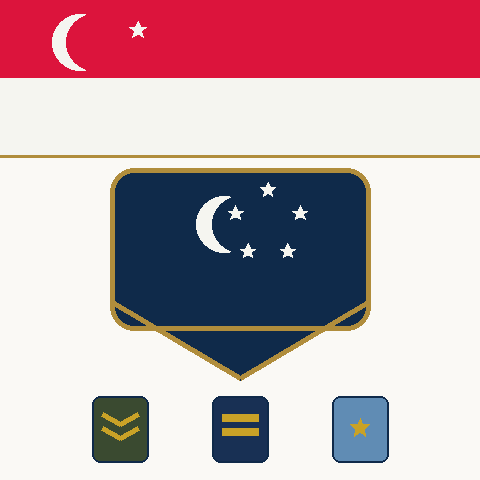
From Recruit to Chief Warrant Officer: The Other-Ranks Ladder (OR-1 to OR-9)
Every Singapore serviceman begins as a Recruit, and the uniform gives that away at once: a recruit wears nothing at all. New enlistees hold the rank through Basic Military Training, and on passing out they become Privates — who also wear no insignia. The first mark appears with Private First Class, a single downward chevron given to privates who performed well, although some references say it is no longer awarded to new enlistees. From there the ladder climbs through the corporals, whose badges are built from downward chevrons under an arc: a Lance Corporal wears one chevron with an arc above it, a Corporal two, and a Corporal First Class two chevrons with an extra arc above. Above the enlistees sit the specialists, the SAF’s junior commanders, whose badges are three downward chevrons with upward chevrons added as they climb, and the national coat of arms at staff level. Above them stand the warrant officers, the most experienced soldiers in the force, whose badges are built around the national coat of arms with an arc below it and upward chevrons that grow thicker and more numerous with seniority — topped by the Chief Warrant Officer‘s laurel wreath. Warrant officers are the senior mentors and disciplinarians of their units, appointed by the Armed Forces Council, and may be given command of units. A soldier is addressed as “Sergeant” from Third Sergeant upward, and as “Encik” — Malay for “Mister” — as a warrant officer.
| Rank | Abbreviation | NATO Equivalent | Insignia | Typical Role |
|---|---|---|---|---|
| Recruit | REC | OR-1 | No insignia | New enlistee in Basic Military Training |
| Private | PTE | OR-1 | No insignia | Trained soldier |
| Private First Class | PFC | OR-2 | One downward chevron | Private who performed well in training |
| Lance Corporal | LCP | OR-3 | 1 down chevron + arc | Section second or third in command |
| Corporal | CPL | OR-4 | 2 down chevrons + arc | Senior enlistee |
| Corporal First Class | CFC | OR-4 | 2 down chevrons + extra arc | Most senior enlistee |
| Specialist Cadet | SCT | — (cadet) | Cadet chevron + arc | Trainee at the Specialist Cadet School |
| Third Sergeant | 3SG | OR-5 | Three downward chevrons | Section commander; junior commander |
| Second Sergeant | 2SG | OR-5 | 3 down + 1 up chevrons | Platoon sergeant |
| First Sergeant | 1SG | OR-5 | 3 down + 2 up chevrons | Platoon sergeant |
| Staff Sergeant | SSG | OR-6 | Coat of arms, 2 up + 3 down chevrons | Company sergeant major |
| Master Sergeant | MSG | OR-6 | Coat of arms, 3 up + 3 down chevrons | Regimental sergeant major |
| Third Warrant Officer | 3WO | OR-7 | Coat of arms, arc, 1 thin up chevron | Company sergeant major |
| Second Warrant Officer | 2WO | OR-8 | Coat of arms, arc, 1 thick up chevron | Regimental sergeant major |
| First Warrant Officer | 1WO | OR-8 | Coat of arms, arc, 2 thick up chevrons | Regimental sergeant major |
| Master Warrant Officer | MWO | OR-9 | Coat of arms, arc, 3 thick up chevrons | Senior warrant officer |
| Senior Warrant Officer | SWO | OR-9 | Coat of arms, arc, 4 thick up chevrons | Senior adviser |
| Chief Warrant Officer | CWO | OR-9 | Coat of arms, arc, 4 thick up chevrons, laurel | SAF Sergeant Major |
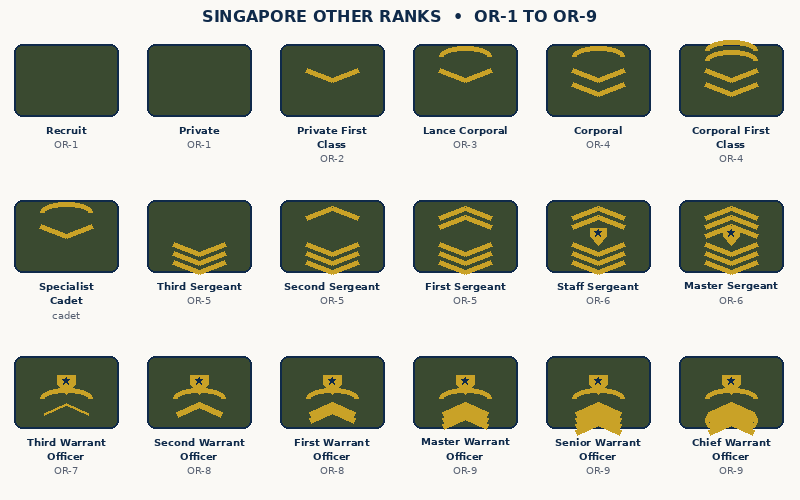
Did you know? Singapore soldiers have their own nicknames for the shapes on their uniforms: the arc above an enlistee’s chevrons is a “dome”, a junior officer’s gold bars are “chocolate bars”, and a field officer’s coat of arms is a “crab”.
How to Read a Singapore Uniform
A Singapore uniform is easy to read once you know its three families of shapes. Chevrons mean an enlistee or a specialist: downward chevrons for the junior ranks, upward chevrons added as a specialist climbs, and the national coat of arms appearing at staff level. Bars mean a junior officer: one, two or three gold bars. Coats of arms mean a field officer, and stars mean a general — while the warrant officers mix the families, with a coat of arms, an arc and upward chevrons. Where the badge sits depends on the uniform: on the camouflage Number 4 dress, all rank insignia are worn on the chest straps, while on other dresses the badges move to the shoulders for officers, warrant officers and military experts, and to the sleeves for specialists and enlistees. The background colour changes with the service — green for the Army, dark blue for the Navy, light blue for the Air Force — but the devices stay the same: a sergeant’s three chevrons mean the same thing in green, blue or grey. Singapore has only two exceptions to the single system: in the Navy, the three general-officer ranks become Rear Admiral (One-Star), Rear Admiral (Two-Star) and Vice Admiral, and a Navy officer cadet is a Midshipman, not an Officer Cadet.
Officers: From Officer Cadet to Lieutenant-General (OF(D) to OF-8)
The officer ladder will look familiar to anyone who knows a Commonwealth army, because the titles are the same from Second Lieutenant to Lieutenant-General. A new Second Lieutenant, fresh from Officer Cadet School, takes command of a platoon; a Lieutenant does the same job with more months behind him; and a Captain commands a company. The three junior officer ranks are told apart by their bars: one for a Second Lieutenant, two for a Lieutenant, three for a Captain — and below them sits the Officer Cadet, Midshipman in the Navy, still in training and graded OF(D). Above the captains come the field officers, and the badge changes completely: no more bars, but the national coat of arms. A Major wears one coat of arms, a Lieutenant Colonel two, a Senior Lieutenant Colonel two with a distinguishing bar, and a Colonel three. At the top sit three general-officer ranks — Brigadier-General, Major-General and Lieutenant-General — wearing one, two and three stars. The Chief of Defence Force, the head of the whole SAF, holds the rank of Lieutenant-General, or Vice Admiral if he comes from the Navy. Above even that, the law provides for a four-star General — but no Singapore officer has ever held it, and its insignia is not confirmed. Officers are addressed as “Sir”; warrant officers, as “Encik”.
| Rank | Abbreviation | NATO Equivalent | Insignia | Typical Role |
|---|---|---|---|---|
| Officer Cadet / Midshipman | OCT / MID | OF(D) | Single cadet bar | Officer cadet |
| Second Lieutenant | 2LT | OF-1 | One gold bar | Platoon commander |
| Lieutenant | LTA | OF-1 | Two gold bars | Platoon commander |
| Captain | CPT | OF-2 | Three gold bars | Company commander |
| Major | MAJ | OF-3 | One national coat of arms | Battalion executive officer |
| Lieutenant Colonel | LTC | OF-4 | Two national coats of arms | Battalion commander |
| Senior Lieutenant Colonel | SLTC | OF-4 | Two national coats of arms with a bar | Senior staff officer |
| Colonel | COL | OF-5 | Three national coats of arms | Brigade commander |
| Brigadier-General / Rear Admiral (One-Star) | BG / RADM(1) | OF-6 | One star | Brigade commander |
| Major-General / Rear Admiral (Two-Star) | MG / RADM(2) | OF-7 | Two stars | Division commander |
| Lieutenant-General / Vice Admiral | LG / VADM | OF-8 | Three stars | Chief of Defence Force |
| General / Admiral | GEN / ADM | OF-9 | Four stars (not confirmed; no holder) | Never held |
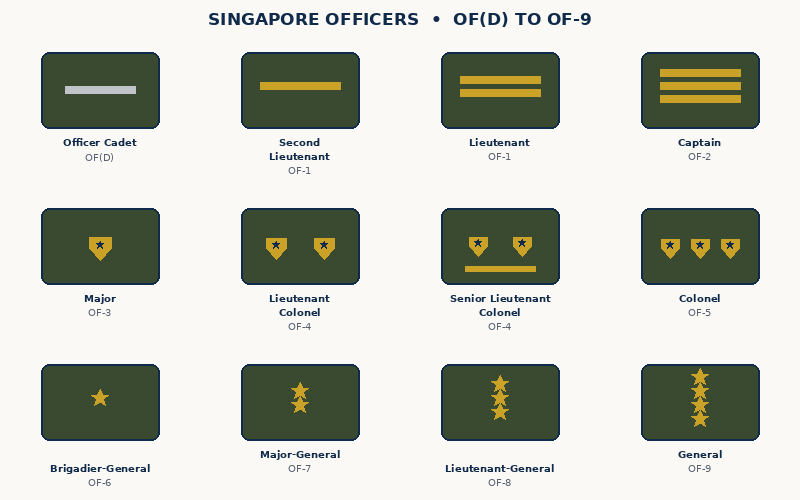
Key point: Singapore is not a NATO member, so every OF and OR code here is an equivalent, not an official grade — and the reference tables do not all agree on some warrant-officer grades. This guide follows the most widely used mapping; where two ranks share one code, that is normal — a code marks roughly where a rank stands, not what the job is.
Two Ladders, One Spine: Specialists, Warrant Officers and Military Experts
The most distinctive thing about the system is in the middle, not at the top. Until 1992 the SAF had a conventional non-commissioned officer corps, like any Commonwealth army. That year it was replaced by the specialist corps and the warrant officer corps, together known as the WOSpec corps — a professional spine of career soldiers to train each short National Service intake and carry standards from one intake to the next. The system was reshaped again in the reforms that took effect on 1 April 2010: two new ranks appeared that day, Third Warrant Officer, which let outstanding specialists reach the warrant officer corps as early as the end of their sixth year of service where the old route had taken about twelve, and Senior Lieutenant Colonel, a new step between Lieutenant Colonel and Colonel. At the same time the SAF created the Military Domain Experts Scheme, a separate career track for deep technical specialists — engineers, intelligence professionals and cyber specialists — running from Military Expert 1 to Military Expert 9, with a Military Expert 1 sitting beside the sergeants, a Military Expert 4 beside the captains, and a Military Expert 9 beside the brigadier-generals. Two years later, in July 2012, the warrant officer ladder gained its own summit with the creation of Chief Warrant Officer. The result is a system with three ways to build a career: an officer climbs by command, a specialist by leadership and training, and a military expert by depth — staying inside one technical field and going deeper instead of broader.
Climbing the Ladder: Courses, Selection and Time in Rank
Moving up the Singapore ladder takes more than time served. Each step needs the right training course passed, a good record, and an open post to step into — and the schools that run those courses are the gates of the system. Enlistees with command potential are picked out during Basic Military Training and sent on to the Specialist Cadet School or to Officer Cadet School; a specialist cadet graduates as a Third Sergeant, and an officer cadet graduates as a Second Lieutenant, and the pattern repeats at every level. Regular servicemen can keep climbing well past the point where a full-time national serviceman’s service ends: a regular specialist may reach Staff Sergeant or Master Sergeant, and the best may cross into the warrant officer corps, where Third Warrant Officer can now come as early as the sixth year. The Chief of Defence Force is appointed by the President, on the advice of the Prime Minister, who must consult the Armed Forces Council.
One Force, Four Services: Singapore Today
Singapore’s armed forces are young by the standards of the region. The SAF traces its roots to independence in 1965, when a new country had to build an army from scratch, and to the introduction of National Service, which made service a shared duty of every male citizen. The three services were unified in 1972, and a decade later, in 1982, they adopted the identical rank insignia that still defines the system today. The Digital and Intelligence Service joined them as a fourth service to cover the cyber and intelligence domains, and each year on 1 July, SAF Day marks the founding of the force. What has not changed is the shape of the ladder: a recruit still starts with a bare chest strap, a specialist still earns three chevrons, and the Chief of Defence Force still wears three stars — a deliberately compact system of thirty titles, one set of names and two exceptions.
Read next
US Army Ranks · British Military Ranks · Military Ranks and Insignia Overview · Philippine Military Ranks · Polish Military Ranks
FAQs
What is the highest rank in the Singapore Armed Forces?
Lieutenant-General — or Vice Admiral in the Navy — is the highest rank actually held, and it belongs to the Chief of Defence Force. The law also provides for a four-star General, but no Singapore officer has ever held it, and its insignia is not confirmed.
How many ranks are there in the Singapore Armed Forces?
There are 30 titles in the main system: 18 other ranks, from Recruit to Chief Warrant Officer including the two cadet ranks, and 12 officer titles, from Officer Cadet to General. A separate Military Expert track runs from ME1 to ME9 alongside them.
Are Singapore ranks the same in the Army, Navy and Air Force?
Yes — the SAF uses one unified rank system, and the same titles and insignia apply in all four services. The only exceptions are the Navy’s admiral titles and the title of Midshipman for Navy officer cadets.
Is Singapore a NATO member?
No. Singapore is not a NATO member, so the OF and OR codes in this guide are reference equivalents for comparison only, not official NATO grades. Different reference tables disagree on some of the warrant-officer equivalents, as the note in this guide explains.
All images in this article are original graphics drawn for Forces Guide. The charts are simplified, stylised versions of SAF chest-strap and shoulder-board badges — diagrams, not photographs of real insignia.