Cuba’s ranks carry two histories at once: Soviet-style stars for the generals, Rebel Army sleeve chevrons for the other ranks — and two odd grades: a Primer coronel above the colonel, and a Navy whose top admiral sits one grade below the Army’s top general. Here is the ladder, from Soldado to General de ejército.
AT A GLANCE
Services: Army, Navy, Air and Air Defense Force (DAAFAR)
Top rank: General de ejército (OF-9) · Size: about 49,000 active
Founded: 1959, after the Revolution
How the ranks changed — in 1959 the Rebel Army knew only a handful of ranks, from lieutenant to comandante. Law 1315 of November 1976 created the modern system. From 1980 to 1989 the shoulder boards copied the Soviet pattern; then the old junior-officer insignia and Rebel Army sleeve chevrons came back. Only the generals kept the Soviet style. Primer coronel and Capitán de flotilla came later — neither is in the 1976 tables.
The Revolutionary Armed Forces
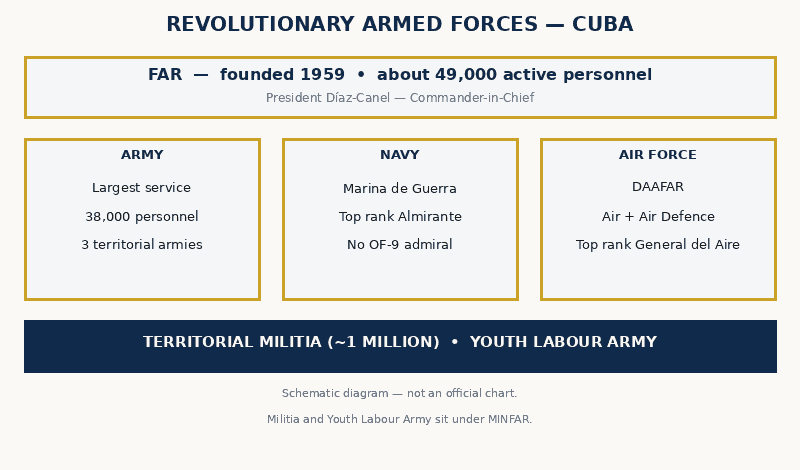
The Revolutionary Armed Forces (FAR) were born with the Revolution in 1959; Law 1315 of November 1976 gave them their current shape. Three services serve under MINFAR in Havana: the Revolutionary Army, the Revolutionary Navy (Marina de Guerra Revolucionaria) and the Air and Air Defense Force (DAAFAR). The President, Miguel Díaz-Canel, is commander-in-chief; the minister is Corps General Álvaro López Miera. The Army, about 38,000 strong, is split into Western, Central and Eastern armies. The rank titles are Spanish — a legacy of centuries as a Spanish colony — and the same words run through Spain‘s own ladder. Men serve two years, compulsory.
Officer Ranks
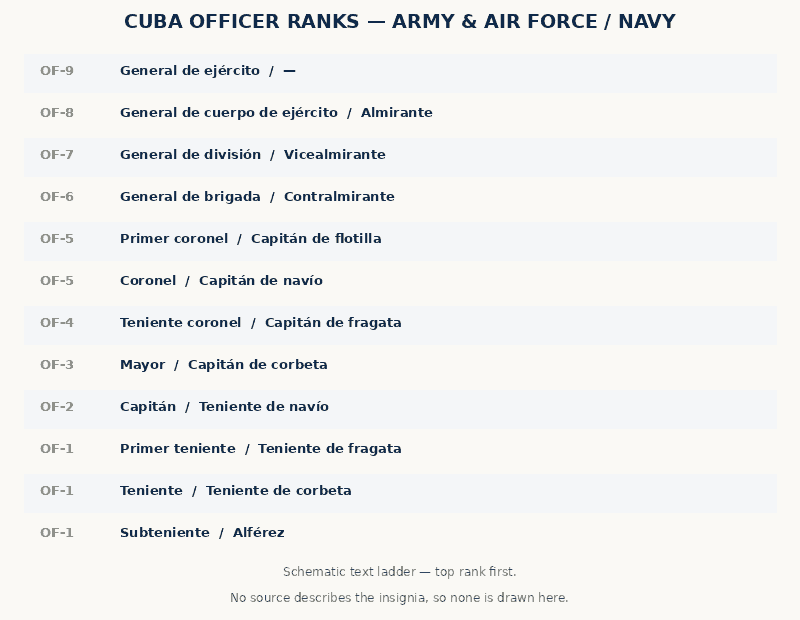
Cuba has twelve officer grades in the Army and Air Force, and eleven in the Navy. The four generals run from General de ejército to General de brigada — then comes the ladder’s first surprise: Primer coronel, a senior colonel above the ordinary Coronel. Mexico, across the Yucatán Channel, uses the same Spanish rank words — Coronel, Capitán, Teniente — but has no such grade. The Navy mirrors the Army grade for grade, with its own titles — but its top rank, Almirante, is only OF-8: Cuba has no OF-9 admiral. Above the ladder sit two honorary grades, Comandante en Jefe and Comandante de la Revolución.
| NATO code | Army & Air Force | Navy | Insignia |
|---|---|---|---|
| OF-9 | General de ejército | — | — |
| OF-8 | General de cuerpo de ejército | Almirante | — |
| OF-7 | General de división | Vicealmirante | — |
| OF-6 | General de brigada | Contralmirante | — |
| OF-5 | Primer coronel | Capitán de flotilla | — |
| OF-5 | Coronel | Capitán de navío | — |
| OF-4 | Teniente coronel | Capitán de fragata | — |
| OF-3 | Mayor | Capitán de corbeta | — |
| OF-2 | Capitán | Teniente de navío | — |
| OF-1 | Primer teniente | Teniente de fragata | — |
| OF-1 | Teniente | Teniente de corbeta | — |
| OF-1 | Subteniente | Alférez | — |
* The Air Force’s top rank is General del Aire. Two grades share OF-5, three share OF-1. Dashes mean no source describes the insignia.
Did you know? Behind the 49,000 regulars stands the Territorial Troop Militia — about a million citizens, twenty times the regular force.
Other Ranks
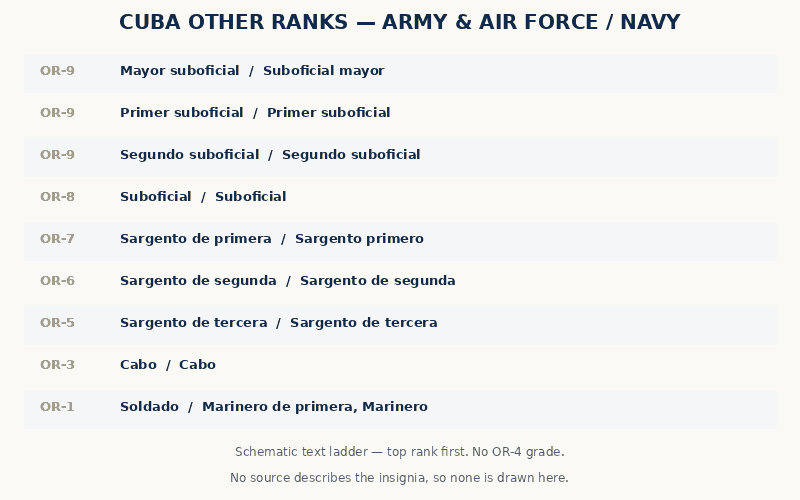
Below the officers, nine grades in the Army and Air Force and ten in the Navy. Three suboficial grades share OR-9; the Navy’s top one reads Suboficial mayor, not Mayor suboficial. Sergeants run de primera, de segunda and de tercera, then Cabo; the lowest grade, Soldado, wears no insignia. The Navy adds one grade the Army lacks, Marinero de primera, and its two lowest grades both wear no insignia.
| NATO code | Army & Air Force | Navy | Insignia |
|---|---|---|---|
| OR-9 | Mayor suboficial | Suboficial mayor | — |
| OR-9 | Primer suboficial | Primer suboficial | — |
| OR-9 | Segundo suboficial | Segundo suboficial | — |
| OR-8 | Suboficial | Suboficial | — |
| OR-7 | Sargento de primera | Sargento primero | — |
| OR-6 | Sargento de segunda | Sargento de segunda | — |
| OR-5 | Sargento de tercera | Sargento de tercera | — |
| OR-3 | Cabo | Cabo | — |
| OR-1 | Soldado | Marinero de primera, Marinero | No insignia |
The Militia and the Youth Labour Army
Two more forces wear the same titles. The Territorial Troop Militia (MTT), about a million strong, is the backbone of the War of All the People — citizens organised in battalions in every municipality, ready to fight a guerrilla war if invaded. The Youth Labour Army (EJT) works farms and building sites in uniform, also under MINFAR.
The same Spanish titles travel the region. Argentina‘s navy uses the same Capitán de navío and Capitán de fragata, and Colombia, across the Caribbean, runs its own Spanish-titled ladder. Cuba’s is the only one with a Primer coronel — and a Navy that tops out at OF-8.
Read next
Spanish military ranks · Mexican military ranks · Argentine military ranks · Colombian military ranks · Chilean military ranks · World military ranks index
Which would you rather be — a Primer coronel in the Army, or the Navy’s Capitán de flotilla?
FAQs
What is Cuba’s highest military rank?
General de ejército, at OF-9. Above it sits only the honorary Comandante en Jefe, Fidel Castro’s rank.
Does Cuba’s Navy have a full admiral?
No. The Navy’s top rank, Almirante, is OF-8. Cuba has no OF-9 admiral.
What is a Primer coronel?
A senior colonel, one step above Coronel — both map to OF-5. The Navy’s equivalent is Capitán de flotilla.
All images are original graphics drawn for Forces Guide — text ladders and diagrams, not real insignia.