
US Military Academy Directory
Norwich University — The Military College of Vermont
Founded in 1819, Norwich University is the oldest private military college in the United States and the birthplace of the Reserve Officers’ Training Corps. This complete guide covers everything a prospective student needs: admissions requirements, the step-by-step application process, programmes and majors, tuition and costs, the Corps of Cadets lifestyle, service opportunities and answers to frequently asked questions.
Directory Information
| Full name | Norwich University — The Military College of Vermont |
| Location | Northfield, Vermont, United States |
| Official address | 158 Harmon Drive, Northfield, VT 05663 |
| Main phone | 1 (802) 485-2000 |
| Official website | www.norwich.edu |
| Founded | 1819 (by Captain Alden Partridge, U.S. Army) |
| Type | Private, four-year senior military college |
| Motto | “I will try!” |
| Student & cadet strength | Approximately 3,100 students in total, including around 1,150 cadets in the Corps of Cadets |
About the University
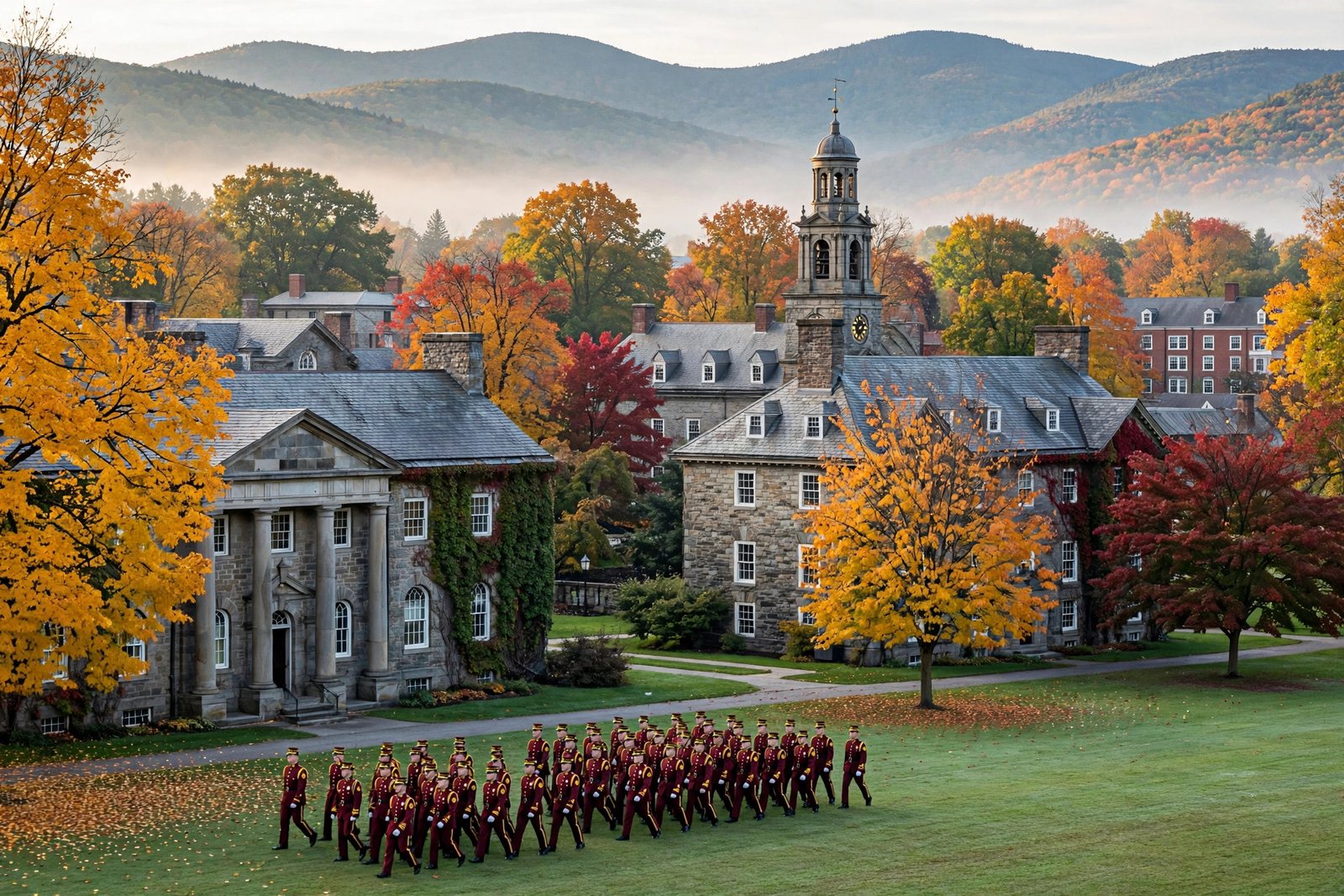
Norwich University was founded in 1819 by Captain Alden Partridge of the United States Army, a former superintendent of West Point who held a radical conviction for his time: that a military education should not be reserved for a small elite, but should be made available to citizen-soldiers across the young republic. The school opened in Norwich, Vermont, as the American Literary, Scientific and Military Academy — the first private institution in America to offer a full military education — and moved to its present home in Northfield later in the nineteenth century.
Over two centuries the university has kept Partridge’s founding charge alive. Its mission statement, quoted in the official university catalogue, pledges to give students an education that is “American in its character — to enable them to act as well as to think — to execute as well as to conceive”, and to form “moral, patriotic, efficient, and useful citizens”. Norwich remains one of only six federally recognised senior military colleges in the nation, and the U.S. Department of Defense recognises it as the birthplace of the Reserve Officers’ Training Corps (ROTC).
What makes Norwich unusual is its dual character. Traditional-age undergraduates choose one of two lifestyles: the Corps of Cadets, a regimented, uniformed military environment that is one of the largest cadet corps in the country, or the civilian student lifestyle, which offers the same degrees without the military regimen. The two groups live in separate residences but share classrooms, laboratories, dining halls and athletic fields — and civilian students may take part in ROTC if they wish. Alongside the residential campus, Norwich’s College of Graduate and Continuing Studies delivers respected online bachelor’s-completion and master’s programmes for working adults.
Life on “the Hill”, as the campus is known, is steeped in tradition. Rook training — the demanding induction that new cadets undergo — tests resolve from the first week. The Corps is structured like an Army regiment, with cadets filling real leadership billets and rising through the ranks. Athletics are an integral part of that life: the Norwich Cadets compete in NCAA Division III, and intramural and club sport is woven through both cadet and civilian routines.
Programmes & Majors
Norwich awards the Bachelor of Science (BS), Bachelor of Arts (BA), Bachelor of Public Health (BPH) and Bachelor of Interdisciplinary Studies (BIS), together with master’s degrees and graduate certificates through its online college. Residential students choose from more than forty undergraduate majors, including:
- Engineering: Civil Engineering, Electrical & Computer Engineering, Mechanical Engineering, Interdisciplinary Engineering, Construction Management
- Science & technology: Biology, Biochemistry, Chemistry, Physics, Geology, Environmental Science, Mathematics, Mathematics and Computer Science, Computer Science, Cybersecurity & Advanced Computing, Neuroscience, Health Sciences
- Professional & service fields: Nursing, Criminal Justice, Criminology, Education, Physical Education, Exercise Science, Public Health, Architecture Studies, Communications, Design, Media Arts
- Business & leadership: Accounting, Management, International Business, Leadership
- Humanities & social sciences: English, History, International Studies, Political Science, Psychology, Spanish, Studies in War & Peace, Interdisciplinary Studies
Popular combinations reflect the university’s mission: cadets often pair a technical degree with an ROTC commissioning track, while the David Crawford School of Engineering is one of the school’s academic flagships. Bachelor’s degrees require a minimum of 120 undergraduate credits and a cumulative GPA of 2.0.
Admission Requirements
Norwich reviews applicants holistically and admits a broad range of students — it is a far more accessible route into a military-college education than a federal service academy. The essentials are:
- High school record: a completed high school transcript and GPA are required; competitive applicants typically present solid B-average or better coursework across a college-preparatory curriculum.
- Standardised tests: Norwich is test-optional — SAT and ACT scores are considered if submitted, and can strengthen an application, but are not mandatory for most programmes.
- Recommendations: at least one letter of recommendation from a teacher or counsellor is recommended.
- International students: must provide proof of English proficiency (for example TOEFL or IELTS).
- Corps of Cadets applicants: no additional academic hurdle beyond the university’s admission standards, but candidates should be ready for the physical demands of Rook training — fitness preparation before arrival is strongly advised.
Applicants apply through Norwich’s own online application portal at norwich.edu/admissions/apply. Admission requirements and deadlines can change between cycles, so always confirm the current details with the admissions office before you apply.
How to Apply: Step by Step
- Explore and decide. Read through norwich.edu, choose your intended major and decide between the Corps of Cadets lifestyle and the civilian lifestyle — you will declare this choice as part of your application.
- Create your application. Start the online application through the university’s admissions portal (norwich.edu/admissions/apply) and fill in your personal details, academic history and lifestyle preference.
- Send your transcript. Ask your high school counsellor to submit your official transcript. If you have taken AP or college-level courses, arrange for those records too — Norwich accepts AP and transfer credit.
- Add test scores and recommendations (optional but helpful). Submit SAT or ACT scores if they strengthen your file, and ask a teacher to write a recommendation letter.
- Visit if you can. Norwich encourages campus visits, tours and overnight stays so prospective students — especially future cadets — can see the Corps lifestyle first-hand before committing.
- Watch your portal and respond. The admissions team reviews applications on a rolling basis. Check your applicant portal regularly and respond promptly to any requests for additional material or to your offer of admission.
Tuition & Costs
As a private university, Norwich charges tuition like other private colleges — there is no federal funding of the kind enjoyed by the service academies. The university’s bursar publishes the following figures for the 2025–26 academic year for full-time residential undergraduates:
| Category | Annual figure (2025–26) |
|---|---|
| Tuition (12–19 credits per semester) | $48,730 |
| Room | $10,810 |
| Board | $4,470 |
| Mandatory fees (activities, technology, health services, facilities) | ≈ $3,760 |
| Total before insurance & aid | ≈ $67,770 |
Full-time residential students are billed at the full-time tuition rate regardless of credit hours, and a refundable security deposit applies. Norwich also publishes separate, lower tuition schedules for commuter, part-time and online students — civilian students living off campus avoid the room and board charges entirely.
Service & Career Outcomes
Norwich is the birthplace of ROTC, and commissioning remains the beating heart of its career outcomes. All three military ROTC programmes — Army, Navy and Air Force — operate on campus, and cadets who complete ROTC graduate with a commission as an officer in the U.S. armed forces. Scholarship cadets typically contract for several years of active or reserve service after graduation. As one of six senior military colleges, Norwich ROTC graduates enter with a strong national reputation for leadership.
Military service is far from the only destination. Norwich graduates work across engineering, cybersecurity, construction management, nursing, law enforcement, federal service and the private sector, and the university’s career and alumni networks support civilian placement. Programmes such as nursing, criminal justice and engineering carry their own professional pipelines — clinical placements, internships and co-op experiences — so students graduate with workplace-ready credentials whether or not they wear a uniform afterwards.
Frequently Asked Questions
Is Norwich University a federal service academy like West Point?
No. Norwich is a private senior military college, not a federally funded academy. That means students pay tuition (offset by generous aid), and there is no automatic military service obligation — although cadets may choose to commission through ROTC.
Do I have to join the Corps of Cadets to attend Norwich?
No. Residential undergraduates choose between the Corps of Cadets lifestyle and a civilian student lifestyle, both leading to the same Norwich degree. Only Corps students wear the uniform and follow the cadet regimen, but civilians can still participate in ROTC.
Is Norwich test-optional for admissions?
Yes. SAT and ACT scores are considered when submitted but are not required for most programmes. Your high school transcript and GPA carry the most weight, and a strong recommendation letter helps.
How much does Norwich University cost?
Published 2025–26 costs for full-time residential students are about $48,730 in tuition plus room, board and fees, totalling roughly $67,770 before insurance. However, 99% of students receive institutional gift aid and up to $30,000 in academic scholarships is available — so use the net price calculator on norwich.edu to estimate your real cost.
Can Norwich cadets commission as officers in the military?
Yes. Army, Navy and Air Force ROTC programmes all operate on campus. Cadets who complete ROTC graduate with an officer’s commission, and Norwich carries the historic distinction of being the birthplace of ROTC itself.
Where is Norwich University located?
The university’s main campus sits on a hill above Northfield, Vermont, in the Green Mountains — about a 20-minute drive from the state capital, Montpelier. The official mailing address is 158 Harmon Drive, Northfield, VT 05663, and the main switchboard is 1 (802) 485-2000.
Thinking of joining the oldest private military college in America? Start your application on Norwich’s official admissions portal, or call the university on 1 (802) 485-2000. Facts in this guide were verified against norwich.edu — always confirm current deadlines, costs and requirements directly with the university before applying.
Apply to Norwich UniversityForcesGuide.com is an independent directory and is not affiliated with Norwich University.