
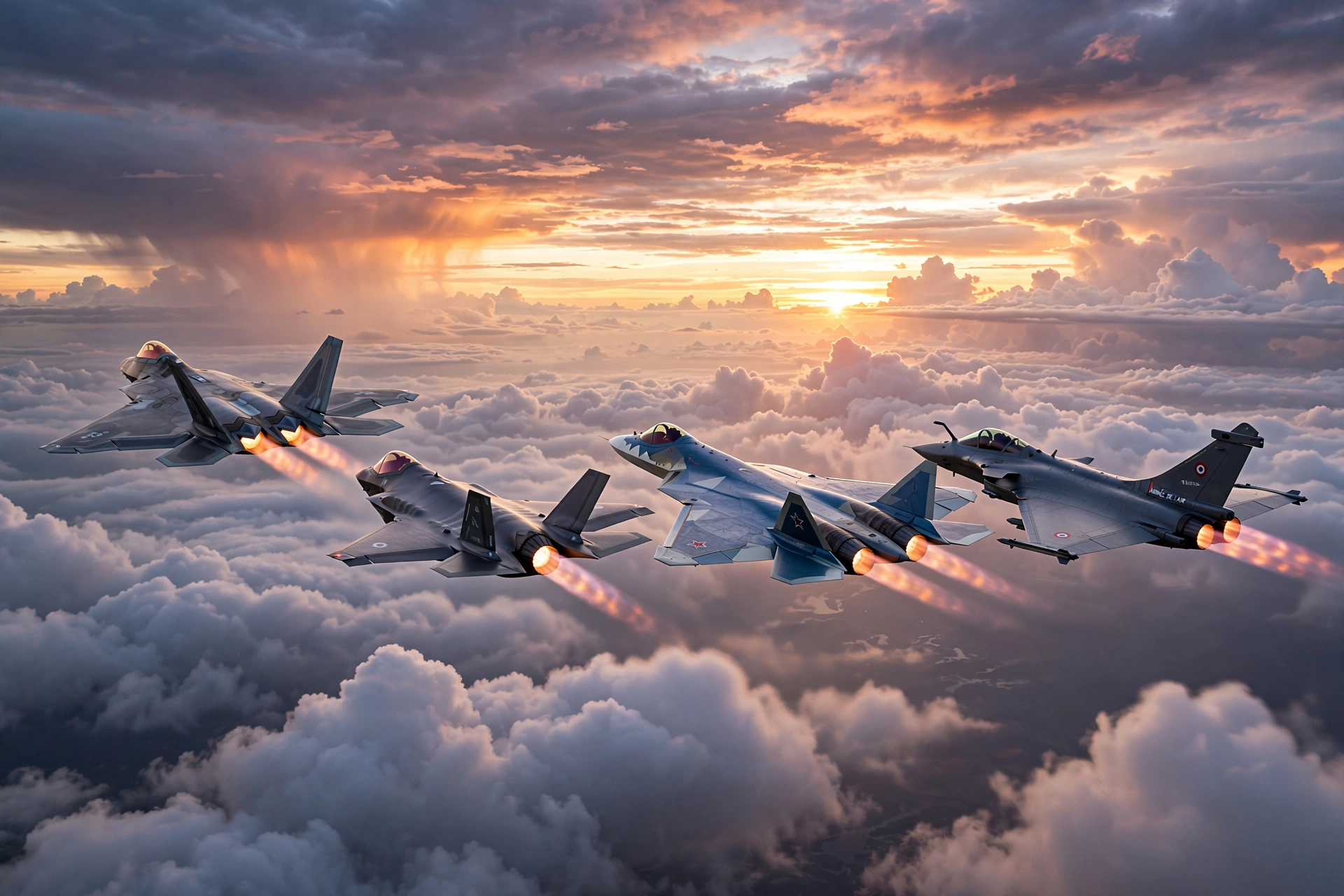
Top 20 Best Fighter Aircrafts in the World
From the stealthy F-22 Raptor to the combat-proven Rafale, we rank the twenty most capable fighter jets flying today — judged on stealth, avionics, weapons and real combat record.
Fighter aircraft remain the sharp end of modern air power. In an era where a single sortie can decide the fate of an air campaign, the difference between a fourth-generation workhorse and a fifth-generation stealth fighter is the difference between seeing first and being seen first. Air forces around the globe are spending billions to keep their fleets at the cutting edge, blending stealth shaping, powerful active electronically scanned array (AESA) radars, networked data links and long-range missiles into machines that dominate both beyond-visual-range and close-in fights.
But which fighter jets truly stand above the rest in 2026? To answer that, we compared the world’s leading combat aircraft across four pillars: low observability, sensor and avionics sophistication, weapons and payload, and proven performance in real operations. The result is this definitive ranking of the top 20 best fighter aircrafts in the world — from American icons like the F-22 and F-35 to Russian, Chinese, European and South Asian designs that each bring something unique to the fight.
How We Judged the Best Fighter Aircrafts
Ranking fighter jets is never purely about top speed or turn rate. Modern air combat is won long before the merge, so our ranking weighs the factors that decide real engagements:
Stealth & Survivability
Low radar cross-section, infrared signature management and electronic self-protection decide who detects whom first.
Avionics & Sensors
AESA radars, infrared search and track, sensor fusion and data links that let a pilot see the whole battlespace.
Weapons & Payload
Access to long-range air-to-air missiles, precision strike munitions and the hardpoints to carry them.
Combat Record & Maturity
Proven reliability in exercises and real operations, upgrade roadmaps and fleet numbers in service.
The Top 20 Best Fighter Aircrafts in the World
F-22 Raptor
The undisputed king of the skies. The F-22 blends all-aspect stealth, supercruise and thrust-vectoring agility into one airframe, with an AN/APG-77 AESA radar that sees enemies long before they see it. In exercises it has posted lopsided kill ratios against fourth-generation jets, and it remains the benchmark every other fighter is measured against.
F-35 Lightning II
The most numerous stealth fighter ever built, flown by a growing club of allied air forces. Its true strength is sensor fusion — the F-35 acts as a flying command post, sharing targeting data across the battlespace. Three variants (A, B and C) cover conventional, STOVL and carrier operations, making it the most versatile combat aircraft of its generation.
Su-57 Felon
Russia’s first operational stealth fighter pairs low-observable shaping with the legendary supermanoeuvrability of the Flanker family. Internal weapons bays, an AESA radar and 3D thrust vectoring give it a potent mix of stealth and dogfighting ability, and it is steadily maturing with new engines and weapons integration.
Chengdu J-20 Mighty Dragon
China’s heavyweight stealth fighter is built for long-range air dominance over the Pacific. With canard-delta aerodynamics, a large internal weapons bay and increasingly powerful domestic WS-10C/WS-15 engines, the J-20 gives the PLAAF a genuine fifth-generation spearhead produced in significant numbers.
Dassault Rafale
The Rafale is the gold standard of 4.5-generation fighters: combat-proven from Libya to the Middle East, carrier-capable, and equipped with the superb SPECTRA electronic warfare suite. Its RBE2 AESA radar, Meteor beyond-visual-range missiles and ability to swing between air-to-air and strike in a single sortie make it arguably the most complete non-stealth fighter flying.
Eurofighter Typhoon
A delta-canard thoroughbred with phenomenal agility and a superb high-altitude, high-speed envelope. The Typhoon’s CAPTOR-E AESA radar and Meteor missile pairing is among the deadliest in Europe, and continuous upgrades keep it at the heart of RAF, Luftwaffe and other European air fleets well into the 2030s.
F-15EX Eagle II
The ultimate evolution of the undefeated Eagle. The F-15EX adds fly-by-wire controls, a digital backbone, the AN/APG-82 AESA radar and a staggering weapons capacity — up to 12 air-to-air missiles. With a combat-proven lineage and Mach 2.5 speed, it is the perfect high-end complement to stealth fleets.
Su-35 Flanker-E
The most advanced Flanker derivative, the Su-35 combines 3D thrust vectoring with the powerful Irbis-E radar — claimed to detect stealth targets at extended ranges. Superb range, a heavy weapons load and brutal close-in agility keep it a formidable opponent for any Western fighter.
Shenyang J-16
China’s answer to the strike Eagle: a twin-seat Flanker derivative with an AESA radar, reduced radar signature treatments and the long-range PL-15 missile. The J-16 is the PLAAF’s premier strike fighter, equally at home in air superiority, maritime strike and suppression of enemy air defences.
F-16V Viper (Block 70/72)
The world’s most-produced Western fighter refuses to retire. The latest F-16V adds the AN/APG-83 SABR AESA radar — derived from F-35 technology — a new mission computer and structural life extension. Affordable, reliable and flown by two dozen nations, the Viper remains the backbone of allied air power.
Saab JAS 39 Gripen E
The thinking air force’s fighter. The Gripen E pairs a Raven AESA radar and the Skyward-G infrared sensor with famously low operating costs and the ability to operate from short, dispersed road strips. For smaller air forces, few jets offer so much capability per dollar.
KAI KF-21 Boramae
Asia’s newest indigenous fighter is a striking achievement for South Korea’s aerospace industry. With semi-recessed weapons carriage for reduced signature, an AESA radar and growth potential toward full stealth, the Boramae is set to anchor the ROKAF and attract export customers through the 2030s.
F/A-18E/F Super Hornet (Block III)
The backbone of US Navy carrier air wings. Block III upgrades bring conformal fuel tanks for extra range, an advanced cockpit and the IRST21 infrared sensor. Rugged, reliable and proven in combat from Iraq to the Red Sea, the Super Hornet remains the world’s premier carrier fighter until the F-35C fully takes over.
MiG-35 Fulcrum-F
The ultimate Fulcrum. The MiG-35 adds the Zhuk-A AESA radar, thrust-vectoring engines and modern precision weapons to the classic MiG-29 formula. Lighter and cheaper to run than the Flanker family, it keeps the legendary MiG agility relevant in the AESA era.
JF-17 Thunder Block III
The pride of the Pakistan Air Force. Co-developed by PAC and Chengdu, the Block III adds a KLJ-7A AESA radar, a helmet-mounted display and PL-15 long-range missiles — genuine beyond-visual-range teeth at a fraction of a Western fighter’s price. Combat-tested and continuously upgraded, it is the PAF’s frontline multirole workhorse.
HAL Tejas Mk1A
India’s indigenous light fighter has matured into a genuinely capable platform. The Mk1A brings the ELTA EL/M-2052 AESA radar, improved maintainability and a modern electronic warfare suite. Compact, agile and increasingly homegrown, the Tejas is the foundation of the IAF’s future light fighter fleet.
Mitsubishi F-2
Often called the enlarged Viper, the F-2 was the first production fighter with an AESA radar. Its larger wing, composite construction and superb anti-ship strike capability — paired with the ASM-3 supersonic missile — make it a uniquely capable maritime strike fighter for the Japan Air Self-Defense Force.
Dassault Mirage 2000
The delta-wing veteran that refuses to fade. Combat-proven across decades — from the Gulf War to Kargil and beyond — the Mirage 2000’s later variants carry MICA missiles and precision strike weapons. Its superb instantaneous turn rate and reliability keep it in frontline service with several air forces.
Su-30MKI Flanker-H
The Indian Air Force’s heavyweight champion. Thrust-vectoring engines, canards and a massive weapons load give the Su-30MKI extraordinary agility and reach, while Indian, French and Israeli avionics make it a true multinational powerhouse. The planned Super Sukhoi upgrade will add AESA radar and keep it lethal for decades.
Chengdu J-10C Vigorous Dragon
China’s canard-delta lightweight punches far above its weight. The J-10C’s AESA radar and PL-15 missiles give it a genuine beyond-visual-range edge, and its export success — notably with the Pakistan Air Force — proves its competitiveness against far more expensive Western designs.
Top 5 Compared: Speed, Range & Generation
How do the top five stack up on the headline numbers? Figures below are widely published manufacturer and open-source estimates; actual combat radius varies greatly with loadout and mission profile.
| Aircraft | Max Speed | Combat Radius (approx.) | Generation |
|---|---|---|---|
| F-22 Raptor | Mach 2.25 | ~850 km | 5th |
| F-35A Lightning II | Mach 1.6 | ~1,240 km | 5th |
| Su-57 Felon | Mach 2.0 | ~1,500 km (claimed) | 5th |
| J-20 Mighty Dragon | Mach 2.0+ | ~2,000 km (claimed) | 5th |
| Rafale | Mach 1.8 | ~1,850 km (with drop tanks) | 4.5 |
Frequently Asked Questions
Which is the best fighter aircraft in the world?
The Lockheed Martin F-22 Raptor is widely regarded as the best air-superiority fighter ever built, thanks to its unmatched combination of stealth, supercruise and agility. For overall versatility across many air forces, the F-35 Lightning II is the most important fighter of its generation.
What is the fastest fighter jet on this list?
The F-15EX Eagle II tops this ranking for outright speed at around Mach 2.5, followed by the F-22 at Mach 2.25. Historically, interceptors like the MiG-25 reached Mach 2.8+, but modern designs trade absolute speed for stealth, sensors and agility.
What makes a fighter "fifth generation"?
Fifth-generation fighters combine stealth shaping, supercruise (sustained supersonic flight without afterburner), highly integrated avionics with sensor fusion, and networked data sharing. The F-22, F-35, Su-57 and J-20 are the operational examples.
Which is the best fighter aircraft of Pakistan?
The JF-17 Thunder Block III is the Pakistan Air Force’s most advanced indigenous fighter, with an AESA radar and PL-15 long-range missiles. The PAF also operates F-16s and has inducted the Chinese J-10C, both among the most capable jets in the region.
How much does an F-35 cost?
In recent production lots, the flyaway cost of an F-35A has fallen to roughly $80–85 million per aircraft, making it cheaper than many fourth-generation fighters — though lifetime operating costs remain a subject of debate.
Will sixth-generation fighters replace these jets?
Programmes like America’s NGAD, the UK-Italy-Japan GCAP and the Franco-German-Spanish FCAS are developing sixth-generation fighters with loyal-wingman drones and AI-assisted combat, expected from the mid-2030s. Until then, upgraded fifth and 4.5-generation jets will dominate the world’s air forces.
Keep Exploring Military Aviation
The race for air superiority never stands still. Every year brings new radars, longer-range missiles and smarter electronic warfare — and the jets on this list will keep evolving to stay ahead. Bookmark this page: we will update these rankings as new fighters enter service and fresh combat lessons reshape what "best" really means.