
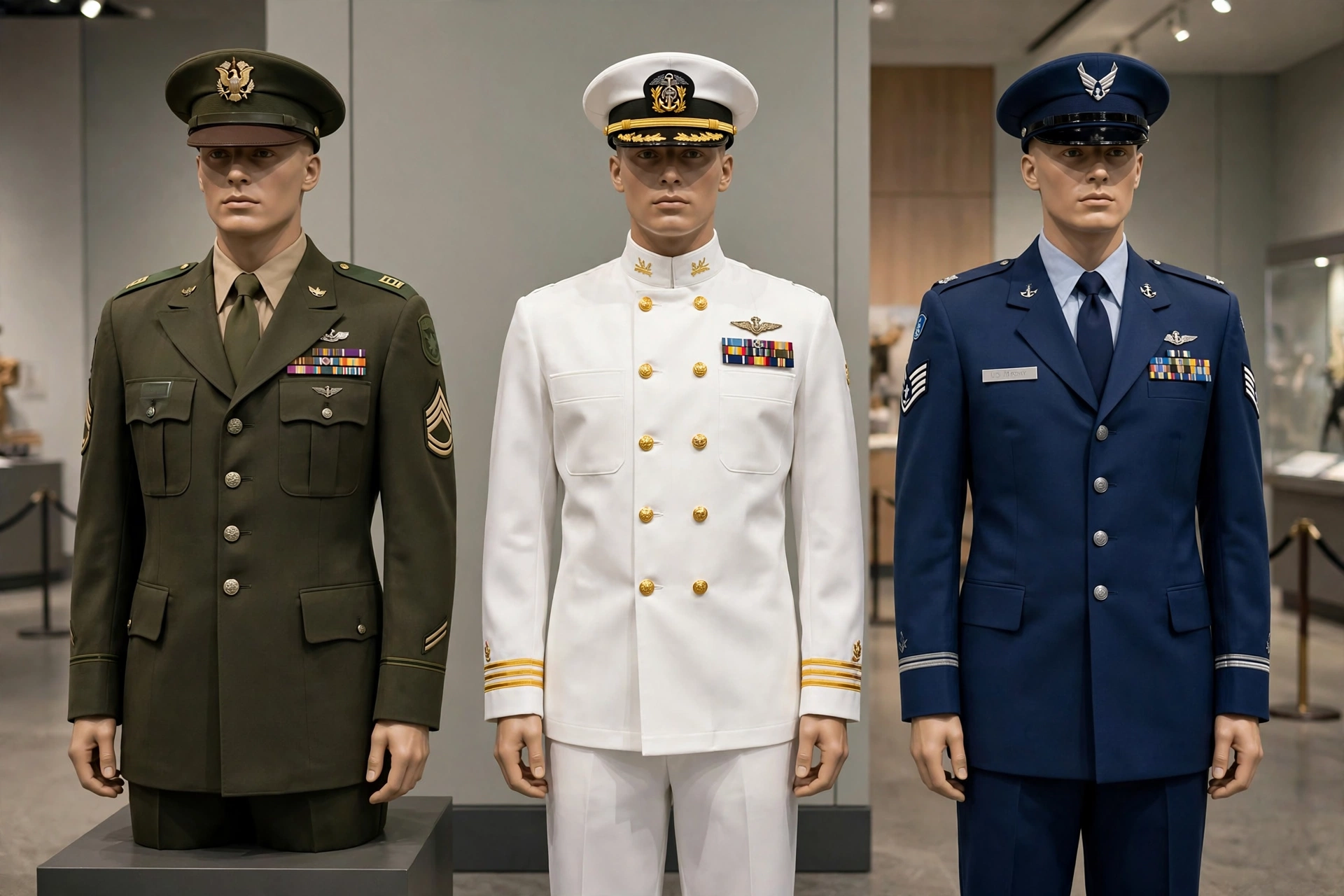
Ask someone to picture a soldier and they will usually imagine combat gear — helmet, camouflage and body armour. Yet for most service personnel, that is only one of several uniforms hanging in the wardrobe. Modern armed forces maintain whole families of uniforms, each designed for a different purpose: ceremony, daily duties, the battlefield and formal evenings.
Understanding the main types of military uniforms explains a great deal about how armed forces work. Every uniform family has its own rules about when it is worn, what is worn with it, and what it says about the wearer’s service, rank and regiment. This guide walks through the four great families of military dress used by armies, navies and air forces around the world.
Why Does One Soldier Need So Many Uniforms?
Military dress has always had two jobs. The first is practical: a uniform must suit the work being done, whether that is standing guard in driving rain or attending a state dinner. The second is symbolic: uniforms broadcast identity — service, regiment, rank and country — at a glance. That is why most forces issue their people several uniforms instead of one. A camouflage combat uniform that hides a soldier on patrol would look absurd at a royal parade, and a glittering ceremonial uniform would be useless in the field. Between those extremes sit the service and mess uniforms that cover daily duties and formal evenings. Together they form a complete wardrobe in which every item has a clear purpose, and wearing the right one at the right time is itself a matter of military discipline.
Dress Uniforms: The Face of Ceremony
When armies march past cheering crowds, this is the uniform you see. Dress uniforms — sometimes called full dress, parade dress or No.1 dress — are the most formal and decorative outfits a service issues. They are rich with tradition: bright facings, gold braiding, polished buttons, medals and ceremonial headgear that often trace back a century or more. The British Army’s scarlet tunics and bearskin caps at royal ceremonies, the US Army’s dark-blue uniform for formal occasions, and the Royal Air Force’s No.1 Service Dress all belong to this family. Dress uniforms are worn for state occasions, national parades, presidential or royal reviews, remembrance ceremonies and guards of honour. Because they are expensive to make and maintain, and often uncomfortable to wear, they are reserved for special occasions — yet they remain the most powerful public image any military owns.
Service Uniforms: Smart Dress for Daily Duties
Between ceremony and the battlefield sits the service uniform: the smart, practical outfit worn for everyday duties, office work, classroom instruction and public events. If a service member has a desk job, attends a meeting or appears in public on official business, this is usually what they wear. The American example is the Army Green Service Uniform — the modern take on the wartime “pinks and greens” — while the British Army wears khaki No.2 dress and naval and air force personnel have their own equivalents in navy blue and grey-blue. Service uniforms are designed to look professional without the expense and fuss of ceremonial dress. They carry the rank insignia, name tapes and badges that identify the wearer, and they bridge the gap between the parade ground and the office. For much of a peacetime career, the service uniform is the outfit a soldier, sailor or airman wears most often.
Combat Uniforms: Built for the Battlefield
The combat uniform — also called field dress, battle dress or working uniform — is designed for one thing: warfighting. Modern combat uniforms are cut for movement, made from tough ripstop fabrics and printed in camouflage patterns matched to the environment. The US Army’s Army Combat Uniform in Operational Camouflage Pattern, the British Army’s Personal Clothing System in Multi-Terrain Pattern, and equivalent working rigs in navies and air forces all belong to this family. Pockets are positioned for access over body armour, trousers tuck into boots, and insignia are often subdued rather than bright so the wearer is harder to spot. Interestingly, in many modern armies the combat uniform doubles as the everyday working uniform: a clerk on a headquarters staff or a mechanic in a workshop will often wear combat dress simply because it is practical, washable and cheap to replace. It is the uniform of real military life, and the one most veterans remember best.
Mess Uniforms: Formal Dress After Dark
Every evening has its formal dress, and in the military it is the mess uniform — roughly the armed forces’ answer to black tie. Worn to formal dinners, mess nights, regimental celebrations and evening receptions, the mess uniform usually centres on a short jacket with elaborate details: miniature medals, a waistcoat or cummerbund, and a bow tie. Officers and senior non-commissioned officers typically wear it; the US Army and the British Army both keep distinctive mess dress traditions, and navies have their own evening rig for formal occasions. Mess dress is never worn on duty. It belongs entirely to the social and ceremonial life of the services — the dinners, toasts and traditions that bind a unit together after the working day ends.
The Four Uniform Families at a Glance
The same four families appear in every major armed force, though the names and details change from country to country:
| Uniform family | Purpose | Typical examples |
|---|---|---|
| Full dress / ceremonial | Parades, state occasions, guards of honour | British Army No.1 Dress, US Army “blues”, RAF No.1 Service Dress |
| Service | Daily smart dress: office, meetings, public duties | US Army Green Service Uniform (AGSU), British Army No.2 Dress, naval and air force service uniforms |
| Combat / working | Field training, operations and everyday working wear | US Army Combat Uniform (OCP), British MTP Personal Clothing System, navy and air force working rigs |
| Mess / formal evening | Formal dinners, mess nights and evening receptions | British Army mess dress, US Army mess uniform, naval mess undress |
Did You Know?
- In the British tradition, uniforms are numbered: No.1 dress is ceremonial, No.2 is service dress and No.8 is combat — which is why soldiers simply say “I’ll wear my No.2s.”
- Sailors’ white summer dress and dark winter dress go back to the days when white uniforms were cooler in the tropics.
- Camouflage combat dress is now so common that in some armies it is the default daily uniform, not just a field outfit.
- The word “uniform” comes from the Latin for “one shape” — the whole point is that everyone looks alike.
Beyond the Big Four: Specialist and Working Dress
Beyond the four main families, the services issue a host of specialist uniforms. Physical training kit — shorts, T-shirts and tracksuits in service colours — is worn for sport and fitness. Aircrew wear fire-resistant flight suits and jackets; maintainers and engineers wear coveralls; cooks, medics and military police all have their own working dress with the extras their jobs demand. These are uniforms in every sense: issued by the service, marked with rank and name, and governed by strict rules. They simply cover specialist roles that the main four families cannot, and a seasoned service member can read a person’s trade and experience from the combination of badges, patches and practical extras on display.
How the Uniform Families Evolved
Uniform families were not designed in a single moment; they grew out of centuries of military custom. Brightly coloured dress uniforms descend from the coats of the seventeenth and eighteenth centuries, when armies still wanted their soldiers to look splendid — and easy to spot — on smoky battlefields. Service dress emerged in the late nineteenth century as armies professionalised and needed a smart but washable uniform for barracks life and office duties. Truly practical combat dress only arrived with the great wars of the twentieth century, when camouflage, helmets and specialist kit finally replaced parade finery on the front line. Mess dress, meanwhile, developed out of the regimental dinner culture of the nineteenth century and has changed the least of all the families. Each one survives today because it still performs its original job well — which is why even the most modern, technology-driven armed forces still march in uniforms their great-grandfathers would recognise.
Frequently Asked Questions
What is the most formal military uniform?
The most formal is the full dress or ceremonial uniform — No.1 dress in the British system — worn for state occasions and royal or presidential parades. The mess uniform is the formal evening equivalent, worn for dinners and functions rather than parades.
Do soldiers wear camouflage uniforms every day?
In many armies, yes. The combat uniform has become the default daily working dress for large parts of the Army, worn on bases, in offices and on exercises alike. Sailors and airmen, whose daily work is less field-based, are more likely to wear service or working uniforms day to day.
What is the difference between a service uniform and a dress uniform?
A dress uniform is the ceremonial showpiece: decorative, expensive and reserved for parades and state occasions. A service uniform is the smart everyday outfit for office duties, meetings and public business — professional but practical, and much more comfortable.
What is a mess uniform worn for?
Mess uniforms are worn to formal evening events: mess dinners, regimental functions and official receptions. They are never worn on operational duty or during the working day.
Can veterans wear their uniforms after leaving the service?
Rules vary by country. In many countries, former service members may wear uniform on specific ceremonial occasions such as remembrance services, often with the service’s permission or under national regulations — but wearing a uniform to mislead others is an offence.