U.S. Air Force General Officer Ranks
General officers hold the highest commissioned ranks in the United States Air Force. They lead major organizations, advise senior military and civilian officials, oversee resources, and help develop military strategy.
Promotion to general officer is highly selective. Appointments are subject to applicable legal requirements, including presidential nomination and Senate confirmation.
21. Brigadier General (O-7)
Brigadier General
Brigadier General is the first general officer rank in the U.S. Air Force and is commonly known as a one-star rank. Officers at this level may lead major staff functions, serve as deputy commanders, or oversee significant operational and support organizations.
Responsibilities vary according to the position. A brigadier general may coordinate personnel, planning, readiness, and resources across multiple units while advising senior commanders on military requirements.
22. Major General (O-8)
Major General
Major General is a two-star general officer rank associated with substantial leadership responsibilities. Officers may command major organizations, lead agencies, or oversee broad operational and administrative functions.
At this level, decisions can affect large numbers of personnel, aircraft, facilities, and supporting systems. Major generals also contribute to strategic planning and coordination with other military organizations.
23. Lieutenant General (O-9)
Lieutenant General
Lieutenant General is a three-star rank held by highly senior Air Force leaders. Officers may command major subordinate organizations, serve as deputy commanders of large military commands, or occupy senior positions within the Department of the Air Force and joint military structures.
Their work often combines operational leadership with national-level planning, resource allocation, and coordination with senior military and civilian officials.
24. General (O-10)
General
General is the highest regular commissioned officer rank in the U.S. Air Force and is commonly called a four-star rank. Officers holding this grade may lead major commands, serve as the Air Force Chief of Staff, or occupy senior joint military appointments.
Four-star positions are limited, and appointments depend on authorized positions, selection, and the required approval process. The rank is therefore not simply the automatic result of completing a particular number of years in service.
25. General of the Air Force (Five-Star Rank)
General of the Air Force
General of the Air Force is the five-star rank associated with the highest level of military leadership in the service's historical rank structure. It is distinct from the regular four-star rank of General.
Henry H. Arnold was appointed General of the Army in December 1944. Following the establishment of the independent U.S. Air Force, his five-star rank was redesignated General of the Air Force in 1949.
Arnold remains the only person to have held the five-star rank of General of the Air Force. The grade is a historical exception rather than a routine step in the modern Air Force promotion system.
Special Air Force Titles and Positions
Cadet
A cadet is a person undergoing officer education or training, such as at the U.S. Air Force Academy. Cadets are not commissioned officers. Academy cadets follow a separate cadet organizational structure and are subject to military rules while preparing for a potential commission.
Command Chief Master Sergeant
A Command Chief Master Sergeant is a senior enlisted leader who advises a commander on matters affecting enlisted personnel. The position may involve advising on morale, welfare, readiness, discipline, professional development, and the needs of the enlisted force. It is an assignment held by an enlisted member, not a separate pay grade.
Chief Master Sergeant of the Air Force
The Chief Master Sergeant of the Air Force (CMSAF) is the service's highest-ranking enlisted leadership position. The CMSAF advises senior Air Force leadership and represents enlisted personnel on matters such as training, standards, readiness, career development, and quality of life. The position was established in 1967 and is held by one person at a time.
U.S. Air Force Warrant Officer and Officer Ranks
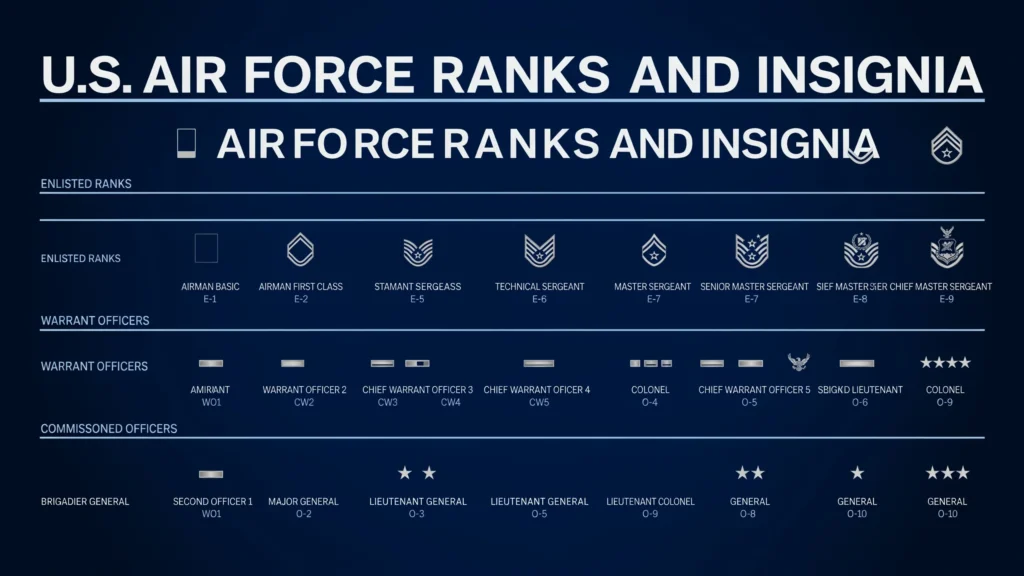
Beyond the enlisted structure, the U.S. Air Force has warrant officers and commissioned officers. Warrant officers provide specialized technical expertise, while commissioned officers lead personnel, manage organizations, plan operations, and exercise command authority according to their assignments.
Warrant Officer Ranks
The Air Force began reintroducing warrant officers in 2024, initially focusing on specialized cyber and information technology roles. This career path is designed to retain and develop technical experts without requiring them to follow the traditional commissioned officer career route.
10. Warrant Officer 1 (WO-1)
Warrant Officer 1
Warrant Officer 1 is the entry grade in the warrant officer structure. Warrant officers are intended to develop deep expertise in specialized technical fields and apply that knowledge to operational requirements.
In the Air Force's reintroduced program, the initial focus is on cyber and information technology expertise. Warrant officers can provide technical guidance, solve complex problems, and help maintain capabilities that require years of specialized experience.
11. Chief Warrant Officer 2 (CWO-2)
Chief Warrant Officer 2
Chief Warrant Officer 2 is the next grade in the warrant officer structure. Personnel at this level are expected to build on their technical experience and contribute to increasingly complex assignments within their specialty.
Warrant officers can support technical planning, advise leaders, improve systems, and help units address problems that require advanced professional knowledge. Promotion depends on applicable eligibility and selection requirements.
12. Chief Warrant Officer 3 (CWO-3)
Chief Warrant Officer 3
Chief Warrant Officer 3 is a more senior warrant officer grade associated with increasing experience and technical responsibility. Members may be expected to advise teams and leaders on difficult technical issues and contribute to the development of specialized capabilities.
As the warrant officer program develops, assignments and advancement opportunities will depend on the service's requirements, career structure, and applicable personnel policies.
13. Chief Warrant Officer 4 (CWO-4)
Chief Warrant Officer 4
Chief Warrant Officer 4 is a senior technical grade. In warrant officer career structures, personnel at this level generally bring extensive experience and can provide expert advice on systems, procedures, and specialized operations.
For the Air Force, the availability of this grade and the progression of its warrant officer program should be distinguished from the broader rank structures used by other U.S. military services.
14. Chief Warrant Officer 5 (CWO-5)
Chief Warrant Officer 5
Chief Warrant Officer 5 is the highest grade in the U.S. warrant officer rank structure. In services with established warrant officer career paths, this grade represents an exceptionally experienced technical specialist.
Although the Air Force has reintroduced warrant officers, the existence of a grade in a rank structure does not mean that the Air Force has already filled positions at every grade.
Commissioned Officer Ranks
Commissioned officers receive their commissions through authorized commissioning routes, including the U.S. Air Force Academy, Air Force Reserve Officer Training Corps (AFROTC), and Officer Training School (OTS). Their duties vary by specialty, qualifications, and assignment.
15. Second Lieutenant (O-1)
Second Lieutenant
Second Lieutenant is the entry commissioned officer rank in the U.S. Air Force. Newly commissioned officers begin developing leadership skills and learning how to apply their professional training within military organizations.
Some second lieutenants enter pilot or other aircrew training, while others work in fields such as engineering, intelligence, logistics, communications, or personnel management. Their initial duties depend on their career assignment.
16. First Lieutenant (O-2)
First Lieutenant
First Lieutenant is the second commissioned officer grade. Officers at this level typically gain experience in their specialties and take on greater responsibility for projects, personnel, or operational tasks.
For officers in aviation career fields, this period may include completing advanced training and transitioning to an operational assignment. Promotion timing is governed by applicable service rules and eligibility requirements.
17. Captain (O-3)
Captain
Captain is a mid-level company-grade officer rank. Air Force captains may serve as pilots, intelligence officers, engineers, medical professionals, cyber specialists, or supervisors of enlisted personnel.
Unlike some ground-service assignments, where captains commonly command companies, Air Force captain duties vary widely. Many focus on carrying out missions, managing specialized teams, or developing expertise in their professional fields.
18. Major (O-4)
Major
Major is the first field-grade commissioned officer rank. Officers at this level often take on broader planning, management, and staff responsibilities while drawing on their operational experience.
Majors may serve as operations officers, staff officers, program managers, or experienced specialists. Some remain closely involved in operational work while also taking on organizational leadership duties.
19. Lieutenant Colonel (O-5)
Lieutenant Colonel
Lieutenant Colonel is a senior field-grade officer rank. One important assignment for officers at this grade is command of an Air Force squadron, although not every lieutenant colonel is selected for or assigned to squadron command.
Squadrons are major operational and support units whose size and mission vary considerably. Lieutenant colonels may also hold senior staff positions, oversee programs, or lead specialized organizations.
20. Colonel (O-6)
Colonel
Colonel is a senior commissioned officer rank and the highest field-grade officer rank in the U.S. Air Force. Colonels may command groups or wings, lead major programs, or serve in senior staff roles.
A wing can include numerous squadrons, personnel, aircraft, and support functions. Selection for colonel is competitive, and officers at this grade may be considered for general officer appointments depending on their record and service needs.