
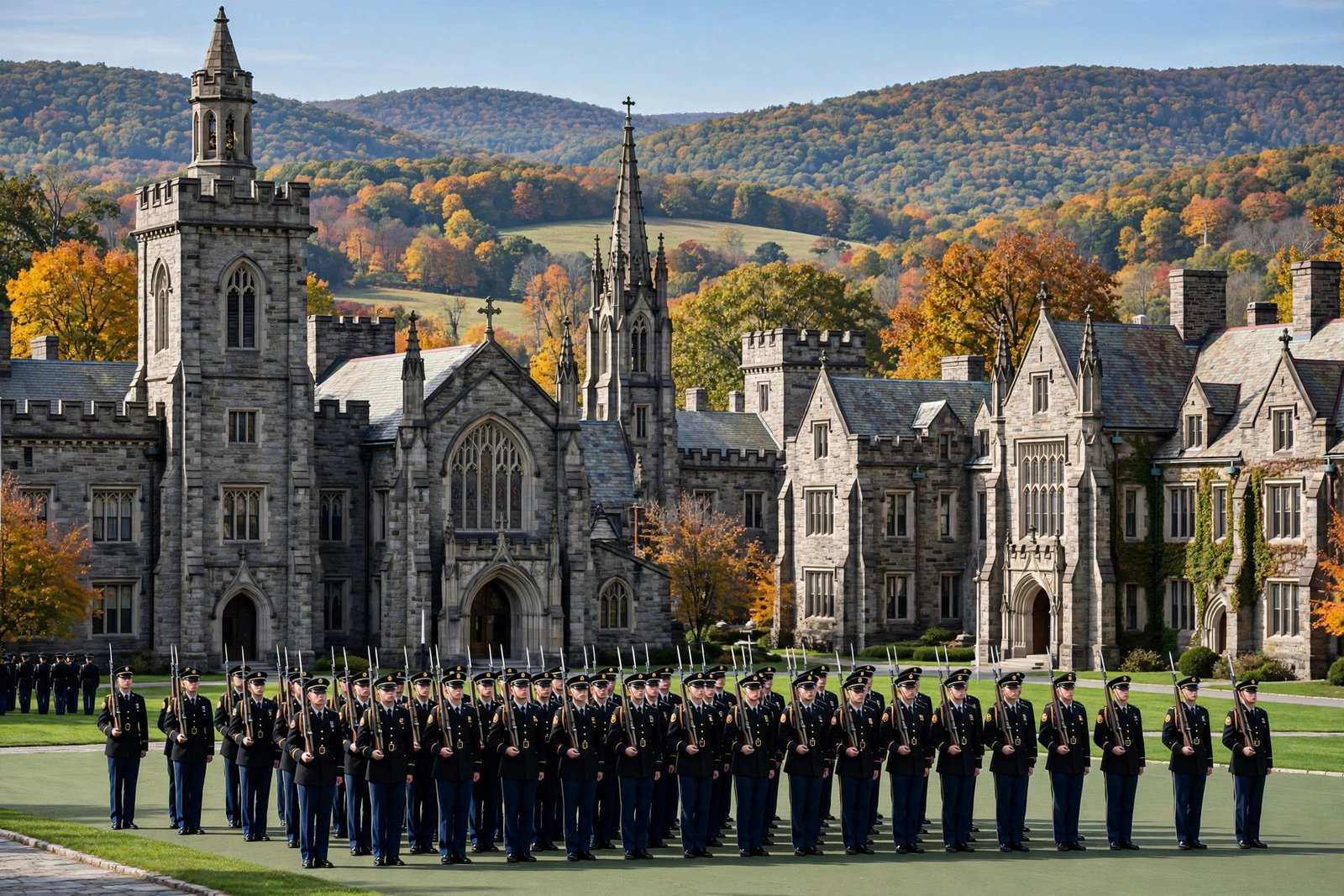
Valley Forge Military Academy and College (VFMAC)
Founded in 1928 in Wayne, Pennsylvania, Valley Forge Military Academy and College built a near-century-long reputation for forging leaders of character. This directory guide tells the full story — the Academy’s legacy and its closure in 2026, the College that carries the tradition forward, its associate-degree programmes, the Army ROTC Early Commissioning Program, admission steps, costs, career outcomes and the questions families ask most.
Directory Information
| Full name | Valley Forge Military Academy and College — the College now operates independently as Valley Forge Military College (VFMC) |
|---|---|
| Location | Wayne, Radnor Township, Pennsylvania, United States |
| Official address | 1001 Eagle Road, Wayne, PA 19087-3695 |
| Phone | Admissions: 610-989-1311 | Main: 610-989-1200 |
| Official website | https://vfmcollege.edu/ |
| Founded | 1928 (Academy); college programme added 1935–36 |
| Type | Private military junior college (formerly a combined military academy and college) |
| Motto | “Courage, Honor, Conquer” (on the school crest) |
| Cadet strength | Approximately 90–100 cadets (recent published data) |
About & History
The story of Valley Forge Military Academy and College begins in 1928, when Lieutenant General Milton G. Baker, Pennsylvania Guard (Retired), founded a military school with an American Revolutionary War soul. For the first five months of its existence the young academy sat in Devon, Pennsylvania, on the south side of Berkley Road — a modest, single-building campus in the former Devon Park Hotel, several miles from where the school would ultimately take root.
Then came the night of 17–18 January 1929, when fire destroyed that original campus. The academy was moved to its present site in Wayne, Pennsylvania, the former Saint Luke’s School. In tribute to the heroism of the first Corps of Cadets on the night of the fire, the institution created its highest decoration, the Order of Anthony Wayne — named for the Revolutionary War hero whose name also graces one of the campus buildings.
General Baker gave the school a deliberate and distinctive identity. The colours were buff and blue, the colours of the Continental Army’s uniforms; the Wayne campus buildings were named for Revolutionary War leaders; and the uniforms, crest, Alma Mater and cadet rank structure were modelled on those of the United States Military Academy at West Point. During the 1935–36 school year, Baker expanded the academy to include a two-year college programme — the first college cadets joined the Corps that year — and the school became known as Valley Forge Military Academy and Junior College.
Over the decades the college earned recognition from the United States Department of Defense as one of the nation’s four military junior colleges — and the only one in the North-East — and it evolved into a co-educational institution. In 2023, after nearly a century of shared history, the Academy and the College separated into two independent institutions, each with its own board of trustees, leadership and accreditation. In May 2026, following the graduation of its 98th Corps of Cadets, Valley Forge Military Academy concluded operations by decision of its independent board, closing the chapter on 98 years of cadet life on Eagle Road.
The College carries on. Valley Forge Military College — “The Military College of Pennsylvania” — remains open in Wayne, fully independent and accredited by the Middle States Commission on Higher Education, accepting applications on a rolling basis. It still offers associate degrees inside a structured Corps of Cadets, and it remains one of the very few places in America where a cadet can commission as a second lieutenant in the United States Army after just two years of college.
Programmes Offered
Valley Forge Military College is a two-year college: cadets earn an Associate of Arts (A.A.) or Associate of Science (A.S.) degree, or complete a one-year undergraduate certificate. Degrees require a minimum of 60 credits, 12 credits per semester and a cumulative GPA of 2.0. The student–faculty ratio is a genuinely personal 10:1, and every cadet belongs to the structured Corps of Cadets while studying.
Associate of Arts (A.A.) programmes
- Behavioral and Social Science
- Criminal Justice
- History
- Liberal Arts
- Political Science
- National Security
Associate of Science (A.S.) programmes
- Business Administration
- Computer Science
- Construction Management
- Cybersecurity
- Engineering and Physical Sciences
- Health Science
- Mathematics
- Pre-Nursing
One-year undergraduate certificates
- Cybersecurity
- Digital Forensics
Alongside academics runs the military track: Army ROTC, including the prestigious Early Commissioning Program (ECP), in which cadets train to commission as second lieutenants after two years. Students who prefer a military-modelled education without a service obligation can choose the Citizen Leader Pathway instead — a traditional college education within the Corps of Cadets, developing leadership, self-discipline and ethical decision-making for civilian careers or transfer to a four-year university.
Admission Requirements
VFMC accepts applications on a rolling basis for January or September enrolment, and the College is committed to notifying applicants of its decision within one week of receiving a completed application. The requirements are straightforward but the standards are high:
- School records: a completed application, after which the College requests transcripts and evaluation forms from the candidate’s present school. No acceptance decision can be made until this information arrives.
- Standardised testing: SAT or ACT scores support the application (the College publishes its test codes for prospective students); international applicants use the TOEFL code 002955.
- Medical fitness: applicants should be physically fit and free from any factors that could limit full participation in cadet life. Every student must submit a recent physical examination (within the last six months) with updated immunisation records; medication use must be verified in writing by the prescribing physician, and any history of counselling or therapy requires a clinical summary.
- Residential life: the College is an immersive residential experience — all first-year cadets live in barracks-style housing with a roommate, and second-year students move into two-person, fully equipped campus apartments.
- Co-educational: VFMC is a fully co-educational, military-modelled college; the programme is described as in no way gender-based.
How to Apply: Step by Step
- Visit the campus. The best way to know if VFMC fits is to see it. Attend an open house or schedule a campus visit — visits are held Monday to Friday, 9:00 a.m. to 3:00 p.m., with Saturdays available by appointment.
- Submit your application. Complete the online application form for college enrolment. Applications are accepted on an ongoing basis for January or September entry — and the earlier you apply, the earlier you can be accepted and considered for scholarships.
- Complete your file. Once your application is received, the College will request transcripts and evaluation forms from your present school. A decision cannot be rendered until this information arrives, so respond to your admissions counsellor’s requests promptly.
- Meet the medical requirements. Arrange a physical examination with your physician (within the last six months), update all immunisations, and submit any required medication or counselling documentation to the Health Center before arrival.
- Receive your decision. VFMC commits to notifying you within one week of receiving your completed application, with written notification by post. Early Decision applicants face a 15 October deadline, with decisions mailed by 1 November and deposits due by 15 December.
- Secure your place and plan your finances. A $500 deposit is required upon acceptance, credited toward tuition (Early Decision cadets may choose a $2,500 scholarship or a reduced $100 deposit instead). Then file the FAFSA (VFMC code 003386) and talk to the Financial Aid Office on 610-989-1467 about ROTC scholarships, federal and state aid, and the Pennsylvania Pledge.
Tuition & Costs
The College publishes a full cost of attendance each year. The official 2025–26 figures from the VFMC Course Catalog (figures below; always confirm the current year’s rates with the College before applying):
| 2025–26 cost of attendance | Full year | Per semester |
|---|---|---|
| Total | $53,987 | $27,294 |
| Tuition | $30,976 | $15,488 |
| Housing | $9,450 | $4,725 |
| Food | $7,550 | $3,775 |
| Miscellaneous | $600 | $600 |
| Personal miscellaneous | $2,262 | $1,131 |
| Transportation | $1,251 | $626 |
| Estimated fees (books, supplies, loan fees) | $1,898 | $949 |
Returning cadets pay a $250 re-enrolment fee each year. Fall semester payment is due by 1 August and spring by 1 December; payments can be made by check, money order, wire transfer, cash or credit card (a 3% fee applies to credit cards).
Service & Career Outcomes
Valley Forge’s signature outcome is the Early Commissioning Program: ECP cadets commission as second lieutenants in the United States Army after just two years of college, instead of the usual four — one of only four military junior colleges in the nation offers this route. ECP students link with Pennsylvania Army National Guard units matched to their interests, such as aviation or engineers, giving them real unit experience long before most ROTC cadets see it. After commissioning, the new lieutenants serve in the Army Reserve or National Guard while completing their bachelor’s degrees at four-year institutions — and lieutenants who later enter active duty do so at a higher grade and higher pay than officers commissioned through the traditional four-year route.
For cadets who do not take the ECP path, the College reports a 100% transfer placement rate: every cadet must transfer to a four-year institution to complete the bachelor’s degree (Citizen Leaders excepted, who may head straight into civilian careers), and VFMC credits are transferable. Graduates transfer on to four-year universities and the federal service academies, while Citizen Leader Pathway graduates carry disciplined leadership training into civilian professions.
The experience itself is part of the outcome. With a 10:1 student–faculty ratio, barracks-to-apartment residential progression, Trojans athletics competing at the collegiate level, and a Corps of Cadets that has trained leaders since 1928, cadets leave with leadership practice — not just leadership theory — on their record. ROTC scholarships, federal and state financial aid, the GI Bill and parent-transfer benefits all help make that experience affordable.
Frequently Asked Questions
Is Valley Forge Military Academy still open?
No. Valley Forge Military Academy — the high-school division — concluded operations in May 2026 following the graduation of its 98th Corps of Cadets, by decision of its independent board of trustees. Valley Forge Military College continues to operate fully and independently on the same Wayne, Pennsylvania campus, accepting applications on a rolling basis.
Can I really become an Army officer in two years?
Yes, through the Army ROTC Early Commissioning Program. ECP cadets commission as second lieutenants in the U.S. Army after completing two years at VFMC, rather than the typical four years at a traditional university. They then serve in the Army Reserve or National Guard while finishing their bachelor’s degrees at four-year institutions within the programme’s requirements.
Do I have to join the military after graduating?
No. The Citizen Leader Pathway gives students a traditional college education inside the Corps of Cadets with no military service obligation — ideal preparation for civilian careers or transfer to a four-year university. Only ECP cadets take on a commissioning obligation.
What does Valley Forge Military College cost?
The official 2025–26 cost of attendance is $53,987 for the full year ($27,294 per semester), covering tuition, housing, food, miscellaneous expenses and estimated fees. Pennsylvania residents in the Citizen Leader Pathway may qualify for the Pennsylvania Pledge, which meets 100% of demonstrated financial need. ROTC scholarships, GI Bill benefits and federal and state aid are also available.
Where do cadets live?
The College is fully residential. All first-year cadets live in barracks-style housing with a roommate; second-year students move into refinished two-person, fully equipped apartments on campus.
Does the College admit women?
Yes. Valley Forge Military College is a fully co-educational, military-modelled institution — the College describes its programme as in no way gender-based, with cadet life, housing and leadership opportunities open to all cadets.
Ready to take the next step?
Start at vfmcollege.edu, contact the Admissions Office at admissions_college@vfmac.edu or call 610-989-1311. The Financial Aid Office can be reached on 610-989-1467.
Facts in this guide were verified against Valley Forge Military College’s official websites (vfmcollege.edu and vfmac.edu) and its official 2025–26 Course Catalog in October 2026. Always confirm current deadlines, costs and enrolment status with the College directly before applying.