
The United States Army uses one of the most recognisable rank systems in the world. Whether you are considering enlistment, preparing for a commission, or simply trying to read the insignia on a soldier’s uniform, this guide lists every US Army rank from Private (E-1) to General (O-10), with official insignia images, pay grades, typical responsibilities, and how promotion works in each tier.
Army ranks fall into three broad groups: commissioned officers (O-1 to O-10), who lead and command; warrant officers (W-1 to W-5), who are technical specialists; and enlisted soldiers (E-1 to E-9), who form the backbone of the force and include the non-commissioned officers (NCOs) who run day-to-day operations.
US Army Officer Ranks (O-1 to O-10)
Commissioned officers earn their commission through the US Military Academy at West Point, ROTC programmes, or Officer Candidate School (OCS). Company-grade officers (O-1 to O-3) lead small units directly; field-grade officers (O-4 to O-6) command battalions and brigades or serve as senior staff; general officers (O-7 to O-10) lead divisions, corps, and entire theatres.
| Insignia | Rank | Pay Grade | Typical Role |
|---|---|---|---|
 | Second Lieutenant (2LT) | O-1 | Platoon leader (16–44 soldiers); the Army’s entry-level officer rank |
 | First Lieutenant (1LT) | O-1 | Platoon leader or company executive officer; usually promoted automatically after ~18 months |
 | Captain (CPT) | O-2 | Company commander (60–200 soldiers); the first rank with real independent command |
 | Major (MAJ) | O-3 | Battalion executive officer or brigade staff officer; first field-grade rank |
 | Lieutenant Colonel (LTC) | O-4 | Battalion commander (300–1,000 soldiers) |
 | Colonel (COL) | O-5 | Brigade commander (3,000–5,000 soldiers) or division chief of staff |
 | Brigadier General (BG) | O-6 | Deputy division commander or brigade-level command; first general-officer rank |
 | Major General (MG) | O-7 | Division commander (10,000–15,000 soldiers) |
 | Lieutenant General (LTG) | O-8 | Corps commander (20,000–45,000 soldiers) |
 | General (GEN) | O-9 | Theatre army commander or Army Chief of Staff; the highest peacetime rank |
Note: The five-star rank of General of the Army exists only in wartime and has not been awarded since 1950. Its insignia (five stars in a circle) is shown here for reference: 
US Army Warrant Officer Ranks (W-1 to W-5)
Warrant officers are a separate track for deep technical specialists — helicopter pilots, intelligence technicians, cyber experts, and maintenance masters. They rank above all enlisted soldiers but below commissioned officers. There are five grades: Warrant Officer 1 (WO1), Chief Warrant Officer 2 through 5 (CW2, CW3, CW4, CW5). A CW5 is the Army’s senior technical authority in their field, often advising generals.
Per-rank warrant insignia images were not available from verified sources at the time of writing.
US Army Enlisted Ranks (E-1 to E-9)
Enlisted soldiers make up roughly 80% of the Army. The junior enlisted grades (E-1 to E-4) are the doers; non-commissioned officers (E-5 to E-9) are the leaders who train, discipline, and mentor them. The NCO corps is often called the backbone of the Army.
| Insignia | Rank | Pay Grade | Typical Role |
|---|---|---|---|
| No insignia | Private (PVT) | E-1 | New recruit in basic training; wears no rank insignia |
 | Private (PV2) | E-2 | Single chevron; usually automatic after 6 months of service |
 | Private First Class (PFC) | E-3 | Experienced junior soldier beginning to mentor privates |
 | Specialist (SPC) | E-4 | Technical expert track; same pay as Corporal but without NCO authority |
 | Corporal (CPL) | E-4 | Junior NCO; leads a small team, the first leadership rank |
 | Sergeant (SGT) | E-5 | Team leader (4–10 soldiers); the backbone NCO rank |
 | Staff Sergeant (SSG) | E-6 | Squad leader (8–16 soldiers) |
 | Sergeant First Class (SFC) | E-7 | Platoon sergeant; senior tactical advisor to the platoon leader |
 | Master Sergeant (MSG) | E-8 | Senior technical NCO at battalion level and above |
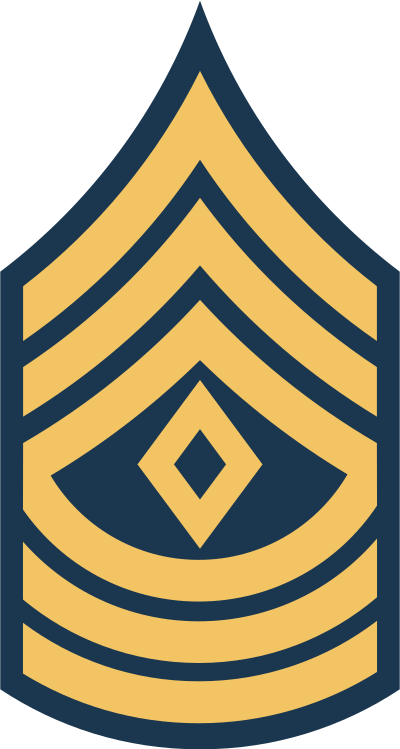 | First Sergeant (1SG) | E-8 | Senior enlisted leader of a company; the commander’s right hand |
 | Sergeant Major (SGM) | E-9 | Senior staff NCO at battalion level and above |
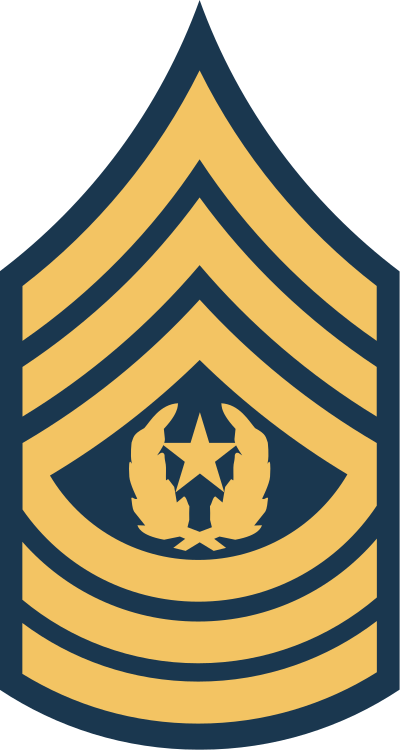 | Command Sergeant Major (CSM) | E-9 | Senior enlisted advisor to a battalion, brigade, or division commander |
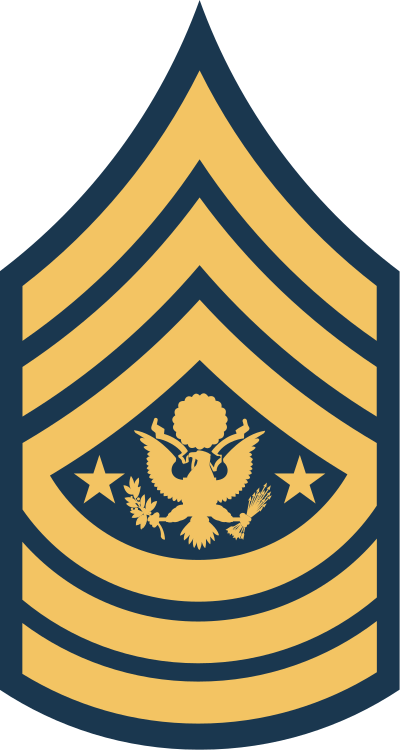 | Sergeant Major of the Army (SMA) | E-9 | The Army’s single most senior enlisted soldier; advisor to the Chief of Staff |
How Promotion Works
Junior enlisted promotions (E-1 to E-4) are largely automatic based on time in service and time in grade. From E-5 upward, soldiers compete on a points system combining weapons qualification, fitness scores, awards, education, and board appearances. Officers are promoted by centralised selection boards, with “below the zone”, “in the zone”, and “above the zone” consideration windows. Warrant officers are selected by specialised boards within their technical branch. Time-in-service requirements lengthen sharply at senior grades — reaching Sergeant Major typically takes 15–20 years.
How to Read Army Insignia
Officer insignia follows a simple visual logic once you know the code. Junior officers wear bars: a gold bar for Second Lieutenant, a silver bar for First Lieutenant, two silver bars for Captain. Field-grade officers wear oak leaves: gold for Major, silver for Lieutenant Colonel. A full Colonel wears the silver eagle — soldiers joke that a Colonel is “as high as an eagle flies”. General officers wear stars: one for Brigadier General, two for Major General, three for Lieutenant General, four for General.
Enlisted insignia is built from chevrons (the V-shaped stripes). Each chevron broadly marks a step: one for Private E-2, two for Private First Class, three for Sergeant. From Staff Sergeant upward, rockers (curved bars beneath the chevrons) are added, and senior NCO ranks add a star between the chevrons and rockers. The Sergeant Major of the Army’s insignia adds a distinctive coat of arms. Specialist insignia is unique — a green disc with an eagle device — deliberately different from the Corporal’s chevrons to signal the technical rather than leadership track.
Officers, Warrant Officers, and NCOs: How the Three Tiers Work Together
The Army’s leadership model splits responsibility three ways, and understanding the split explains a lot about how the service actually runs. Commissioned officers own the mission: they set objectives, make decisions, and bear ultimate responsibility. A Captain decides what the company must achieve. Warrant officers own deep expertise: the CW4 Apache pilot or cyber technician advises commanders on what is technically possible and executes the hardest specialist tasks. Non-commissioned officers own execution: the Sergeant and the Platoon Sergeant turn the officer’s intent into trained, disciplined action by individual soldiers.
This is why the relationship between a young officer and a senior NCO is so important in Army culture. A Second Lieutenant fresh from training may legally outrank everyone in the platoon except no one — but the Sergeant First Class beside them has a decade of experience. The Army’s doctrine explicitly expects officers to seek their NCOs’ counsel. Units where that partnership works are the ones that perform.
FAQs
What is the highest rank in the US Army?
General (four stars, O-10) is the highest peacetime rank. The five-star General of the Army exists by law but is awarded only in wartime; it was last held in 1950.
What is the difference between a Specialist and a Corporal?
Both are pay grade E-4, but a Corporal is a non-commissioned officer with leadership authority, while a Specialist is on the technical track and has no formal command authority over other soldiers.
Do officers outrank all enlisted soldiers?
Yes — even a newly commissioned Second Lieutenant technically outranks the Sergeant Major of the Army. In practice, wise young officers lean heavily on their senior NCOs’ experience.
What does a Warrant Officer do?
Warrant officers are technical masters — Apache pilots, cyber operators, intelligence technicians. They stay in one specialty for their whole career rather than rotating through command assignments like commissioned officers.
How long does it take to become a Sergeant (E-5)?
Typically 2–4 years, depending on the soldier’s military occupational specialty, promotion points, and unit vacancies. High-demand jobs promote faster.
Image credits: Rank insignia images via Wikimedia Commons, public domain as works of the United States federal government.