
The United States Navy organises its people differently from the Army or Air Force, and its language reflects centuries of seafaring tradition. Officers are ranked O-1 to O-10; enlisted sailors hold rates (E-1 to E-9) rather than ranks, and each sailor also carries a rating — their occupational specialty, such as Boatswain’s Mate or Hospital Corpsman. This guide covers every US Navy officer rank with insignia images, explains the enlisted rating system, and shows how promotion works at sea and ashore.
US Navy Officer Ranks (O-1 to O-10)
Navy officers wear their rank as sleeve stripes on dress uniforms — gold bands around the cuff, with the number and width of stripes marking seniority. Junior officers (O-1 to O-3) serve as division officers aboard ships; mid-grade officers (O-4 to O-6) command ships, squadrons, and submarines; flag officers (O-7 to O-10) command fleets and naval regions.
| Insignia | Rank | Pay Grade | Typical Role |
|---|---|---|---|
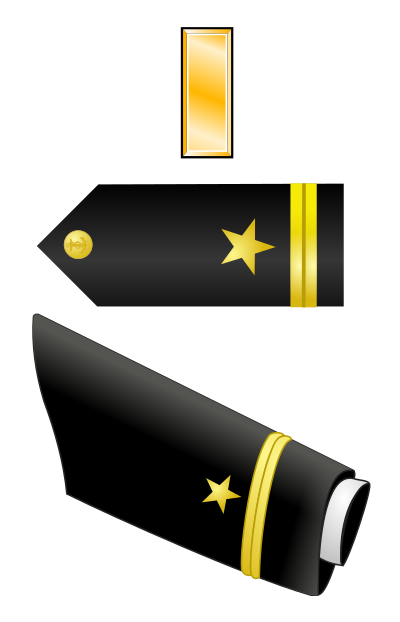 | Ensign (ENS) | O-1 | Division officer aboard ship; the Navy’s entry-level commissioned rank |
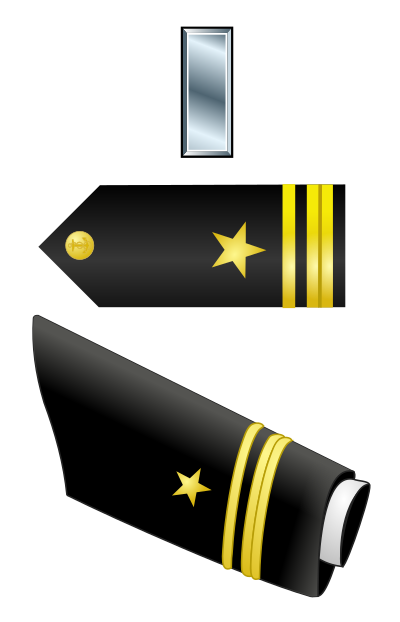 | Lieutenant Junior Grade (LTJG) | O-2 | Division officer with greater responsibility; usually automatic after 2 years |
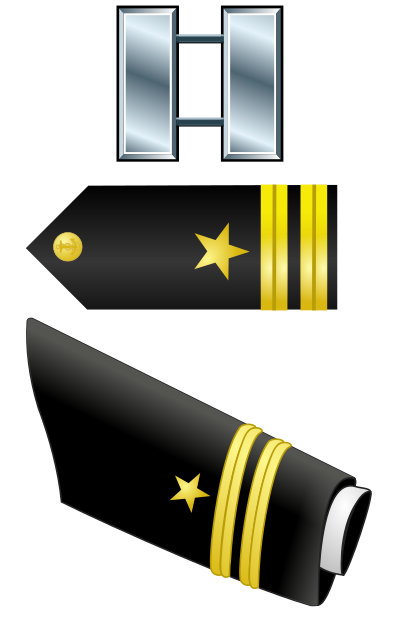 | Lieutenant (LT) | O-3 | Department head on smaller ships; may command a patrol craft |
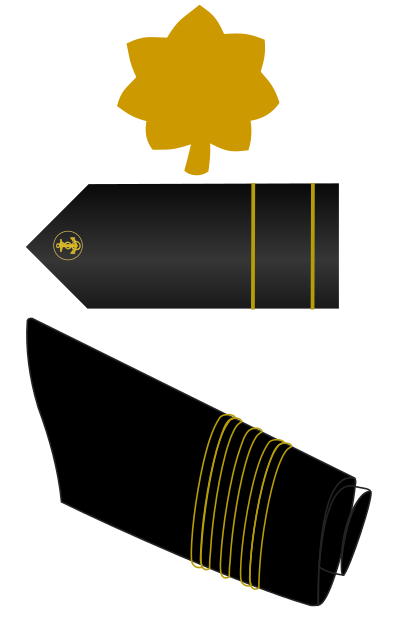 | Lieutenant Commander (LCDR) | O-4 | Executive officer of smaller vessels; department head on large ships |
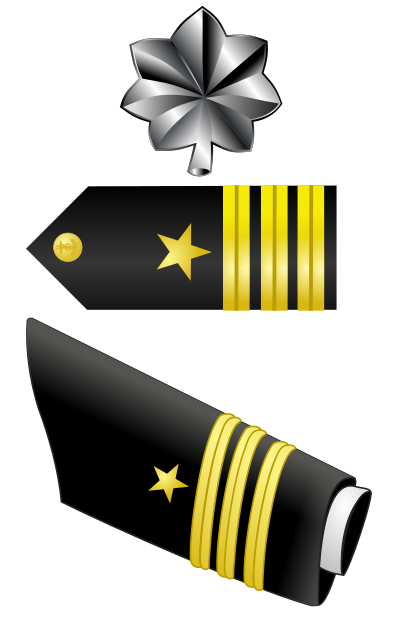 | Commander (CDR) | O-5 | Commanding officer of destroyers, frigates, and submarines |
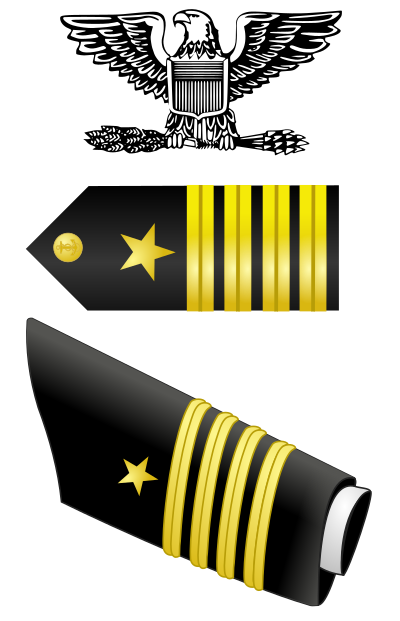 | Captain (CAPT) | O-6 | Commanding officer of cruisers, carriers, and major shore installations |
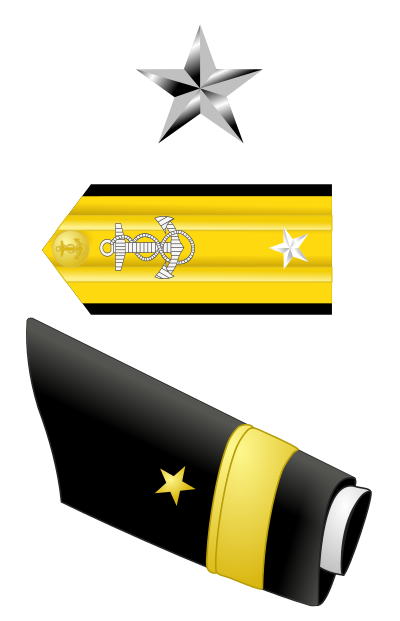 | Rear Admiral Lower Half (RDML) | O-7 | Strike group deputy commander or programme manager; one star |
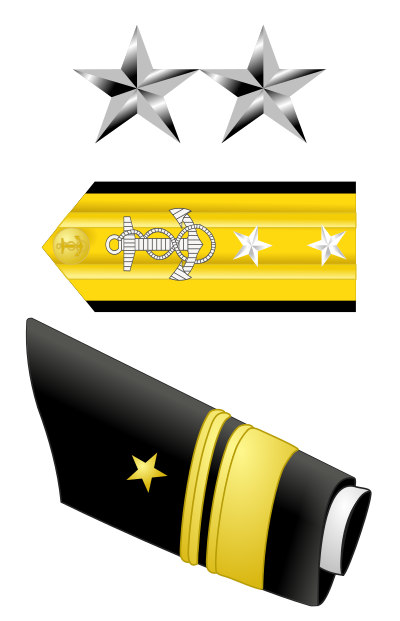 | Rear Admiral (RADM) | O-8 | Carrier strike group commander; two stars |
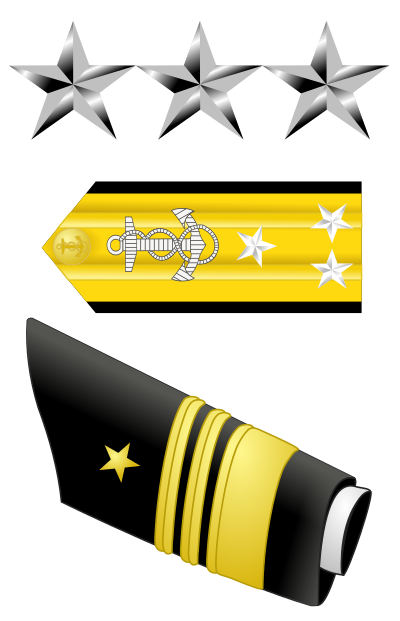 | Vice Admiral (VADM) | O-9 | Numbered fleet commander; three stars |
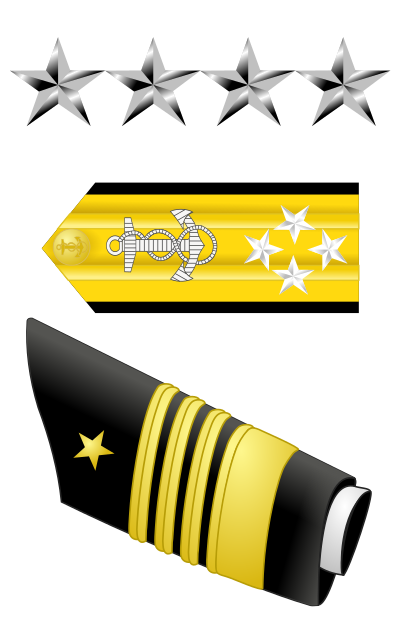 | Admiral (ADM) | O-10 | Chief of Naval Operations or combatant commander; four stars |
Line officers — those qualified in warfare specialties like surface, submarine, or aviation — wear a star above their sleeve stripes. Staff corps officers (supply, medical, chaplain, JAG, civil engineer) wear their corps device instead, such as the oak leaf of the Supply Corps or the caduceus of the Medical Corps.
US Navy Enlisted Rates (E-1 to E-9)
Navy enlisted sailors are addressed by the combination of their rate (pay grade) and rating (job). A “BM2” is a Boatswain’s Mate Second Class — an E-5 in the boatswain’s mate rating. This is unique among US services and a constant source of confusion for outsiders.
| Rate | Pay Grade | Title Pattern | Typical Role |
|---|---|---|---|
| Seaman Recruit (SR) | E-1 | — | New recruit in boot camp; wears no insignia |
| Seaman Apprentice (SA) | E-2 | — | Striker training for a rating |
| Seaman (SN) | E-3 | — | Qualified in basic seamanship duties |
| Petty Officer Third Class (PO3) | E-4 | [Rating] + “Third Class” | Junior petty officer; first leadership level |
| Petty Officer Second Class (PO2) | E-5 | [Rating] + “Second Class” | Work-centre supervisor |
| Petty Officer First Class (PO1) | E-6 | [Rating] + “First Class” | Leading petty officer of a division |
| Chief Petty Officer (CPO) | E-7 | “Chief [Rating]” | Deckplate leader; the revered “Chief” — wears khakis like officers |
| Senior Chief Petty Officer (SCPO) | E-8 | Senior enlisted leader at department level | |
| Master Chief Petty Officer (MCPO) | E-9 | Senior enlisted advisor; command master chiefs advise commanding officers directly | |
| Master Chief Petty Officer of the Navy (MCPON) | E-9 | — | The single most senior enlisted sailor; advisor to the Chief of Naval Operations |
Note on images: unlike officers, enlisted sailors wear rating badges — an eagle (“crow”) above chevrons with their rating’s specialty mark between them — rather than a single per-rank device. Because each rating has its own badge, no single per-rank image set exists; per-rank insignia images are therefore omitted for enlisted rates in this article.
Rating vs Rank: The Navy’s Special Vocabulary
In the Navy, rank properly refers only to officers. Enlisted sailors hold a rate (their pay grade level) and a rating (their job). There are dozens of ratings — Aviation Boatswain’s Mate, Culinary Specialist, Information Systems Technician, and many more. A sailor’s full title fuses both: an E-6 Culinary Specialist is a “Culinary Specialist First Class”, or CS1. Sailors who have not yet chosen a rating are called “undesignated” and wear striped insignia without a specialty mark. This system dates to the age of sail, when a man’s “rating” was literally the job the ship’s books rated him for.
Line vs Staff Corps Officers
Navy officers belong to either the line or a staff corps. Unrestricted line officers — surface warfare, submariners, aviators, SEALs — are eligible to command ships and combat units at sea. Restricted line officers serve in specialties like intelligence or engineering duty. Staff corps officers are the professionals: doctors, dentists, nurses, chaplains, lawyers, and supply officers. A useful rule of thumb: only line officers command warships, and only the most senior line officers become admirals in operational commands.
How Promotion Works
Enlisted advancement to E-4 through E-6 runs on a final multiple system combining exam scores, performance evaluations, awards, and time in service — sailors literally compete against quotas set by the Navy’s manpower needs. Advancement to Chief (E-7) adds a selection board that reviews the whole record; making Chief is a career milestone celebrated with a pinning ceremony and the transition to khaki uniforms. Officer promotions follow centralised boards similar to the other services, with command at sea — particularly command of a ship — being the defining career gate for line officers.
A Note on Recent Rank Changes
The Navy’s flag ranks carry a quirk worth knowing: Rear Admiral is split into two grades — Lower Half (one star, O-7) and Upper Half (two stars, O-8). From 1985 to the early 2000s the one-star grade was called “Commodore Admiral” and then simply “Commodore”, before the Navy settled on the current Lower Half/Upper Half naming. You will still occasionally hear old salts say “Commodore” for the one-star. The substantive Commodore title also survives as a positional title for officers commanding squadrons of ships or submarines, regardless of their actual rank — one of many places where Navy tradition overrules tidy logic.
FAQs
Why does the Navy say “rate” instead of “rank” for enlisted sailors?
It is a tradition from the sailing era: a sailor was “rated” for a shipboard job in the ship’s books. Officers hold rank; enlisted sailors hold a rate (pay grade) plus a rating (job specialty).
What is the difference between a Commander and a Captain in the Navy?
A Commander (O-5) typically commands destroyers, frigates, or submarines. A Captain (O-6) — not to be confused with an Army Captain, who is a junior officer — commands cruisers, aircraft carriers, and major shore commands. Navy Captain is a senior rank.
What does the star above an officer’s sleeve stripes mean?
The star marks an unrestricted line officer qualified in a warfare specialty. Staff corps officers wear their corps device (such as a medical caduceus) in that position instead.
How does someone become a Navy SEAL officer?
SEAL officers come through the same commissioning sources as other line officers, then volunteer for and pass BUD/S training and SEAL Qualification Training — among the most demanding pipelines in the US military.
What is a “Frocked” officer?
Frocking is when an officer selected for promotion wears the higher rank’s insignia before the promotion (and its pay) officially takes effect — common when filling a billet that requires the senior rank.
Image credits: Rank insignia images via Wikimedia Commons, public domain as works of the United States federal government.