Forces Guide · Camouflage Guide
Camouflage is the art of not being seen — and for modern armies it is a science of pattern, colour and compromise. The swirling prints on a soldier’s uniform are far more than decoration: each one is engineered to break up the human shape against a particular landscape, season and light.
No two countries hide their soldiers in quite the same way. Some trust the classic greens and browns of the forest, others have gone fully digital with computer-designed pixels, and a few issue uniforms that try to work everywhere at once. This guide tours the main military camouflage patterns around the world — woodland, desert, digital, MultiCam, arctic and night — and explains which forces use what, and why.
Why Soldiers Wear Patterns, Not Colours
Solid olive green or khaki was the first step away from the bright colours of the nineteenth century, and it worked well enough when battles happened at long range across open ground. But a solid-coloured silhouette still reads as a solid shape to the eye, and shape is exactly what human vision hunts for. A good disruptive pattern breaks the body’s outline into patches that match the background: dark shapes suggest shadow and depth, light shapes suggest bare earth and dry foliage, and the boundary between them dissolves the outline of shoulders, helmet and rifle.
Camouflage also has to work at different distances. Large blotches dominate what an observer sees from far away, while small details matter at close quarters. That tension between big “macro” shapes and fine “micro” detail is why modern patterns combine sweeping forms with speckles and grain, and why the perfect all-terrain pattern remains an elusive prize that designers have chased for a century.
Woodland Patterns: The Forest Classics
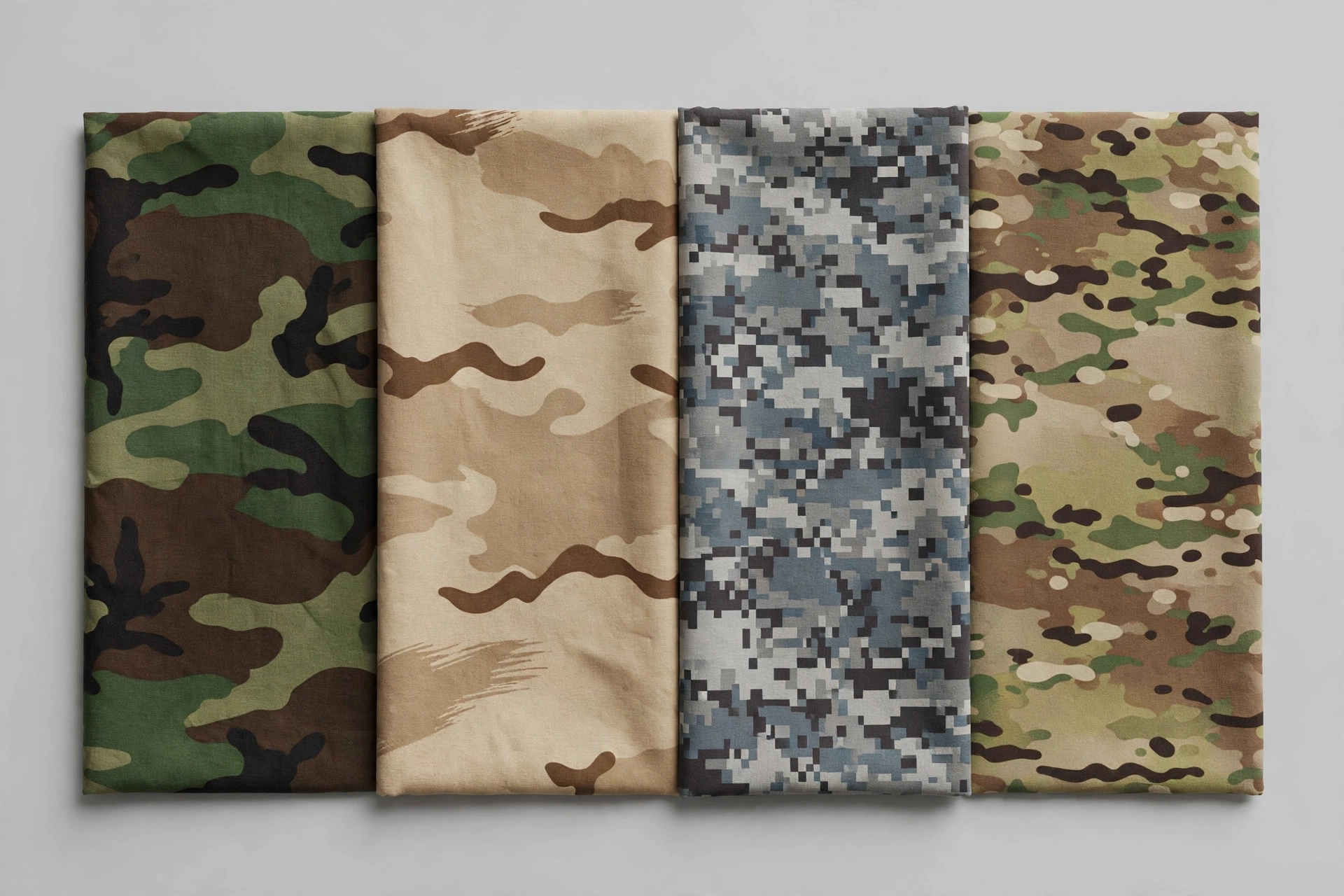
Woodland camouflage is the family most people picture: bold, leaf-like blotches of green, brown and black scattered over a lighter base. Britain formalised the idea with its Disruptive Pattern Material (DPM), worn in evolving forms from the 1960s until the 2010s, while Germany took a different route with Flecktarn — thousands of tiny multi-coloured flecks that blur the wearer into dappled undergrowth. The United States standardised the M81 Woodland pattern in 1981, and it became the world’s most widely copied camouflage, still seen today from Latin America to Southeast Asia. France’s centre-Europe (CCE) pattern and Russia’s various flora designs kept the same leafy logic.
Woodland patterns excel in temperate forest, where layered greens and deep shadow dominate the view. Their weakness is the reverse of their strength: on dry, pale or urban ground those same dark, saturated colours stand out sharply — which is why most armies that operate beyond the forest eventually bought something else.
Desert Patterns: Hiding in Sun and Sand
Desert camouflage strips the palette back to tans, sands and soft browns, and swaps leafy curves for broad, dusty shapes. The United States demonstrated the idea during the 1991 Gulf War with the six-colour “chocolate chip” pattern — sandy ground flecked with dark and light dots — before moving to the smoother three-colour desert design that followed. Britain produced a desert version of DPM, France fielded its Daguet pattern in the Gulf, and armies across the Middle East — including Pakistan, Saudi Arabia and Egypt — adopted sandy schemes suited to rock, dust and scrub.
Desert patterns face a particular trap: real deserts are not uniformly beige. Shadowed wadis, dark volcanic rock and sparse green shrubs mean a pattern that is too pale can glow against broken ground. Successful desert designs therefore keep a spread of mid-tones and enough contrast to confuse the eye at rifle range, rather than simply matching the lightest sand.
Digital Patterns: MARPAT and the Pixel Revolution
In the late 1990s, camouflage went computerised. Canada led the way with CADPAT, the first widely issued pixelated design, and the United States Marine Corps followed in 2002 with MARPAT — a pattern of tiny rectangles designed to mimic the way nature repeats itself at every scale. MARPAT came in woodland and desert versions, complete with tiny embedded Marine Corps emblems, and it made the Marines instantly recognisable. The US Army’s answer, the grey-green Universal Camouflage Pattern (UCP), proved far less successful in Afghanistan and was quietly replaced. Russia developed its own pixelated EMR pattern, nicknamed “digital flora”, while China, Jordan and many others fielded digital designs of their own.
Pixelation is not magic, but at typical combat distances the fine dithering softens edges in a way smooth shapes struggle to match. The digital era also revived an old idea: camouflage is as much about identity as concealment. Services now protect their patterns almost like trademarks, and rival branches deliberately choose designs that set them apart on the battlefield and in photographs.
MultiCam and Multi-Terrain Patterns
If digital was a revolution, MultiCam was the compromise that conquered the world. Developed in the United States by Crye Precision and unveiled in 2002, MultiCam blends seven colours — soft greens, browns and tans merging through gentle gradients — to sit comfortably in woodland, scrub, desert and everything between. Special forces loved it, and officialdom followed: the US Army replaced UCP with the closely related Operational Camouflage Pattern (OCP), Britain created its Multi-Terrain Pattern (MTP), which mixes MultiCam’s colour palette with shapes inherited from DPM, and Australia adopted its own multicam-derived AMCU. France’s new Bariolage Multi-Environnement (BME) follows the same multi-environment philosophy.
The appeal is logistical as much as tactical: one pattern means one supply chain, one set of matching kit and no last-minute guessing about which uniform a deployment will need. Critics point out that a jack of all trades is master of none — in deep jungle or open snow, dedicated patterns still win — but for general-purpose forces, the multi-terrain route has become the default answer of the 2020s.
Arctic, Snow and Night Camouflage
Extreme environments demand extreme solutions. Snow camouflage is the simplest-looking and the hardest to get right: pure white over-garments, worn over insulated layers, erase the soldier against snowfields, while transitional patterns add sparse grey or green speckling for patchy thaw ground. Such kit is standard for forces in Finland, Sweden, Canada and Russia, and for mountain troops worldwide. At the other end of the light scale, the American “night desert” pattern of the 1980s and 1990s was designed to defeat early night-vision sights: a grid of dark shapes over a green base that disrupted the tell-tale blob a soldier makes through an image intensifier.
Modern night operations rely less on printed cloth and more on controlling infrared reflection, using fabrics treated so they do not shine under night-vision devices. Navies have their own niche, too: several have trialled blue-grey “sea” patterns, although many sailors still wear plain navy working dress — the open ocean being rather forgiving of silhouettes.
Who Uses What: Patterns Around the World
Patterns change often, and special forces frequently wear something different from the general issue. This snapshot shows the main general-issue designs of some of the world’s most watched armies.
| Country / force | Main pattern | Family |
|---|---|---|
| United States Army | OCP (Operational Camouflage Pattern) | Multi-terrain |
| US Marine Corps | MARPAT (woodland and desert) | Digital |
| United Kingdom | MTP (Multi-Terrain Pattern) | Multi-terrain |
| Germany | Flecktarn, with Multitarn being phased in | Woodland fleck |
| France | CCE woodland, with BME replacing it | Woodland → multi-terrain |
| Russia | EMR (“digital flora”) | Digital |
| Canada | CADPAT | Digital |
| Australia | AMCU | Multi-terrain |
| Pakistan | Woodland and desert variants by service | Woodland / desert |
| China | Type 07 and newer “starry sky” designs | Digital |
Did You Know?
- The word camouflage comes from the French verb camoufler — to disguise — and entered military English during the First World War.
- Britain’s First World War “dazzle” ships were not trying to hide: their wild patterns were meant to confuse enemy rangefinders about a ship’s course and speed.
- CADPAT made Canada the first country to field a computer-designed, pixelated pattern across an entire force.
- Some patterns hide a signature: MARPAT contains tiny Marine Corps emblems woven into the design.
The Future of Camouflage
The next generation of camouflage may not be printed cloth at all. Researchers are testing fabrics that shift colour like a chameleon, thermal camouflage that hides a soldier’s heat signature from drones, and materials engineered to behave differently in the near-infrared. Unmanned aircraft and cheap sensors have changed the problem completely: hiding from the human eye is no longer enough when cameras watch in thermal, ultraviolet and radar bands all at once. Even so, printed patterns will be with us for decades, because they are cheap, tough and need no power. Expect the big families — woodland, desert, digital and multi-terrain — to keep evolving quietly, one procurement contract at a time, while the science of not being seen moves steadily into wavelengths the eye cannot reach.
Frequently Asked Questions
What is the most common camouflage pattern in the world?
MultiCam-style multi-terrain designs are now among the most widespread, worn officially or unofficially by dozens of forces. Copies and descendants of the classic M81 Woodland remain extremely common too, especially with reserve units, police and partner forces around the world.
Why did armies switch to digital camouflage?
Trials suggested that tiny pixel-like elements break up a soldier’s outline more effectively at the short and medium ranges where troops are actually spotted, because the eye cannot latch onto smooth edges. Digital designs also became a badge of identity — each service wanted a pattern nobody else wore.
What camouflage does the British Army use?
The British armed forces wear the Multi-Terrain Pattern (MTP), introduced from 2010. It blends the colour palette of MultiCam with shapes derived from the old DPM pattern, and it is used by the Army, Royal Navy and Royal Air Force in field roles.
Is MultiCam the same as OCP?
Not exactly. The US Army’s OCP is based on the Scorpion W2 design, a close relative from the same design lineage as MultiCam. The two look very similar at a glance, but the shapes, proportions and licensing differ — close enough to confuse, different enough to matter to procurement lawyers.
Do special forces wear different camouflage?
Often, yes. Special forces typically choose patterns mission by mission, and may wear MultiCam, a local pattern, or commercial designs that help them blend in with partner forces. They also frequently test new camouflage concepts years before those ideas reach general issue.