Forces Guide · Dog Tags Guide
They hang on a simple chain, weigh almost nothing, and carry some of the most important information a soldier owns. Military dog tags — small stamped metal identity plates — exist for a solemn reason: so that every service member can be identified, treated and remembered, even in the worst moments of a battle.
From hand-carved discs in the American Civil War to the stainless-steel tags issued today, this guide explains what dog tags mean, where they came from, what is stamped on them, why soldiers wear two, and how modern forces still use them.
What Are Military Dog Tags?
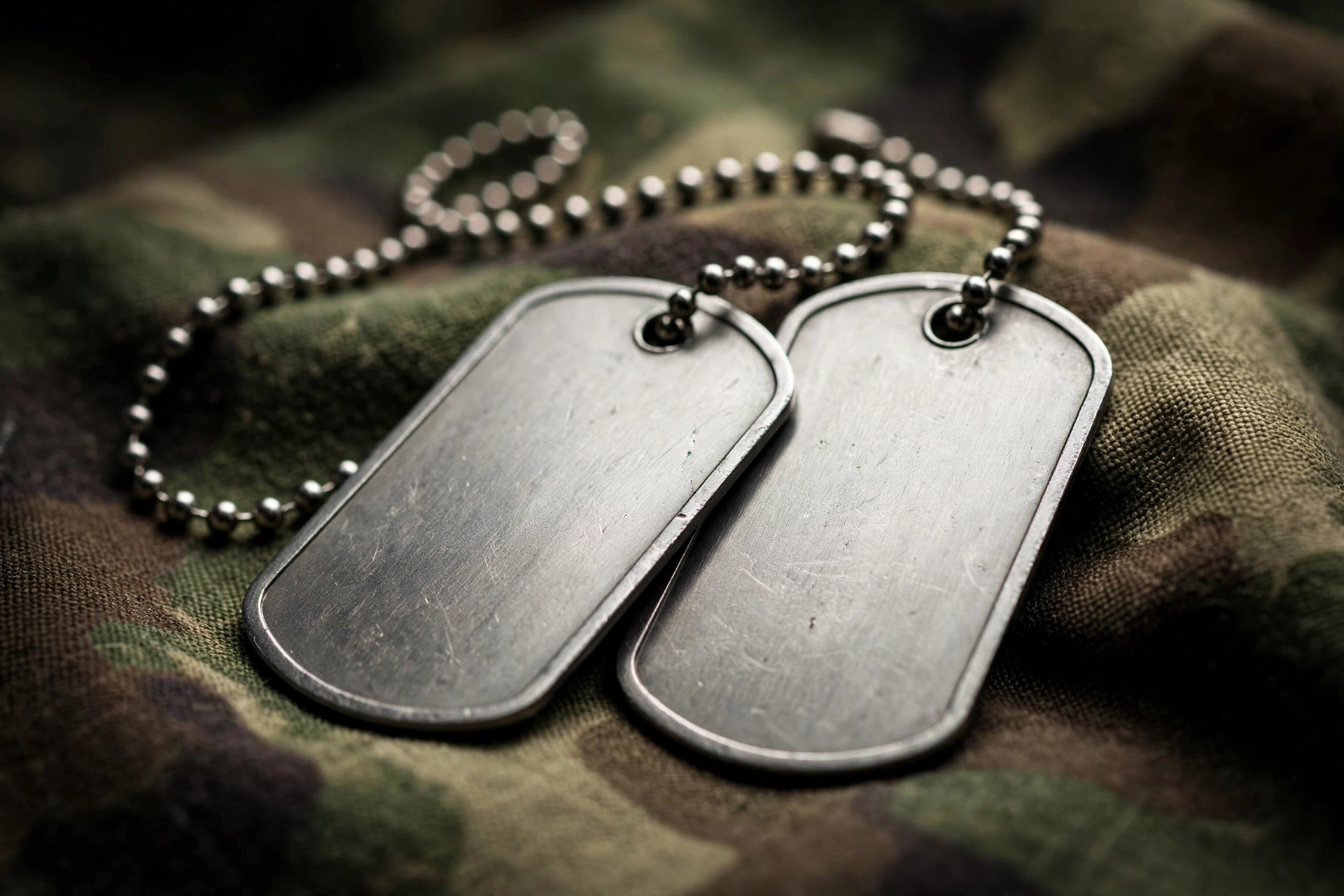
Dog tags are identification plates worn around the neck on a ball chain, usually tucked beneath the uniform. Their job is brutally practical. If a soldier is wounded and cannot speak, the tag tells medics who they are and what blood they can receive. If the worst happens, the tag ensures the fallen are identified with dignity rather than buried as unknown — and that a family, somewhere, gets an answer instead of a question mark.
The nickname stuck because the plates resembled the metal licence tags worn by pet dogs, and soldiers adopted the term with the dark humour the services are famous for. Officially, different countries call them identity discs, ID tags or recognition marks, but “dog tags” is the name the world knows. Most are made from corrosion-resistant metal — early versions used brass or copper alloys, modern ones stainless steel — and many soldiers fit thin rubber “silencers” around the edges so the pair does not jingle on patrol.
A Short History of Dog Tags
The idea is far older than the name. Roman legionaries carried a lead disc called a signaculum in a small pouch around the neck — an ancestor of the dog tag separated from it by nearly two thousand years. The modern story, though, begins with the American Civil War of 1861–65. With no official identification issued, soldiers who feared an anonymous grave improvised: they pinned paper notes inside their coats, carved wooden discs, or bought stamped metal tags from travelling sutlers who followed the armies.
Governments soon caught up. Prussian soldiers carried official identity marks during the Franco-Prussian War of 1870–71. Britain issued identity discs in the early twentieth century, and by the First World War British troops wore pressed-fibre discs — later a pair of them. The United States Army formally adopted the identity tag in 1906 and made it compulsory during the First World War; by the Second World War, stamped metal tags were standard kit in virtually every major army on earth.
Second World War American tags had a distinctive notch cut into one end. For decades, a persistent myth claimed the notch was used to wedge the tag between a fallen soldier’s teeth. Historians are clear that the real reason was mundane: the notch aligned the blank tag in the embossing machine that stamped it. The myth survives because it is dramatic; the truth is that even dog tags are shaped by the machinery of mass production.
What Information Is on a Dog Tag?
Formats vary by country and era, but a modern American-style tag usually carries five lines of information, stamped in capital letters:
| Line | Information | Why it is there |
|---|---|---|
| 1 | Surname | The soldier’s family name — the primary identifier |
| 2 | First name and middle initial | Distinguishes soldiers who share a surname |
| 3 | Service / ID number | A unique number linking the soldier to their records; modern US tags use a Department of Defense ID number rather than a Social Security number |
| 4 | Blood type | For example “O POS” — vital for fast transfusions in the field |
| 5 | Religious preference | For example “CATHOLIC”, “MUSLIM” or “NO PREF” — guides chaplain support, rites and burial |
Earlier tags carried more: First and Second World War designs sometimes included the next of kin and a home address, details later removed for obvious security reasons. Some armies add the service branch, a unit, or a date of birth. Whatever the exact layout, the principle never changes — the minimum information needed to identify a person and help them, nothing more.
Why Do Soldiers Wear Two Tags?
The pair of tags is not a spare. The two tags have two different destinations. If a service member is killed, one tag remains with the body so that identification travels with them through burial and any later investigation. The second tag is removed by the unit or graves registration personnel and used for the official record — the paperwork that confirms the death and sets in motion the notification of the family. Splitting the pair means identity is never lost, even if records and remains are separated in the chaos of a battlefield.
The wearing arrangement reflects this. One tag hangs on the main long chain around the neck; the second hangs from a shorter chain looped to the first, so the two can be separated quickly without unthreading anything — and so that if one chain snaps, both tags are not lost together. Some soldiers have also worn a third tag laced into a boot, a field practice that dates back at least to the Vietnam era: boots and their laces, troops reasoned, tend to stay with the wearer.
Did You Know?
- The name “dog tag” comes from the plates’ resemblance to pet licence tags — the term spread widely during the Second World War.
- Not every country issues two separate tags: the German Erkennungsmarke was a single oval disc scored down the middle, designed to be snapped in half — one half stayed with the fallen soldier, the other went for records.
- Recovered tags from old battlefields are still identified and returned to families today, sometimes more than seventy years after they were lost.
- Tags were once made of compressed fibre, not metal — British First World War discs were pressed fibre that struggled to survive mud, fire and time, one reason metal became universal.
Dog Tags Around the World
Every army answers the same question in its own way. British forces built their system around the identity disc — fibre in the world wars, with modern personnel producing metal tags as operations require. Many Commonwealth forces, including Pakistan and India, follow that British disc tradition, typically stamping name, service number, blood group and religion. Canada issues a pair of discs, one designed to be detached for records. Australia and New Zealand have long issued paired identity discs, and their soldiers wear them with the same two-chain logic as the Americans. Germany’s split-disc design remains the most elegant engineering solution of all: one piece of metal, two records, no chain gymnastics required.
What unites all these systems is the obligation behind them. The Geneva Conventions expect armies to record and report the identity of the dead — the humble dog tag is how that legal and moral duty is carried out at the level of the individual soldier.
Dog Tags in the Modern Era
It would be easy to assume electronics have retired the dog tag. Armies now hold digital personnel files, medical records and even DNA reference samples collected at enlistment, and some units have trialled tags with barcodes or embedded data chips. Yet the stamped metal plate endures for the oldest reason in engineering: it cannot run out of battery, lose signal or be hacked. On operations from desert patrols to peacekeeping duties, soldiers still wear them — a First World War solution that twenty-first-century warfare has not improved enough to discard.
Dog tags have also acquired a second life as symbols. Veterans keep theirs for life; memorials display the tags of the fallen; families treasure returned tags as the most personal of all military heirlooms. Replica and fashion tags are sold everywhere, but to those who were issued a real pair, the meaning is unmistakable: two small pieces of metal that promise you will never be just a number, because they carry your name.
Frequently Asked Questions
Why are they called dog tags?
Because the stamped metal plates resembled the licence tags worn by pet dogs. The nickname spread during the Second World War, when mass-issued tags became universal, and soldiers kept it — the services have always preferred a blunt nickname to an official mouthful like “identity disc”.
Do soldiers still wear dog tags today?
Yes. Most armed forces still issue identity tags, and wearing them is typically compulsory on operations, exercises and flights. Aircrew, infantry and deployed personnel of all trades rely on them as the simplest, most failure-proof form of identification ever devised.
What happens to the tags if a soldier is killed?
One tag stays with the body so identification is never separated from the fallen; the other is taken for official records and to begin notifying the family. Personal effects, including tags, are handled through formal channels and returned to next of kin with care.
Can civilians buy and wear dog tags?
Replica and personalised tags are widely sold as fashion items, memorials and even pet tags, and wearing those is fine. What is not acceptable is passing off replicas as genuine issue from real service — laws on impersonating service members vary by country, and veterans take the distinction seriously.
Why do some soldiers lace a tag into their boots?
As extra insurance. A neck chain can break or be removed during medical treatment, but a tag laced into a boot tends to stay with the wearer. The practice was seen widely from the Vietnam era onwards and is still used by some troops on operations.