Argentina’s armed forces wear their history on their shoulders — quite literally. An Argentine Army officer’s rank is read from the golden suns on his shoulder boards, a naval officer’s from the gold braid stripes on his sleeve cuffs, and an air force officer’s from the stripes and stars on a sky-blue board. This guide covers every Argentine military rank with its insignia, from the newest volunteer soldier to the three-star generals and admirals who command the services, across the Army (Ejército Argentino), the Navy (Armada de la República Argentina) and the Air Force (Fuerza Aérea Argentina).
Argentina’s military is organised into three equal branches under the Joint Chiefs of Staff, with about 72,000 active personnel. The Army is the oldest service, founded on 29 May 1810 during the May Revolution; the Navy traces its birth to the same revolutionary year under the Irish-born Admiral Guillermo Brown; and the Air Force, founded in 1945, is the youngest branch.
All three use Spanish rank titles, and all three map onto the NATO OF (officer) and OR (other ranks) grading system, so an Argentine rank can be matched to its American or British equivalent at a glance.
One thing to know before reading the tables: Argentine ranks do not translate word for word. Teniente general sounds like “lieutenant general” but is the Army’s highest rank, equal to a full four-star general.
Comodoro in the Air Force means colonel, while Comodoro de marina in the Navy is a one-star flag distinction. And the Army has a rank most countries do not — Coronel mayor, senior colonel — sitting between colonel and brigadier general.
Key facts
- Country: Argentina
- Branches: Argentine Army (Ejército Argentino), Argentine Navy (Armada de la República Argentina), Argentine Air Force (Fuerza Aérea Argentina)
- Officer ranks: OF-D to OF-9 (Subteniente / Guardiamarina / Alférez to Teniente general / Almirante / Brigadier general)
- Enlisted ranks: OR-1 to OR-9 (Voluntario segundo / Marinero segundo to Suboficial mayor)
- Highest ranks: Teniente general (Army), Almirante (Navy) and Brigadier general (Air Force), all OF-9
- Active personnel: about 72,000
- Notable fact: Army officers wear the golden Sun of May from the national flag, and Argentina’s military has been all-volunteer since conscription ended in 1995
Argentine Army Officer Ranks (OF-9 to OF-D)
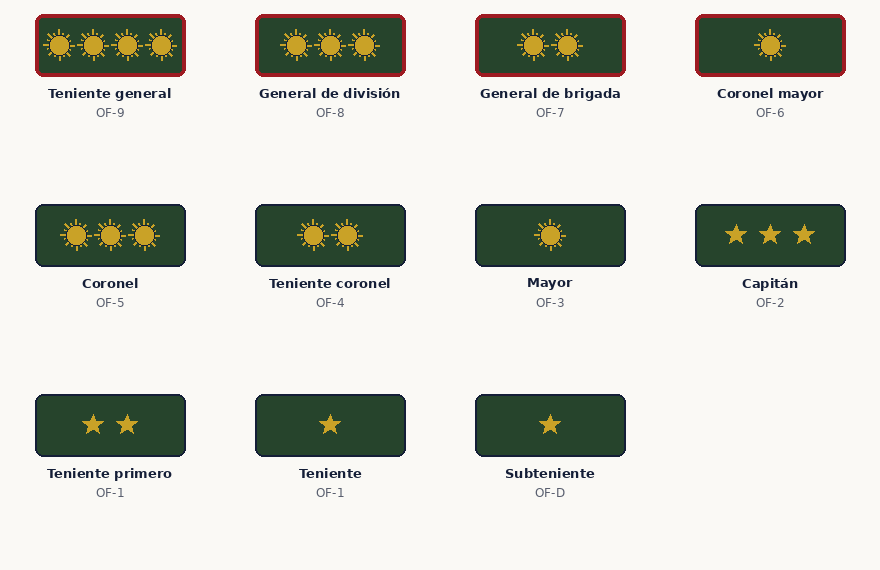
The Argentine Army has eleven officer ranks. Generals command at the top, senior officers (colonels and majors) run regiments and staffs, and junior officers lead platoons and companies. The highest rank in use is Teniente general, held by the Chief of the General Staff of the Army.
A higher rank, Capitán general (captain general), was awarded twice in the nineteenth century — to José de San Martín and Bernardino Rivadavia — but it is purely honorary and no insignia for it exists today.
| Rank (Spanish) | English Equivalent | NATO Grade | Insignia | Typical Role |
|---|---|---|---|---|
| Teniente general | Lieutenant General (full general) | OF-9 | Four golden suns on a red-trimmed shoulder board | Chief of the General Staff of the Army |
| General de división | Divisional General | OF-8 | Three golden suns on a red-trimmed shoulder board | Division or military region commander |
| General de brigada | Brigade General | OF-7 | Two golden suns on a red-trimmed shoulder board | Brigade commander |
| Coronel mayor | Senior Colonel | OF-6 | One golden sun on a red-trimmed shoulder board | Senior colonel; honorary distinction for long-serving colonels |
| Coronel | Colonel | OF-5 | Three golden suns on a black shoulder board | Regiment commander or senior staff officer |
| Teniente coronel | Lieutenant Colonel | OF-4 | Two golden suns on the shoulder board | Battalion or regiment commander |
| Mayor | Major | OF-3 | One golden sun on the shoulder board | Battalion second-in-command or staff officer |
| Capitán | Captain | OF-2 | Three stars on the shoulder board | Company commander |
| Teniente primero | First Lieutenant | OF-1 | Two stars on the shoulder board | Platoon leader or company second-in-command |
| Teniente | Lieutenant | OF-1 | One star on the shoulder board | Platoon leader |
| Subteniente | Sub-Lieutenant | OF-D | One star on the shoulder board | Newly commissioned officer from the Colegio Militar |
Did you know? Teniente general sounds like “lieutenant general” but is the Army’s highest rank, equal to a full four-star general — and the Army’s Coronel mayor (senior colonel) is a rank most countries do not have at all.
How to Read Argentine Army Officer Insignia
Army officers wear their rank on shoulder boards, and the whole system is built around one national symbol — the Sun of May (Sol de Mayo), the golden sun from the Argentine flag. Once you know the sun-and-star code, any Argentine Army shoulder board reads at a glance:
- Suns for senior officers and generals — the number of suns counts down with seniority in the opposite direction from what you might expect at the top. A colonel wears three suns, a lieutenant colonel two, and a major one. Among the generals the count runs the other way: a brigade general wears two suns, a divisional general three, and a lieutenant general four.
- The red trim — shoulder boards from Coronel mayor upward carry a red (garnet) trim, and their suns are worked in gold braid rather than metal. That red edge is the fastest way to spot a general officer or senior colonel. Generals also wear golden laurel wreath leaves on their coat lapels.
- Stars for junior officers — below major, the suns give way to stars: three for a captain, two for a first lieutenant and one for a lieutenant. A sub-lieutenant, the rank held on graduation from the Colegio Militar de la Nación, wears a single star.
- The odd one out — Coronel mayor wears a single red-trimmed golden sun, where a regular colonel wears three plain suns. The rank is an official distinction, created in 1992, for long-serving colonels who have not been promoted to brigade general. It sits above colonel and below brigade general, and it is roughly equal to a brigadier general in the US system.
- Combat uniform — on campaign dress the same ranks appear as smaller collar insignia instead of shoulder boards, and volunteer soldiers wear their rank on the sleeve rather than the shoulder.
Argentine Navy Officer Ranks (OF-9 to OF-D)
The Argentine Navy’s officer ranks follow the Royal Navy tradition: rank is read from gold braid stripes on the sleeve cuffs, with the number and width of the stripes rising with seniority. The top stripe of a line officer carries the distinctive loop — the curled “executive curl” borrowed from the British Navy.
The Navy’s highest rank is Almirante (admiral), held by the Chief of the General Staff of the Navy. The Naval Infantry (marines) use the same ranks and insignia as the rest of the Navy.
| Rank (Spanish) | English Equivalent | NATO Grade | Insignia | Typical Role |
|---|---|---|---|---|
| Almirante | Admiral | OF-9 | One wide and three narrow gold sleeve stripes, top stripe looped | Chief of the General Staff of the Navy |
| Vicealmirante | Vice Admiral | OF-8 | One wide and two narrow gold sleeve stripes, top stripe looped | Fleet or naval area commander |
| Contralmirante | Rear Admiral | OF-7 | One wide and one narrow gold sleeve stripe, top stripe looped | Naval zone or base commander |
| Comodoro de marina | Commodore | OF-6 | One wide gold sleeve stripe; a star on the shoulder board | Senior captain holding a flag appointment |
| Capitán de navío | Ship-of-the-Line Captain | OF-5 | Four gold sleeve stripes | Commanding officer of a major warship |
| Capitán de fragata | Frigate Captain | OF-4 | Three gold sleeve stripes | Commanding officer of a frigate or corvette |
| Capitán de corbeta | Corvette Captain | OF-3 | Two gold sleeve stripes and one narrow stripe | Commanding officer of a small vessel or department head |
| Teniente de navío | Ship Lieutenant | OF-2 | Two gold sleeve stripes | Department head aboard ship |
| Teniente de fragata | Frigate Lieutenant | OF-1 | One gold sleeve stripe and one narrow stripe | Division officer aboard ship |
| Teniente de corbeta | Corvette Lieutenant | OF-1 | One gold sleeve stripe | Junior watchkeeping officer |
| Guardiamarina | Midshipman | OF-D | One narrow gold sleeve stripe | Newly commissioned officer from the Escuela Naval Militar |
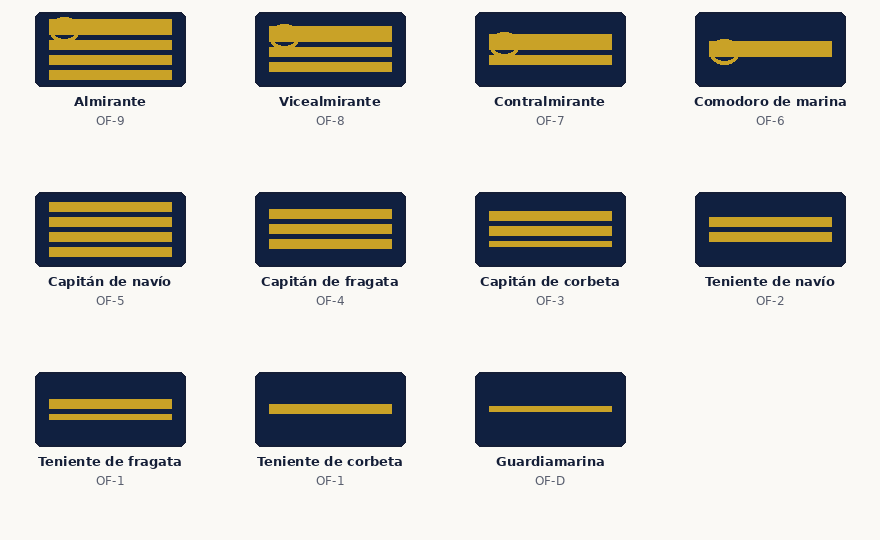
Key point: the loop in the top stripe — the Royal Navy executive curl — is the mark of a line (command) officer. Staff Corps officers wear their stripes on a coloured background instead: purple for chaplains, blue for engineers, red for the health corps, white for paymasters and green for judge advocates.
How to Read Argentine Navy Officer Insignia
Navy rank is a counting exercise in gold braid. The rules are simple once you know them:
- Count the stripes — a corvette lieutenant wears one stripe, a ship lieutenant two, a frigate captain three and a ship-of-the-line captain four. Each step up adds a stripe until the flag ranks, where a wide stripe joins the pattern.
- The loop — the top stripe of a line (command) officer ends in a loop, the Royal Navy executive curl. It is the mark of an officer of the Command Corps, trained at the Escuela Naval Militar. Staff Corps officers — engineers, doctors, paymasters, chaplains and lawyers — wear their stripes on a coloured background that shows their speciality: purple for chaplains, blue for engineers, red for the health corps, white for paymasters and green for judge advocates.
- The commodore distinction — Comodoro de marina is not quite a normal rank. Created in the late 1990s, it is a distinction given to senior captains holding a rear admiral’s post, and it can be granted by the chief of staff without the congressional approval a flag promotion needs. Its sleeve lace matches the Royal Navy commodore’s, and it carries one star on the shoulder board.
- Where it is worn — stripes go on the sleeve cuffs of the dress uniform or on shoulder boards, and on the chest when officers are in shipboard or flying coveralls. Combat uniforms use metal pin-on or embroidered collar insignia instead.
Argentine Air Force Officer Ranks (OF-9 to OF-D)
The Air Force’s officer ranks use a mix of Army-style and Navy-style titles that is unique to Argentina. The general officers are all Brigadier of one kind or another, and the senior officers are Comodoro and Vicecomodoro — commodore titles that in most air forces would be a single rank.
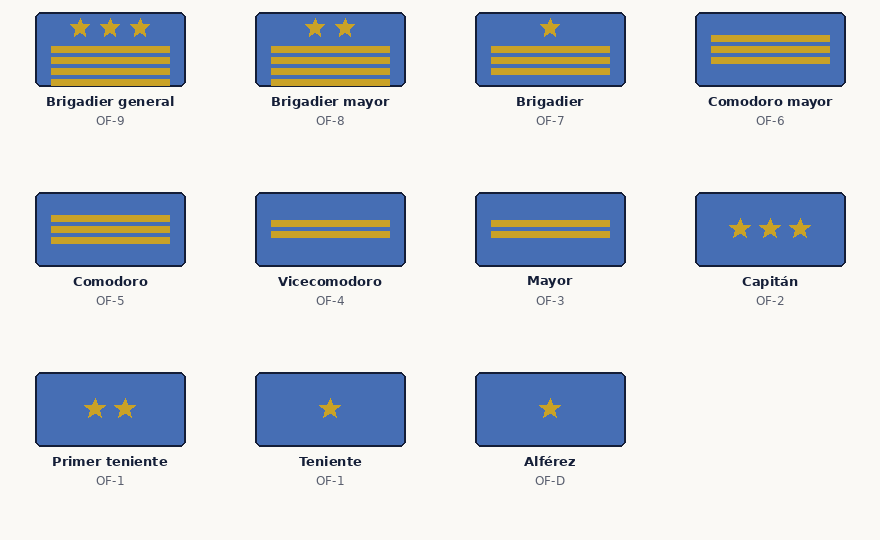
The highest rank is Brigadier general, held by the Chief of the General Staff of the Air Force. Officers wear their rank as sleeve stripes, with matching shoulder boards in grey for ranks from ensign to commodore; general officers wear different shoulder boards of their own.
| Rank (Spanish) | English Equivalent | NATO Grade | Insignia | Typical Role |
|---|---|---|---|---|
| Brigadier general | Brigadier General | OF-9 | Gold sleeve stripes with stars on the shoulder board | Chief of the General Staff of the Air Force |
| Brigadier mayor | Brigadier-Major | OF-8 | Gold sleeve stripes with stars on the shoulder board | Deputy chief or major command chief |
| Brigadier | Brigadier | OF-7 | Gold sleeve stripes with a star on the shoulder board | Air brigade commander |
| Comodoro mayor | Commodore-Major | OF-6 | Gold sleeve stripes on a blue shoulder board | Senior commodore; equivalent of a senior colonel |
| Comodoro | Commodore | OF-5 | Gold sleeve stripes on a blue shoulder board | Air group commander; equivalent of a colonel |
| Vicecomodoro | Vice-Commodore | OF-4 | Gold sleeve stripes on a blue shoulder board | Squadron commander; equivalent of a lieutenant colonel |
| Mayor | Major | OF-3 | Gold sleeve stripes on a blue shoulder board | Staff officer or flight commander |
| Capitán | Captain | OF-2 | Three stars on the shoulder board | Flight commander |
| Primer teniente | First Lieutenant | OF-1 | Two stars on the shoulder board | Pilot or flight officer |
| Teniente | Lieutenant | OF-1 | One star on the shoulder board | Pilot or flight officer |
| Alférez | Ensign | OF-D | One star on the shoulder board | Newly commissioned officer from the Escuela de Aviación Militar |
Did you know? Comodoro in the Air Force equals a colonel (OF-5), while Comodoro de marina in the Navy is a one-star flag rank (OF-6). Same word, different ladder — the Air Force’s OF-6 equivalent is Comodoro mayor.
How to Read Argentine Air Force Officer Insignia
Air Force insignia is the youngest of the three systems, and it borrows from both sister services:
- Sleeve stripes, like the Navy — officers wear their rank in gold stripes on the sleeve, with the number of stripes rising with seniority. The same pattern is repeated on grey shoulder boards for ranks between ensign and commodore.
- Stars for the junior ranks — like the Army, the Air Force marks its junior officers with stars on the shoulder board: three for a captain, two for a first lieutenant and one for a lieutenant or ensign.
- Blue boards — Air Force rank insignia is gold on a bright blue shoulder board, against the Army’s green or black and the Navy’s dark blue. The colour alone tells you the service before you count a single stripe.
- The brigadier ladder — the three general ranks are all brigadiers: Brigadier (one star, OF-7), Brigadier mayor (OF-8) and Brigadier general (OF-9). Do not confuse Brigadier with the British brigadier, a colonel-level rank — in Argentina it is a general officer.
- The commodore trap — Comodoro in the Air Force equals a colonel (OF-5), while Comodoro de marina in the Navy is a one-star flag rank (OF-6). Same word, different ladder. The Air Force’s OF-6 equivalent is Comodoro mayor.
Argentine Enlisted and Non-Commissioned Officer Ranks (OR-9 to OR-1)
Below the officers, each branch has its own ladder of non-commissioned officers and enlisted personnel. The senior NCO ranks all begin with Suboficial (sub-officer), and the most senior — Suboficial mayor — is the equivalent of a sergeant major or master chief.
The Army and Air Force still use the old term Voluntario (volunteer) for their lowest ranks, a reminder that Argentina’s military has been all-volunteer since conscription ended in 1995. The Navy instead uses Marinero (seaman).
Argentine Army Enlisted Ranks
| Rank (Spanish) | English Equivalent | NATO Grade | Insignia | Typical Role |
|---|---|---|---|---|
| Suboficial mayor | Senior Sub-Officer | OR-9 | Senior NCO sleeve insignia | Most senior NCO of a unit; advisor to the commander |
| Suboficial principal | Principal Sub-Officer | OR-8 | Senior NCO sleeve insignia | Senior NCO at battalion level |
| Sargento ayudante | Adjutant Sergeant | OR-7 | Chevrons on the sleeve | Senior sergeant; company-level NCO |
| Sargento primero | First Sergeant | OR-6 | Chevrons on the sleeve | Platoon sergeant |
| Sargento | Sergeant | OR-5 | Chevrons on the sleeve | Squad leader |
| Cabo primero | First Corporal | OR-4 | Chevrons on the sleeve | Team leader |
| Cabo | Corporal | OR-3 | Chevrons on the sleeve | Junior NCO; fire-team leader |
| Voluntario primero | First Volunteer | OR-2 | Sleeve insignia | Trained soldier |
| Voluntario segundo | Second Volunteer | OR-1 | Sleeve insignia | Soldier in training |
| Soldado de segunda en comisión | Second-Class Soldier on Commission | OR-1 | Sleeve insignia | Entry-level soldier |
Argentine Navy Enlisted Ranks
| Rank (Spanish) | English Equivalent | NATO Grade | Insignia | Typical Role |
|---|---|---|---|---|
| Suboficial mayor | Senior Sub-Officer | OR-9 | Senior NCO shoulder board or patch | Master chief; most senior rating of a unit |
| Suboficial principal | Principal Sub-Officer | OR-8 | Senior NCO shoulder board or patch | Senior chief petty officer |
| Suboficial primero | First Sub-Officer | OR-7 | Shoulder board or breast patch | Chief petty officer |
| Suboficial segundo | Second Sub-Officer | OR-6 | Shoulder board or breast patch | Petty officer first class |
| Cabo principal | Principal Corporal | OR-5 | Shoulder board or breast patch | Petty officer second class |
| Cabo primero | First Corporal | OR-4 | Shoulder board or breast patch | Petty officer third class |
| Cabo segundo | Second Corporal | OR-3 | Shoulder board or breast patch | Leading seaman |
| Marinero primero | First Seaman | OR-2 | Sleeve insignia | Able seaman |
| Marinero segundo | Second Seaman | OR-1 | Sleeve insignia | Ordinary seaman; entry-level sailor |
Argentine Air Force Enlisted Ranks
| Rank (Spanish) | English Equivalent | NATO Grade | Insignia | Typical Role |
|---|---|---|---|---|
| Suboficial mayor | Senior Sub-Officer | OR-9 | Senior NCO sleeve insignia | Most senior NCO of a unit |
| Suboficial principal | Principal Sub-Officer | OR-8 | Senior NCO sleeve insignia | Senior NCO at wing level |
| Suboficial ayudante | Adjutant Sub-Officer | OR-7 | Chevrons on the sleeve | Senior NCO; flight-line supervisor |
| Suboficial auxiliar | Auxiliary Sub-Officer | OR-6 | Chevrons on the sleeve | Technical supervisor |
| Cabo principal | Principal Corporal | OR-5 | Chevrons on the sleeve | Section leader |
| Cabo primero | First Corporal | OR-4 | Chevrons on the sleeve | Team leader |
| Cabo | Corporal | OR-3 | Chevrons on the sleeve | Junior NCO |
| Voluntario primero | First Volunteer | OR-2 | Sleeve insignia | Trained airman |
| Voluntario segundo | Second Volunteer | OR-1 | Sleeve insignia | Airman in training; entry level |
How to Read Argentine Enlisted Insignia
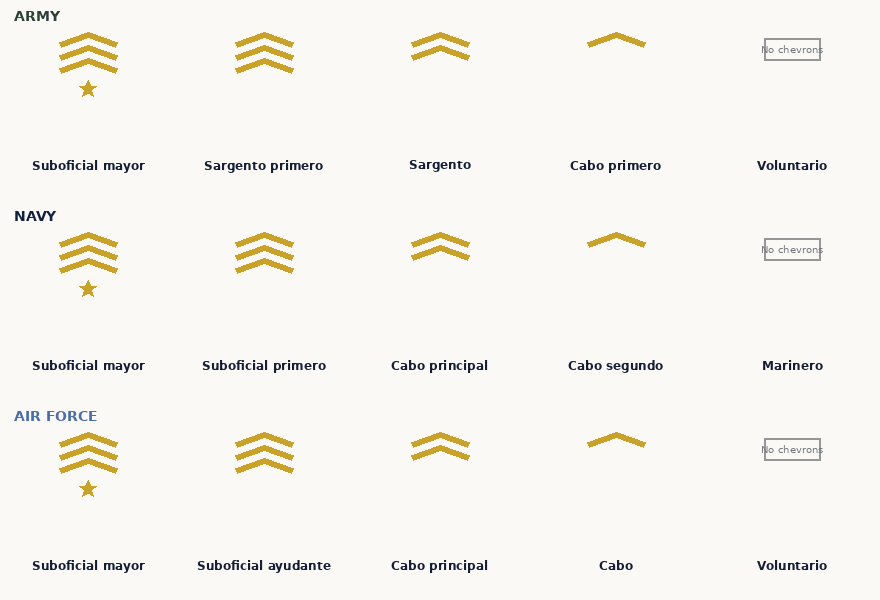
Enlisted insignia is worn on the sleeve in the Army and Air Force, and on shoulder boards, breast patches or sleeves in the Navy, depending on the uniform. The pattern is the same in all three branches: more chevrons and more elaborate devices mean more seniority. Senior sub-officers wear distinctive insignia that set them apart from the sergeants and corporals below them, and the lowest ranks — volunteers and seamen — wear simple sleeve insignia with no chevrons at all.
Two details help in telling the branches apart. First, the words: only the Navy uses Marinero, only the Army and Air Force use Voluntario, and the Air Force is the only branch with Suboficial ayudante and Suboficial auxiliar in the middle of its ladder.
Second, the colour of the backing: Army insignia sits on green or black, Air Force insignia on bright blue. Navy other ranks wear their insignia on dark blue, and seamen wear theirs on the sleeve.
Argentine Military Badges and Emblems
Rank insignia shows a person’s grade. Badges show what they are qualified to do, and Argentina’s are rich in national symbolism:
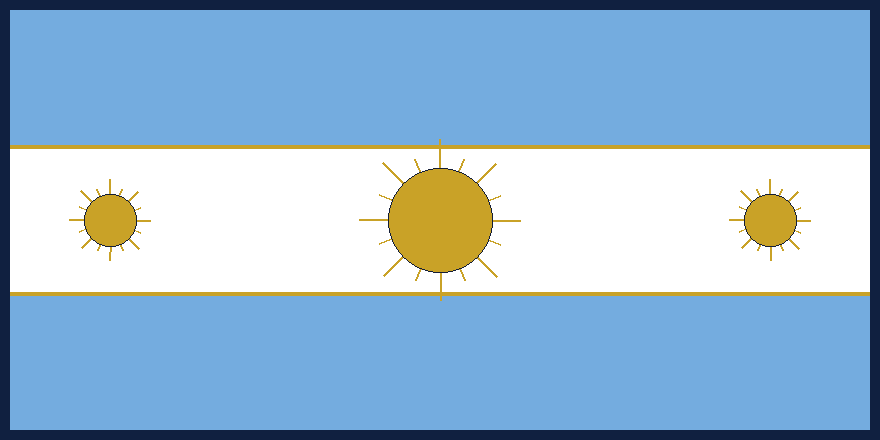
- The Sun of May (Sol de Mayo) — the golden sun with a face and alternating straight and wavy rays, taken from the national flag. It is the defining mark of Argentine Army officer rank, and it appears on the national cockade and the presidential sash. It represents the Inca sun god Inti and the May Revolution of 1810.
- The naval anchor — the fouled anchor of the Armada, worn as a branch badge by sailors and naval officers, recalling the Navy’s founding under Admiral Guillermo Brown, the Irish-born “father of the Argentine Navy”.
- Air Force wings — pilot and aircrew wings are worn on the chest by qualified air force personnel, with the condor — the great bird of the Andes — featuring in the service emblem.
- Specialist and qualification badges — paratrooper wings, mountain troops badges, commando qualification and the Antarctic service badge mark the Army’s specialist units, including the mountain brigades of the Andes and the personnel who support Argentina’s Antarctic bases.
- Unit and branch insignia — each regiment, naval command and air brigade carries its own shield and colours, and Army officers wear branch-coloured backing on their shoulder boards showing their arm or service, such as infantry, cavalry, artillery or engineers.
How Promotion Works in the Argentine Military
Promotion in Argentina is a mix of time in grade, courses and selection. Officers enter through their branch academy — the Colegio Militar de la Nación for the Army, the Escuela Naval Militar for the Navy and the Escuela de Aviación Militar for the Air Force — and graduate as sub-lieutenant, midshipman or ensign. Junior officers then advance roughly every four to five years through the lieutenant and captain grades, as long as they complete the required courses and hold good records.
Promotion to the senior ranks is competitive and selective. Officers must pass staff college and command courses, and the choice of who becomes a colonel, a general or an admiral is made by senior boards and confirmed at the highest level: promotions to general and flag rank require the agreement of the Senate, as the constitution gives Congress a role in senior military appointments.
Enlisted personnel enter as volunteers or seamen and climb the ladder from corporal to sergeant to sub-officer through trade courses, time in grade and selection boards. The most senior NCOs — the Suboficial mayor of each service — act as the enlisted voice to their chief of staff. Since Argentina ended conscription in 1995, every rank from volunteer upward is filled by professional volunteers.
A Note on Argentine Military Tradition
Two threads run through everything about Argentine military ranks. The first is independence: the Army was born in the May Revolution of 1810, the sun on its shoulder boards is the sun of the May flag, and the highest honorary rank belongs to José de San Martín, the Liberator of Argentina, Chile and Peru.
The second is European heritage with a local accent: the Navy’s sleeve stripes and executive curl come from the Royal Navy, the Army’s shoulder boards and suns from the Spanish tradition, and the Air Force’s brigadier and commodore titles from Britain — yet the combination is unmistakably Argentine.
For comparison with other services, see our guides to US Navy ranks, the US military branches, the US military uniform and Brazilian military ranks, Argentina’s largest neighbour.
FAQs
What is the highest rank in the Argentine military?
In the Army it is Teniente general (OF-9), in the Navy Almirante (OF-9) and in the Air Force Brigadier general (OF-9). Each is held by the chief of staff of its service.
The highest enlisted rank in all three branches is Suboficial mayor (OR-9). There is no five-star or OF-10 rank in Argentina.
What is a Coronel mayor?
Coronel mayor (senior colonel, OF-6) is an official distinction created in 1992 for long-serving colonels who have not been promoted to brigade general. It sits between colonel and brigade general, and its insignia — a single golden sun on a red-trimmed shoulder board — looks like a general’s board, which is why it confuses newcomers. Its Navy equivalent is Comodoro de marina and its Air Force equivalent is Comodoro mayor.
Why do Argentine Army officers wear suns?
The suns are the Sun of May (Sol de Mayo), the golden sun from the Argentine flag, representing the May Revolution of 1810. Generals and senior officers are read by the number of suns on their shoulder boards, while junior officers are read by stars. The red trim on boards from senior colonel upward marks the general-officer style.
Is an Air Force Comodoro the same as a Navy Comodoro de marina?
No. An Air Force Comodoro is OF-5, the equivalent of an Army colonel. A Navy Comodoro de marina is OF-6, a one-star flag distinction for senior captains in flag appointments.
The Air Force’s OF-6 equivalent is Comodoro mayor.
Do Argentine ranks have NATO equivalents?
Yes. Argentina uses the NATO OF/OR grading system: officers run OF-D (sub-lieutenant, midshipman, ensign) to OF-9 (lieutenant general, admiral, brigadier general), and enlisted personnel run OR-1 to OR-9. That makes it straightforward to match an Argentine rank with its US or British equivalent.
What is the lowest rank in the Argentine military?
The lowest ranks are Soldado de segunda en comisión in the Army, Marinero segundo in the Navy and Voluntario segundo in the Air Force — all OR-1, the entry level for new volunteers.
All insignia diagrams and images in this article are original graphics created for Forces Guide.