The United States Marine Corps has one of the most recognisable rank systems in the world. A Marine’s rank is read from chevrons, rockers, bars, oak leaves and stars worn on the collar and sleeves — and, for enlisted Marines, from the crossed rifles that appear in almost every chevron. This guide covers every US Marine Corps rank with its insignia, from Private (E-1) to General (O-10), plus warrant officers, badges and how promotion works.
Marine Corps ranks fall into three groups: enlisted ranks (E-1 to E-9), warrant officer ranks (W-1 to W-5) and commissioned officer ranks (O-1 to O-10). The letter tells you the ladder — E for enlisted, W for warrant officer, O for officer — and the number tells you the seniority within it.
Key facts
- Country: United States
- Branch: United States Marine Corps (part of the Department of the Navy)
- Enlisted ranks: E-1 to E-9 (Private to Sergeant Major of the Marine Corps)
- Warrant officers: W-1 to W-5
- Commissioned officers: O-1 to O-10 (Second Lieutenant to General)
- Highest rank: General (O-10), held by the Commandant of the Marine Corps
- Motto: Semper Fidelis — “Always Faithful”
US Marine Corps Enlisted Ranks (E-1 to E-9)
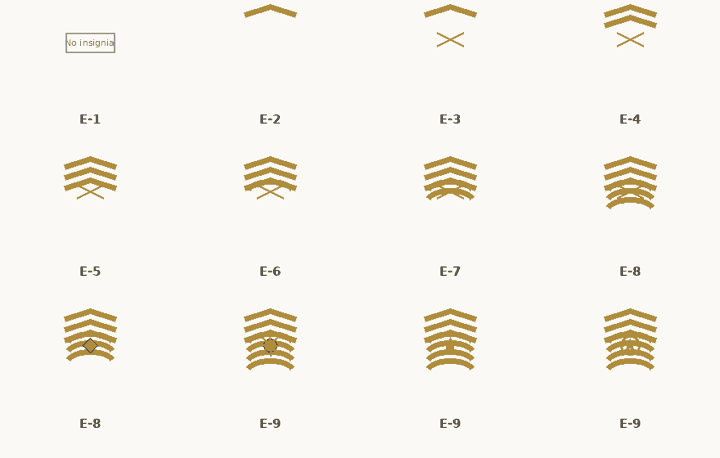
Enlisted Marines are the backbone of the Corps. They wear their rank as chevrons — V-shaped stripes — on their sleeves. Junior enlisted Marines (E-1 to E-3) are still learning the trade; noncommissioned officers (NCOs, E-4 and E-5) lead small teams; and staff noncommissioned officers (SNCOs, E-6 to E-9) run platoons, companies and battalions.
| Rank | Pay Grade | Insignia | Typical Role |
|---|---|---|---|
| Private (Pvt) | E-1 | No insignia | New recruit in boot camp; entry-level Marine |
| Private First Class (PFC) | E-2 | One chevron | Completes training and joins a unit |
| Lance Corporal (LCpl) | E-3 | One chevron with crossed rifles | Team member building tactical skills; most common rank in the Corps |
| Corporal (Cpl) | E-4 | Two chevrons with crossed rifles | First NCO rank; leads a fire team of four Marines |
| Sergeant (Sgt) | E-5 | Three chevrons with crossed rifles | Leads a squad; trains and mentors junior Marines |
| Staff Sergeant (SSgt) | E-6 | Three chevrons over one rocker, with crossed rifles | Platoon sergeant; senior tactical leader |
| Gunnery Sergeant (GySgt) | E-7 | Three chevrons over two rockers, with crossed rifles | Company-level senior enlisted advisor; operations expert |
| Master Sergeant (MSgt) | E-8 | Three chevrons over three rockers, with crossed rifles | Technical specialist and senior advisor in an occupational field |
| First Sergeant (1stSgt) | E-8 | Three chevrons over three rockers, with a diamond | Company-level senior enlisted leader; discipline, morale and welfare |
| Master Gunnery Sergeant (MGySgt) | E-9 | Three chevrons over four rockers, with a bursting bomb | Highest technical expert in an occupational field |
| Sergeant Major (SgtMaj) | E-9 | Three chevrons over four rockers, with a star | Senior enlisted leader at battalion level and above |
| Sergeant Major of the Marine Corps (SgtMajMC) | E-9 | Three chevrons over four rockers, with the Eagle, Globe and Anchor flanked by stars | The single most senior enlisted Marine; advisor to the Commandant |
Did you know? Lance Corporal is the most common rank in the Marine Corps, and a Private (E-1) is the only Marine who wears no rank insignia at all.
How to Read Marine Enlisted Insignia
Every Marine enlisted insignia is built from the same few pieces, so once you know the code you can read any chevron at a glance:
- Chevrons — the V-shaped stripes on top. One chevron means E-2, two means E-4, three means E-5 and above.
- Crossed rifles — two crossed rifles sit inside the chevron from Lance Corporal (E-3) upward. They declare the Marine Corps creed that every Marine is a rifleman first, whatever their job.
- Rockers — the curved stripes below the chevrons. Staff NCOs add one rocker per grade: one for Staff Sergeant (E-6), two for Gunnery Sergeant (E-7), three for Master Sergeant and First Sergeant (E-8), four for Master Gunnery Sergeant and Sergeant Major (E-9).
- The centre device — at E-8 and E-9 the middle of the insignia tells you the path. A diamond marks a First Sergeant (command leadership track); crossed rifles mark a Master Sergeant (technical track). At E-9 a bursting bomb marks a Master Gunnery Sergeant and a star marks a Sergeant Major.
- No insignia at all — a Private (E-1) wears no rank insignia. It is the only Marine rank with nothing to show.
Marines also wear service stripes — diagonal “hash marks” on the lower sleeve, one for every four years of honourable service. They are not a rank, but they tell you at a glance how long a Marine has served.
US Marine Corps Warrant Officer Ranks (W-1 to W-5)
Warrant officers are a small, elite group: former enlisted Marines who become technical specialists. They hold a warrant from the Secretary of the Navy rather than a commission, and they stay on the W pay grades even after becoming commissioned at Chief Warrant Officer 2. A warrant officer’s insignia is a bar with scarlet blocks or a stripe — read the metal colour and the scarlet markings together.
| Rank | Pay Grade | Insignia | Typical Role |
|---|---|---|---|
| Warrant Officer 1 (WO1) | W-1 | Gold bar with two scarlet blocks | Technical specialist beginning the warrant officer path |
| Chief Warrant Officer 2 (CWO2) | W-2 | Gold bar with three scarlet blocks | Experienced technical leader; commissioned from this grade |
| Chief Warrant Officer 3 (CWO3) | W-3 | Silver bar with two scarlet blocks | Advanced technical expert and advisor |
| Chief Warrant Officer 4 (CWO4) | W-4 | Silver bar with three scarlet blocks | Senior technical leader; master of their field |
| Chief Warrant Officer 5 (CWO5) | W-5 | Silver bar with a scarlet stripe running lengthwise | Highest warrant officer grade; institutional expert |
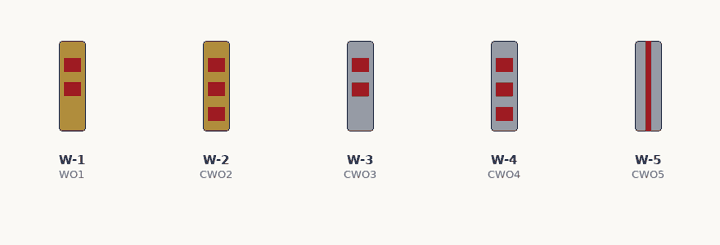
Key point: gold does not mean senior here. A gold bar comes before a silver bar in the warrant officer sequence, just as a gold oak leaf comes before a silver oak leaf for officers. Rank order, not metal value, decides seniority.
US Marine Corps Commissioned Officer Ranks (O-1 to O-10)
Commissioned officers lead Marines at every level, from a platoon of 40 to the entire Marine Corps. Junior officers (O-1 to O-3) lead platoons and companies; field grade officers (O-4 to O-6) command battalions and regiments; general officers (O-7 to O-10) command divisions, expeditionary forces and the Corps itself.
| Rank | Pay Grade | Insignia | Typical Role |
|---|---|---|---|
| Second Lieutenant (2ndLt) | O-1 | One gold bar | Platoon commander; entry-level commissioned officer |
| First Lieutenant (1stLt) | O-2 | One silver bar | Platoon commander or executive officer |
| Captain (Capt) | O-3 | Two silver bars | Company commander (around 200 Marines) |
| Major (Maj) | O-4 | One gold oak leaf | Battalion executive officer or staff officer |
| Lieutenant Colonel (LtCol) | O-5 | One silver oak leaf | Battalion commander (around 1,000 Marines) |
| Colonel (Col) | O-6 | Silver eagle | Regiment commander or senior staff officer |
| Brigadier General (BGen) | O-7 | One silver star | Assistant division commander or task force commander |
| Major General (MajGen) | O-8 | Two silver stars | Division commander |
| Lieutenant General (LtGen) | O-9 | Three silver stars | Marine Expeditionary Force commander |
| General (Gen) | O-10 | Four silver stars | Commandant of the Marine Corps or combatant commander |
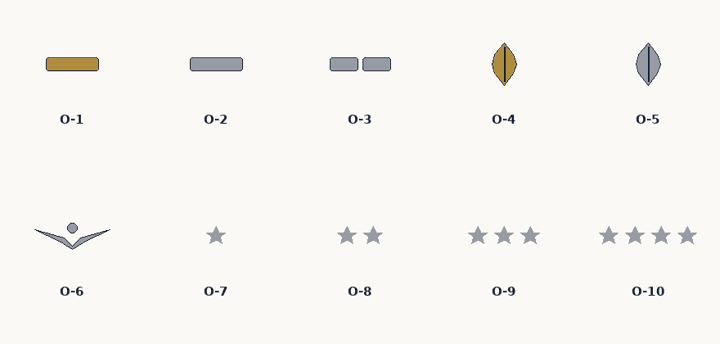
How to Read Marine Officer Insignia
Officer insignia follow a simple ladder of bars, leaves, an eagle and stars:
- Bars — one gold bar (O-1), one silver bar (O-2), two silver bars (O-3). Remember: silver outranks gold.
- Oak leaves — one gold oak leaf (O-4), one silver oak leaf (O-5). Again, the silver leaf is senior.
- The eagle — a silver eagle marks a Colonel (O-6), the senior field grade rank.
- Stars — one to four silver stars mark the generals, O-7 to O-10. Four stars is the highest rank in the Marine Corps.
Unlike the Army, the Marine Corps has no five-star rank and no separate rank of “brigadier” — its one-star general is a Brigadier General, and its most senior officer is the Commandant of the Marine Corps, a four-star General who sits on the Joint Chiefs of Staff.
Marine Corps Badges
Rank insignia shows a Marine’s grade. Badges show what a Marine is qualified to do. The most important Marine Corps badges are:
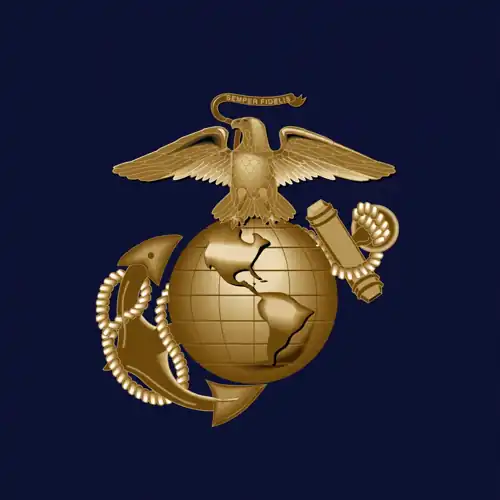
- The Eagle, Globe and Anchor (EGA) — the emblem of the Marine Corps, not a rank. The eagle stands for service to the nation, the globe for worldwide commitment, and the anchor for the Corps’ naval heritage. Marines earn the EGA at the end of boot camp, and it appears on the Sergeant Major of the Marine Corps’ insignia.
- Marksmanship badges — rifle and pistol badges in three levels: Marksman, Sharpshooter and Expert. The Rifle Expert Badge is one of the most respected qualifications in the Corps, reflecting the “every Marine a rifleman” standard.
- Naval Aviator wings — gold wings worn by Marine pilots, who train alongside Navy aviators and fly aircraft from carriers and amphibious ships.
- Parachutist badge (jump wings) — worn by Marines qualified in military parachuting, including reconnaissance and special operations personnel.
- Drill instructor and recruiter badges — worn on the service uniform by Marines serving in these demanding special duties.
- Combat Action Ribbon — awarded to Marines who have actively participated in ground or surface combat. It is a ribbon rather than a badge, but it is one of the most valued decorations an enlisted Marine can earn.
How Promotion Works in the Marine Corps
Promotion in the Marine Corps is competitive at every step. Junior enlisted Marines (E-2 and E-3) advance largely on time in service and good conduct. Promotion to Corporal (E-4) and Sergeant (E-5) uses a composite score — combining rifle qualification, physical fitness, time in service, time in grade, and proficiency and conduct marks — against a monthly cutoff that rises or falls with the needs of the Corps.
Promotion to Staff Sergeant (E-6) and above goes through a selection board, where senior Marines review the whole record. Making Gunnery Sergeant (E-7) is a career milestone, and the choice between the Master Sergeant and First Sergeant tracks at E-8 shapes the rest of a career. Warrant officers are appointed from the senior enlisted ranks, while commissioned officers are promoted by centralised boards, with command — of a company, a battalion, a regiment — as the defining career gate.
A Note on Marine Corps Tradition
Two traditions explain almost everything about Marine Corps ranks. The first is “every Marine a rifleman” — which is why crossed rifles appear in enlisted insignia from Lance Corporal upward, and why rifle qualification counts toward promotion. The second is the Corps’ small size: with fewer than 200,000 active-duty Marines, it has the flattest, most selective rank structure of any US service, and its senior enlisted leaders — Gunnery Sergeants and Sergeants Major — carry an authority that surprises outsiders.
Read next
US Navy Ranks · US Space Force Ranks · US Military Uniform · US Military Branches
FAQs
What is the highest rank in the US Marine Corps?
General (O-10), with four silver stars. The Commandant of the Marine Corps holds this rank. The highest enlisted rank is Sergeant Major of the Marine Corps (E-9), and the highest warrant officer rank is Chief Warrant Officer 5 (CWO5).
What is the difference between a Master Sergeant and a First Sergeant?
Both are E-8, but they follow different tracks. A Master Sergeant is a technical specialist, marked by crossed rifles in the insignia. A First Sergeant is a command leader responsible for discipline and welfare, marked by a diamond. The same split exists at E-9: Master Gunnery Sergeant (bursting bomb, technical) versus Sergeant Major (star, command).
Why do Marine chevrons have crossed rifles?
The crossed rifles declare that every Marine is a rifleman first, whatever their job. They appear in enlisted insignia from Lance Corporal (E-3) upward, and rifle qualification is part of promotion scoring.
What does the Eagle, Globe and Anchor mean?
It is the emblem of the Marine Corps: the eagle for service to the nation, the globe for worldwide commitment, and the anchor for naval heritage. It is earned at the end of boot camp and is not itself a rank.
How long does it take to become a Sergeant in the Marine Corps?
Typically around four years, but it depends on the composite score and the monthly cutoff for the Marine’s job field. High-demand fields promote faster; the cutoff rises and falls with the Corps’ manpower needs.
Do Marine officers outrank Navy officers of the same grade?
No — officers of the same pay grade hold equal rank across services. A Marine Captain (O-3) and a Navy Lieutenant (O-3) are equals, though their titles differ. The Marine Corps falls under the Department of the Navy, which is why the two services share many traditions.
All insignia diagrams and images in this article are original graphics created for Forces Guide.