
The Iraqi Armed Forces use one of the most recognisable rank systems in the Middle East. An Iraqi officer’s rank is read from gold stars, the republican eagle and crossed swords worn on the shoulder boards — and an enlisted soldier’s rank from chevrons on the sleeve. The titles are Arabic, the structure traces back to the Ottoman era, and the insignia themselves are inspired by the British system. This guide covers every Iraqi military rank with its insignia, from Jundi (Private) to Mushir (Field Marshal), across the Iraqi Army, Iraqi Navy and Iraqi Air Force.
Iraqi ranks fall into two groups: commissioned officers, eleven grades from Mulazim (Second Lieutenant) to Mushir (Field Marshal), and other ranks — warrant officers, non-commissioned officers and enlisted soldiers — six grades from Jundi (Private) to Nayib dabit (Warrant Officer). The same Arabic titles are used in all three services; only the English equivalents change, because a naval Fariq is a Vice Admiral while an army Fariq is a Lieutenant General.
Key facts
- Country: Iraq
- Branches: Iraqi Army (Ground Forces), Iraqi Navy and Iraqi Air Force, under the Ministry of Defence
- Commissioned officers: OF-1 to OF-10 (Mulazim to Mushir)
- Other ranks: OR-1 to OR-9 (Jundi to Nayib dabit)
- Highest rank: Mushir (Field Marshal, OF-10) — reserved for the President and not in active use
- Highest rank actually held: Fariq ‘awal (General, OF-9)
- Notable fact: the same Arabic rank titles are used in all three services; the titles come from the Ottoman era, while the insignia follow the British pattern
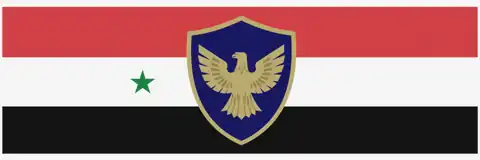
Iraqi Military Ranks at a Glance
The Iraqi Armed Forces are made up of three services — the Iraqi Ground Forces (the Army), the Iraqi Navy and the Iraqi Air Force — under the Ministry of Defence, with the Prime Minister as Commander-in-Chief. The Army is by far the largest service, built around infantry, armoured, artillery and mechanised units. The Air Force flies fighters, transports and helicopters in reconnaissance, transport and strike roles, and the Navy, the smallest service, guards Iraq’s short Gulf coastline, its oil terminals and the sea lanes that serve them. An elite Counter Terrorism Service, often called the Golden Division, reports directly to the Prime Minister.
The whole force was rebuilt after 2003, when the old army was dissolved and a new one raised from scratch, and it has been shaped ever since by counterinsurgency and the long campaign against ISIS. That history shows in the rank system: the titles and the eagle-and-swords insignia survived from the older army, while the structure was rebuilt along modern, NATO-compatible lines. Iraqi officers are usually shown with their NATO code — OF-1 to OF-10 for officers, OR-1 to OR-9 for other ranks — which makes it easy to match an Iraqi rank to its American or British equivalent.
Iraqi Commissioned Officer Ranks (OF-1 to OF-10)
Commissioned officers command at every level, from a platoon of thirty soldiers to the entire armed forces. Junior officers (OF-1 to OF-2) lead platoons and companies; field officers (OF-3 to OF-5) command battalions and serve as senior staff officers; general officers (OF-6 to OF-10) command brigades, divisions and the joint headquarters. The table below gives the Arabic title, the NATO code, the English equivalent in the Army and Air Force, the naval equivalent, the insignia and the typical role.
| Rank (Arabic) | NATO | Army / Air Force | Navy | Insignia | Typical Role |
|---|---|---|---|---|---|
| Mulazim (ملازم) | OF-1 | Second Lieutenant | Ensign | One gold star on the shoulder board | Platoon commander; entry-level commissioned officer |
| Mulazim awwal (ملازم أول) | OF-1 | First Lieutenant | Sub-Lieutenant | Two gold stars on the shoulder board | Platoon commander or deputy company commander |
| Naqib (نقيب) | OF-2 | Captain | Lieutenant | Three gold stars on the shoulder board | Company commander; first rank of real command responsibility |
| Ra’id (رائد) | OF-3 | Major | Lieutenant Commander | The republican eagle | Battalion staff officer or commander of an independent unit |
| Muqaddam (مقدم) | OF-4 | Lieutenant Colonel | Commander | The republican eagle with one star | Battalion commander or senior staff officer |
| Aqid (عقيد) | OF-5 | Colonel | Captain | The republican eagle with two stars | Brigade chief of staff or senior regimental commander |
| Amid (عميد) | OF-6 | Brigadier | Commodore | Three stars in a triangle with the eagle above | Brigade commander; the lowest general rank |
| Liwa (لواء) | OF-7 | Major General | Rear Admiral | Two crossed swords with the eagle above | Division commander or senior headquarters appointment |
| Fariq (فريق) | OF-8 | Lieutenant General | Vice Admiral | Crossed swords with one star and the eagle above | Corps commander or deputy chief of staff |
| Fariq ‘awal (فريق أول) | OF-9 | General | Admiral | Crossed swords with two stars and the eagle above | Chief of Staff or service chief |
| Mushir (مشیر) | OF-10 | Field Marshal | Admiral of the Fleet | Crossed swords with two wheat sprigs and the eagle above | Highest rank; reserved for the President and not in active use |
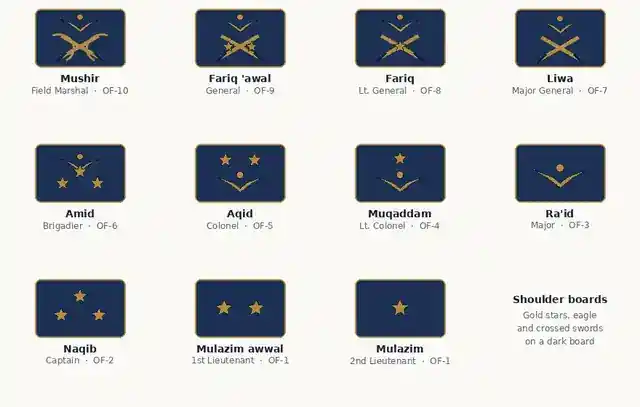
How to Read Iraqi Officer Insignia
Every Iraqi officer’s shoulder board is built from the same three devices — stars, the eagle and the crossed swords — so once you know the code you can read any board at a glance:
- Stars — the junior officers are counted in stars. One star is a Mulazim (Second Lieutenant), two stars a Mulazim awwal (First Lieutenant), and three stars a Naqib (Captain). The stars sit in a row on the shoulder board.
- The republican eagle — the eagle marks the field officers. A Ra’id (Major) wears the eagle alone; a Muqaddam (Lieutenant Colonel) adds one star below it, and an Aqid (Colonel) adds two. The eagle is the dividing line between company-grade and field-grade officers.
- Three stars in a triangle — an Amid (Brigadier) wears three stars arranged in a triangle with the eagle above them. It is the first general’s board, and the triangle sets it apart from the three-in-a-row of a Captain.
- Crossed swords — the senior generals wear two crossed swords with the eagle above. A Liwa (Major General) has the swords alone; a Fariq (Lieutenant General) adds one star; a Fariq ‘awal (General) adds two. The swords are the mark of general rank, just as the eagle is the mark of field rank.
- The wheat sprigs — a Mushir (Field Marshal) adds two wheat sprigs around the crossed swords, with the eagle above. It is the most elaborate board in the system, and the only one that uses the wheat.
One more marking is worth knowing: a red strip along the outer edge of the shoulder board shows that the officer is a graduate of the staff course — the Iraqi equivalent of staff college. It is not a rank, but it marks an officer trained for headquarters and planning work, and it appears on boards at every grade.
Key point: the red stripe is not a rank. A red strip along the outer edge of the shoulder board marks a graduate of the staff course, and it appears on boards at every grade — it tells you the officer is staff-trained, not how senior they are.
Iraqi Enlisted and NCO Ranks — Army and Air Force
The other ranks are the backbone of the Iraqi Army and Air Force. A Jundi is a new recruit; a Jundi ‘awwal has a little experience; ‘Arif, Raqib and Raqib ‘awal are the non-commissioned officers who lead sections, squads and platoons; and a Nayib dabit is the senior warrant officer who advises the commander. Unlike the officers, who wear their rank on the shoulder, other ranks wear theirs as chevrons on the sleeve, in the British style that the whole Iraqi system is modelled on.
| Rank (Arabic) | NATO | English Equivalent | Insignia | Typical Role |
|---|---|---|---|---|
| Jundi (جندي) | OR-1 | Private | No insignia | New recruit; entry-level soldier or airman |
| Jundi ‘awwal (جندي أول) | OR-2 | Private First Class | One chevron on the sleeve | Experienced private with extra duties |
| ‘Arif (عريف) | OR-4 | Corporal | Two chevrons on the sleeve | First NCO rank; leads a small team or section |
| Raqib (رقيب) | OR-6 | Sergeant / Staff Sergeant | Three chevrons on the sleeve | Squad leader; trains and supervises junior soldiers |
| Raqib ‘awal (رقيب أول) | OR-7 | First Sergeant / Sergeant First Class | Three chevrons with a senior device | Senior NCO at company level; the commander’s right hand |
| Nayib dabit (نائب ضابط) | OR-9 | Warrant Officer / Sergeant Major | Senior chevron device with a star in a wreath | Highest other rank; senior enlisted advisor to the commander |
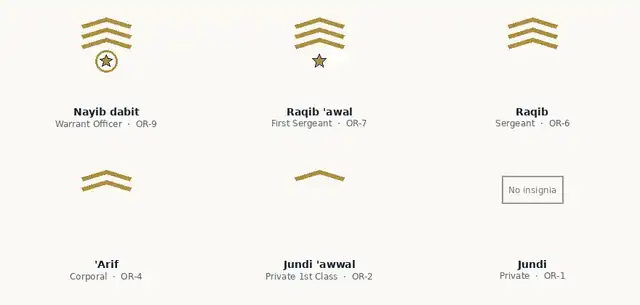
Notice the gaps in the NATO column: the Iraqi system has no OR-3, OR-5 or OR-8 grade. There is no Iraqi equivalent of a Lance Corporal or a Staff Sergeant as a separate grade — a soldier goes straight from Jundi ‘awwal (OR-2) to ‘Arif (OR-4), and from Raqib (OR-6) to Raqib ‘awal (OR-7). The same six grades serve the Air Force, where a Jundi is an airman rather than a soldier, but the titles and the chevrons are identical.
Did you know? the Iraqi other ranks skip three NATO grades — there is no Iraqi OR-3, OR-5 or OR-8. A soldier jumps straight from Jundi ‘awwal (OR-2) to ‘Arif (OR-4), with no Lance Corporal equivalent in between.
Iraqi Navy Ranks
The Iraqi Navy uses exactly the same officer titles as the Army and Air Force — a naval officer is still a Mulazim, a Naqib or a Fariq — but the English equivalents follow naval tradition, so a naval Aqid is a Captain, a naval Muqaddam is a Commander, and a naval Fariq ‘awal is an Admiral. The Navy’s other ranks, its ratings, have their own names, and they wear their chevrons in gold on navy blue.
| Rank (Arabic) | NATO | English Equivalent | Insignia | Typical Role |
|---|---|---|---|---|
| Jundi (جندي) | OR-1 | Seaman | No insignia | New sailor; entry-level rating |
| Jundi ‘awwal (جندي أول) | OR-2 | Able Seaman | One gold chevron | Experienced seaman with extra duties |
| Na’ib ‘arif (نائب عريف) | OR-4 | Petty Officer | Two gold chevrons | Junior petty officer; leads a small team of sailors |
| ‘Arif (رقيب) | OR-6 | Petty Officer First Class | Three gold chevrons | Senior petty officer; runs a department or watch |
| Ra’is ‘urafa (رقيب أول) | OR-7 | Chief Petty Officer | Three gold chevrons with a senior device | Senior rating aboard ship; advisor to the commanding officer |
| Nayib dabit (نائب ضابط) | OR-9 | Master Chief Petty Officer | Senior chevron device with a star in a wreath | Highest rating; senior enlisted advisor in the Navy |
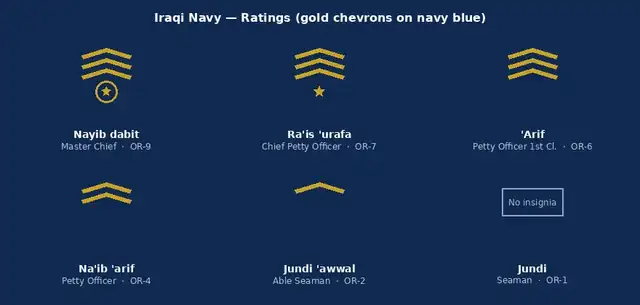
Two details deserve a note. First, the navy’s middle grades use the same Arabic words as the Army but in different places: in the Navy, ‘Arif is the OR-6 grade (Petty Officer First Class), while in the Army ‘Arif is the OR-4 grade (Corporal) — the word alone does not tell you the grade, so check the chevrons. Second, sources differ on the exact English equivalent of Na’ib ‘arif, some giving Petty Officer Second Class and others Petty Officer Third Class; the Arabic title and the OR-4 grade are not in dispute.
Did you know? the same Arabic word means a different grade in different services — ‘Arif is OR-4 (Corporal) in the Army but OR-6 (Petty Officer First Class) in the Navy. The word alone does not tell you the grade, so check the chevrons.
How to Read Iraqi Enlisted Insignia
Iraqi other-rank insignia follow the British pattern the whole system is borrowed from, and they are simpler than the officers’ boards:
- Chevrons — the V-shaped stripes on the sleeve. One chevron is a Jundi ‘awwal, two is an ‘Arif, three is a Raqib. Count the chevrons and you have the grade.
- The senior device — at the top of the ladder the chevrons gain an extra mark. A Raqib ‘awal and a Nayib dabit wear three chevrons with a star or wreath device that sets them apart from an ordinary Raqib, just as a British staff sergeant’s crown sets him apart from a sergeant.
- No insignia at all — a Jundi wears nothing. Like a private in almost every army, the lowest rank is the one with no mark to show.
- Colour tells you the service — Army and Air Force chevrons are gold on the uniform’s sleeve, while Navy chevrons are gold on navy blue. The shapes are the same; the background is the giveaway.
Iraqi Military Badges and Special Markings
Rank insignia shows a soldier’s grade. Badges show what a soldier is qualified to do, and a few markings that look like rank are not rank at all:
- The republican eagle — the eagle is both a rank device and the national emblem of the Iraqi armed forces. It appears on officers’ shoulder boards from Major upward, and in stylised form on cap badges and unit emblems. Its design has changed with Iraq’s governments, but the eagle itself has been the constant symbol of the officer corps.
- The red staff stripe — the thin red strip along the edge of an officer’s shoulder board marks a graduate of the staff course. It is worn at every grade and is the easiest way to spot a staff-trained officer in a group photograph.
- Branch and corps badges — soldiers wear the badge of their arm or service — infantry, armour, artillery, engineers, signals, medical — usually on the collar or beret. The beret colour itself varies by corps, as in most armies.
- Pilot wings — Iraqi Air Force pilots wear gold wings on the chest, earned after flight training. Aircrew and ground crew wear their own qualification badges, and the wings are one of the most respected badges in the Air Force.
- Parachutist wings — worn by soldiers qualified in military parachuting, including special forces and the Counter Terrorism Service. The CTS, the Golden Division, also wears its own distinctive insignia as an elite formation reporting directly to the Prime Minister.
How Promotion Works in the Iraqi Armed Forces
Promotion in the Iraqi Armed Forces runs on the same principles as in most Arab and Commonwealth armies: time in service, professional courses, and selection by senior officers. Officers are commissioned after training at the military college, and they advance through the junior grades as they gain service and complete the required courses. Promotion to field rank and above goes through selection, with command appointments — of a company, a battalion, a brigade — as the defining test of an officer’s career. The staff course, marked by the red stripe, is the gateway to the senior staff appointments that lead to general rank.
Other ranks advance on experience and courses of their own. A Jundi becomes a Jundi ‘awwal with service and good conduct; promotion to ‘Arif and above requires NCO training and a vacancy in the unit, and the step to Raqib ‘awal and Nayib dabit is a selection for the most trusted senior soldiers. Because the new armed forces were rebuilt from 2003 onward, the early years saw unusually fast promotion as the ranks were filled; today the system is steadier, and seniority in grade and course qualifications carry more weight. As in any army, the needs of the service — which units are expanding, which are short of leaders — shape how fast any individual rises.
A Note on Iraqi Military Tradition
Two histories explain almost everything about Iraqi ranks. The first is the Ottoman inheritance: Iraq’s army was founded in 1921, but its rank titles — Mulazim, Naqib, Fariq — come from the Ottoman military vocabulary, and the same words are still used across the Arab world, from Saudi Arabia to Egypt. An Iraqi officer and a Saudi officer with the same Arabic title hold the same rank, even if their insignia differ. The second is the British influence: the shoulder boards, the sleeve chevrons and the eagle-and-swords devices all follow the British pattern that Iraq adopted under the Mandate and kept ever since.
The break came in 2003, when the old army was dissolved and a new one built in its place. The titles survived the break, but the old symbols of the previous regime did not: the highest rank, Mushir — called Maheeb in older sources — was held by the president under the old order and is now reserved and unused, and the republican eagle itself was redesigned. What remains is a system that is at once very old and very new: Ottoman words, British shapes, and a force still defining itself two decades after its rebirth.
Read next
US Navy Ranks · US Military Branches · US Military Uniform · Saudi Arabian Military Ranks · Egyptian Military Ranks
FAQs
What is the highest rank in the Iraqi military?
Mushir (Field Marshal, OF-10), shown by crossed swords with two wheat sprigs and the republican eagle above. It is reserved for the President and is not in active use in the current Iraqi Armed Forces, so the highest rank actually held is Fariq ‘awal (General, OF-9). The highest other rank is Nayib dabit (Warrant Officer, OR-9).
What does Mulazim mean?
Mulazim (ملازم) is the lowest commissioned officer rank — Second Lieutenant in the Army and Air Force, Ensign in the Navy. Its insignia is a single gold star on the shoulder board. Mulazim awwal (First Lieutenant) wears two stars, and Naqib (Captain) wears three.
Do the Iraqi Army, Navy and Air Force use the same ranks?
Yes, for officers: the same eleven Arabic titles are used in all three services. The English equivalents differ in the Navy — a naval Aqid is a Captain, not a Colonel — and the Navy’s other ranks have their own names, such as Ra’is ‘urafa (Chief Petty Officer) instead of Raqib ‘awal.
What is the republican eagle on Iraqi insignia?
The eagle is the mark of a field officer: a Ra’id (Major) wears the eagle alone, a Muqaddam (Lieutenant Colonel) adds one star, and an Aqid (Colonel) adds two. It also appears above the stars on a Brigadier’s board and above the crossed swords on every general’s board, and in stylised form on cap badges and unit emblems.
What does the red stripe on an Iraqi officer’s shoulder board mean?
It shows the officer is a graduate of the staff course — the Iraqi equivalent of staff college. It is not a rank, but it marks an officer trained for headquarters and planning work, and it is worn at every grade from Second Lieutenant to General.
How many ranks are there in the Iraqi military?
Seventeen in each service: eleven commissioned officer ranks (OF-1 to OF-10) and six other ranks (OR-1 to OR-9), making 51 ranks across the Army, Navy and Air Force. The other ranks skip some NATO grades — there is no Iraqi OR-3, OR-5 or OR-8.
All insignia diagrams and images in this article are original graphics created for Forces Guide.