
The Vietnam People’s Army has one of the most distinctive rank systems in Asia. A Vietnamese soldier’s rank is read from a gold shoulder board carrying gold stars, and the colour of the piping around the board tells you the service: red for the Army, dark blue for the Navy, azure for the Air Force. This guide covers every Vietnamese military rank with its insignia, from Binh nhì (Private) to Đại tướng (General), across the Army, Navy and Air Force.
Vietnamese ranks fall into four career paths: officers (sĩ quan), professional soldiers (Quân nhân Chuyên nghiệp), non-commissioned officers (hạ sĩ quan) and enlisted personnel (chiến sĩ). The officer ladder has twelve ranks, and the same titles are used in the Army and the Air Force — only the Navy’s flag officers have different names. Two things make the system unusual: each of the three officer levels has four steps marked by four, three, two or one star, so a Captain wears four stars; and there is no Brigadier General and no Marshal in the Vietnamese system at all.
Key facts
- Country: Vietnam
- Branches: Vietnam People’s Army — Ground Force, Navy and Air Force (with Border Guard and Coast Guard piping colours too)
- Officers: 12 ranks, from Thiếu úy (Second Lieutenant) to Đại tướng (General); the Navy uses its own flag-officer titles
- Enlisted and NCOs: 5 ranks, from Binh nhì (Private) to Thượng sĩ (Sergeant Major)
- Professional soldiers: Long-serving specialists holding officer-style ranks from Thiếu úy to Thượng tá, marked by a pink silk line since 2008
- Highest rank: Đại tướng (General), reserved by law for the Minister of National Defence; the Navy’s highest rank is Đô đốc (Admiral)
- Notable fact: There is no Brigadier General and no Marshal — and each officer level runs from four stars down to one, so a Captain wears four stars
Vietnamese Officer Ranks (Army and Air Force)
Commissioned officers of the Vietnam People’s Army are grouped into three levels: general officers (sĩ quan cấp tướng), field grade officers (sĩ quan cấp tá) and junior officers (sĩ quan cấp úy). Within each level, seniority runs from four stars down to one: the most senior rank in a level wears four stars and the most junior wears one. That is why a Colonel (Đại tá) and a Captain (Đại úy) both wear four stars — the star count only has meaning inside its own level.
| Vietnamese Rank | English Equivalent | Stars | Insignia | Typical Role |
|---|---|---|---|---|
| Đại tướng | General | 4 | Fully gold board, 4 gold stars, gold crest | Highest rank; reserved by law for the Minister of National Defence |
| Thượng tướng | Colonel General | 3 | Fully gold board, 3 gold stars, gold crest | Senior general; deputy minister or chief of the General Staff |
| Trung tướng | Lieutenant General | 2 | Fully gold board, 2 gold stars, gold crest | Commands a military region, corps or service arm |
| Thiếu tướng | Major General | 1 | Fully gold board, 1 gold star, gold crest | Commands a division or a major military school |
| Đại tá | Colonel | 4 | Gold board with woven lines, 4 gold stars | Commands a regiment or brigade; senior staff officer |
| Thượng tá | Senior Colonel | 3 | Gold board with woven lines, 3 gold stars | Deputy regiment commander or senior staff officer |
| Trung tá | Lieutenant Colonel | 2 | Gold board with woven lines, 2 gold stars | Commands a battalion; regimental staff officer |
| Thiếu tá | Major | 1 | Gold board with woven lines, 1 gold star | Battalion staff officer or company group commander |
| Đại úy | Captain | 4 | Gold board, 4 gold stars | Commands a company (around 100 soldiers) |
| Thượng úy | Senior Lieutenant | 3 | Gold board, 3 gold stars | Company executive officer or platoon commander |
| Trung úy | Lieutenant | 2 | Gold board, 2 gold stars | Platoon commander |
| Thiếu úy | Second Lieutenant | 1 | Gold board, 1 gold star | Entry-level commissioned officer; platoon commander |
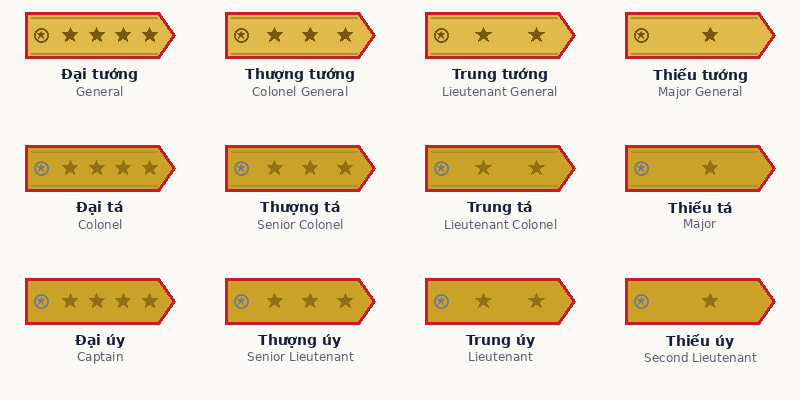
Did you know? A Captain (Đại úy) wears four stars and a Major (Thiếu tá) wears only one — yet the Major outranks the Captain. The stars only count inside their own level, so always read the board pattern first, then count the stars.
How to Read Vietnamese Officer Insignia
Every Vietnamese officer shoulder board is built from the same few elements, so once you know the code you can read any board at a glance:
- The stars — one to four gold stars. Within each level, four stars is the most senior and one star the most junior: Đại tướng (4), Thượng tướng (3), Trung tướng (2), Thiếu tướng (1); Đại tá (4), Thượng tá (3), Trung tá (2), Thiếu tá (1); Đại úy (4), Thượng úy (3), Trung úy (2), Thiếu úy (1).
- The board pattern — this is what separates the levels. General officers wear fully gold boards woven with a traditional Dong Son drum and flamingo pattern, with a gold crest and an encircled star. Field grade officers wear gold boards with woven lines. Junior officers wear plain gold boards.
- The crest — from Private to Colonel, the board carries a silver crest with an encircled silver star. Generals and admirals carry the same crest in gold.
- The piping — the coloured edge of the board shows the service: red for the Ground Force, azure (sky blue) for the Air Force and Air Defence, dark blue for the Navy, green for the Border Guard and blue for the Coast Guard.
- The trap for foreigners — never read the stars on their own. A Captain (Đại úy) with four stars does not outrank a Major (Thiếu tá) with one star: the Captain’s stars belong to the junior level, the Major’s to the field grade level. Read the board pattern first, then count the stars.
Vietnam People’s Navy Ranks
The Vietnam People’s Navy uses the same officer ranks as the Army from Đại tá downwards, but its flag officers have naval titles, adopted in 1982 — before that year the Navy used the same ranks as the rest of the armed forces. The Navy has no equivalent of Đại tướng: its highest rank is Đô đốc (Admiral), equivalent to a Colonel General.
The Navy is also the only service with gold sleeve insignia: since the 2010s, Navy officers wear gold stripes on the cuff of the full dress uniform, following the practice of most of the world’s navies, complete with the executive curl.
| Vietnamese Rank | English Equivalent | Army Equivalent | Insignia |
|---|---|---|---|
| Đô đốc | Admiral | Thượng tướng (Colonel General) | Fully gold board, 3 gold stars |
| Phó đô đốc | Vice Admiral | Trung tướng (Lieutenant General) | Fully gold board, 2 gold stars |
| Chuẩn đô đốc | Rear Admiral | Thiếu tướng (Major General) | Fully gold board, 1 gold star |
| Đại tá | Commodore | Đại tá (Colonel) | Gold board, dark blue piping, 4 gold stars |
| Thượng tá | Captain | Thượng tá (Senior Colonel) | Gold board, dark blue piping, 3 gold stars |
| Trung tá | Commander | Trung tá (Lieutenant Colonel) | Gold board, dark blue piping, 2 gold stars |
| Thiếu tá | Lieutenant Commander | Thiếu tá (Major) | Gold board, dark blue piping, 1 gold star |
| Đại úy | Captain Lieutenant | Đại úy (Captain) | Gold board, dark blue piping, 4 gold stars |
| Thượng úy | Lieutenant | Thượng úy (Senior Lieutenant) | Gold board, dark blue piping, 3 gold stars |
| Trung úy | Lieutenant Junior Grade | Trung úy (Lieutenant) | Gold board, dark blue piping, 2 gold stars |
| Thiếu úy | Ensign | Thiếu úy (Second Lieutenant) | Gold board, dark blue piping, 1 gold star |
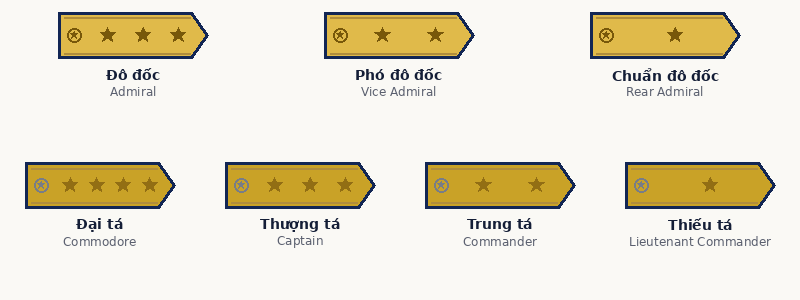
Key point: The Navy’s flag-officer titles — Đô đốc, Phó đô đốc and Chuẩn đô đốc — were only adopted in 1982. Before that, the Navy used the same ranks as the rest of the armed forces, and it still has no equivalent of Đại tướng.
Note that English translations of the Navy’s junior ranks vary between sources — Đại úy is sometimes rendered “Senior Lieutenant” rather than “Captain Lieutenant” — so the Vietnamese title is always the reliable form.
Vietnam People’s Air Force Ranks
The Vietnam People’s Air Force uses exactly the same officer ranks as the Army, from Thiếu úy (Second Lieutenant) up to Thượng tướng (Colonel General) — like the Navy, the Air Force has no Đại tướng. The only visible difference is the piping: Air Force shoulder boards are edged in azure (sky blue) instead of the Army’s red.
Air Force officers therefore read exactly like Army officers in the table and chart above — count the stars within the level, check the board pattern, and look for the azure edge.
Vietnamese Enlisted and NCO Ranks
Below the officers, the Vietnam People’s Army has just five other ranks: three non-commissioned officer grades and two enlisted grades. The senior NCO, Thượng sĩ, is the highest rank a non-commissioned officer can reach.
| Vietnamese Rank | English Equivalent | Insignia | Typical Role |
|---|---|---|---|
| Thượng sĩ | Sergeant Major / Master Sergeant | Gold board, 3 gold chevrons | Senior NCO; company or battalion sergeant major |
| Trung sĩ | Sergeant | Gold board, 2 gold chevrons | Squad leader; trains and supervises soldiers |
| Hạ sĩ | Corporal | Gold board, 1 gold chevron | Team leader; first NCO rank |
| Binh nhất | Private First Class | Gold board, 1 gold stripe | Experienced private; senior soldier in a squad |
| Binh nhì | Private | Plain gold board | New recruit; entry-level soldier |
How to Read Vietnamese Enlisted Insignia
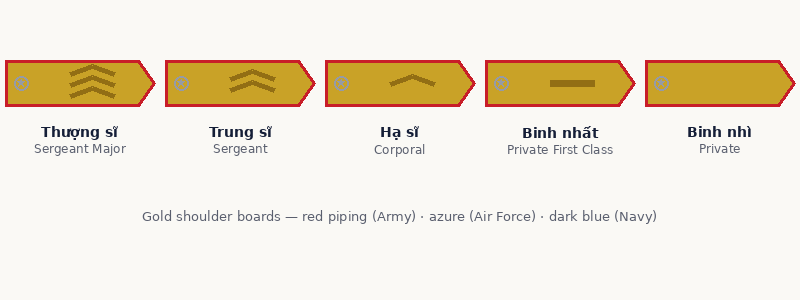
Enlisted and NCO insignia use the same gold shoulder board as officers, but the rank is shown with chevrons and stripes instead of stars:
- Chevrons — the V-shaped marks on the board. One chevron marks Hạ sĩ (Corporal), two mark Trung sĩ (Sergeant) and three mark Thượng sĩ (Sergeant Major). The more chevrons, the more senior the NCO.
- The single stripe — Binh nhất (Private First Class) wears one straight gold stripe on the board, marking a soldier who has completed initial service and earned the first step above Private.
- The plain board — Binh nhì (Private) wears a plain gold board with only the silver crest and encircled star. It is the entry rank for every Vietnamese soldier, sailor and airman.
- The crest — like junior and field grade officers, enlisted boards carry the silver crest with an encircled silver star at the top of the board.
- The piping — the same service colours apply: red for the Army, azure for the Air Force, dark blue for the Navy.
Professional Soldiers (Quân nhân Chuyên nghiệp)
Vietnam also has a separate corps of professional soldiers (Quân nhân Chuyên nghiệp, often translated as warrant officers). These are long-serving technical and specialist personnel — mechanics, signallers, medics and other experts — who hold officer-style ranks from Thiếu úy up to Thượng tá, but are not commissioned officers and do not command troops in the same way.
Their shoulder boards look like an officer’s board of the same rank, with one clear difference: since 2008 a pink silk line runs along the shoulder board to mark them out from the regular officer corps (before 2008 the distinction was a V-shaped chevron).
Did you know? Professional soldiers are marked by a pink silk line on the shoulder board, in use since 2008. It signals a career built on specialist skill — mechanics, signallers and medics — rather than command.
Badges and Branch Colours
Rank insignia shows a Vietnamese service member’s grade. Branch colours and badges show where they serve and what they are qualified to do:
- Branch piping — red for the Ground Force, dark blue for the Navy, azure for the Air Force and Air Defence, green for the Border Guard, blue for the Coast Guard. The piping is the fastest way to tell the service of a soldier in a photograph.
- The silver crest — the encircled silver star worn on the shoulder board from Private to Colonel is the shared emblem of the People’s Army, and it turns gold for generals and admirals.
- Navy sleeve stripes — Navy officers wear gold stripes with the executive curl on the cuff of the full dress uniform, a tradition shared with most of the world’s navies and unique among Vietnam’s services.
How Promotion Works in Vietnam’s Military
Promotion in the Vietnam People’s Army is governed by military law — the ranks themselves were set by the National Assembly in the Law on Vietnam People’s Army Officers of 30 December 1981 — and advancement combines time in grade, merit and selection. Officers are commissioned from Vietnam’s military academies as Thiếu úy and rise through the junior and field grade levels with command and staff appointments.
The very top is fixed by law: the rank of Đại tướng is reserved for the Minister of National Defence, and is only occasionally held by the Chief of the General Staff or the head of the General Political Department.
Enlisted soldiers are promoted from Binh nhì to Binh nhất on completion of their initial service, and the most capable are selected for NCO training, rising from Hạ sĩ to Thượng sĩ. Professional soldiers advance through their own technical ladder rather than the command ladder, which is why the pink line on their shoulder boards matters: it marks a career built on specialist skill rather than command.
A Note on Vietnamese Military Tradition
Vietnam’s rank system is younger than most: it was first introduced on 22 March 1946, when President Hồ Chí Minh signed the decree creating ranks for the Vietnamese National Army, the forerunner of today’s People’s Army. The current system dates from 1958, and it has been adjusted several times since — the Navy’s flag officer ranks were added in 1982, and the professional soldier insignia was changed to the pink line in 2008.
Two features explain almost everything about it. The first is its four-star pattern: each officer level runs from four stars to one, which is why ranks such as Senior Colonel (Thượng tá) and Senior Lieutenant (Thượng úy) exist here but in few other armies. The second is its unity: one set of ranks serves the Army, Navy and Air Force, with only the flag officers and the piping colour changing.
Read next
US Navy Ranks · Chinese Military Ranks · Indonesian Military Ranks · US Military Uniform · US Military Branches
FAQs
What is the highest rank in the Vietnamese military?
Đại tướng (General), with four gold stars on a fully gold shoulder board. It is reserved by law for the Minister of National Defence. The Navy’s highest rank is Đô đốc (Admiral), equivalent to Thượng tướng (Colonel General), and the Air Force tops out at Thượng tướng.
Why does a Vietnamese Captain wear four stars?
Because each of the three officer levels runs from four stars down to one. Đại úy (Captain) is the most senior junior officer, so it wears four stars; Thiếu tá (Major) is the most junior field grade officer, so it wears one star. The board pattern — plain for junior officers, woven for field grade, fully gold for generals — tells you which level the stars belong to.
What is the difference between Thượng tá and Đại tá?
Both are field grade officers, but Thượng tá (Senior Colonel, three stars) is junior to Đại tá (Colonel, four stars). Senior Colonel is a rank that exists in Vietnam, China and a few other countries but has no direct equivalent in the US or British armies, where Colonel is a single rank.
How can you tell which service a Vietnamese soldier belongs to?
By the piping around the shoulder board: red for the Army, azure (sky blue) for the Air Force, dark blue for the Navy, green for the Border Guard and blue for the Coast Guard. Navy officers are also the only ones who wear gold sleeve stripes with the executive curl.
What are professional soldiers (Quân nhân Chuyên nghiệp)?
Long-serving technical specialists who hold officer-style ranks from Thiếu úy to Thượng tá but are not commissioned officers. Since 2008 their shoulder boards have carried a pink silk line to distinguish them from regular officers.
Do Vietnamese NCOs wear chevrons like US NCOs?
Yes, in effect: Vietnamese NCOs wear gold chevrons on the shoulder board — one for Hạ sĩ (Corporal), two for Trung sĩ (Sergeant) and three for Thượng sĩ (Sergeant Major). Privates wear a single stripe (Binh nhất) or a plain board (Binh nhì).
All insignia diagrams and images in this article are original graphics created for Forces Guide.