
Qatar has one of the smallest armed forces in the Gulf, but it is also one of the best equipped — and its rank system is one of the easiest in the region to read once you know the code. A Qatari service member’s rank is worn on shoulder boards, and the same set of Arabic rank names is used across the Army, the Navy and the Air Force. This guide covers every Qatar military rank, from Jundi (Private) to Fariq ’awal (General), with insignia, badges and promotion explained.
Qatari ranks follow the Arab military tradition shared with Saudi Arabia, Egypt and Jordan, layered over a British framework inherited from the protectorate era. The names are Arabic, the insignia are British in style — stars and crossed swords on shoulder boards for officers, chevrons on the sleeve for other ranks — and the colour of the shoulder board tells you the service: tan for the Army, black for the Navy and blue for the Air Force.
Key facts
- Country: Qatar
- Branches: Qatari Emiri Land Force, Qatari Emiri Navy, Qatar Emiri Air Force — plus the Qatar Amiri Guard
- Commissioned officers: OF-1 to OF-9 (Mulazim to Fariq ’awal)
- Enlisted and warrant officers: OR-1 to OR-9 (Jundi to Wakil awwal)
- Highest rank: Fariq ’awal (General in the Army and Air Force, Admiral in the Navy)
- Rank names: the same Arabic titles in all three branches; only the English translations change
- How to tell the branch: tan shoulder boards for the Army, black for the Navy, blue for the Air Force
The Qatar Armed Forces at a Glance
The Qatar Armed Forces (Al-Quwwat Al-Musallahah Al-Qatariyyah) were founded in 1971, when Qatar gained independence from the United Kingdom. They have three main service branches — the Qatari Emiri Land Force, the Qatari Emiri Navy and the Qatar Emiri Air Force — plus the Qatar Amiri Guard, a specialist protection force that reports directly to the Emir. The Chief of Staff is Lieutenant General Jassim bin Mohammed bin Ahmed Al Mannai.
The force is small: about 26,500 active personnel, with the Land Force the largest branch at around 12,500, followed by the Air Force at about 5,000 and the Navy at about 4,500, plus air defence and special forces elements and around 4,000 reservists. Since 2015 Qatar has operated mandatory military conscription for men, with about 2,000 conscripts a year. Despite its size, the force is well equipped — Leopard 2A7+ tanks, Doha-class corvettes and Rafale, F-15QA and Typhoon fighters among them.
There are 17 ranks in each branch: 10 commissioned officer ranks (OF-1 to OF-9) and 7 other ranks (OR-1 to OR-9). There is no five-star or field-marshal rank in Qatar — the ladder tops out at OF-9 — and there are gaps in the enlisted ladder, with no equivalents of OR-7 or OR-2.
Qatar Commissioned Officer Ranks (OF-1 to OF-9)
Qatari commissioned officers are ranked from OF-1 to OF-9 on the NATO scale: junior officers (OF-1 to OF-2) lead platoons, field officers (OF-3 to OF-5) command companies and battalions, and general and flag officers (OF-6 to OF-9) command at the highest levels. The Arabic name is identical in every branch — a Fariq is a Fariq whether he serves on land, at sea or in the air — but the English title changes in the Navy, where the titles become naval ones.
| Rank (Arabic) | NATO | Army & Air Force Title | Navy Title | Insignia |
|---|---|---|---|---|
| Fariq ’awal (فريق أول) | OF-9 | General | Admiral | Shoulder board with crossed scimitars and stars |
| Fariq (فريق) | OF-8 | Lieutenant General | Vice Admiral | Shoulder board with crossed scimitars and stars |
| Liwa (لواء) | OF-7 | Major General | Rear Admiral | Shoulder board with crossed scimitars and stars |
| Amid (عميد) | OF-6 | Brigadier General | Commodore | Shoulder board with crossed scimitars and stars |
| Aqid (عقيد) | OF-5 | Colonel | Captain | Shoulder board with gold emblem and stars |
| Muqaddam (مقدم) | OF-4 | Lieutenant Colonel | Commander | Shoulder board with gold emblem and stars |
| Ra’id (رائد) | OF-3 | Major | Lieutenant Commander | Shoulder board with gold emblem and stars |
| Naqib (نقيب) | OF-2 | Captain | Lieutenant | Shoulder board with gold stars |
| Mulazim awwal (ملازم أول) | OF-1 | First Lieutenant | Sub-Lieutenant | Shoulder board with gold stars |
| Mulazim (ملازم) | OF-1 | Second Lieutenant | Ensign | Shoulder board with gold stars |
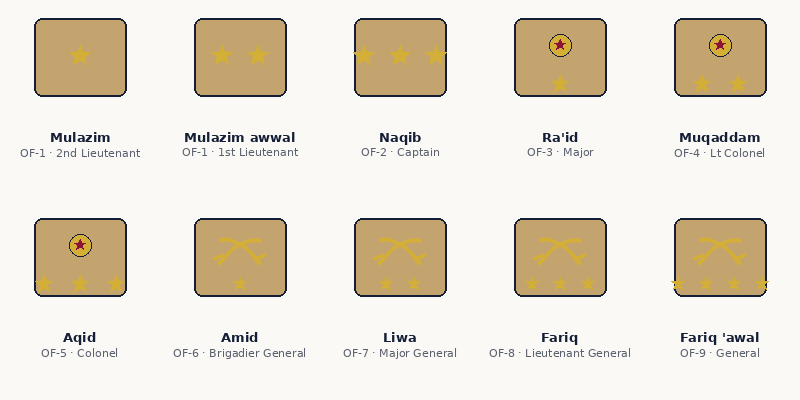
Did you know? The two most junior ranks share the NATO code OF-1: Mulazim and Mulazim awwal are both OF-1. And the Qatar Amiri Guard uses the same officer ladder, but its highest rank is Fariq — it has no Fariq ’awal.
How to Read Qatari Officer Insignia
Qatari officer rank is read from the shoulder board (epaulette) on the uniform. Three things on the board tell you everything: the colour, the stars and the swords.
- Board colour — the branch. Tan or khaki boards belong to the Qatari Emiri Land Force, black boards to the Qatari Emiri Navy, and blue boards to the Qatar Emiri Air Force. This is the fastest way to identify a service at a glance.
- Gold stars — seniority. Junior officers wear stars alone on the board, and the number of stars rises with the rank. Field officers add a gold emblem above the stars.
- Crossed scimitars — the generals. The four general and flag ranks (Amid through Fariq ’awal) carry the two crossed curved swords taken from Qatar’s national emblem. If you see the crossed scimitars, you are looking at a general or a flag officer, whatever the number of stars beneath them.
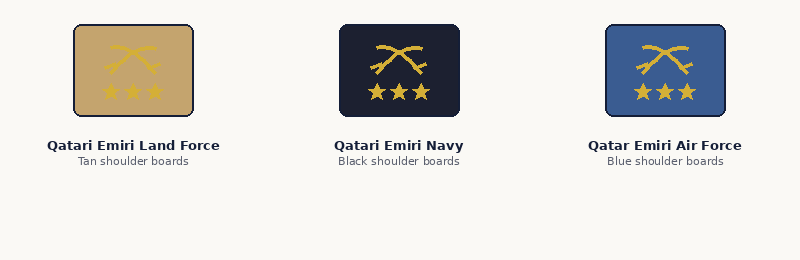
The chart above is a simplified schematic of the Army’s boards: the real boards carry the same devices in gold embroidery. On camouflage and working dress the same insignia is worn on a slip-on rank slide in the uniform’s colours.
Qatar Enlisted and Warrant Officer Ranks (OR-1 to OR-9)
The other ranks — non-commissioned officers, warrant officers and enlisted personnel — use seven grades. The Arabic titles are the same in all three branches, while the English equivalents change by service: the Navy’s titles are naval, and the Air Force’s are airman titles. The two most senior grades, Wakil awwal and Wakil thani, are the warrant officers.
| Rank (Arabic) | NATO | Army Title | Navy Title | Air Force Title | Insignia |
|---|---|---|---|---|---|
| Wakil awwal (وكيل اول) | OR-9 | Warrant Officer 1st Class | Warrant Officer Class I | Warrant Officer Class I | Crossed scimitars in a wreath |
| Wakil thani (وكيل ثاني) | OR-8 | Warrant Officer 2nd Class | Warrant Officer Class II | Warrant Officer Class II | Crown in a wreath |
| Raqib (رقيب) | OR-6 | Staff Sergeant | Chief Petty Officer | Staff Sergeant | Three chevrons with a crown above |
| Nayib (نائب) | OR-5 | Sergeant | Petty Officer | Sergeant | Three chevrons |
| Earif (عريف) | OR-4 | Corporal | Leading Seaman | Corporal | Two chevrons |
| Wakil earif (وكيل عريف) | OR-3 | Lance Corporal | Able Seaman | Lance Corporal | One chevron |
| Jundi (جندي) | OR-1 | Private | Seaman | Aircraftman | No insignia |
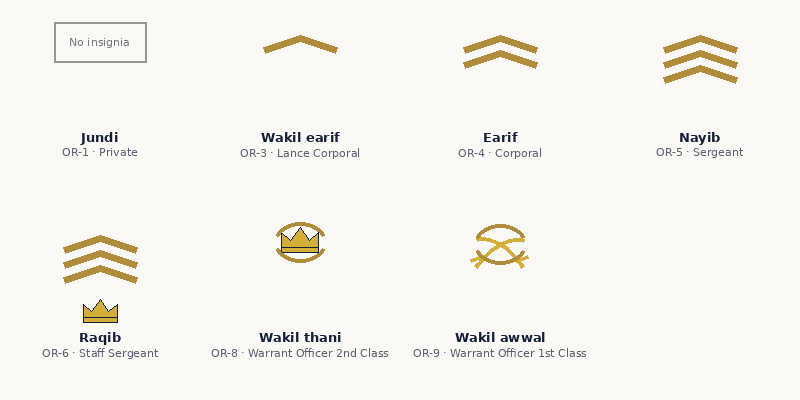
Key point: there is no Qatari equivalent of OR-7 (Sergeant First Class) or OR-2 (Private First Class) — a soldier jumps straight from Raqib (OR-6) to Wakil thani (OR-8). The word wakil means “deputy”, so a Wakil earif is literally a “deputy corporal”.
How to Read Qatari Enlisted Insignia
Enlisted insignia are worn as chevrons — V-shaped stripes — on the sleeve, in the British pattern Qatar inherited. Once you know the count, you can read any sleeve at a glance:
- Chevrons — one chevron for a Wakil earif (Lance Corporal), two for an Earif (Corporal), three for a Nayib (Sergeant). The Air Force follows the same Royal Air Force pattern, with a fourth chevron marking a Raqib (Staff Sergeant).
- The crown — a crown above the three chevrons marks a Raqib, the senior sergeant grade. The crown is the dividing line between the junior NCOs and the senior NCOs.
- Warrant officer badges — the two warrant grades leave chevrons behind entirely. A Wakil thani wears a crown inside a wreath, and a Wakil awwal wears crossed scimitars inside a wreath, echoing the crossed swords of the generals’ shoulder boards.
- No insignia at all — a Jundi wears nothing. Like a US Marine Private, the lowest rank in the Qatari system is the only one with a bare sleeve.
Qatari Military Badges and the National Emblem
Rank insignia shows a Qatari service member’s grade. Badges show what they are and what they have earned. The most important symbol in the Qatari system is not a rank at all: it is the national emblem, adopted in its current form in 2022 — a dhow sailing on waves between two palm trees, supported by two crossed scimitars in Qatar’s national maroon. Those crossed scimitars mark the general and flag ranks and the senior warrant officer grade.
- The crossed scimitars — taken from the national emblem and the sword of the founder, Sheikh Jassim bin Mohammed Al Thani. They appear on the shoulder boards of generals and flag officers and in the badge of a Wakil awwal, and they are the most recognisable single feature of Qatari rank insignia.
- Branch and unit badges — the service name tape (“QATAR ARMY”, “QATAR NAVY” or “QATAR AIR FORCE”) on the chest and the Qatar flag patches on both sleeves identify the branch.
- Qualification badges — as in most modern forces, specialist badges are worn alongside rank: wings for aircrew, parachutist badges for airborne and special forces personnel, and trade badges for technical specialists. They show a qualification, not a rank, and they do not change the wearer’s place in the chain of command.
- Ceremonial dress — for parades and state occasions, above all the National Day parade on 18 December, Qatari personnel wear ceremonial uniform with gold-embroidered shoulder boards, aiguillettes, medals and, for officers, a ceremonial sword.
How Promotion Works in the Qatar Armed Forces
Qatari officers are commissioned after a four-year course at one of the country’s military colleges: the Ahmed Bin Mohammed Military College for the Army, the Al Zaeem Mohammed bin Abdullah Al Attiyah Air Academy for the Air Force, and the Mohammed bin Ghanem Al Ghanem Naval Academy for the Navy. Cadets graduate as commissioned officers with a military diploma and a bachelor’s degree, entering service as Mulazim.
Promotion after commissioning follows the pattern of most Arab armed forces: junior officers advance on time in service and satisfactory performance, while promotion to field rank and above is competitive, decided by selection boards that weigh the officer’s record, courses and command performance. Command is the defining career gate — of a company, then a battalion, then a brigade. Enlisted personnel enter as Jundi, as volunteers or through the conscription system introduced in 2015, and advance through the chevron grades on time served, conduct and trade qualification, with the step up to warrant officer reserved for the most experienced senior NCOs. Promotion timelines are not published.
A Note on Qatari Military Tradition
Two heritages explain almost everything about Qatari ranks. The first is the British connection: Qatar was a British protectorate until independence in 1971, and its armed forces kept the British framework — shoulder boards and pips for officers, chevrons and crowns for other ranks, and the warrant officer system. The second is the Arab tradition: the rank names themselves — Fariq, Liwa, Amid, Aqid, Muqaddam, Ra’id, Naqib, Mulazim — are the same titles used across the Arab world, from Egypt to Jordan to Saudi Arabia, so a Qatari officer’s rank is immediately understood by any Arab counterpart.
The third strand is newer: the national emblem. The crossed scimitars that mark Qatari generals come from the emblem redesigned in 2022 around the founder’s sword, the dhow and the palm trees — the armed forces carry the symbols of the state itself.
Read next
US Navy Ranks · US Military Uniform · US Military Branches · Saudi Arabian Military Ranks · Egyptian Military Ranks
FAQs
What is the highest rank in the Qatar Armed Forces?
Fariq ’awal (فريق أول), translated as General in the Army and Air Force and Admiral in the Navy — NATO code OF-9. Qatar has no five-star rank and no field marshal, so OF-9 is the ceiling.
Do the Army, Navy and Air Force use the same rank names?
Yes — the Arabic rank names are identical in all three branches. A Fariq is a Fariq on land, at sea and in the air. Only the English translations differ, becoming naval titles in the Navy.
What do the crossed swords on Qatari insignia mean?
They are crossed scimitars taken from Qatar’s national emblem. On insignia they mark the general and flag officers (Amid to Fariq ’awal) and the senior warrant officer grade, Wakil awwal. Seeing the scimitars tells you at once that the wearer is a general or flag officer.
How can you tell which branch a Qatari service member belongs to?
By the colour of the shoulder board: tan or khaki for the Qatari Emiri Land Force, black for the Qatari Emiri Navy, and blue for the Qatar Emiri Air Force. The chest tape also reads “QATAR ARMY”, “QATAR NAVY” or “QATAR AIR FORCE”.
What is the lowest rank in the Qatar Armed Forces?
Jundi (جندي), translated as Private in the Army, Seaman in the Navy and Aircraftman in the Air Force — NATO code OR-1. A Jundi wears no rank insignia at all, which makes the bare sleeve itself the mark of the entry rank.
What is the difference between Wakil awwal and Wakil thani?
Both are warrant officers, the two most senior enlisted grades. Wakil thani (OR-8) is Warrant Officer 2nd Class, marked by a crown in a wreath; Wakil awwal (OR-9) is Warrant Officer 1st Class, marked by crossed scimitars in a wreath.
How do Qatari ranks compare to US ranks?
They line up through the NATO codes. A Qatari Fariq ’awal (OF-9) equals a US General or Admiral; an Aqid (OF-5) equals a US Colonel or Navy Captain; a Naqib (OF-2) equals a US Captain or Navy Lieutenant. On the enlisted side, a Nayib (OR-5) equals a US Sergeant and a Raqib (OR-6) equals a US Staff Sergeant. The main difference is the missing grades: Qatar has no equivalents of OR-7 or OR-2.
All insignia diagrams and images in this article are original graphics created for Forces Guide. Rank titles follow the standard Qatari rank table; insignia charts are simplified schematics of the shoulder-board and chevron system.