
The Sultan’s Armed Forces of Oman use one of the most distinctive rank systems in the Gulf. Every officer in the army, navy and air force carries the same Arabic rank title — from Mulazim (Second Lieutenant) up to Mushir (Field Marshal) — while the badges follow a British pattern of stars, crossed swords and chevrons, a legacy of Oman’s long history as a British protectorate. This guide covers every Oman military rank with its insignia, from Jundiun (Private) to Mushir, across the Royal Army of Oman, the Royal Navy of Oman and the Royal Air Force of Oman.
Omani ranks are best understood in two halves. Commissioned officers wear their rank on shoulder boards, in gold stars and crossed swords, and use identical Arabic titles in all three services. Other ranks — warrant officers, non-commissioned officers and enlisted personnel — wear chevrons and sleeve badges, with the navy following a seafaring version of the same ladder.
Key facts
- Country: Sultanate of Oman
- Branch: Sultan’s Armed Forces — Royal Army of Oman, Royal Navy of Oman and Royal Air Force of Oman
- Commissioned officers: OF-10 to OF-1 (Mulazim to Mushir), plus student officer Dabit murashshah
- Other ranks: OR-1 to OR-9 (Jundiun to Wakil katiba)
- Highest rank: Mushir (Field Marshal, OF-10)
- Supreme Commander: the Sultan of Oman
- Notable fact: the same Arabic officer titles are used in all three services, with British-pattern insignia of stars, crossed swords and chevrons
How the Oman Military Ranks System Is Organised
The Sultan’s Armed Forces (SAF) are the armed forces of the Sultanate of Oman, and the Sultan is their Supreme Commander. The three main services are the Royal Army of Oman (الجيش السلطاني العماني), the Royal Navy of Oman (البحرية السلطانية العمانية) and the Royal Air Force of Oman (سلاح الجو السلطاني العماني). Together they number around 42,000 active personnel.
Two smaller formations sit alongside them: the Royal Guard of Oman, which protects the Sultan and the royal family, and the Sultan’s Special Force, an elite unit that handles counter-terrorism and special reconnaissance. Both use the same rank titles as the army.
All three services share their headquarters at Mu’askar al-Murtafa’ah in Muscat. The Royal Army of Oman fields armoured, mechanised and infantry regiments, including Challenger 2 main battle tanks. The Royal Navy of Oman patrols the Strait of Hormuz and Oman’s territorial waters from bases at Muscat and Wudam Al-Sahil, operating missile corvettes and offshore patrol vessels. The Royal Air Force of Oman flies F-16 and Eurofighter Typhoon fighters from Thumrait and Masirah air bases.
Despite their different jobs, all three services use the same officer ranks and the same Arabic titles — the system is deliberately unified.
Oman Commissioned Officer Ranks (OF-10 to OF-1)
Oman has eleven commissioned officer ranks, from Second Lieutenant to Field Marshal, plus a student officer rank for cadets. The same Arabic titles are used in the Royal Army of Oman, the Royal Navy of Oman and the Royal Air Force of Oman — the navy does not use separate admiral titles.
The English equivalents below are the standard translations used in NATO comparisons, and the NATO code shows where each rank sits in the international scale.
Before commissioning, a future officer is a Dabit murashshah (ضابط مرشح), a student officer or officer cadet graded OF(D), who trains at the Sultan Qaboos Military Academy and the service academies.
| Rank (Arabic) | English Equivalent | NATO Code | Insignia | Typical Role |
|---|---|---|---|---|
| Mushir (مشیر) | Field Marshal | OF-10 | Crossed batons in a wreath with the national emblem | Highest rank in the Sultan’s Armed Forces; held only by the most senior commanders |
| Fariq ‘awal (فريق أول) | General (Admiral in the navy) | OF-9 | Crossed sword and baton with stars | Chief of Staff level; commands a whole service |
| Fariq (فريق) | Lieutenant General (Vice Admiral in the navy) | OF-8 | Crossed sword and baton with stars | Senior service commander or deputy chief |
| Liwa (لواء) | Major General (Rear Admiral in the navy) | OF-7 | Crossed sword and baton with a star | Division or major formation commander |
| Amid (عميد) | Brigadier General (Commodore in the navy) | OF-6 | Crossed sword and baton | Brigade commander or senior staff appointment |
| Aqid (عقيد) | Colonel (Captain in the navy) | OF-5 | Stars and the national emblem on the shoulder board | Regiment or major unit commander; senior staff officer |
| Muqaddam (مقدم) | Lieutenant Colonel (Commander in the navy) | OF-4 | Two stars and the national emblem on the shoulder board | Battalion commander or senior staff officer |
| Ra’id (رائد) | Major (Lieutenant Commander in the navy) | OF-3 | One star and the national emblem on the shoulder board | Company commander or battalion second-in-command |
| Naqib (نقيب) | Captain (Lieutenant in the navy) | OF-2 | Three stars on the shoulder board | Company commander or junior staff officer |
| Mulazim awwal (ملازم أول) | First Lieutenant (Lieutenant Junior Grade in the navy) | OF-1 | Two stars on the shoulder board | Platoon commander or junior officer in a unit |
| Mulazim (ملازم) | Second Lieutenant (Ensign in the navy) | OF-1 | One star on the shoulder board | Newly commissioned officer learning the trade |
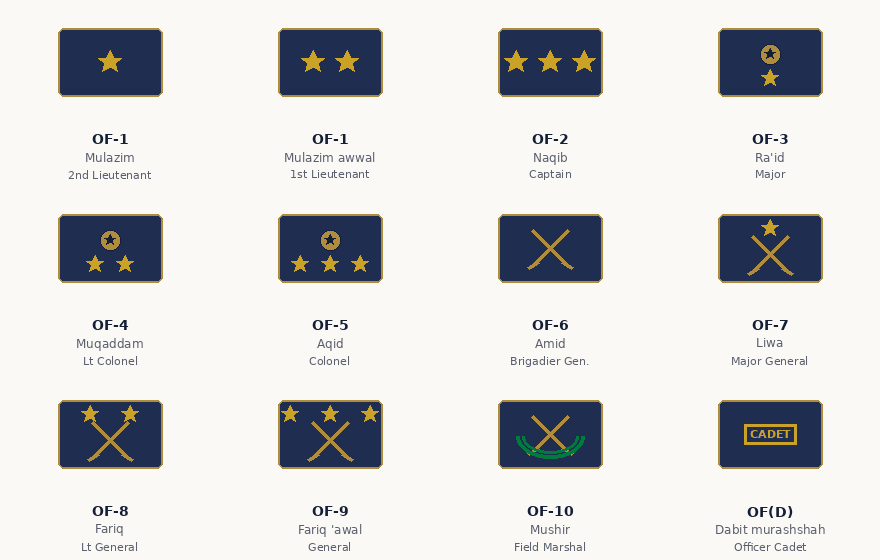
Key point: all three Omani services use the same Arabic officer titles — the navy does not have separate admiral titles. A Fariq ‘awal is a General in the army and an Admiral in the navy, so the English equivalent depends on the uniform.
How to Read Omani Officer Insignia
Omani officer insignia follow the British pattern, so they are read from the shoulder board:
- Stars — junior officers wear gold stars on the shoulder board, one for a Mulazim (Second Lieutenant), two for a Mulazim awwal (First Lieutenant) and three for a Naqib (Captain). More stars mean more seniority, but only up to Captain.
- The national emblem — senior officers add the emblem of Oman, the khanjar (curved dagger) over crossed swords, to the shoulder board. It marks the field ranks from Major upward.
- Crossed sword and baton — the mark of a general officer. A Brigadier General (Amid) wears a crossed sword and baton, and the higher generals add stars above it: one star for a Major General (Liwa), two for a Lieutenant General (Fariq) and three for a General (Fariq ‘awal).
- Crossed batons in a wreath — the rarest badge of all. Only a Mushir (Field Marshal) wears crossed batons inside a laurel wreath, the top of the Omani rank ladder.
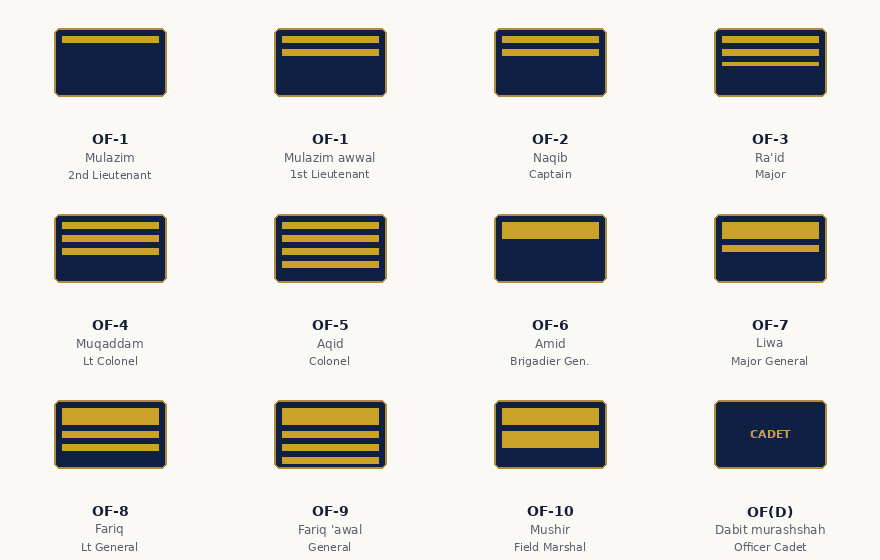
- The navy difference — Royal Navy of Oman officers also wear their rank as gold stripes on the sleeve, in the British naval tradition: one stripe for a Mulazim, two for a Mulazim awwal, two and a half for a Ra’id, three for a Muqaddam, four for an Aqid, and a broad stripe for the flag ranks.
Oman Enlisted and Other Ranks: Royal Army and Royal Air Force
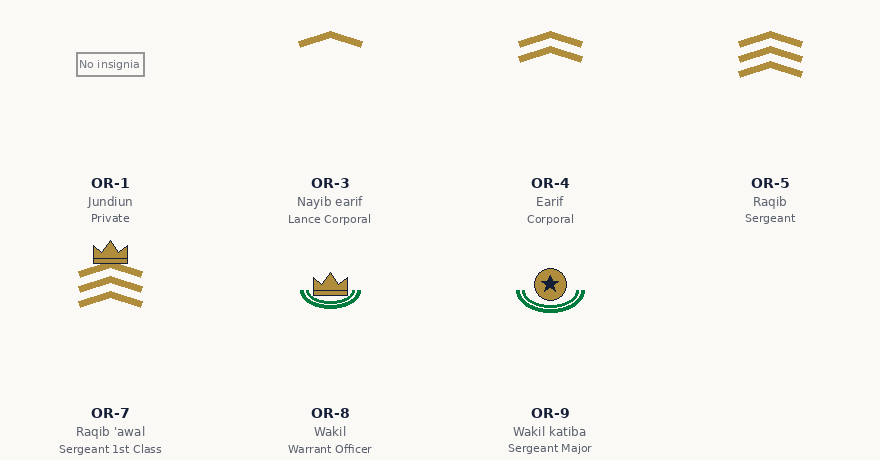
Below the officers come the other ranks: warrant officers, senior and junior non-commissioned officers, and enlisted soldiers and airmen. The Royal Army of Oman and the Royal Air Force of Oman use the same ladder of seven ranks, from Jundiun (Private) to Wakil katiba (Sergeant Major). A Jundiun wears no insignia at all.
| Rank (Arabic) | English Equivalent | NATO Code | Insignia | Typical Role |
|---|---|---|---|---|
| Wakil katiba (وكيل كتيبة) | Sergeant Major | OR-9 | Royal arms on the sleeve | Senior enlisted advisor to a battalion commander |
| Wakil (وكيل) | Warrant Officer | OR-8 | Crown in a wreath on the sleeve | Senior technical expert and regimental warrant officer |
| Raqib ‘awal (رقیب اول) | Sergeant First Class | OR-7 | Three chevrons with a crown above | Senior sergeant; company-level leader |
| Raqib (رقیب) | Sergeant | OR-5 | Three chevrons | Section or squad leader; first-line supervisor |
| Earif (عریف) | Corporal | OR-4 | Two chevrons | Team leader; junior non-commissioned officer |
| Nayib earif (نائب عریف) | Lance Corporal | OR-3 | One chevron | Second-in-command of a team; first step up from private soldier |
| Jundiun (جندي) | Private (Aircraftman in the air force) | OR-1 | No insignia | New soldier or airman in training or in a unit |
Oman Enlisted and Other Ranks: Royal Navy of Oman
The Royal Navy of Oman follows the same ladder, but with seafaring titles. Its senior ranks are warrant officers rather than sergeants major, and its junior ranks are seamen rather than corporals. There is no plain “seaman” rank in the Omani navy — the ladder starts at Able Seaman.
| Rank (Arabic) | English Equivalent | NATO Code | Insignia | Typical Role |
|---|---|---|---|---|
| Wakil ‘awal (وكيل أول) | Warrant Officer Class I | OR-9 | Royal arms on the sleeve | Most senior sailor on a ship or in a naval establishment |
| Wakil (وكيل) | Warrant Officer Class II | OR-8 | Crown in a wreath on the sleeve | Senior technical warrant officer; department head |
| Raqib ‘awal (رقیب أول) | Chief Petty Officer | OR-7 | Three chevrons with a crown above | Senior petty officer; runs a department or division |
| Raqib (رقیب) | Petty Officer | OR-5 | Three chevrons | Supervisor of a watch or work party |
| Earif (عریف) | Leading Seaman | OR-4 | Two chevrons | Leads a small team of sailors |
| Nayib earif (نائب عریف) | Able Seaman | OR-3 | One chevron | Trained sailor; first step up from new entry |
How to Read Omani Enlisted Insignia
Enlisted insignia in Oman follow the same British code used across the Commonwealth, so they are read from the sleeve:
- Chevrons — the V-shaped stripes on the upper arm. One chevron means a Nayib earif (Lance Corporal or Able Seaman), two mean an Earif (Corporal or Leading Seaman) and three mean a Raqib (Sergeant or Petty Officer).
- The crown — a crown above the three chevrons marks a Raqib ‘awal (Sergeant First Class or Chief Petty Officer). The crown is the sign of a senior non-commissioned officer.
- Crown in a wreath — a Wakil (Warrant Officer) wears a crown inside a laurel wreath, the mark of a warrant officer rather than a sergeant.
- The royal arms — the most senior other rank, the Wakil katiba (Sergeant Major) or the navy’s Wakil ‘awal (Warrant Officer Class I), wears the royal arms — the national emblem — on the sleeve.
- No insignia at all — a Jundiun (Private) wears no rank insignia. Like a Private in most armies, the newest soldier has nothing to show yet.
Did you know? There is no OR-6 and no OR-2 grade in the Omani system. A soldier jumps from Raqib ‘awal (OR-7) to Raqib (OR-5), and from Nayib earif (OR-3) straight to Jundiun (OR-1). The gaps are normal in Arab rank systems, which were built around a smaller set of grades than the American E-1 to E-9 ladder.
Omani Military Badges and Emblems
Rank insignia shows an Omani service member’s grade. Badges and emblems show which service they belong to and what they are qualified to do:
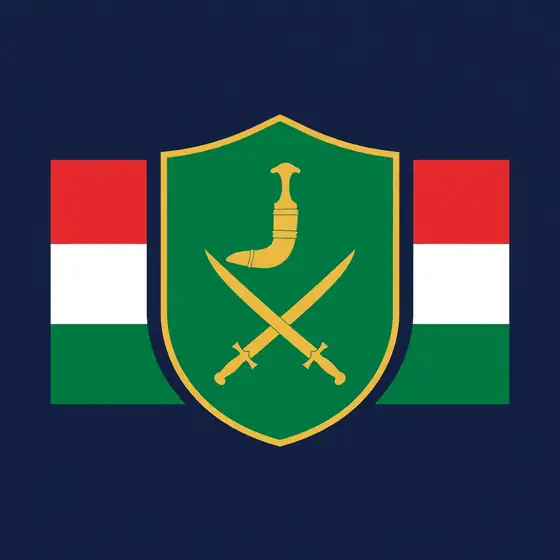
- The national emblem — the khanjar, a curved Omani dagger in its sheath, shown over two crossed swords and fastened with a belt. It is the emblem of Oman itself, and it appears on the flag, on currency, on cap badges and in the insignia of senior ranks. The crossed swords add a martial meaning: readiness and the right to bear arms in the Sultan’s service.
- Cap badges — every service member wears a cap badge built around the national emblem. Until 1977 the same emblem served as the cap badge of the entire Sultan’s Armed Forces; since then each service and unit has carried its own badge, all of them approved by the Sultan.
- Service identity — because the rank titles are identical across services, the badge, the uniform colour and the cap badge are what tell an army officer from a naval officer from an air force officer at a glance.
How Promotion Works in the Sultan’s Armed Forces
Promotion in Oman’s armed forces follows the British pattern the system was built on. Junior other ranks advance largely on time in service, good conduct and passing trade courses: a Jundiun becomes a Nayib earif, then an Earif, as they complete training and prove themselves in a unit.
Promotion to Raqib and above is competitive, decided by selection boards that weigh service records, course results and the needs of the service — and a move to warrant officer is a career milestone that marks a soldier or sailor as one of the most trusted members of their unit.
Officers are commissioned as Mulazim after completing cadet training, then promoted through the junior ranks on a mix of time in grade and professional courses.
Promotion to field rank — Ra’id and above — goes through centralised selection boards, and command is the defining career gate: a company, then a battalion, then a brigade or a ship.
A Note on Omani Military Tradition
Two traditions explain almost everything about Omani ranks. The first is the khanjar: the curved dagger that sits at the centre of the national emblem and in the insignia of senior ranks. Omani men traditionally wear the khanjar at the waist on formal occasions, and its place on the uniform ties the modern armed forces to centuries of Omani identity.
The second is the British connection: Oman was a protectorate until 1971, its forces were shaped by British officers through the Dhofar War of the 1960s and 1970s, and the rank structure they built — shoulder boards, chevrons, crossed swords and batons — has been kept ever since, simply translated into Arabic.
The result is a system that looks familiar to anyone who knows Commonwealth ranks, but reads differently: the badges are British, the titles are Arabic, and the emblem at the centre is Omani. A Fariq ‘awal may be the equivalent of a General or an Admiral depending on the uniform, and a Jundiun with no badge at all is where every Omani military career begins.
Read next
US Navy Ranks · US Military Branches · US Military Uniform · Saudi Arabian Military Ranks · Egyptian Military Ranks
FAQs
What is the highest rank in the Oman military?
Mushir (Field Marshal), graded OF-10. It is the top of the Omani rank ladder and is held only by the most senior commanders. The highest other rank is Wakil katiba (Sergeant Major) in the army and air force, and Wakil ‘awal (Warrant Officer Class I) in the navy.
Do the Omani army, navy and air force use the same ranks?
Yes, for officers. All three services use the same eleven Arabic titles, from Mulazim to Mushir. The navy uses the same titles too — it does not have separate admiral titles — so the English equivalent (Admiral, Vice Admiral and so on) depends on the service. The other ranks differ: the navy uses warrant officer and petty officer titles, while the army and air force use sergeant and corporal titles.
What does Mushir mean?
Mushir (مشیر) is the Arabic title for the highest military rank, translated as Field Marshal. It sits at OF-10, the equivalent of a five-star rank, and its insignia is crossed batons inside a laurel wreath.
What is a Wakil katiba?
Wakil katiba (وكيل كتيبة) is the most senior other rank in the Royal Army of Oman and the Royal Air Force of Oman, graded OR-9 and translated as Sergeant Major. The title literally means “deputy of the battalion”. The Wakil katiba is the senior enlisted advisor to a battalion commander, and wears the royal arms on the sleeve.
Why does the lowest Omani rank have no insignia?
A Jundiun (Private) wears no rank insignia, just as a new private in most armies wears none. The rank exists — OR-1 — but there is nothing to show until the soldier is promoted to Nayib earif (Lance Corporal), which brings the first chevron.
What is the Omani national emblem on military badges?
It is the khanjar, a curved Omani dagger in its sheath, shown over two crossed swords and fastened with a belt. It appears on the national flag, on cap badges and in the insignia of senior officers and warrant officers, and it is the most recognisable symbol of Omani identity.
All insignia diagrams and images in this article are original graphics created for Forces Guide. The charts are simplified schematics following the British-pattern design of Omani insignia.