
The Bahrain military ranks of the Bahrain Defence Force are read from stars, crowns and crossed sabres on an officer’s shoulder boards, and from chevrons on a soldier’s sleeve. The system is small and easy to learn once you know its logic: just 16 ranks in total — 11 commissioned officer ranks and 5 other ranks — and the same Arabic rank titles are used in the Army, the Navy and the Air Force alike. This guide covers every Bahrain military rank with its insignia, from Private (Jundiun) to Field Marshal (Mushir), plus the badges, berets and promotion path of the Bahrain Defence Force.
Bahrain’s ranks follow the British Army pattern, a legacy of the British presence in the Gulf before Bahrain’s independence in 1971. The building blocks are the same as in Britain — stars known as “pips”, a crown for field officers, and crossed blades for generals — but Bahrain makes two of its own substitutions: a plain five-pointed star replaces the British Bath star, and two crossed sabres replace the crossed sabre and baton of British generals. The rank names themselves are Arabic, shared with the armies of Saudi Arabia, Egypt, Jordan and the other Arab states.
Key facts
- Country: Bahrain
- Branch: Bahrain Defence Force — Royal Bahraini Army, Royal Bahraini Naval Force and Royal Bahraini Air Force, plus the Royal Guard
- Commissioned officers: 11 ranks, OF-1 to OF-10 (Second Lieutenant to Field Marshal)
- Other ranks: 5 ranks, OR-1 to OR-7 (Private to Master Sergeant) — no warrant officers
- Highest rank: Field Marshal (Mushir, OF-10), held by the commander-in-chief of the Bahrain Defence Force
- Pattern: British Army pattern with Arabic rank titles shared across the Arab armies
- Founded: 1968, as the National Guard; renamed the Bahrain Defence Force on 1 November 1969
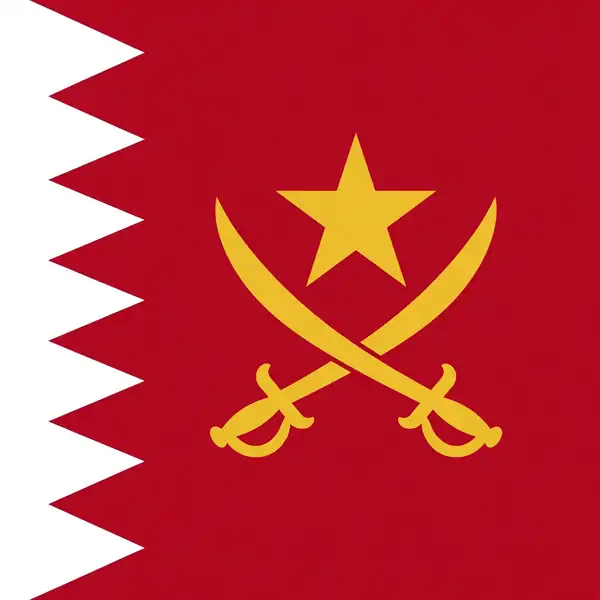
The Bahrain Defence Force at a Glance
The Bahrain Defence Force (BDF, قوة دفاع البحرين) was established in 1968 by Sheikh Isa bin Salman Al Khalifa, at first under the name of the National Guard. It was renamed the Bahrain Defence Force on 1 November 1969, shortly before Bahrain became independent from Britain in 1971. The first batch of recruits began basic training on 28 October 1968, and the first class graduated on 5 February 1969 — so the force is still young by the standards of the region’s armies, but its traditions are deliberately old, borrowed from the British model that trained its first officers.
Today the BDF is a compact, all-volunteer force built around three services — the Royal Bahraini Army, the Royal Bahraini Naval Force and the Royal Bahraini Air Force — together with the Royal Guard and the Royal Medical Services. The King of Bahrain is the supreme commander of the armed forces, and the commander-in-chief of the BDF holds the rank of Field Marshal. Estimates of the force’s size vary widely between sources, from about 8,000 to about 18,000 active personnel, which makes it one of the smallest armed forces in the Gulf.
Two other organisations wear Bahraini military rank but sit outside the BDF chain of command. The Royal Guard is the King’s own combined-arms force, responsible for royal security and high-readiness operations, and it uses the same Army ranks. The National Guard is a separate force that reports directly to the King, and it too uses the same rank titles, from Lieutenant General downwards.
Bahrain Commissioned Officer Ranks (OF-10 to OF-1)
Bahrain has 11 commissioned officer ranks, and the same Arabic title is used in all three services. Only the English translation of the very top rank changes with the service: Mushir is a Field Marshal in the Army, a Fleet Admiral in the Navy and an Air Marshal in the Air Force. The officers are grouped into junior officers (OF-1 to OF-2), field and senior officers (OF-3 to OF-5), and general or flag officers (OF-6 to OF-10).
| Rank (English) | Arabic Title | NATO Code | Insignia | Typical Role |
|---|---|---|---|---|
| Second Lieutenant | ملازم Mulazim | OF-1 | One five-pointed star | Platoon commander; entry-level commissioned officer |
| First Lieutenant | ملازم أول Mulazim awwal | OF-1 | Two five-pointed stars | Platoon commander or deputy company commander |
| Captain | نقيب Naqib | OF-2 | Three five-pointed stars | Company commander; senior junior officer |
| Major | رائد Ra’id | OF-3 | A crown | Company commander or battalion staff officer |
| Lieutenant Colonel | مقدم Muqaddam | OF-4 | Crown above one star | Battalion commander |
| Colonel | عقيد Aqid | OF-5 | Crown above two stars | Brigade staff officer or regimental commander |
| Brigadier General | عميد Amid | OF-6 | Crown above three stars | Brigade commander; senior staff appointment |
| Major General | لواء Liwa | OF-7 | Crossed sabres below one star | Division or formation commander |
| Lieutenant General | فريق Fariq | OF-8 | Crossed sabres below two stars | Service chief or senior command appointment |
| General | فريق أول Fariq ‘awal | OF-9 | Crossed sabres with crown and one star | Chief of staff or deputy commander-in-chief |
| Field Marshal / Fleet Admiral / Air Marshal | مشیر Mushir | OF-10 | Crossed sabres in a wreath, topped by a crown | Commander-in-chief of the Bahrain Defence Force; the highest rank in Bahrain |
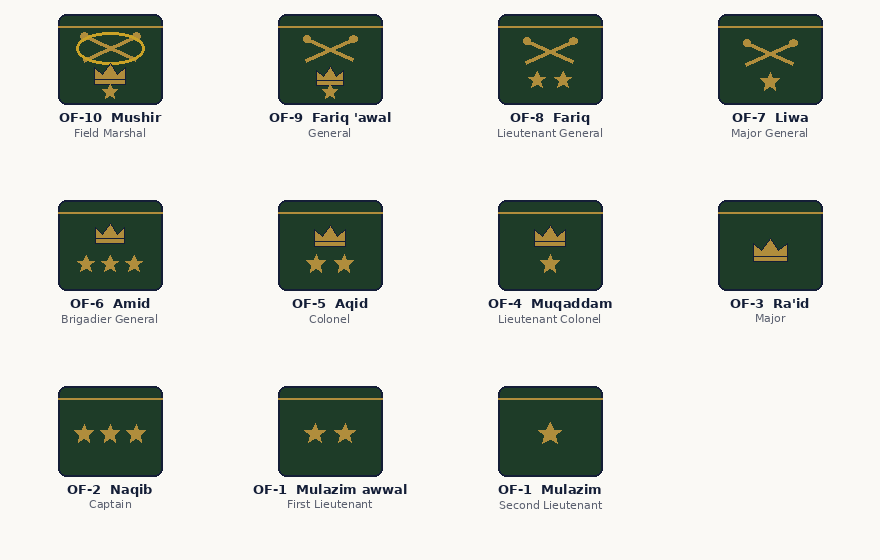
Did you know? Bahrain has just 16 ranks in total — one of the smallest rank ladders in the Gulf — and there is no warrant officer class in the Bahrain Defence Force at all.
How to Read Bahraini Officer Insignia
Every Bahraini officer’s rank is worn on the shoulder boards, and the whole system is built from just three devices — stars, a crown and crossed sabres — stacked in a fixed order. Once you know the code, you can read any Bahraini officer at a glance:
- Stars — the five-pointed star is the basic counting unit for junior officers. One star means Second Lieutenant, two stars mean First Lieutenant, and three stars mean Captain. Bahrain’s star replaces the eight-pointed Bath star used in the British system, which is the most visible difference between a Bahraini and a British shoulder board.
- The crown — the crown marks the field officers. A crown alone means Major. Add one star below it and you have a Lieutenant Colonel; two stars, a Colonel; three stars, a Brigadier General. The crown sits above the stars, never below them.
- Crossed sabres — two crossed sabres mark the generals, in place of the British crossed sabre and baton. A Major General wears crossed sabres with one star, a Lieutenant General with two stars, and a General adds a crown as well. The crossed sabres are the Arab touch on a British pattern, and they appear in the insignia of general officers across the Gulf.
- The wreath and crown — the Field Marshal’s insignia, Mushir, sets the crossed sabres inside a wreath and tops them with a crown. It is the only rank in the system that uses a wreath, and it is held by the commander-in-chief of the Bahrain Defence Force.
- One title, three services — the Arabic titles never change between the Army, Navy and Air Force. A Naqib is a Naqib whether he commands a rifle company, a patrol boat or a fighter squadron. Only the top rank takes a different English name in each service: Field Marshal on land, Fleet Admiral at sea and Air Marshal in the air.
A common point of confusion is the rank of Amid (Brigadier General). In the British system a brigadier is the most senior field officer, not a general, but Bahrain follows the Arab practice of treating Amid as a one-star general officer, equivalent to NATO OF-6.
Bahrain Other Ranks: NCOs and Enlisted (OR-1 to OR-7)
Below the commissioned officers, Bahrain has just five other ranks — the shortest enlisted ladder of any Gulf Arab force. There is no warrant officer class in the Bahrain Defence Force: the ladder runs from Private to Master Sergeant in five steps, and the same titles and insignia are used in the Army, the Navy and the Air Force.
| Rank (English) | Arabic Title | NATO Code | Insignia | Typical Role |
|---|---|---|---|---|
| Private | جندي Jundiun | OR-1 | No insignia | New recruit; entry-level soldier, sailor or airman |
| Lance Corporal | جندي أول Jundiun awwal | OR-3 | One chevron | Trained soldier; assistant team leader |
| Corporal | عريف Earif | OR-4 | Two chevrons | Junior NCO; leads a section or team |
| Sergeant | رقیب Raqib | OR-6 | Three chevrons | Senior NCO; platoon sergeant or specialist supervisor |
| Master Sergeant | رقیب أول Raqib ‘awal | OR-7 | Three chevrons with a crown above | Most senior NCO; company sergeant major and senior advisor |
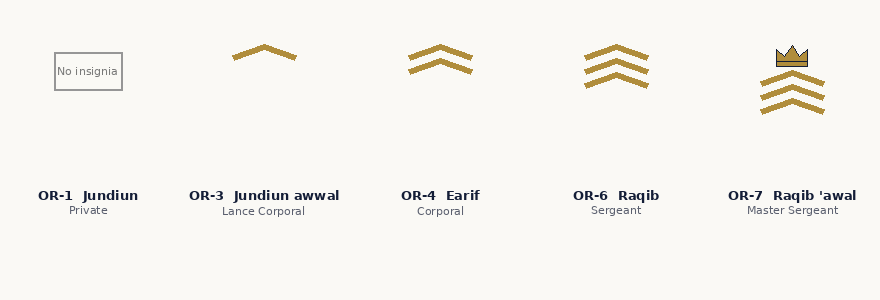
Key point: there is no rank above Master Sergeant before the commissioned officers begin — so a Raqib ‘awal is the senior enlisted voice in a company, and in a small force like Bahrain’s his word carries a great deal of weight.
How to Read Bahraini Enlisted Insignia
Bahraini other ranks wear their rank as chevrons — V-shaped stripes — on the sleeve, in the British tradition. The code is a simple count:
- No insignia at all — a Private (Jundiun) wears nothing on the sleeve. It is the only rank in the Bahrain Defence Force with no insignia, exactly as in the British Army.
- One chevron — a Lance Corporal (Jundiun awwal), literally “first soldier”. The single stripe marks a trained soldier who has begun to take responsibility for others.
- Two chevrons — a Corporal (Earif), the first full non-commissioned officer rank, leading a section or a small team.
- Three chevrons — a Sergeant (Raqib), the backbone of the platoon and the first senior NCO grade.
- Three chevrons and a crown — a Master Sergeant (Raqib ‘awal), literally “first sergeant”. The crown above the three chevrons is what separates the most senior NCO from the sergeants below him, and it mirrors the British staff sergeant’s crown.
Because the ladder is so short, each step matters more than in a larger army. There is no rank above Master Sergeant before the commissioned officers begin — so a Raqib ‘awal is the senior enlisted voice in a company, and in a small force like Bahrain’s his word carries a great deal of weight.
The Three Services and the Royal Guard
Although the rank titles are identical, the three services of the Bahrain Defence Force are easy to tell apart by their berets and their history. The Royal Bahraini Army is the largest service and the ground arm of the BDF, built around armoured, mechanised infantry and artillery brigades. The Royal Bahraini Naval Force is small — a few hundred sailors operating corvettes, patrol craft and landing vessels from Mina Salman Naval Base, guarding Bahrain’s coastline and offshore infrastructure in the Gulf. The Royal Bahraini Air Force operates from Isa Air Base and Riffa Air Base, flying multirole fighters and helicopters for air defence and close air support.
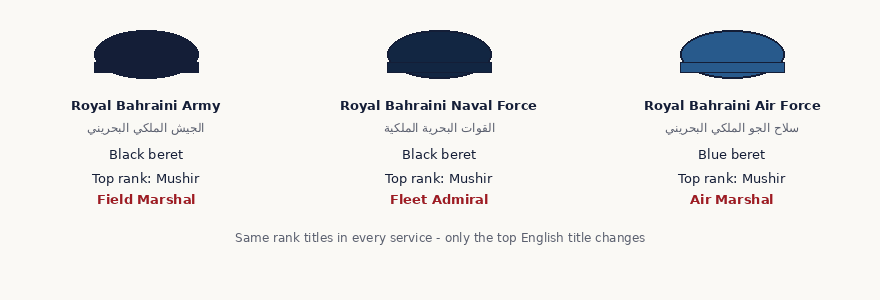
The beret is the quickest way to tell the services apart on parade. Soldiers and sailors of the Army and the Naval Force wear a black beret; the Air Force wears a blue beret. The Royal Guard wears green, special forces wear tan, the military police wear red, and the National Guard wears olive green. Officers of colonel rank and above in the Army wear the black beret regardless of their corps.
Did you know? The beret is the quickest way to tell Bahrain’s services apart: black for the Army and Navy, blue for the Air Force, green for the Royal Guard, tan for special forces, red for military police and olive green for the National Guard.
Bahraini Military Badges and Emblems
Rank insignia shows a Bahraini service member’s grade. Badges show what they are qualified to do, and which unit they belong to. The most important emblems to know are:
- The Bahrain Defence Force emblem — the crown above crossed swords within a wreath, with the word “Bahrain” beneath it. The same crown-and-crossed-swords motif appears on shoulder-board buttons and cap badges, and it is the single most recognisable symbol of the Bahraini armed forces.
- The flag of Bahrain — a white serrated band of five points on a red field. The five white points are traditionally said to represent the Five Pillars of Islam, and the red-and-white colours are among the oldest national colours in the Gulf. The serrated edge also appears as a design motif on Bahraini military insignia and patches.
- Beret badges and flashes — each service and corps wears its own cap badge above the left eye of the beret. Officers wear their rank insignia within the beret flash, while other ranks wear their unit insignia there instead.
- Parachutist and special forces badges — worn by members of the BDF’s special forces battalion and other airborne-qualified personnel. The special forces wear the distinctive tan beret that marks them out on parade.
- Medals and decorations — Bahrain awards its own orders and campaign medals, worn on the left chest of the service dress. They are decorations, not ranks, but on a Bahraini uniform they sit alongside the rank insignia and tell the story of where a service member has served.
How Promotion Works in the Bahrain Defence Force
Promotion in the Bahrain Defence Force follows the British pattern the rank system is built on: a mix of time in service, merit and selection, with senior appointments decided at the top of the force. Junior other ranks advance largely on time served and good conduct. Promotion to Sergeant and Master Sergeant is competitive: the number of posts is small, and a candidate’s record, courses passed and the recommendation of his commanding officer all count.
For officers, the early steps — from Second Lieutenant to Captain — follow time in rank and satisfactory service. Promotion to Major and above goes through selection, with staff college and command appointments as the defining career gates. A Bahraini officer who commands a company well, completes the staff course and serves on a formation headquarters is on the path to Lieutenant Colonel and Colonel; command of a brigade is the gate to general rank. Appointments at the very top — service chiefs, the chief of staff and the commander-in-chief — are made by the King as supreme commander.
Bahraini officer cadets have traditionally trained abroad, including at the Royal Military Academy Sandhurst in the United Kingdom, which is one reason the British rank pattern sits so naturally on a Bahraini uniform. Note that exact minimum times in each Bahraini rank are not published in open sources, so the timelines above describe the general pattern rather than fixed rules.
A Note on Bahraini Tradition
Two traditions explain almost everything about Bahrain military ranks. The first is the British connection: Bahrain was under British protection until 1971, and its insignia still use the British ladder of stars, crowns and crossed blades. The second is the Arab rank tradition: the titles — Mushir, Fariq, Liwa, Amid, Aqid, Muqaddam, Ra’id, Naqib, Mulazim, Raqib, Earif, Jundiun — are the shared vocabulary of the Arab armies, so a Bahraini Naqib and a Saudi Naqib hold the same rank.
That combination — British form, Arab names — is what makes the Bahraini system worth learning. It is the smallest and simplest rank ladder in the Gulf, with no warrant officers and only five ranks below commissioned officer, yet it carries the full weight of two military traditions at once. Learn the three devices — star, crown and crossed sabres — and the five chevrons, and you can read any Bahraini uniform you meet.
For comparison with the other services and neighbours, see our guides to US Navy ranks, the US military uniform and the US military branches, as well as our guides to Saudi Arabian military ranks and Egyptian military ranks.
Read next
Saudi Arabian Military Ranks · Egyptian Military Ranks · US Navy Ranks · US Military Uniform · US Military Branches
FAQs
What is the highest rank in the Bahrain Defence Force?
Field Marshal (Mushir, OF-10), held by the commander-in-chief of the Bahrain Defence Force. The same Arabic title is used in the Navy, where it translates as Fleet Admiral, and in the Air Force, where it translates as Air Marshal. The highest other rank is Master Sergeant (Raqib ‘awal, OR-7).
How many ranks are there in the Bahrain military?
Sixteen in total: 11 commissioned officer ranks, from Second Lieutenant (Mulazim) to Field Marshal (Mushir), and 5 other ranks, from Private (Jundiun) to Master Sergeant (Raqib ‘awal). There are no warrant officers in the Bahrain Defence Force.
Are Bahraini military ranks the same in the Army, Navy and Air Force?
Yes — the Arabic rank titles and the insignia are the same in all three services. Only the English translation of the top rank changes: Field Marshal in the Army, Fleet Admiral in the Navy and Air Marshal in the Air Force. The services are told apart by beret colour instead: black for the Army and Navy, blue for the Air Force.
What does Mushir mean?
Mushir (مشیر) is the Arabic title for the highest military rank, translated as Field Marshal in the Army. It comes from a word meaning counsellor or advisor, and in Bahrain it is the rank of the commander-in-chief of the Bahrain Defence Force. The same title is the top rank in several other Arab armed forces.
Why do Bahraini officer ranks look British?
Because the insignia are based on the British Army system, reflecting the period of British protection before Bahrain’s independence in 1971. Bahrain kept the British ladder of stars, crowns and crossed blades but replaced the Bath star with a plain five-pointed star and the crossed sabre and baton with two crossed sabres.
What rank is a Raqib in Bahrain?
Raqib (رقیب) is a Sergeant, NATO code OR-6, and wears three chevrons. The senior form, Raqib ‘awal — literally “first sergeant” — is a Master Sergeant (OR-7) and wears three chevrons with a crown above. Raqib is one of the most widely used NCO titles in the Arab world.
All insignia diagrams and images in this article are original graphics created for Forces Guide.