
Belgium may be a small country, but its rank system is one of the most distinctive in NATO. A Belgian soldier’s rank is read from gold and silver stars on the shoulder strap or collar, a sailor’s from gold sleeve stripes with a curl, and a non-commissioned officer’s from chevrons on the sleeve — and every rank has a name in Dutch and in French, and often in German too.
This guide covers every Belgian military rank with its insignia, from Soldaat (Private, OR-1) to Generaal (General, OF-9), across the Land, Naval and Air Components.
Key facts
- Country: Belgium
- Components: Land, Naval, Air, Medical and Cyber Components of Defence (Defensie / La Défense)
- Officer ranks: OF-1 to OF-9 (Onderluitenant to Generaal)
- Enlisted and NCO ranks: OR-1 to OR-9 (Soldaat to Adjudant-majoor)
- Highest rank: Generaal (OF-9) in the Army and Air Force; Admiraal (OF-9) in the Navy
- Notable rank: Kapitein-commandant, a senior captain with no direct equivalent in the US or British armies
- Languages: Every rank has a Dutch and a French name; Belgium is a founding NATO member (1949) and hosts NATO headquarters in Brussels
Belgium’s armed forces are a single unified service, Defence (Defensie in Dutch, La Défense in French), organised into the Land Component (the Army), the Naval Component (the Navy), the Air Component (the Air Force), the Medical Component and a Cyber Component. The King of the Belgians is commander-in-chief.
Belgium — a founding member of NATO in 1949, host of NATO headquarters in Brussels and of SHAPE near Mons — uses the NATO OF and OR grade system throughout. That makes Belgian ranks easy to compare with American, British, French and German ranks, even when the names themselves look unfamiliar.
Two things catch out almost every newcomer. The first is the Kapitein-commandant, a senior captain who sits between Captain and Major and has no direct equivalent in the US or British armies. The second is the language: Belgium has three official languages, so a rank such as Adjudant-majoor in Dutch is Adjudant-major in French and Majoradjutant in German.
The tables below give the Dutch name first, then the French, because those are the two working languages of the armed forces.
Belgian Army Officer Ranks (OF-1 to OF-9)
The Belgian Land Component — the Army — has eleven commissioned officer ranks, from Onderluitenant (Second Lieutenant) to Generaal (General). There is no OF-10 rank in Belgium: Generaal, at OF-9, is the highest rank in the Army and the Air Force, and no Belgian officer holds a five-star grade.
Officers are grouped as Opperofficieren (general officers, OF-6 to OF-9), Hoofdofficieren (senior or field officers, OF-3 to OF-5) and Lagere officieren (junior officers, OF-1 to OF-2).
| Rank (Dutch / French) | NATO Grade | Insignia | Typical Role |
|---|---|---|---|
| Generaal / Général | OF-9 | Four stars on the shoulder strap | Chief of Defence or the most senior Army commander |
| Luitenant-generaal / Lieutenant général | OF-8 | Three stars on the shoulder strap | Senior commander; corps or component-level command |
| Generaal-majoor / Général-major | OF-7 | Two stars on the shoulder strap | Division or brigade-group commander |
| Brigadegeneraal / Général de Brigade | OF-6 | One star on the shoulder strap | Brigade commander; the most junior general officer |
| Kolonel / Colonel | OF-5 | Three stars with a gold braid band | Regiment or brigade-level commander; senior staff officer |
| Luitenant-kolonel / Lieutenant-colonel | OF-4 | Two stars with a gold braid band | Battalion commander |
| Majoor / Major | OF-3 | One silver star with a gold braid band | Battalion executive officer or senior staff officer |
| Kapitein-commandant / Capitaine-commandant | OF-3 | Three pips under a narrow stripe | Senior company commander; experienced captain just below Major |
| Kapitein / Capitaine | OF-2 | Three gold stars | Company commander |
| Luitenant / Lieutenant | OF-1 | Two gold stars | Platoon commander |
| Onderluitenant / Sous-lieutenant | OF-1 | One gold star | Newly commissioned officer; platoon commander |
Officer cadets hold the rank of Aspirant (OF-D, officer candidate) while training at the Royal Military Academy in Brussels. Academy students pass through the enlisted ranks — Soldaat, Korporaal and Sergeant — as they progress, and take the oath as Onderluitenant when they complete their bachelor’s degree and their second-language examination.
Did you know? The Kapitein-commandant is a senior captain who sits directly above Captain and immediately below Major — and it is graded OF-3 in the NATO system, the same grade as a Major. No US or British rank matches it exactly.
How to Read Belgian Army Officer Insignia
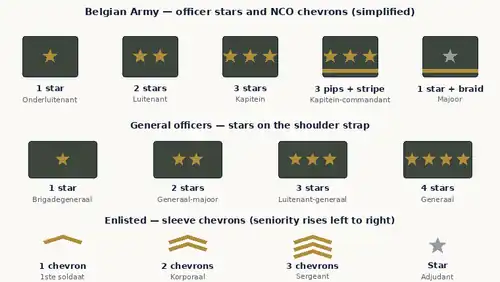
Belgian Army officer insignia follow a star system that is simple once the pattern clicks. Count the stars, then look for the braid:
- Junior officers wear gold stars. One star marks an Onderluitenant (Second Lieutenant), two stars a Luitenant, and three stars a Kapitein. The stars are six-pointed and are worn on the shoulder strap or collar, in gold.
- The Kapitein-commandant adds a stripe. A Kapitein-commandant wears three pips under a narrow stripe, which is what separates this senior captain from an ordinary Kapitein at a glance. The rank sits directly above Captain and immediately below Major, and it is graded OF-3 in the NATO system — the same grade as a Major.
- Senior officers add a gold braid band. A Majoor wears one silver star with a gold braid band, a Luitenant-kolonel two stars with the band, and a Kolonel three stars with the band. The braid, rather than the star count alone, is the mark of a field officer.
- Generals wear stars on the shoulder strap. One star marks a Brigadegeneraal, two a Generaal-majoor, three a Luitenant-generaal and four a Generaal. Generals are the only officers whose rank is shown on the shoulder strap in this way, and their cap and collar insignia become more elaborate with seniority.
- Silver means senior, not junior. As in several European armies, the move from gold stars to silver stars — and from a plain strap to a braided one — marks promotion into the senior ranks. Do not read the metal as a value judgement; read the whole badge.
Belgian Army Enlisted and NCO Ranks (OR-1 to OR-9)
Below the officers, the Belgian Army has twelve other ranks, divided into Hoofdonderofficieren (senior NCOs, OR-7 to OR-9), Keuronderofficieren and Lagere onderofficieren (junior NCOs, OR-5 to OR-6) and Vrijwilligers (volunteers, the private soldiers, OR-1 to OR-4).
The senior NCOs are the Adjudanten — warrant-officer equivalents whose French title, Adjudant, is familiar from the French Army. There is no separate American-style warrant officer corps in Belgium: the Adjudant grades fill that senior enlisted role.
| Rank (Dutch / French) | NATO Grade | Insignia | Typical Role |
|---|---|---|---|
| Adjudant-majoor / Adjudant-major | OR-9 | Star and braid on the shoulder strap; the senior NCO badge | Most senior NCO in a unit or corps; advisor to the commander |
| Adjudant-chef / Adjudant-chef | OR-9 | Star and braid on the shoulder strap | Senior warrant officer; regimental or battalion-level advisor |
| Adjudant / Adjudant | OR-8 | Silver star on the shoulder strap | Warrant officer; senior specialist and advisor |
| 1ste sergeant-majoor / 1er sergent-major | OR-7 | Chevrons with a crown device on the sleeve | First sergeant-major; senior NCO of a company or squadron |
| 1ste sergeant-chef / 1er sergent-chef | OR-6 | Chevrons on the sleeve | Senior sergeant; platoon or section leader |
| 1ste sergeant / 1er sergent | OR-6 | Chevrons on the sleeve | First sergeant; experienced NCO leader |
| Sergeant / Sergent | OR-5 | Chevrons on the sleeve | Section or squad leader; the first NCO rank |
| 1ste korporaal-chef / 1er caporal-chef | OR-4 | Chevrons on the sleeve | Senior corporal; team leader |
| Korporaal-chef / Caporal-chef | OR-4 | Chevrons on the sleeve | Master corporal; experienced junior leader |
| Korporaal / Caporal | OR-3 | Chevrons on the sleeve | Corporal; team leader |
| 1ste soldaat / 1er soldat | OR-2 | Single chevron on the sleeve | First-class private; experienced soldier |
| Soldaat / Soldat | OR-1 | No rank insignia | New soldier; entry-level private |
How to Read Belgian Enlisted Insignia
Belgian enlisted insignia are built from chevrons and stars, and the two families meet at the top of the ladder:
- Chevrons mark the corporals and sergeants. A 1ste soldaat wears a single chevron, corporals wear chevrons on the sleeve, and sergeants wear fuller chevron badges. The more senior the grade, the more elaborate the sleeve badge — the 1ste (first) prefix always marks the senior form of a rank.
- The Adjudant grades wear a star, not chevrons. An Adjudant wears a silver star on the shoulder strap, and the two senior Adjudant grades add braid. That star is the visual break between the sergeant family and the warrant-officer family, and it is why an Adjudant can be mistaken for a junior officer by an outsider.
- Appointments add a crown. A Company Sergeant Major (CSM) wears the insignia of their rank with a small crown at the top, and a Regimental Sergeant Major — the Adjudant de corps or Korpsadjudant, the most senior NCO in the corps — wears it with a large crown. A Corps Corporal (Caporal de corps / Korpskorporaal) likewise adds a crown to the 1ste korporaal-chef badge. The crown marks a job, not a new rank.
- Cavalry, artillery and logistics units use different names. In units whose traditions descend from horse-mounted troops, Korporaal becomes Brigadier and Sergeant becomes Wachtmeester (Maréchal des logis in French), and the lowest rank is Cavalier in French and Ruiter in Dutch. The insignia stay the same; only the title changes.
Key point: a crown on Belgian enlisted insignia marks an appointment, not a rank. The Company Sergeant Major’s small crown and the Regimental Sergeant Major’s large crown show the job the NCO holds — the underlying rank underneath stays the same.
Belgian Navy Officer Ranks (OF-1 to OF-9)
The Belgian Naval Component is small — built around frigates, patrol vessels and mine countermeasures ships, many of them operated jointly with the Netherlands — but its officer ranks follow the classic naval pattern of gold sleeve stripes, with the distinctive executive curl (a loop at the top of the upper stripe) that marks a seagoing officer.
The highest naval rank is Admiraal (OF-9); there is no higher flag rank. Naval ranks have completely different names from the Army, so a naval OF-5 is a Kapitein-ter-zee, not a Kolonel.
| Rank (Dutch / French) | NATO Grade | Insignia | Typical Role |
|---|---|---|---|
| Admiraal / Amiral | OF-9 | Four gold sleeve stripes with curl | Most senior naval officer; component commander |
| Vice-admiraal / Vice-amiral | OF-8 | Three gold sleeve stripes with curl | Senior flag officer; deputy component commander |
| Divisieadmiraal / Amiral de division | OF-7 | Two gold sleeve stripes with curl | Flag officer; division or flotilla commander |
| Flottieljeadmiraal / Amiral de flottille | OF-6 | One broad gold sleeve stripe with curl | Flotilla commander; the most junior admiral |
| Kapitein-ter-zee / Capitaine de vaisseau | OF-5 | Four gold sleeve stripes with curl | Captain of a major warship; senior naval commander |
| Fregatkapitein / Capitaine de frégate | OF-4 | Three gold sleeve stripes with curl | Frigate captain; commander of a frigate |
| Korvetkapitein / Capitaine de corvette | OF-3 | Two and a half gold sleeve stripes with curl | Corvette captain; commander of a smaller vessel |
| Luitenant-ter-zee 1ste klasse / Lieutenant de vaisseau de 1re classe | OF-3 | Two and a half gold sleeve stripes with curl | Senior naval lieutenant; the naval equivalent of Kapitein-commandant |
| Luitenant-ter-zee / Lieutenant de vaisseau | OF-2 | Two gold sleeve stripes with curl | Naval lieutenant; watchkeeping and department officer |
| Vaandrig-ter-zee / Enseigne de vaisseau | OF-1 | One gold sleeve stripe with curl | Ensign; junior officer under training at sea |
| Vaandrig-ter-zee 2de klasse / Enseigne de vaisseau de 2e classe | OF-1 | One narrow gold sleeve stripe with curl | Second-class ensign; newly commissioned naval officer |
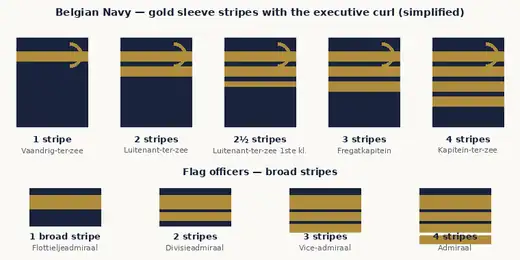
Did you know? The executive curl — the loop at the top of a Belgian naval officer’s upper sleeve stripe — is the single most reliable way to tell a naval officer from an air force officer, whose stripes are straight. It marks the wearer as a seagoing line officer.
How to Read Belgian Navy Insignia
Naval insignia are read by counting stripes on the sleeve, exactly as in the Royal Navy or the US Navy, with two Belgian twists:
- Count the stripes. One stripe marks an ensign, two a lieutenant, two and a half a senior lieutenant or corvette captain, three a frigate captain and four a captain at sea. The half stripe — a narrow stripe above two broad ones — is the mark of the OF-3 grades, and it appears twice in the table because Belgium has two OF-3 naval ranks.
- Look for the curl. The top stripe ends in a loop, the executive curl, which identifies the wearer as a seagoing line officer. It is the single most reliable way to tell a Belgian naval officer’s sleeve from an air force officer’s, whose stripes are straight.
- Admirals restart the count. A Flottieljeadmiraal wears one broad stripe, a Divisieadmiraal two, a Vice-admiraal three and an Admiraal four. The broad stripe of the one-star admiral is wider than the stripes below it, so a broad stripe plus a curl at the top of the sleeve always means a flag officer.
- Do not confuse the two OF-3 ranks. A Korvetkapitein and a Luitenant-ter-zee 1ste klasse wear the same two-and-a-half stripes and hold the same NATO grade. The difference is the career path: the Korvetkapitein is the naval equivalent of an Army Major, while the Luitenant-ter-zee 1ste klasse is the naval equivalent of a Kapitein-commandant — a senior lieutenant promoted within the lieutenant’s ladder.
Belgian Navy Enlisted and NCO Ranks (OR-1 to OR-9)
Belgian sailors use the Meester (master) family of titles, which has no Army equivalent. The senior grades are the Oppermeesters, the middle grades the Meesters, and the junior grades the Kwartiermeesters (quartermasters) and Matrozen (seamen).
| Rank (Dutch / French) | NATO Grade | Insignia | Typical Role |
|---|---|---|---|
| Oppermeester-chef / Maître principal-chef | OR-9 | Senior master-chief badge on the sleeve | Most senior naval NCO; advisor to the ship’s command |
| Oppermeester / Maître-principal | OR-9 | Master-chief badge on the sleeve | Senior master chief; department-level advisor |
| Eerste meesterchef / Premier-maître chef | OR-8 | Senior chief badge on the sleeve | First master chief; senior specialist |
| Eerste meester / Premier maître | OR-7 | Chief badge on the sleeve | Chief petty officer; division leader |
| Meester-chef / Maître-chef | OR-6 | Petty officer badge on the sleeve | First-class petty officer |
| Meester / Maître | OR-6 | Petty officer badge on the sleeve | Petty officer; work-centre supervisor |
| Tweede meester / Second-maître | OR-5 | Petty officer badge on the sleeve | Second-class petty officer; the first naval NCO rank |
| Eerste kwartiermeester-chef / Premier quartier-maître-chef | OR-4 | Quartermaster badge on the sleeve | Senior leading seaman |
| Kwartiermeester-chef / Quartier-maître-chef | OR-4 | Quartermaster badge on the sleeve | Leading seaman, chief grade |
| Kwartiermeester / Quartier-maître | OR-3 | Quartermaster badge on the sleeve | Leading seaman |
| Eerste matroos / Premier matelot | OR-2 | Single chevron on the sleeve | Able seaman; experienced sailor |
| Matroos / Matelot | OR-1 | No rank insignia | New sailor; entry-level seaman |
Belgian Air Force Ranks
The Belgian Air Component uses exactly the same officer and enlisted rank names as the Army — Generaal down to Onderluitenant, and Adjudant-majoor down to Soldaat — so the tables above cover the Air Force as well.
What changes is the insignia: Air Force officers wear their rank as blue sleeve stripes with the naval-style curl, while a Kapitein-commandant in the Air Force wears three blue stripes with a curl.
| Rank (Dutch / French) | NATO Grade | Insignia | Typical Role |
|---|---|---|---|
| Generaal / Général | OF-9 | Four blue sleeve stripes with curl | Air Component commander |
| Luitenant-generaal / Lieutenant général | OF-8 | Three blue sleeve stripes with curl | Senior air commander |
| Generaal-majoor / Général-major | OF-7 | Two blue sleeve stripes with curl | Air base or wing group commander |
| Brigadegeneraal / Général de Brigade | OF-6 | One broad blue sleeve stripe with curl | Brigade-level air commander |
| Kolonel / Colonel | OF-5 | Blue sleeve stripes with curl | Wing commander |
| Luitenant-kolonel / Lieutenant-colonel | OF-4 | Blue sleeve stripes with curl | Squadron commander |
| Majoor / Major | OF-3 | Blue sleeve stripes with curl | Squadron executive officer or staff officer |
| Kapitein-commandant / Capitaine-commandant | OF-3 | Three blue stripes with curl | Senior flight commander |
| Kapitein / Capitaine | OF-2 | Blue sleeve stripes with curl | Flight commander; pilot or specialist officer |
| Luitenant / Lieutenant | OF-1 | Blue sleeve stripes with curl | Junior pilot or officer |
| Onderluitenant / Sous-lieutenant | OF-1 | Blue sleeve stripes with curl | Newly commissioned air officer |
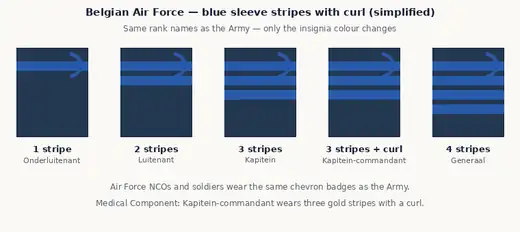
The Medical Component uses the same rank names as the Army and Air Force, with its own variations: a Kapitein-commandant in the Medical Component wears three gold stripes with a curl, and doctors, dentists, pharmacists and veterinarians hold medical rank titles within the same OF and OR ladder.
The Medical Component is commanded by a Generaal-majoor and provides the medical battalions and field hospitals that support all four components.
Belgian Military Badges
Rank insignia shows a Belgian service member’s grade. Badges show what they are qualified to do, and Belgium has several that outsiders notice at once:
- Beret badges and colours. Belgian soldiers wear berets in the colour of their arm of service — the dark green beret of the Para-Commandos and the Special Operations Regiment is the most famous — with a cap badge that identifies the regiment.
- Para-Commando wings. The winged dagger and parachute badge of the Para-Commando Regiment, earned through commando and parachute training, is one of the most respected qualifications in the Belgian Army.
- Pilot wings. Belgian Air Force pilots wear gold pilot wings on the chest, earned after flight training. Aircrew, parachutists and other specialists wear their own qualification badges beside them.
- The Belgian lion and the cockade. Belgian cap badges and cockades carry the national colours — black, yellow and red — and the Belgian lion appears in regimental insignia across the Army. On ceremonial uniforms, the Grenadiers and the Royal Escort wear distinctive red epaulettes.
How Promotion Works in the Belgian Armed Forces
Promotion in Belgium is a mix of time in grade, examinations, courses and selection, and it runs differently for the three career groups. A Soldaat advances to 1ste soldaat and then Korporaal on time served and good conduct, but promotion to Sergeant requires the NCO course and a place on the promotion list.
Each step above that — through the 1ste sergeant grades and into the Adjudant grades — needs further training, seniority and a vacancy at the higher rank. The Adjudant grades are the summit of the NCO career: an Adjudant-majoor is a regimental or corps-level appointment, not simply a rank held by time served.
Officers are commissioned from the Royal Military Academy in Brussels, where officer cadets study for a master’s degree alongside their military training, or from direct-entry routes for specialists such as doctors and lawyers. Promotion from Onderluitenant to Luitenant and then Kapitein follows time in grade and satisfactory reports, but the step to Kapitein-commandant — and then to Majoor — is selective, and promotion to Kolonel and above goes through central boards, with command of a battalion, a regiment or a wing as the defining career gate.
Generals are appointed by the King on the advice of the government.
Belgium is also rebuilding its numbers. After decades as a small all-volunteer force of roughly 24,000 to 26,000 active personnel, Belgium has begun a paid voluntary one-year military service from 2026 to rebuild its reserves, and it is spending more on defence in line with NATO capability targets.
A Note on Belgian Military Tradition
Two traditions explain almost everything about Belgian ranks. The first is the country’s language compromise: every rank exists in Dutch and French, and the armed forces are deliberately bilingual, with units and headquarters working in both languages.
The second is Belgium’s French military heritage: the star-and-braid officer system, the Adjudant grades, the Maréchal des logis titles in the cavalry and the Kapitein-commandant all come from the French tradition that shaped the Belgian Army when the country became independent in 1830, while the naval sleeve stripes and the curl come from the British naval tradition. Belgium sits at the crossroads of those two military cultures, and its rank system shows it.
FAQs
What is the highest rank in the Belgian military?
Generaal (General, OF-9) in the Army and Air Force, and Admiraal (Admiral, OF-9) in the Navy. Belgium has no OF-10 rank, so a four-star general or admiral is the highest grade in the Belgian Armed Forces. The Chief of Defence holds the rank of Generaal.
What is a Kapitein-commandant?
A Kapitein-commandant (Capitaine-commandant in French, Stabshauptmann in German) is a senior captain who ranks directly above a Kapitein and immediately below a Majoor. It is graded OF-3 in the NATO system — the same grade as a Major — and its insignia in the Land Component is three pips under a narrow stripe. Its naval equivalent is the Luitenant-ter-zee 1ste klasse.
Why do Belgian ranks have Dutch and French names?
Belgium has three official languages — Dutch, French and German — and its armed forces are bilingual in Dutch and French. Every rank has a Dutch name and a French name (and usually a German one), and soldiers use the name that matches their regiment’s language regime. The rank and the NATO grade are identical in every language.
What is the difference between an Adjudant and a Sergeant?
Both are non-commissioned officers, but an Adjudant is a warrant officer — the senior NCO family, graded OR-8 to OR-9 — while a Sergeant is a junior NCO, graded OR-5 to OR-6. An Adjudant wears a silver star on the shoulder strap; a Sergeant wears chevrons on the sleeve. The most senior NCO grade is Adjudant-majoor (OR-9).
Do the Belgian Army and Air Force use the same ranks?
Yes. The Air Component uses exactly the same officer and enlisted rank names as the Land Component, from Generaal to Soldaat. Only the insignia differ: Air Force officers wear blue sleeve stripes with a curl, while Army officers wear stars on the shoulder strap or collar. The Navy, by contrast, has entirely different rank names.
How can I tell a Belgian naval officer from an army officer?
Look at the sleeve. A naval officer wears gold sleeve stripes ending in a loop, the executive curl, while an army officer wears stars on the shoulder strap or collar and an air force officer wears blue sleeve stripes. The curl is the quickest single clue that you are looking at the Naval Component.
All insignia diagrams and images in this article are original graphics created for Forces Guide.