
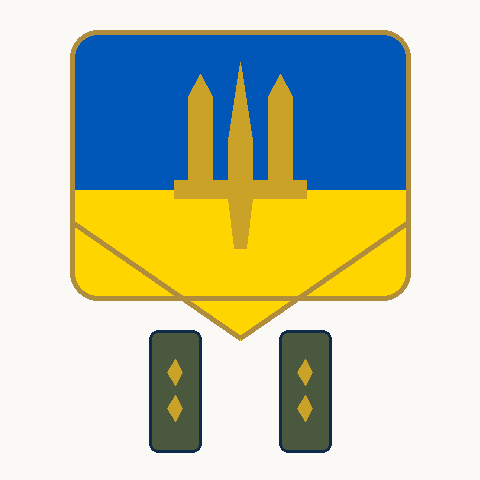
If you have ever watched footage of a Ukrainian soldier and tried to work out what the chevrons and little diamond stars on their shoulder boards mean, you are in the right place. Ukraine’s rank system is one of the most interesting in Europe right now — not because it is complicated, but because it has been rebuilt twice in less than a decade. The old Soviet-style ladder is gone. In its place is a NATO-style system of 22 army ranks, from Soldat (Private) to Heneral (General), with a brand-new sergeant corps at its heart and a diamond-shaped star — the Zoria — where other armies wear the familiar five-pointed one. This guide goes through every Ukrainian military rank in plain language: the Ukrainian name, the NATO-style code, the insignia on the shoulder board, and the job that goes with the rank.
The force behind them is the Armed Forces of Ukraine (Zbroini Syly Ukrainy, or ZSU), whose Ground Forces form the main fighting arm. The Air Force and the Marine Corps use the same army ranks; only the Navy has a separate set of naval titles. The codes in the tables below are NATO-style equivalents, not official NATO grades, because Ukraine is not a NATO member — they are there so you can line a Ukrainian rank up against the army you already know. The pattern is easy once you see it: chevrons mean a sergeant, diamond stars mean an officer, and the more of either, the higher the rank.
Key facts
- Country: Ukraine
- Force: Armed Forces of Ukraine (ZSU) — Ground Forces, Air Force and Marine Corps share one army rank system; the Navy uses naval ranks
- Other ranks: OR-1 to OR-9 (Soldat to Holovnyi maister-serzhant)
- Commissioned officers: OF(D) to OF-9, plus the cadet Kursant (Molodshyi leytenant to Heneral)
- Highest rank: Heneral (OF-9), held by the Commander-in-Chief
- Total army ranks: 22 — 10 other ranks and 12 officer ranks including the cadet
- Notable fact: the whole system was rebuilt in the 2020 reform — the warrant-officer ranks were abolished, a new sergeant ladder was created, and the top rank became Heneral instead of General of the Army of Ukraine
From Soldat to Chief Master Sergeant: The Enlisted Ladder (OR-1 to OR-9)
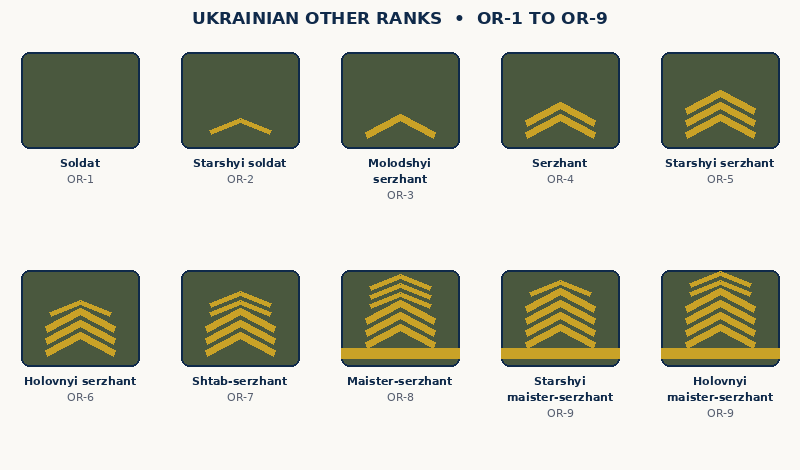
Every Ukrainian soldier begins as a Soldat, and the rank shows it: the shoulder board is completely plain, with no device at all. That is the rank every new soldier holds, whether they joined as a volunteer or were called up. One step up, a Starshyi soldat (Senior Soldier) wears a single narrow chevron — a small mark that says “this soldier has some experience”. From there the ladder climbs through the sergeants, and the sergeants are where the modern Ukrainian army is different from the one it replaced.
There are eight sergeant ranks in today’s system, and they were built from scratch in the 2020 reform. The junior sergeants — Molodshyi serzhant, Serzhant and Starshyi serzhant — lead teams and squads, the way corporals and sergeants do in most armies. Then come the senior sergeants, the ranks that did not exist before 2020: Holovnyi serzhant (Chief Sergeant), Shtab-serzhant (Staff Sergeant) and Maister-serzhant (Master Sergeant), who run companies and battalions alongside their officers. At the very top sit the two master sergeants, Starshyi maister-serzhant and Holovnyi maister-serzhant, both graded OR-9 — the most senior enlisted soldiers in a formation, the ones a brigade commander relies on to keep the unit running day to day.
| Rank (Ukrainian) | English Equivalent | NATO Code | Insignia | Typical Role |
|---|---|---|---|---|
| Soldat (Soldat) | Private | OR-1 | Plain olive shoulder board, no device | New soldier in basic training |
| Starshyi soldat (Starshyi soldat) | Senior Soldier | OR-2 | One narrow gold chevron | Trained soldier |
| Molodshyi serzhant (Molodshyi serzhant) | Junior Sergeant | OR-3 | One wide gold chevron | Team leader |
| Serzhant (Serzhant) | Sergeant | OR-4 | Two wide gold chevrons | Squad leader |
| Starshyi serzhant (Starshyi serzhant) | Senior Sergeant | OR-5 | Three wide gold chevrons | Senior squad leader |
| Holovnyi serzhant (Holovnyi serzhant) | Chief Sergeant | OR-6 | Three wide chevrons with one arc below | Company chief sergeant |
| Shtab-serzhant (Shtab-serzhant) | Staff Sergeant | OR-7 | Three wide chevrons with two arcs below | Battalion staff sergeant |
| Maister-serzhant (Maister-serzhant) | Master Sergeant | OR-8 | Three wide chevrons with three arcs and a gold base band | First sergeant; senior NCO of a battalion |
| Starshyi maister-serzhant (Starshyi maister-serzhant) | Senior Master Sergeant | OR-9 | Four wide chevrons with one arc and a gold base band | Senior NCO of a brigade |
| Holovnyi maister-serzhant (Holovnyi maister-serzhant) | Chief Master Sergeant | OR-9 | Four wide chevrons with two arcs and a gold base band | Command sergeant major of a formation; most senior enlisted soldier |
Did you know? Before 2020, Ukraine had warrant officers — praporshchyk and senior praporshchyk — the way the old Soviet system did. The reform abolished both ranks entirely. Serving praporshchyks were recertified as staff sergeants and senior praporshchyks as master sergeants, and the new sergeant ladder took their place. Ukraine even has a day for its sergeants: Sergeant’s Day is marked every year on 18 November, a holiday created by presidential decree in 2019 to honour the sergeant corps.
How to Read a Ukrainian Uniform
Reading a Ukrainian uniform is easier than it looks, because the insignia follow a few simple rules. On the field uniform the marks sit on olive-green shoulder boards; on the dress uniform the same marks appear on darker boards edged in gold. Learn the rules once and the whole ladder opens up.
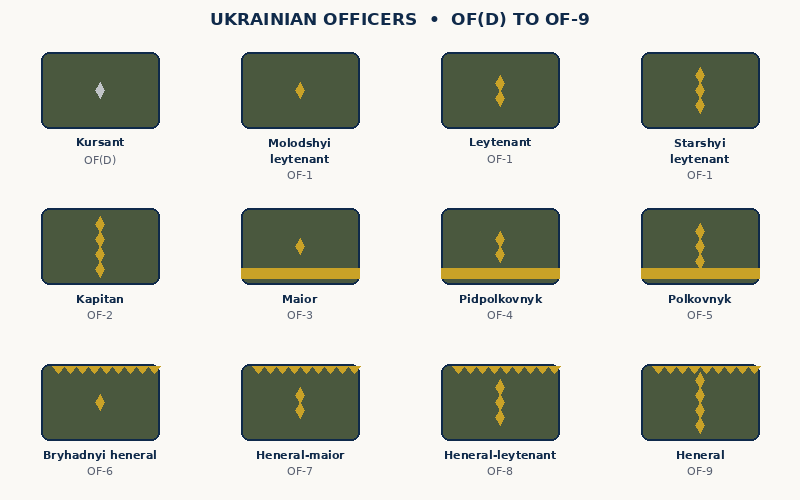
The first rule is to count the marks. A sergeant’s mark is the chevron — a V-shaped stripe the Ukrainians call kutnyk, meaning “angle”. Junior sergeants carry one to three of them, and the senior grades add small arcs underneath, the duzhka or “hoop”. An officer’s mark is the diamond star, the Zoria. Its four-pointed shape is a deliberate throwback to a star worn by the Ukrainian army of 1918, revived when the insignia were redesigned after independence. Junior officers wear one diamond for a junior lieutenant, two for a lieutenant, three for a senior lieutenant and four for a captain; generals wear one to four larger diamonds.
The group is shown by a band: senior officers — major, lieutenant colonel, colonel — have a woven gold band, the pletinka (“network”), across the base of the board, while generals have a gold zigzag edge, the zubchatka (“rack wheel”), along the top. Service is shown by colour instead of rank: Ground Forces boards are olive, Air Force boards are blue-grey, and the Navy uses black boards with gold sleeve stripes rather than stars. Most uniforms also carry the blue-and-yellow flag of Ukraine on the sleeve, above the unit’s own shield-shaped patch.
Officers: From Cadet to Four-Star General (OF(D) to OF-9)
The officer ladder will look familiar if you know any Western army. A Molodshyi leytenant just out of the academy takes charge of a platoon; a Leytenant does the same; a Starshyi leytenant leads a platoon or serves as a company second-in-command; and a Kapitan commands a company, roughly a hundred soldiers. Above them sit the field officers — Maior, Pidpolkovnyk and Polkovnyk — who run battalions and brigades and hold the staff posts that keep a formation moving.
Below the lieutenants sits the Kursant: an officer cadet still in training at a military academy. A Kursant is graded OF-Student rather than OF-1, because a cadet is not yet a commissioned officer — the single small silver diamond on the board marks that, and a new junior lieutenant’s gold diamond replaces it at graduation. At the very top is the Heneral, a four-star rank held by the Commander-in-Chief of the Armed Forces. Four stars is the highest any Ukrainian officer can reach; the old five-star-style top rank, General of the Army of Ukraine, was abolished in 2020.
| Rank (Ukrainian) | English Equivalent | NATO Code | Insignia | Typical Role |
|---|---|---|---|---|
| Kursant (Kursant) | Officer Cadet | OF(D) | One small silver diamond star | Officer cadet at a military academy |
| Molodshyi leytenant (Molodshyi leytenant) | Junior Lieutenant | OF-1 | One small gold diamond star | Platoon leader, newly commissioned |
| Leytenant (Leytenant) | Lieutenant | OF-1 | Two small gold diamond stars | Platoon leader |
| Starshyi leytenant (Starshyi leytenant) | Senior Lieutenant | OF-1 | Three small gold diamond stars | Platoon leader or company second-in-command |
| Kapitan (Kapitan) | Captain | OF-2 | Four small gold diamond stars | Company commander |
| Maior (Maior) | Major | OF-3 | One gold diamond star with a woven gold band | Battalion executive officer or staff officer |
| Pidpolkovnyk (Pidpolkovnyk) | Lieutenant Colonel | OF-4 | Two gold diamond stars with a woven gold band | Battalion commander |
| Polkovnyk (Polkovnyk) | Colonel | OF-5 | Three gold diamond stars with a woven gold band | Brigade commander |
| Bryhadnyi heneral (Bryhadnyi heneral) | Brigadier General | OF-6 | One gold diamond star with a gold zigzag edge | Brigade commander; first general officer rank |
| Heneral-maior (Heneral-maior) | Major General | OF-7 | Two gold diamond stars with a gold zigzag edge | Formation commander or senior staff officer |
| Heneral-leytenant (Heneral-leytenant) | Lieutenant General | OF-8 | Three gold diamond stars with a gold zigzag edge | Corps commander or deputy chief of staff |
| Heneral (Heneral) | General | OF-9 | Four gold diamond stars with a gold zigzag edge | Commander-in-Chief of the Armed Forces; highest rank in Ukraine |
Key point: Because Ukraine is not a NATO member, the OF and OR codes here are reference equivalents rather than official NATO grades — they exist so a Ukrainian rank can be lined up against its counterpart in another army. Sharing a code is normal: all three lieutenants are OF-1, and both master sergeants are OR-9, because a code shows roughly where a rank sits, not exactly what it is. The Navy works the same way, with Admiral (OF-9) at the top and Commodore (OF-6) as the one-star rank introduced in the same reform.
The 2020 Reform: How Ukraine Left the Soviet Ladder Behind
When Ukraine became independent in 1991, its army kept the rank system it had inherited from the Soviet Union — the same titles, the same five-pointed stars, the same warrant officers. The ranks themselves were fixed by law in March 1992, and for almost thirty years they barely changed. The first real break came in 2016, when new insignia designs were approved and first worn on Independence Day, 24 August 2016: the diamond star, the chevrons, the woven band and the zigzag edge all date from that redesign, which deliberately reached back to the symbols of the Ukrainian army of 1917–1920 instead of the Soviet pattern.
The ranks themselves changed in the 2020 reform. On 17 October 2019, Ukraine’s parliament approved a change to the enlisted ranks to match the NATO standard known as STANAG 2116, and the change took effect with the 2020 reform. Three things happened at once. First, the sergeant ladder was rebuilt: eight sergeant ranks replaced the old mix of sergeants and warrant officers, and the praporshchyk ranks were abolished outright. Second, the top of the officer ladder was restructured: the ranks of Colonel General and General of the Army of Ukraine were removed, the rank of Heneral became the highest in the system, and a new one-star rank, Bryhadnyi heneral (Brigadier General), was added below Major General — the Navy got its own one-star rank, Commodore, at the same time. Third, the whole system was lined up with NATO practice, so that a Ukrainian sergeant or colonel now has a clear equivalent in a NATO army, even though Ukraine itself is not a NATO member.
The reform was not just about names. It was about building a professional sergeant corps — the backbone of a modern army — in a force that had run on officers for decades. The first professional sergeants came out of the Training Centre for Sergeants in Kharkiv, wearing shoulder boards with a fundamentally new kind of insignia. Since then the sergeant ranks have become the route by which experienced soldiers stay in the army and lead, instead of having to become officers to get promoted.
War and the Ranks: What Changed After 2022
The full-scale invasion of February 2022 changed the Ukrainian army more in three years than the previous thirty had. The force grew from roughly a quarter of a million service members to nearly a million by early 2025, and almost every part of the rank system was tested by that growth. Thousands of new soldiers were mobilised, new brigades were raised, and the sergeant ranks created in 2020 suddenly had to do the job they were designed for: leading squads, platoons and companies in combat, often with very little time to learn the trade.
The structure changed too. From early 2025 the Armed Forces have been moving to a corps-based structure, with corps — each commanded by a major general or lieutenant general — becoming the main operational formations, replacing the brigade-centred organisation of the earlier war years. The Marine Corps also became a fully separate branch of the Armed Forces in May 2023, after years as part of the Navy; it still wears the naval-style insignia it inherited, while a new set of Marine insignia is prepared. Through all of this the rank titles themselves have stayed the same as the 2020 reform set them — the war changed the size and shape of the army, not the names on its shoulder boards.
How Promotion Actually Works
Moving up the Ukrainian ladder takes more than time in grade. The law sets three conditions for every step: the required service in the current rank, the right training courses passed, and an open post to move into. That applies from Starshyi soldat all the way to Heneral. The first step that changes a soldier’s life is becoming a sergeant: it means going through sergeant training and proving you can lead a team or a squad, and from that day on you answer for other people, not just yourself.
Officers study for years. A career officer’s route runs through a military academy — the best known is the Hetman Petro Sahaidachnyi National Army Academy in Lviv — where cadets hold the rank of Kursant and graduate as junior lieutenants. Sergeants train at their own schools, led by the Training Centre for Sergeants in Kharkiv; the National Guard follows the same army ladder, with no scale of its own, and trains its people the same way. Since 2022 there has also been a wartime route: experienced soldiers and volunteers commissioned from the ranks after short officer courses, because the army needed platoon and company commanders faster than the academies could supply them.
One thing that surprises outsiders is how young the top of the Ukrainian system can look. Because the 2020 reform added Brigadier General and removed the two ranks above General, the ladder from colonel to the top is short — four general ranks in total — and wartime promotions have moved capable officers up it quickly. It is a young army, in both senses of the word, and its ranks show it.
If you want to compare Ukraine with its neighbours and allies, our guides to Russian military ranks, US Army ranks, British military ranks, Turkish military ranks and German Army ranks cover the same ground, and the military ranks and insignia overview puts all of them side by side.
Read next
US Army Ranks · Russian Military Ranks · British Military Ranks · German Army Ranks · Military Ranks and Insignia Overview
FAQs
What is the highest rank in the Ukrainian army?
Heneral, graded OF-9, held by the Commander-in-Chief. It is the top of the whole system: Ukraine has no five-star rank and no field marshal. The rank above it used to exist — General of the Army of Ukraine — but it was abolished in the 2020 reform.
How many ranks are there in the Ukrainian army?
There are 22 ranks in total: 10 other ranks (Soldat up to Holovnyi maister-serzhant) and 12 officer ranks, including the cadet Kursant. The Ground Forces, the Air Force and the Marine Corps all use the same 22 ranks; only the Navy uses a separate, naval set of titles.
What is a Holovnyi serzhant?
Holovnyi serzhant — Chief Sergeant — is a senior sergeant rank graded OR-6, created in the 2020 reform. It sits above Starshyi serzhant and below Shtab-serzhant, and a Holovnyi serzhant is usually the chief sergeant of a company: the most experienced enlisted soldier in the company, working alongside the company commander.
Are Ukrainian ranks the same as NATO ranks?
No — the codes are reference equivalents only. Ukraine is not a NATO member, so the OF and OR codes are published comparisons, not official NATO grades. Sharing a code is normal: all three lieutenants are OF-1 and both master sergeants are OR-9.
What happened to the praporshchyk rank in Ukraine?
It was abolished in the 2020 reform. Praporshchyk and senior praporshchyk were the old warrant-officer ranks, inherited from the Soviet system. Serving praporshchyks were recertified as staff sergeants and senior praporshchyks as master sergeants, and the new eight-rank sergeant ladder took their place.
What does the diamond star on Ukrainian shoulder boards mean?
The diamond-shaped star is called the Zoria, and its shape comes from a star used by the Ukrainian army of 1918. When Ukraine redesigned its insignia after independence, it brought the diamond back instead of keeping the five-pointed Soviet star. Officers wear one to four of these gold diamonds on their shoulder boards; generals wear one to four larger ones with a gold zigzag edge.
Every image in this article is an original graphic made for Forces Guide. The charts are simplified stylised diagrams of field-uniform shoulder boards — not photographs of real insignia.