
A Kazakh officer’s rank would look familiar to a Soviet-era officer — and yet every title is Kazakh. The ladder runs from Qatardağı jawınger, the soldier, up through three classes of sergeant to Armïya generalı, the Army General at the top. The shape is Soviet and Russian, but the names are Kazakh. This guide goes through every Kazakhstan military rank: the Kazakh name, the English equivalent, the NATO-style code, and each rank’s job.
AT A GLANCE
Services: Ground Forces, Air Defense Forces and Naval Forces, plus independent Air Assault, Special Forces, Rocket and Artillery Forces and Territorial Troops.
Top rank: Armïya generalı (Army General, OF-9) — Army only, and it appears to be unheld at present.
The ladder: Soviet in shape, Kazakh in name — 10 Army officers, 10 other ranks shared by Army and Air Force, and a separate naval ladder.
Key quirk: two sergeant classes share one NATO code, twice over, and there is no OR-3 grade at all.
A Soviet-Shaped Ladder with Kazakh Names
Kazakhstan is a former Soviet republic, and its rank system shows it. The titles are built from the same roots as the Russian ones — general, polkovnïk, kapïtan, leytenant, serjant — but each has been respelled in Kazakh, so a Russian speaker would recognise the words at once and still hear them differently. The system was not invented from scratch when Kazakhstan became independent; it was carried over, renamed in the national language, and kept.
That inheritance shapes the whole ladder. There is no brigadier-general grade between colonel and major general — the jump goes straight from Polkovnïk (OF-5) to General-mayor (OF-6), and the four general grades climb in the Soviet pattern: major general, lieutenant general, colonel general, and army general. At the bottom sits Efreĭtor, the gefreiter or lance corporal, a single grade between the ordinary soldier and the junior sergeant.
The Kazakh names carry their own flavour. The ordinary soldier is a Qatardağı jawınger, literally a soldier of the ranks. The senior lieutenant is an Ağa leytenant, with ağa meaning elder or senior — the same word that marks the Ağa serjant. And the sergeants are graded by class — first, second and third — with no tidy Western match, which is why the NATO codes sometimes crowd two ranks into one grade. Those codes are equivalents for comparison only: Kazakhstan is not a NATO member.
One Armed Forces, Many Parts
The Armed Forces of the Republic of Kazakhstan are organised into three services and several independent arms. The largest is the Ground Forces, divided into four regional commands — Astana, East, West and South — which between them cover a country so large that each command is responsible for a territory the size of a European state.
The second service is the Air Defense Forces, joining the Air Force with the ground-based air defences. The Air Force uses the same officer ladder as the Army, and the same other ranks, but it stops one step short at the top. The third service is the Naval Forces, a small Caspian Sea fleet based at Aktau, and the only service with its own rank names, built on the old starshina and matros words for chief petty officer and seaman.
Around those three services sit the independent arms: the Air Assault Forces, the Special Forces, the Rocket and Artillery Forces and the Territorial Troops. They wear the same ranks as the service they most resemble, so this guide needs only four tables to cover the whole armed forces.
Army Officers: From Lieutenant to Army General
The Army officer ladder has ten titles, the fullest ladder in the Kazakh armed forces — the only one that reaches OF-9. A new officer starts as a Leytenant, a lieutenant, then becomes an Ağa leytenant, a senior lieutenant, before promotion to Kapïtan. Those three junior grades do the everyday work: a lieutenant leads a platoon, and a captain commands a company. Above them come the field officers — Mayor, Podpolkovnïk and Polkovnïk — who run battalions and regiments.
The four generals show the Soviet shape most clearly. General-mayor, General-leytenant and General-polkovnïk are major general, lieutenant general and colonel general, and above them all stands Armïya generalı, the Army General, the highest Kazakh rank. There is no higher grade: no marshal, no five-star rank, and no OF-10. The ladder is also unusual in having two grades at OF-1 — lieutenant and senior lieutenant share the code — a reminder that the codes only roughly match Western ranks.
| Rank (Kazakh) | English Equivalent | NATO Equivalent | Insignia | Typical Role |
|---|---|---|---|---|
| Армия генералы — Armïya generalı | Army General | OF-9 | Not described | Highest Army rank; senior command |
| Генерал-полковник — General-polkovnïk | Colonel General | OF-8 | Not described | Senior commander, highest levels |
| Генерал-лейтенант — General-leytenant | Lieutenant General | OF-7 | Not described | Regional command or senior staff |
| Генерал-майор — General-mayor | Major General | OF-6 | Not described | Division command; first general rank |
| Полковник — Polkovnïk | Colonel | OF-5 | Not described | Regiment or brigade command |
| Подполковник — Podpolkovnïk | Lieutenant Colonel | OF-4 | Not described | Battalion commander or senior staff |
| Майор — Mayor | Major | OF-3 | Not described | Battalion staff officer |
| Капитан — Kapïtan | Captain | OF-2 | Not described | Company commander |
| Аға лейтенант — Ağa leytenant | Senior Lieutenant | OF-1 | Not described | Platoon leader; experienced junior officer |
| Лейтенант — Leytenant | Lieutenant | OF-1 | Not described | Platoon leader, newly commissioned |
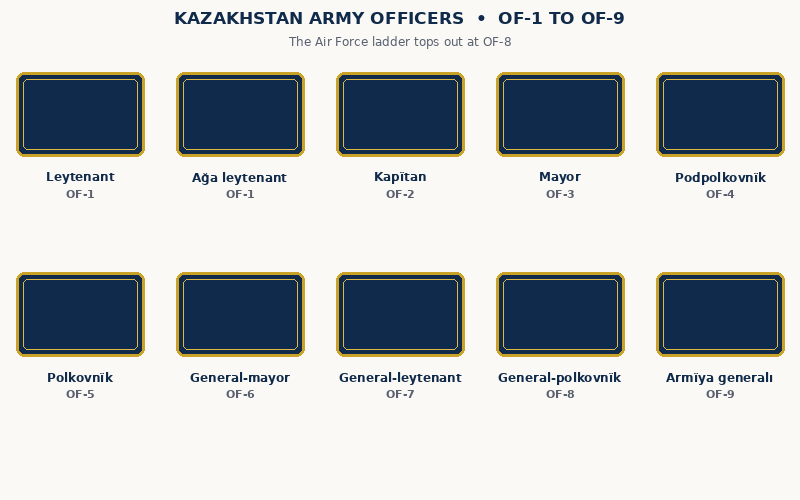
Did you know? The top rank appears to be unheld at present. The Defence Minister is Colonel General Dauren Kossanov (OF-8) and the Chief of the General Staff is Lieutenant General Sultan Kamaletdinov (OF-7) — so the two most senior officers in the country both sit below the Army General grade.
Sergeants and Soldiers: The Other Ranks
The other-ranks ladder is shared by the Army and the Air Force: ten titles from the ordinary soldier to the master sergeant. Every soldier starts as a Qatardağı jawınger, a private, and the first step up is to Efreĭtor, the gefreiter — a senior soldier, but not yet an NCO. The first NCO grade is Kişi serjant, the junior sergeant, who leads a team; above him sits the plain Serjant, who leads a squad.
Above the sergeant, the ladder is graded by class, and this is where it gets crowded. There are three classes of sergeant — third, second and first — and the senior sergeant sits among them, so that two ranks share OR-7 and two share OR-6. At the top stand the Ştab-serjant, the staff sergeant, and the Şeber-serjant, the master sergeant, the most senior enlisted soldier in the force. The names tell the story: şeber means master, ştab means staff, and ağa means senior.
One gap is worth noticing: there is no OR-3 grade in the Kazakh ladder at all. The ranks run OR-4, then straight down to OR-2, with nothing in between. A reader used to a Western army should not go looking for a Kazakh rank to fill that slot — it does not exist, and the gap is part of the system.
| Rank (Kazakh) | English Equivalent | NATO Equivalent | Insignia | Typical Role |
|---|---|---|---|---|
| Шебер-сержант — Şeber-serjant | Master Sergeant | OR-9 | Not described | Most senior enlisted soldier; adviser to commanders |
| Штаб-сержант — Ştab-serjant | Staff Sergeant | OR-8 | Not described | Senior NCO at battalion level |
| Бірінші сыныпты сержант — Birinşi sınıptı serjant | Sergeant First Class | OR-7 | Not described | Senior NCO; company-level adviser |
| Екінші сыныпты сержант — Ekinşi sınıptı serjant | Sergeant Second Class | OR-7 | Not described | Senior NCO |
| Үшінші сыныпты сержант — Üşinşi sınıptı serjant | Sergeant Third Class | OR-6 | Not described | Platoon-level NCO |
| Аға сержант — Ağa serjant | Senior Sergeant | OR-6 | Not described | Platoon sergeant |
| Сержант — Serjant | Sergeant | OR-5 | Not described | Squad leader |
| Кіші сержант — Kişi serjant | Junior Sergeant | OR-4 | Not described | Team leader; most junior NCO |
| Ефрейтор — Efreĭtor | Gefreiter / Lance Corporal | OR-2 | Not described | Experienced junior soldier |
| Қатардағы жауынгер — Qatardağı jawınger | Private / Ordinary Soldier | OR-1 | Not described | New soldier in basic training |
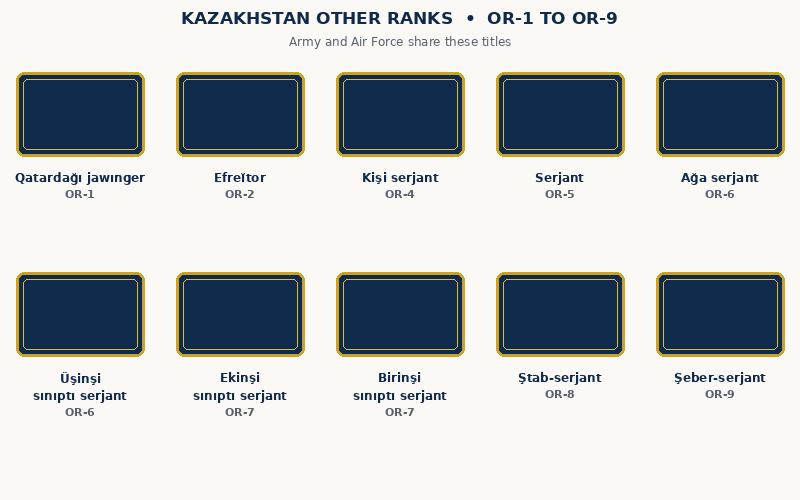
Key point: the shared grades are not a printing error. Two sergeant classes sit at OR-7 and two at OR-6, and there is no OR-3 grade in the Kazakh ladder. The OF and OR codes are approximate equivalents for comparison — Kazakhstan is not a NATO member, so no official NATO table grades these ranks.
The Caspian Navy: A Small Fleet with Its Own Ranks
Kazakhstan’s navy is unlike its army in almost every way. It is a small force on the Caspian Sea, with its headquarters at Aktau. It has no ocean-going fleet; its work is coastal — guarding the shore, the offshore fields and the sea approaches. And because it grew out of the Soviet naval tradition rather than the army one, it keeps its own rank names, built on the old words starshina for chief petty officer and matros for seaman.
The naval officer ladder has nine titles, one fewer than the Army’s, and it tops out one grade lower. Its highest rank is Admïral, graded OF-8 — but note the trap in the name. In Kazakh usage “Admiral” lines up with a vice admiral elsewhere, so the Navy’s top officer sits a grade below the Army’s top general. Below him come Vice-admïral (OF-7) and Kontr-admïral (OF-6). The captains below are graded by class — first, second and third.
| Rank (Kazakh) | English Equivalent | NATO Equivalent | Insignia | Typical Role |
|---|---|---|---|---|
| Admïral | Vice Admiral | OF-8 | Not described | Highest naval rank; most senior naval officer |
| Vice-admïral | Rear Admiral | OF-7 | Not described | Senior naval commander |
| Kontr-admïral | Rear Admiral (lower half) | OF-6 | Not described | Senior naval commander |
| Birinşi därejeli kapïtan | Captain | OF-5 | Not described | Ship command |
| Ekinşi därejeli kapïtan | Commander | OF-4 | Not described | Ship command or senior staff |
| Üşinşi därejeli kapïtan | Lieutenant Commander | OF-3 | Not described | Senior ship’s officer |
| Kapïtan-leytenant | Lieutenant | OF-2 | Not described | Ship’s officer |
| Ağa leytenant | Lieutenant (junior grade) | OF-1 | Not described | Junior ship’s officer |
| Leytenant | Ensign | OF-1 | Not described | Junior officer, newly commissioned |
The naval other ranks follow the same shape as the Army’s, but with seagoing names. There are ten titles, from the ordinary Matros, the seaman, up to the Şeber-starşïna, the master chief petty officer. The middle of the ladder is graded by class and by “article” — first and second article petty officers. The sources give the Kazakh names and grades for these naval ranks; the English readings below follow the matching Army sergeant grade.
| Rank (Kazakh) | English Equivalent | NATO Equivalent | Insignia | Typical Role |
|---|---|---|---|---|
| Şeber-starşïna | Master Chief Petty Officer | OR-9 | Not described | Most senior sailor; adviser to commanders |
| Ştab-starşïna | Senior Chief Petty Officer | OR-8 | Not described | Senior chief at flotilla level |
| Birinşi sınıptı starşïna | Chief Petty Officer (First Class) | OR-7 | Not described | Senior chief aboard ship |
| Ekinşi sınıptı starşïna | Chief Petty Officer (Second Class) | OR-7 | Not described | Senior chief aboard ship |
| Üşinşi sınıptı starşïna | Petty Officer (Third Class) | OR-6 | Not described | Petty officer aboard ship |
| Bas starşyna | Chief Petty Officer | OR-6 | Not described | Chief petty officer aboard ship |
| Birinşi satılı starşïna | Petty Officer First Article | OR-5 | Not described | Petty officer; section leader |
| Ekinşi satılı starşïna | Petty Officer Second Article | OR-4 | Not described | Junior petty officer |
| Ağa matros | Senior Seaman | OR-2 | Not described | Experienced junior sailor |
| Matros | Seaman | OR-1 | Not described | New sailor in basic training |
Note on the naval top rank: the Kazakh Navy has no OF-9 grade — its top is Admiral at OF-8. Some rank tables list a “Fleet Admiral” above Admiral, but the main reference table used for this guide omits it entirely, so it is treated here as unconfirmed and is not presented as an active rank.
The Air Force Ceiling: Why the Air Force Stops at OF-8
The Air Force officer ladder is the same as the Army’s in every grade except the last: it has nine titles and tops out at General-polkovnïk, Colonel General at OF-8. An air force lieutenant is a Leytenant, an air force captain a Kapïtan, and an air force colonel a Polkovnïk — the names do not change between the two services, and neither do the other ranks. Only the ceiling is different: the Army alone climbs to Armïya generalı.
That ceiling is not an accident. The Air Force sits inside the Air Defense Forces, a single command that joins the air arm with the ground-based air defences, and its senior officers command a smaller, more specialised force than the Army’s regional commands. A colonel general at the head of the Air Force is a senior commander by any measure — the same grade as the Defence Minister himself.
Note on the Air Force top rank: the sources disagree here. The main reference table used for this guide lists the Air Force top as Colonel General (OF-8), while other tables show Army General (OF-9) for the Air Force too. This guide shows OF-9 as Army-only, following the main table, and flags the disagreement rather than quietly picking one side.
Reading a Kazakh Uniform: What This Guide Can and Cannot Tell You
A guide to ranks and insignia should say what the insignia look like — and this one must be honest about what it cannot say. The sources used for this article give the rank names, the grades and the place of each rank in the ladder, but they do not describe the shoulder boards or sleeve devices that a Kazakh soldier actually wears. So every “Insignia” cell in the tables above reads “Not described”, and the two charts are plain ladder diagrams, not copies of real Kazakh devices.
The shape of the system is clear enough. The ranks are Soviet in shape, familiar to anyone who knows the Russian system: generals graded by the same four steps, sergeants graded by class, and a navy that keeps the old starshina and matros names. The names themselves are the surest guide: if you can read Şeber-serjant or General-polkovnïk, you can place the soldier who wears it, even without seeing his sleeve.
Between Two Alliances: CSTO Member, NATO Partner
Kazakhstan’s place in the world explains why this guide uses NATO codes at all — and why it must keep warning the reader about them. Kazakhstan is a member of the Collective Security Treaty Organization, the CSTO, the Russian-led security alliance of several former Soviet states. Its armed forces train, equip and organise themselves inside that orbit, and the Soviet shape of its rank ladder is a product of it. At the same time, Kazakhstan holds a NATO Individual Partnership Action Plan, a formal programme of cooperation with the Atlantic alliance.
But a partnership plan is not membership. Kazakhstan is not a NATO member, and no NATO standard grades its ranks, so every OF and OR code in this guide is an equivalence worked out for comparison — a way of saying that a Kazakh Polkovnïk does the job of a colonel elsewhere, not that any NATO document says so. Where the ladder does not line up neatly — the two ranks crowded into OR-7, the two into OR-6, the missing OR-3 — the codes show their limits. To compare, see our guides to US Army ranks, British military ranks, Ukrainian military ranks and Polish military ranks, or the military ranks and insignia overview.
Note on personnel figures: published totals for Kazakhstan’s active armed forces disagree widely — about 39,000 in one reference against roughly 110,000 in others. This guide gives no single figure, because stating one without the other would mislead the reader.
Read next
US Army Ranks · British Military Ranks · Military Ranks and Insignia Overview · Ukrainian Military Ranks · Polish Military Ranks
FAQs
What is the highest rank in Kazakhstan’s military?
Armïya generalı, Army General (OF-9), is the highest rank — but it is Army-only, and it appears to be unheld at present. The Defence Minister is a Colonel General (OF-8) and the Chief of the General Staff a Lieutenant General (OF-7).
How many ranks are there in the Kazakhstan Army?
There are 20 titles in total: 10 officers, from Leytenant up to Armïya generalı, and 10 other ranks, from Qatardağı jawınger up to Şeber-serjant. The Air Force shares the same titles but tops out at OF-8, and the Navy has its own 19-title ladder.
Are Kazakhstan’s NATO codes official?
No. Kazakhstan is not a NATO member — it is a CSTO member with a NATO partnership plan — so the OF and OR codes here are equivalents for comparison only. Two sergeant classes share OR-7 and two share OR-6, and there is no OR-3 grade at all.
Does the Kazakhstan Navy have a Fleet Admiral?
Not as a confirmed active rank. The Navy’s top is Admiral (OF-8), which lines up with a vice admiral elsewhere. Some tables list a “Fleet Admiral” above it, but the main reference table used for this guide omits it entirely, so it is treated as unconfirmed.
Why does the Air Force top out lower than the Army?
The Air Force ladder is the same as the Army’s except for the last step: it stops at General-polkovnïk, Colonel General (OF-8), while the Army alone climbs to Armïya generalı (OF-9). Sources disagree on this point, and this guide flags the conflict.
What does Qatardağı jawınger mean?
It is the Kazakh title for the ordinary soldier — literally a soldier of the ranks — and it is the lowest rank in the Army and Air Force at OR-1. The Navy’s lowest rank is the Matros, the seaman.
All images in this article are original graphics drawn for Forces Guide. The charts are simplified ladder diagrams — plain shoulder-board shapes with rank names and codes — not copies of real Kazakh insignia, because the sources do not describe what the insignia look like.