
Georgia’s army has two gaps that tell you most of what you need to know about it. It has no navy at all, and its generals’ ladder has no Colonel-General — the rank jumps straight from Army General to Lieutenant General. This guide sets out every rank in the Defence Forces of Georgia in plain language: the Georgian name, the English equivalent, the NATO-style code, and the job that goes with each rank. It covers 19 titles in all — 9 other ranks and 10 officer ranks — and it is honest throughout about what the sources do not say.
AT A GLANCE
Country: Georgia
Force: Defence Forces of Georgia — Land Forces, Aviation and Air Defence Command, Special Operations Forces, National Guard; no navy
Other ranks: OR-1 to OR-9, from Rigiti (Private) to Mtavari serzhant’i (Chief Sergeant)
Officers: OF-1 to OF-9, from Leit’enant’i (Lieutenant) to Armiis generali (Army General)
Highest rank: Armiis generali (Army General, OF-9) — appears currently unheld; the Chief of Defence Forces is a Lieutenant General (OF-8)
Notable: no Colonel-General; no navy since 2009; a NATO aspirant, not a member
The Defence Forces of Georgia: Four Parts and No Navy
The Defence Forces of Georgia are made up of four parts. The Land Forces are the largest, the ground arm that holds most of the soldiers and most of the ranks in this guide. Alongside them stand the Aviation and Air Defence Command, which is the country’s air force, the Special Operations Forces, and the National Guard. There is no fifth part, and that absence is the first thing to understand about Georgia’s military.
The air arm needs a careful description, because the sources describe its standing in two different ways. Some call it a separate branch, re-established in 2016; others describe it as a command within the Land Forces. This guide calls it by its full name, the Aviation and Air Defence Command, and does not claim more independence for it than the sources allow. What is certain is that it shares the same officer ranks as the Land Forces, so one ladder serves both arms, and one table in this guide covers them both.
The force itself is small. One recent count puts its active strength at about 20,650 personnel, while older counts give a much larger figure, near 37,000 — so any single number should be read with care, and this guide uses the newer count. At the head of the force stands the Chief of Defence Forces, Lieutenant General Giorgi Matiashvili, who holds the OF-8 grade. That fact matters for the top of the ladder, as the officers’ section below explains.
The Missing Navy: Where Georgia’s Ships Went
Georgia is one of the few countries with a coastline and no navy at all. Its naval forces were merged into the Coast Guard in 2009, and the Coast Guard does not sit under the Ministry of Defence — it sits under the Ministry of the Interior. That means a Georgian sailor is not a soldier in the Defence Forces at all. The sea is guarded by a civilian ministry’s service, while the Defence Forces look after the land and the sky.
That shapes everything in this guide. There are no naval ranks in the tables below: no admiral, no naval captain, no seaman, no petty officer. Every rank listed here belongs to the land and air arms, and the English equivalents are all army ones. A reader looking for Georgia’s admirals will not find them, because there are none to find — the merger took the whole naval ladder with it.
Other Ranks: From Private to Chief Sergeant (OR-1 to OR-9)
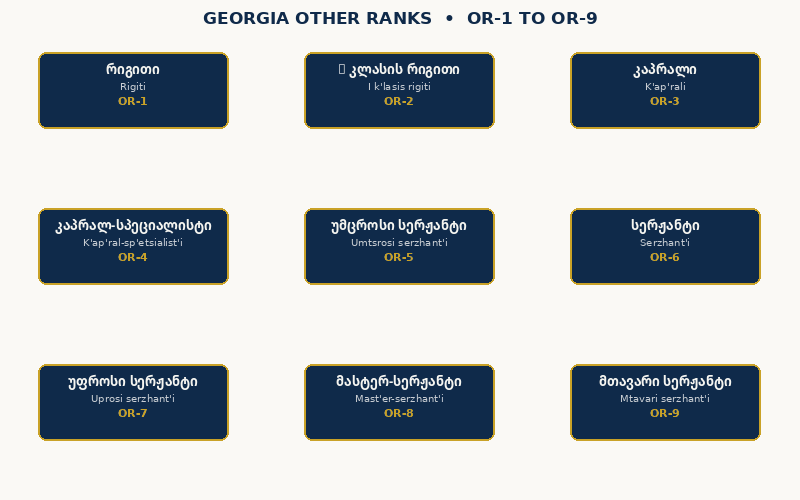
The other ranks run from Rigiti, a Private, up to Mtavari serzhant’i, the Chief Sergeant — nine titles in all. Two private grades sit at the bottom, two corporal grades in the middle, and five sergeant grades at the top. It is a ladder that rewards the long-serving soldier: more than half of its steps are sergeant grades, and the top of it is the most senior enlisted soldier in the force.
The corporal grades hold the ladder’s one unusual title. Above the plain corporal, K’ap’rali, sits K’ap’ral-sp’etsialist’i, the Corporal-Specialist — a corporal with a specialist’s standing, one step above the ordinary corporal and one step below the most junior sergeant. The sergeant grades then climb in plain order: Junior Sergeant, Sergeant, Senior Sergeant, Master Sergeant, and finally Chief Sergeant at the top.
The sources used for this guide give the rank names and grades but describe no insignia, so the Insignia column in the table below says so plainly rather than guessing. The NATO-style OR codes are also estimates: they show where each Georgian rank sits beside its counterpart elsewhere, but they are standard equivalences, not an official Georgian table. The chart that follows the table is a ladder diagram of the nine titles, not a copy of real insignia.
| Rank (Georgian + Transliteration) | English Equivalent | NATO Equivalent | Insignia | Typical Role |
|---|---|---|---|---|
| რიგითი Rigiti | Private | OR-1 | Not described in sources | New soldier in basic training |
| I კლასის რიგითი I k’lasis rigiti | Private First Class | OR-2 | Not described in sources | Trained soldier |
| კაპრალი K’ap’rali | Corporal | OR-3 | Not described in sources | Team leader; most junior NCO |
| კაპრალ-სპეციალისტი K’ap’ral-sp’etsialist’i | Corporal-Specialist | OR-4 | Not described in sources | Corporal with a specialist role |
| უმცროსი სერჟანტი Umtsrosi serzhant’i | Junior Sergeant | OR-5 | Not described in sources | Junior NCO; assistant squad leader |
| სერჟანტი Serzhant’i | Sergeant | OR-6 | Not described in sources | Squad leader |
| უფროსი სერჟანტი Uprosi serzhant’i | Senior Sergeant | OR-7 | Not described in sources | Platoon sergeant |
| მასტერ-სერჟანტი Mast’er-serzhant’i | Master Sergeant | OR-8 | Not described in sources | Senior NCO at battalion level |
| მთავარი სერჟანტი Mtavari serzhant’i | Chief Sergeant / Sergeant Major | OR-9 | Not described in sources | Most senior enlisted soldier; adviser to senior commanders |
Did you know? Georgia has a senior enlisted adviser post at the very top of the enlisted world: the Sergeant Major of the Georgian Defence Forces. The post exists to give the most senior enlisted soldier a voice at the top of the force, beside the generals. This guide names the post but not its holder, because the only holder named in the sources dates from some years ago and has not been freshly confirmed.
Officers: From Lieutenant to Army General (OF-1 to OF-9)
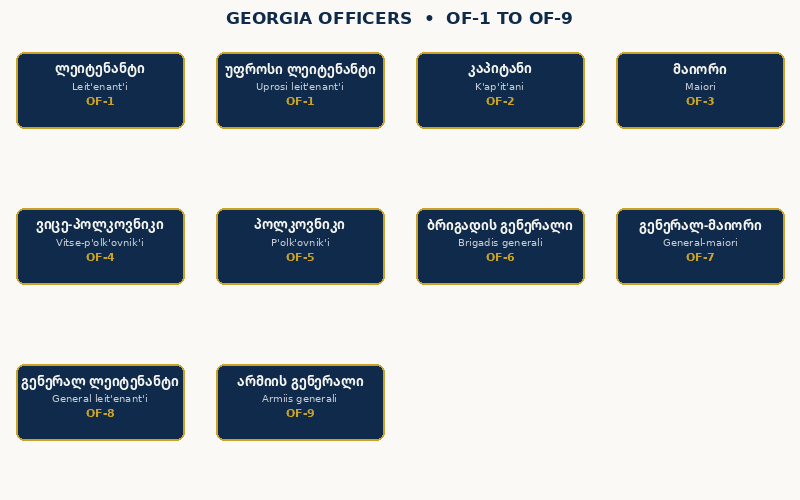
The officers’ ladder holds ten titles, and they are the same in the Land Forces and in the Air Force. At the bottom sit two lieutenants sharing the OF-1 grade: Leit’enant’i, the Lieutenant, and Uprosi leit’enant’i, the Senior Lieutenant. Above them come K’ap’it’ani (Captain), Maiori (Major), Vitse-p’olk’ovnik’i (Lieutenant Colonel) and P’olk’ovnik’i (Colonel). Then the ladder turns to generals, and there are four of those.
The four generals climb in this order: Brigadis generali (Brigadier General, OF-6), General-maiori (Major General, OF-7), General leit’enant’i (Lieutenant General, OF-8) and Armiis generali (Army General, OF-9). A new lieutenant takes command of a platoon, a captain commands a company, a lieutenant colonel commands a battalion, and a colonel commands a regiment or a brigade. The generals command formations above that, and the Army General stands at the very top of the whole force.
But the top rank appears to be currently unheld. The Chief of Defence Forces, Lieutenant General Giorgi Matiashvili, holds the OF-8 grade — one step below the top. So the OF-9 chair is empty for now, and this guide names no Army General holder, because the sources name none. A reader should not expect to meet an Army General in Georgia today; the most senior serving officer is a Lieutenant General.
| Rank (Georgian + Transliteration) | English Equivalent | NATO Equivalent | Insignia | Typical Role |
|---|---|---|---|---|
| ლეიტენანტი Leit’enant’i | Lieutenant | OF-1 | Not described in sources | Platoon leader, newly commissioned |
| უფროსი ლეიტენანტი Uprosi leit’enant’i | Senior Lieutenant | OF-1 | Not described in sources | Platoon leader, experienced junior officer |
| კაპიტანი K’ap’it’ani | Captain | OF-2 | Not described in sources | Company commander |
| მაიორი Maiori | Major | OF-3 | Not described in sources | Battalion executive officer or staff officer |
| ვიცე-პოლკოვნიკი Vitse-p’olk’ovnik’i | Lieutenant Colonel | OF-4 | Not described in sources | Battalion commander |
| პოლკოვნიკი P’olk’ovnik’i | Colonel | OF-5 | Not described in sources | Regiment or brigade commander |
| ბრიგადის გენერალი Brigadis generali | Brigadier General | OF-6 | Not described in sources | Most junior general; brigade commander |
| გენერალ-მაიორი General-maiori | Major General | OF-7 | Not described in sources | Senior general officer; division-level command |
| გენერალ ლეიტენანტი General leit’enant’i | Lieutenant General | OF-8 | Not described in sources | Senior commander; the Chief of Defence Forces holds this grade |
| არმიის გენერალი Armiis generali | Army General | OF-9 | Not described in sources | Most senior rank in the force; appears currently unheld |
Key point: Georgia is not a NATO member, so every OF and OR code in this guide is an equivalent for comparison, not an official NATO grade. A Georgian P’olk’ovnik’i lines up with a colonel elsewhere, but no NATO document grades it — and the OR codes in particular are estimates, mapped by standard equivalence rather than by any official Georgian table.
The Missing Colonel-General
The most distinctive feature of Georgia’s generals’ ladder is a rank that is not there. Most post-Soviet armies have a Colonel-General at OF-8, sitting between the Army General and the Lieutenant General. Georgia does not. Its ladder jumps straight from Armiis generali, the Army General at OF-9, to General leit’enant’i, the Lieutenant General at OF-8. There is no step in between, and no Georgian officer can hold a rank that does not exist.
The gap matters most for readers who already know a neighbouring army’s ladder. If you learned the ranks from the Russian or Ukrainian system, you will look for the Colonel-General and not find it — and you may then misread the grades around it. In Georgia the OF-8 grade belongs to the Lieutenant General, where in most post-Soviet ladders it belongs to the Colonel-General. The names are familiar, but the steps they sit on are not quite the same.
Georgia’s ladder is recognisably post-Soviet in shape — the same general and sergeant titles, the same senior lieutenant — but with this one step cut out. Four generals do the work that five grades do elsewhere, and the distance from a new brigadier general to the top is one step shorter.
One Ladder for Two Services
The same ten officer titles serve the Land Forces and the Air Force, and the same nine other ranks serve them both. A captain in the Aviation and Air Defence Command is a captain in exactly the same sense as a captain in the Land Forces, with the same Georgian name and the same grade. There is no separate air-force ladder to learn, no second set of titles running alongside the army’s.
That single ladder keeps the whole system simple to read. Many countries give each service its own rank names — a naval captain is not an army colonel, even when the grades match — but Georgia does not need that translation, because its two uniformed arms share one set of names. Learn the nineteen titles in the two tables above and you have learned the ranks of the whole Defence Forces.
The Special Operations Forces and the National Guard sit inside the same Defence Forces, alongside the Land Forces and the air command. This guide’s tables are written for the Land Forces and the Air Force, the two arms the sources describe in full.
What the Names Mean
Georgian rank names translate almost word for word, and the pattern is easy to learn once it is seen. Serzhant’i is sergeant, and the words in front of it do the grading: umtsrosi means junior, uprosi means senior, mast’er means master, and mtavari means chief. So Umtsrosi serzhant’i is the Junior Sergeant, Uprosi serzhant’i the Senior Sergeant, and Mtavari serzhant’i the Chief Sergeant at the very top of the enlisted ladder.
The generals follow the same plain logic. Brigadis generali is the Brigadier General, General-maiori the Major General, General leit’enant’i the Lieutenant General, and Armiis generali the Army General — the general of the army itself. Leit’enant’i is lieutenant, so Uprosi leit’enant’i is the Senior Lieutenant, the more experienced of the two lieutenants at OF-1. P’olk’ovnik’i is colonel, and Rigiti is the private soldier, the rank every Georgian soldier starts from.
The spellings in this guide use the transliteration from the rank tables, with apostrophes marking sounds the Latin letters alone cannot carry. The Georgian script sits beside each transliteration in the tables, so a reader who knows the alphabet can match each name to its letters.
Georgia and NATO: An Aspirant, Not a Member
Georgia has been part of NATO’s Partnership for Peace since 1994, and it is a NATO aspirant — a country that seeks membership. But it is not a member, and that single fact decides how the codes in this guide must be read. The OF and OR grades are the site’s house comparison, showing roughly where a Georgian rank sits beside its counterpart in a NATO army. They are not official grades, and no NATO document lists them.
The distinction is sharpest on the enlisted side. The officer grades follow a familiar pattern, so the equivalences are easy to trust. The other ranks are mapped by standard equivalence instead, and the OR column is best read as a guide to seniority rather than as a published grade.
For the reader, the codes are still worth having. They make it possible to set a Georgian rank beside a British, American or Ukrainian one and see at a glance whether the two are equals, and they make the two gaps in the ladder — the missing navy and the missing Colonel-General — visible in a way that names alone would not. Used as comparisons, they help; used as official grades, they would mislead. This guide uses them only in the first sense.
Georgia Today: A Small Force on a Hard Border
The force that wears these ranks is small, and its size is itself uncertain. The newer count gives about 20,650 on active duty, while older counts give about 37,000 — a wide gap between two published figures, and a reminder that even basic numbers about this force should be handled with care. What is not in doubt is the shape: a land-heavy force, with the Land Forces as its largest part, an air arm organised as a command, and no navy of its own.
At its head stands Lieutenant General Giorgi Matiashvili, the Chief of Defence Forces, holding the OF-8 grade while the OF-9 rank above him stands empty. That pairing — a lieutenant general in command, an army general’s rank unheld — sums up the ladder as it stands today. The top of the force is occupied by the second-highest rank, and the highest rank waits for a holder who has not yet been named.
To set Georgia beside the armies it is most often compared with, see our guides to Ukrainian military ranks, Polish military ranks, US Army ranks and British military ranks, or the military ranks and insignia overview.
Read next
Ukrainian Military Ranks · Polish Military Ranks · US Army Ranks · British Military Ranks · Military Ranks and Insignia Overview
FAQs
What is the highest rank in the Georgian military?
Armiis generali, Army General (OF-9), is the highest rank in the Defence Forces of Georgia. It appears currently unheld — the Chief of Defence Forces, Lieutenant General Giorgi Matiashvili, holds the OF-8 grade below it.
Does Georgia have a navy?
No. Georgia’s naval forces were merged into the Coast Guard in 2009, and the Coast Guard sits under the Ministry of the Interior, not the Ministry of Defence. There are no naval ranks in the Defence Forces.
Why is there no Colonel-General in Georgia?
Unlike most post-Soviet armies, Georgia has no Colonel-General rank. Its generals’ ladder jumps straight from Army General (OF-9) to Lieutenant General (OF-8), so the OF-8 grade belongs to the Lieutenant General.
Are Georgia’s NATO codes official?
No. Georgia is a NATO aspirant in the Partnership for Peace since 1994, but it is not a NATO member. The OF and OR codes are equivalents for comparison only, and the OR codes in particular are estimates.
Do the Land Forces and the Air Force use the same ranks?
Yes. The same ten officer titles and nine other ranks serve both arms. The air arm is called the Aviation and Air Defence Command, and its exact standing — separate branch or command within the Land Forces — is described both ways in the sources.
What is the top enlisted rank in Georgia?
Mtavari serzhant’i, the Chief Sergeant (OR-9), also rendered Sergeant Major, is the top other rank. Georgia also has a Sergeant Major of the Georgian Defence Forces post, the senior enlisted adviser at the top of the force.
All images in this article are original graphics drawn for Forces Guide. The charts are simplified, stylised ladder diagrams — the sources consulted did not describe the appearance of Georgian insignia, so no insignia devices are shown.