Afghanistan has one of the shortest rank ladders in the region, and one of the most unusual. Its armed forces use just 19 titles — 13 officers and 6 other ranks — and the same 19 titles serve both the Islamic National Army and the Afghan Air Force. There is no navy: the country is landlocked. There are three grades of lieutenant where most armies have two, and a Senior Captain between Captain and Major. The ladder is also a survivor: the Islamic Emirate kept the former Republic’s rank system on its return in August 2021, changing only the emblem on the insignia. This guide sets out the ranks as they stand now — and says plainly where the record runs thin.
The force behind these ranks is the Armed Forces of the Islamic Emirate of Afghanistan: the Islamic National Army and the Afghan Air Force. Its size is reported as a range — about 150,000 active personnel in one estimate, about 170,000 in others. The Army is organised into eight regional corps, renamed in November 2021, and its best-known elite formations are the Badri 313 Battalion and the Red Unit.
AT A GLANCE
Services: Islamic National Army and Afghan Air Force only — no navy (landlocked).
Ranks: 19 titles in total — 13 officers (OF-1 to OF-10) and 6 other ranks (OR-1 to OR-9).
Top rank: Marshal (مارشال, OF-10) — no current holder is confirmed in the sources.
Key note: one ladder serves Army and Air Force alike; the system was kept from the former Republic, with only the emblem changed in 2024.
One Ladder for Two Services — and No Navy
Many countries run a different ladder for each service, with naval titles that match nothing on land. Afghanistan does not. The Islamic National Army and the Afghan Air Force use the exact same 13 officer titles and the exact same 6 other-rank titles, word for word, in Pashto. An Army colonel and an Air Force colonel hold the same rank, ډگروال (Dagarwal), and a private in either service is a جندي (Jondi).
The second thing is the missing service. Afghanistan is landlocked, with no coastline at all, and it has no navy. That is not a gap in this guide — there is simply no naval ladder to list. Readers used to three-service forces should not go looking for admirals here: Marshal sits at the top of a land-and-air system only.
The third thing is the shape of the ladder. Thirteen officer grades is a generous count — most armies manage with ten or eleven — but only six other ranks is a very small number. There is no corporal grade and no lance corporal, and the jump from the single lowest rank, Jondi, straight to sergeant level is one of the widest steps in any rank system in this series. The officer half is crowded at the bottom; the other-rank half at the top, with four of its six titles at sergeant-major level.
A Ladder Kept, Not Rebuilt: The Republic System Carried Over
New governments usually rename things — armies, units, and rank titles among the first. Afghanistan did the opposite. After the Taliban’s return in August 2021, the Islamic Emirate’s forces kept the rank system and the insignia of the former Islamic Republic’s armed forces. The titles stayed, the grades stayed, and the badges stayed, from جندي (Jondi) at the bottom to مارشال (Marshal) at the top.
Only one change is recorded: as of 2024, the coat of arms of the Islamic Republic on the insignia was replaced with the emblem of the Islamic Emirate. Nothing else moved: no rank was added, none was abolished, and no title was reworded. That single swap is the whole difference between the old system and the current one, which is why this guide presents one system — the current one — rather than two separate ladders.
The continuity matters for readers too: older reference material about Afghan ranks is still broadly usable, provided the reader knows about the emblem change. What the record does not show is how the changeover was managed inside the force — which officers kept their ranks and how the new corps were staffed. The sources do not answer those questions, so this guide does not try to either.
Did you know? The eight regional corps were renamed in November 2021, only months after the Emirate’s return — yet the rank titles worn by the soldiers in those corps did not change at all. New corps names, same ranks: the reorganisation touched the Army’s structure, not the ladder its soldiers climb.
The Other Ranks: Six Titles from Private to Sergeant Major
The other ranks — soldiers who are not commissioned officers — number just six titles. Every Afghan soldier starts as a جندي (Jondi), a Private or Soldier, the only rank at the very bottom of the ladder. There is no private first class above it and no lance corporal: the next step up is already sergeant level. A promoted Jondi moves straight into the non-commissioned officers, and from there the ladder narrows into senior titles that sound alike in English but are distinct grades in Pashto.
The middle of the ladder is held by one title: پرگمشر (Pregmesher), Sergeant. Above it come the sergeant majors, where the Pashto titles need care: English gives two of them the same translation. سرپرگمشر (Serebergemser) is Sergeant Major and معاون سرپرگمشر (Maawan sarpargamshar) is Deputy Sergeant Major — but the word قدمدار (qadamdar) then lifts both titles one grade higher, giving the two qadamdar titles at the top. The English translations repeat themselves; the Pashto does not.
| Rank (Pashto) | English Equivalent | NATO Equivalent | Insignia | Typical Role |
|---|---|---|---|---|
| جندي Jondi | Private / Soldier | OR-1 | Not described in sources | New soldier; rank-and-file of the Army and Air Force |
| پرگمشر Pregmesher | Sergeant | OR-4/5 | Not described in sources | Junior non-commissioned officer; first step above Private |
| معاون سرپرگمشر Maawan sarpargamshar | Deputy Sergeant Major | OR-6 | Not described in sources | Senior non-commissioned officer |
| سرپرگمشر Serebergemser | Sergeant Major | OR-7 | Not described in sources | Senior non-commissioned officer |
| معاون سرپرگمشر قدمدار Maawan serebergemser qadamdar | Deputy Sergeant Major | OR-8 | Not described in sources | Senior non-commissioned officer, deputy to the top grade |
| سرپرگمشر قدمدار Serebergemser qadamdar | Sergeant Major (senior) | OR-9 | Not described in sources | Most senior other rank; adviser to senior commanders |
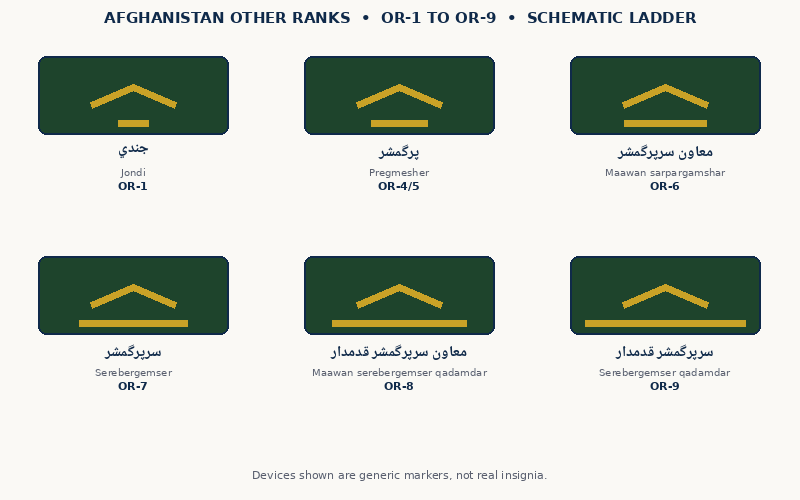
Two features deserve a second look. The first is the missing middle: no OR-2 or OR-3 grade at all, so the ladder jumps from OR-1 straight to OR-4/5 and a soldier’s first promotion is a large one. The second is the weight at the top: four of the six titles sit at sergeant-major level, so most of the ladder’s variety is found among its most senior soldiers.
Key point: do not be confused by the repeated English names in the table. Two grades are both translated “Deputy Sergeant Major” and two are both translated “Sergeant Major” — but in Pashto they are four different titles, and the word قدمدار (qadamdar) is what separates the senior pair from the junior pair. When in doubt, trust the Pashto title, not the English.
Three Lieutenants and a Senior Captain: The Unusual Lower Officers
The bottom of the officer ladder is where Afghanistan is most unlike its neighbours. Most armies go Second Lieutenant, First Lieutenant, Captain — three steps to company command. Afghanistan has five. A new officer starts as a دریم بریدمن (Dreyom baridman), a Third Lieutenant, a grade that barely exists anywhere else. Above him sit a دوهم بریدمن (Dvahomi baridman), Second Lieutenant, and a لمړی بريدمن (Lomri baridman), First Lieutenant. In Pashto the names count plainly: دریم means third, دوهم second, and لمړی first.
The extra steps do not stop there. Above the three lieutenants comes a تورن (Turan), Captain — and then, before Major, a grade that is just as unusual: جگتورن (Jag turan), Senior Captain. The Senior Captain sits at the same NATO-style grade as the Captain, OF-2, but it is a separate rank with its own Pashto title — one more rung before the field-officer grades begin. All five grades share the NATO-style band OF-1 to OF-2, yet they are five distinct titles in Pashto.
The effect is a ladder finely graded at the bottom and steep at the top: five rungs to Major, where most neighbouring armies have three. What the sources do not say is how long each rung takes — no time-in-rank figures are published for any Afghan grade, so this guide gives none, and inventing a timetable would be worse than leaving the question open.
The Officers: Thirteen Grades from Third Lieutenant to Marshal
Above the junior officers, the ladder settles into a familiar shape. جگرن (Jagran), Major, opens the field-officer grades, followed by ډگرمن (Dagarman), Lieutenant Colonel, and ډگروال (Dagarwal), Colonel — the three grades that run battalions and regiments and hold staff posts. Then come four generals: برید جنرال (Brid jenral), Brigadier General; تورن جنرال (Turan jenral), Major General; ډگرجنرال (Dagar jenral), Lieutenant General; and ستر جنرال (Setar jenral), General. The word جنرال (jenral) runs through all four, and the word before it marks the step.
At the very top stands مارشال (Marshal), graded OF-10, the equivalent of a Field Marshal. It is the highest rank in the force, and the least documented fact in this guide: no source confirms who, if anyone, currently holds it. This guide therefore names no holder. The Defence Minister, General Mullah Yaqoob, and the Chief of Staff, General Fasihuddin Fitrat, both carry the title General, but the sources do not tie their titles to a specific OF step, so this guide does not either.
| Rank (Pashto) | English Equivalent | NATO Equivalent | Insignia | Typical Role |
|---|---|---|---|---|
| دریم بریدمن Dreyom baridman | Third Lieutenant | OF-1 | Not described in sources | Most junior commissioned rank; new officer |
| دوهم بریدمن Dvahomi baridman | Second Lieutenant | OF-1 | Not described in sources | Junior officer |
| لمړی بريدمن Lomri baridman | First Lieutenant | OF-1 | Not described in sources | Junior officer |
| تورن Turan | Captain | OF-2 | Not described in sources | Company-grade officer |
| جگتورن Jag turan | Senior Captain | OF-2 | Not described in sources | Senior company-grade officer |
| جگرن Jagran | Major | OF-3 | Not described in sources | Field officer; staff or battalion-level duties |
| ډگرمن Dagarman | Lieutenant Colonel | OF-4 | Not described in sources | Senior field officer |
| ډگروال Dagarwal | Colonel | OF-5 | Not described in sources | Senior field officer; commands a large formation |
| برید جنرال Brid jenral | Brigadier General | OF-6 | Not described in sources | Most junior general; brigade-level command |
| تورن جنرال Turan jenral | Major General | OF-7 | Not described in sources | General officer; senior command |
| ډگرجنرال Dagar jenral | Lieutenant General | OF-8 | Not described in sources | Senior general officer |
| ستر جنرال Setar jenral | General | OF-9 | Not described in sources | Senior general officer; top operational command |
| مارشال Marshal | Marshal / Field Marshal | OF-10 | Not described in sources | Highest rank in the force; holder not confirmed in sources |
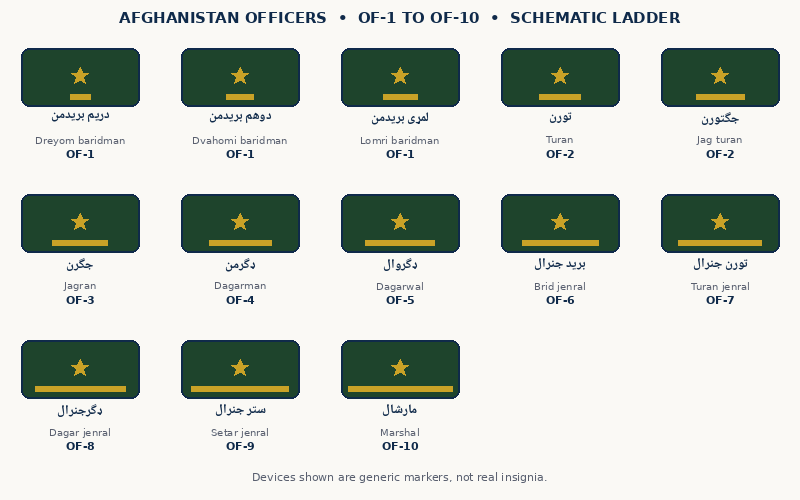
The officer ladder has no gaps: every NATO-style grade from OF-1 to OF-10 is filled, with the lower grades shared by two or three titles — three lieutenants at OF-1, two captains at OF-2 — and a single title at each grade from OF-3 upward. That contrasts with the other ranks, where OR-2 and OR-3 are missing entirely: the officer half is a full staircase, the other-rank half a staircase with its middle steps left out.
Key point: Afghanistan is not a NATO member and holds no alliance memberships at all, so no official NATO grades exist for these ranks — the OF and OR codes in this guide are equivalents for comparison only. And the top of the ladder is genuinely uncertain: no source confirms a current holder of Marshal, so this guide names none — a rank can exist on paper without being filled.
Who Commands the Force
The force has a short chain of command at the top. The Supreme Commander of the Armed Forces of the Islamic Emirate is Hibatullah Akhundzada. Below him, the Defence Minister is General Mullah Yaqoob, and the Chief of Staff is General Fasihuddin Fitrat. Both carry the title General, placing them at the senior end of the ladder above, though the sources do not fix their exact OF grade.
Below the top, the Army is organised into eight regional corps, renamed in November 2021 — the large formations that divide the country between them, and the level at which the general ranks above do their work. The sources name the number of corps and the date of their renaming, but they give no published list of corps commanders or their grades, so this guide does not invent one.
Two formations stand out and are worth a mention by name: the Badri 313 Battalion and the Red Unit, the elite units of the Islamic Emirate’s forces. Their soldiers wear the same 19 ranks as everyone else; there is no separate rank ladder for elite troops. Their distinction lies in their role and reputation, not in their titles.
Reading the Codes: What OF and OR Mean Here
Every rank in this guide carries a code — OF-1 to OF-10 for officers, OR-1 to OR-9 for other ranks — and those codes are easy to misread. They are equivalents for comparison, not official grades. Afghanistan is not a NATO member and holds no alliance memberships at all, so there are no official STANAG codes for Afghan ranks and no NATO document that grades them. The codes are the site’s own comparison mapping, showing roughly where an Afghan rank sits beside its counterpart in another army.
That mapping is rougher than it looks. The officer codes line up fairly well, but the other-rank codes are approximate, as the note above the other-ranks table says: the Pashto titles were not built to match a NATO table, and forcing them onto one leaves rough edges, most of all around Pregmesher and the two deputy sergeant major grades. Three lieutenants share OF-1 and two captains share OF-2, because the NATO-style scale has fewer steps at the bottom than the Afghan ladder does.
Read this guide, then, with the Pashto titles as the real ranks and everything else — the English equivalents and the OF and OR codes — as a translation aid. The Pashto is what an Afghan soldier is actually called; the English says what that title most nearly means; the code says where it sits in a ladder the reader already knows. Keep that order in mind and the system reads cleanly: 19 titles, one ladder for two services, a kept Republic system with a changed emblem, and a handful of grades — three lieutenants, a Senior Captain, a Marshal with no confirmed holder — that make Afghanistan unlike any of its neighbours.
To set Afghanistan beside the armies around it, see Pakistan Army ranks, US Army ranks, British military ranks, Ukrainian military ranks and the military ranks and insignia overview.
Read next
Pakistan Army Ranks · US Army Ranks · British Military Ranks · Military Ranks and Insignia Overview · Ukrainian Military Ranks
FAQs
What is the highest rank in the Afghan military?
Marshal (مارشال, OF-10), the equivalent of a Field Marshal, is the highest rank in the force. No source confirms who, if anyone, currently holds it, so no holder is named here.
Does Afghanistan have a navy?
No. Afghanistan is landlocked and its armed forces are the Islamic National Army and the Afghan Air Force only. There are no naval ranks here because there is no navy to rank.
Do the Afghan Air Force ranks differ from the Army ranks?
No. The Air Force uses the exact same 13 officer titles and 6 other-rank titles as the Army, in the same Pashto words. One table serves both services.
Did the ranks change when the Taliban returned in 2021?
No. The Islamic Emirate’s forces kept the rank system and insignia of the former Islamic Republic. The only recorded change came in 2024, when the Republic’s coat of arms on the insignia was replaced with the Islamic Emirate’s emblem.
Are the NATO OF and OR codes in this guide official?
No. Afghanistan is not a NATO member and holds no alliance memberships at all, so no official NATO grades exist for these ranks. The OF and OR codes are equivalents for comparison only, and the other-rank codes are approximate — the Pashto titles are the real ranks.
Why does Afghanistan have three lieutenants and a Senior Captain?
Afghanistan grades its junior officers more finely than most armies: Third, Second and First Lieutenant, then Captain and Senior Captain, before Major. That is five steps where most armies have three, and the sources give no time-in-rank figures, so no promotion timetable is given here.
All images here are original graphics drawn for Forces Guide. The charts are simplified, stylised ladder diagrams — not photographs of real insignia; the devices shown are generic markers only, because no source describes the real Afghan insignia.