
Myanmar has three armed services and only one rank ladder. The Tatmadaw, the Defence Services, covers the Myanmar Army, the Myanmar Navy and the Myanmar Air Force — and all three use the same system, with the same Burmese titles from the bottom to the top. What changes between services is only the English translation: one Burmese title is a General in the Army and an Admiral in the Navy. Learn that single fact and the whole system falls into place, from a new Recruit to the Senior General at the top. This guide works through every Myanmar military rank in plain language: the Burmese title, the English equivalent in each service, and the NATO-style code for each rank.
The shared ladder is the point of this guide, and it is also its main trap. A reader who expects three separate ladders — one for the Army, one for the Navy, one for the Air Force — will go looking for three sets of titles and will not find them. There is one set of titles, written once in Burmese, and the services translate it differently. The tables below therefore show a single Burmese title in the first column and the service translations beside it. Myanmar is not a NATO member, so the OF and OR codes in this guide are equivalents for comparison, not official NATO grades, and the OR codes in particular are estimates.
AT A GLANCE
Services: Myanmar Army, Myanmar Navy, Myanmar Air Force — one shared rank system
Top rank: Senior General (OF-10), held by the Commander-in-Chief of Defence Services
Officer titles: 12, from Second Lieutenant to Senior General · Other ranks: 8, from Recruit to Warrant Officer Class 1
Key note: the same Burmese title serves all three branches — only the English translation changes
One Ladder, Three Services: How the Tatmadaw Shares Its Ranks
The Tatmadaw is the name for Myanmar’s Defence Services as a whole, and it is a single organisation with three arms: the Army, the Navy and the Air Force. Most countries give each service its own rank titles, so an army colonel and a navy captain are different words for a similar job. Myanmar does not. Here the title is the same word in Burmese whichever uniform wears it, and the difference appears only when the title is turned into English. That is why this guide never lists three ladders side by side. There is one ladder, and the English names are translations of it.
The clearest example sits near the top. The Burmese title ဗိုလ်ချုပ်ကြီး, Builʻkhyupʻkrīʺ, is a General in the Army and the Air Force and an Admiral in the Navy. The same pattern runs down the whole officer ladder: a Lieutenant General on land is a Vice Admiral at sea, a Colonel on land is a Captain at sea, and a Captain on land is a Lieutenant at sea. The person, the Burmese title and the place in the ladder are identical. Only the English word changes to fit the service.
The other ranks work the same way, though the translations there are closer together. A Staff Sergeant in the Army, a Chief Petty Officer in the Navy and a Flight Sergeant in the Air Force are one title translated three ways, and the two warrant officer grades do not change at all between services: Warrant Officer Class 1 and Warrant Officer Class 2 are the same words in the Army, the Navy and the Air Force alike. At the very bottom the ladder is simplest of all, because a Recruit is a recruit in every service, with no translation needed.
This shared system is easy to learn once the trick is understood, and confusing until it is. The English names follow the familiar pattern of generals, colonels and captains, so a reader matching a Myanmar title against a foreign ladder will usually land in the right place. But the English name is the translation, not the rank itself. The rank itself is the Burmese title, and that title is the same in all three services.
Officers: Twelve Titles from Second Lieutenant to Senior General
There are twelve officer titles in the Tatmadaw, running from OF-1 to OF-10. The ladder starts low and narrow: an officer cadet commissions directly as a Second Lieutenant in the Army and Air Force, or as a Sub-Lieutenant in the Navy. There is no separate cadet rank in the tables, and no intermediate step between training and the first commission. A new officer’s first title is the bottom rung of the officer ladder, and the climb begins from there.
The ladder then rises through the junior officers and the field officers — Major, Lieutenant Colonel and Colonel — into the generals. Two grades are shared by two titles each: First Lieutenant and Second Lieutenant both sit at OF-1, and Major General and Brigadier General both sit at OF-6. The twelve titles therefore fill eleven NATO grades.
At the very top stands the Senior General, graded OF-10, the highest rank in the Tatmadaw. It is held by the Commander-in-Chief of Defence Services, the officer who commands the whole force. This guide names no holder, because the leadership changes and a name printed here would date fast. One step below sits a rank found nowhere else: the Vice-Senior General, graded OF-9, which is unique to Myanmar.
| Rank (Burmese + Transliteration) | Army & Air Force | Navy | NATO Equivalent | Insignia | Typical Role |
|---|---|---|---|---|---|
| ဗိုလ်ချုပ်မှူးကြီး Builʻkhyupʻmhūʺkrīʺ | Senior General | Senior General | OF-10 | Not described in sources | Held by the Commander-in-Chief of Defence Services |
| ဒုတိယဗိုလ်ချုပ်မှူးကြီး Dutiya builʻkhyupʻmhūʺkrīʺ | Vice-Senior General | Vice-Senior General | OF-9 | Not described in sources | Second-highest officer rank; unique to Myanmar |
| ဗိုလ်ချုပ်ကြီး Builʻkhyupʻkrīʺ | General | Admiral | OF-8 | Not described in sources | Senior general / flag officer |
| ဒုတိယဗိုလ်ချုပ်ကြီး Dutiya builʻkhyupʻkrīʺ | Lieutenant General | Vice Admiral | OF-7 | Not described in sources | Senior general / flag officer |
| ဗိုလ်ချုပ် Builʻkhyupʻ | Major General | Rear Admiral | OF-6 | Not described in sources | General / flag officer |
| ဗိုလ်မှူးချုပ် Builʻmhūʺkhyupʻ | Brigadier General | Commodore | OF-6 | Not described in sources | Most junior general / flag officer |
| ဗိုလ်မှူးကြီး Builʻmhūʺkrīʺ | Colonel | Captain | OF-5 | Not described in sources | Senior field officer |
| ဒုတိယဗိုလ်မှူးကြီး Dutiya builʻmhūʺkrīʺ | Lieutenant Colonel | Commander | OF-4 | Not described in sources | Field officer |
| ဗိုလ်မှူး Builʻmhūʺ | Major | Lieutenant Commander | OF-3 | Not described in sources | Field officer |
| ဗိုလ်ကြီး Builʻkrīʺ | Captain | Lieutenant | OF-2 | Not described in sources | Junior officer |
| ဗိုလ် Builʻ | First Lieutenant | Lieutenant Junior Grade | OF-1 | Not described in sources | Junior officer |
| ဒုတိယဗိုလ် Dutiyabuilʻ | Second Lieutenant | Sub-Lieutenant | OF-1 | Not described in sources | Most junior commissioned rank; rank of new officers |
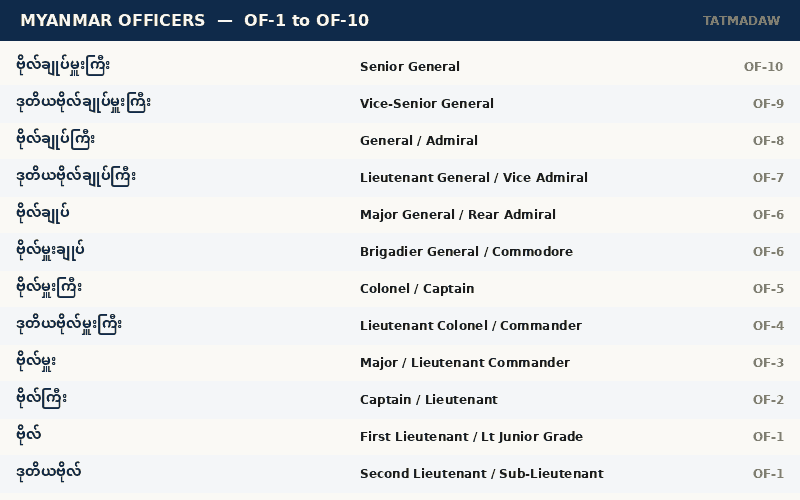
Did you know? The Vice-Senior General (OF-9) is unique to Myanmar — no other country’s rank ladder has a title of that name. It sits one step below the Senior General and one step above the ordinary generals, giving Myanmar a twelve-title officer ladder with a second-in-command grade that exists nowhere else. When a Myanmar officer is introduced as a Vice-Senior General, the title alone tells a reader which country he serves.
Saya and Bo Lay: What Soldiers Actually Call Each Other
Rank tables show titles, but they do not show how soldiers speak to each other, and in Myanmar the spoken forms are worth knowing. Non-commissioned officers are called Saya (ဆရာ), which means “teacher”, by officers and enlisted soldiers alike. The word is the ordinary Burmese word for a teacher, and it is used for sergeants and corporals as a mark of respect for the skill and experience they carry. A new private who calls a sergeant Saya is not using a nickname. He is using the form of address the force itself uses.
The choice of word says something about how the Tatmadaw sees its non-commissioned officers. A teacher is someone who knows the work and shows others how to do it, and that is the role the sergeants hold: they train the new intake and pass on the practical knowledge that no rank table can list. Calling them Saya puts that role into the everyday language of the barracks, and an officer who calls a sergeant “teacher” is acknowledging that the sergeant knows things he may not.
Warrant officers have their own spoken form, and it points the other way. They are called Bo Lay, which means “little lieutenant”. The name places them exactly where they stand: above the sergeants, below the commissioned officers, close enough to the officers to be measured against them but marked as junior. The two forms together draw a small map of the force — the sergeants are the teachers, and the warrant officers are the little lieutenants — though neither form is a rank itself, and neither appears in the tables below.
Other Ranks: Eight Titles from Recruit to Warrant Officer Class 1
Below the officers sit eight other-rank titles, running from OR-1 to OR-9. The ladder starts with the Recruit, the entry rank in all three services, and rises through Private, Lance Corporal and Corporal into the sergeants and then the two warrant officer grades at the top. The top of this ladder is the Warrant Officer Class 1, the most senior other rank in the Tatmadaw, with Warrant Officer Class 2 one step below it. Together the eight titles cover every enlisted soldier and non-commissioned officer in the force.
Two features of the ladder deserve a closer look. The first is a gap: there is no OR-3 rank, so the ladder jumps straight from Lance Corporal at OR-4 to Private at OR-2. Eight titles fill nine grades, and the missing grade is not a mistake in the table. The second feature is the way the translations split by service in the middle of the ladder: at OR-7 one title becomes Staff Sergeant in the Army, Chief Petty Officer in the Navy and Flight Sergeant in the Air Force.
The middle grades also carry small bracketed notes that are part of the titles themselves. The Army’s OR-7 is a Staff Sergeant (Company Quartermaster Sergeant), and its OR-6 is a Sergeant (Sergeant Clerk), with the Navy giving Petty Officer (Petty Officer Clerk) at the same grade. At OR-2 the Navy’s title is Able-body, also written as Able Seaman, where the Army and the Air Force simply say Private.
| Rank (English, per Branch) | Army | Navy | Air Force | NATO Equivalent | Insignia | Typical Role |
|---|---|---|---|---|---|---|
| Warrant Officer Class 1 | Warrant Officer Class 1 | Warrant Officer Class 1 | Warrant Officer Class 1 | OR-9 | Not described in sources | Most senior other rank |
| Warrant Officer Class 2 | Warrant Officer Class 2 | Warrant Officer Class 2 | Warrant Officer Class 2 | OR-8 | Not described in sources | Senior warrant officer |
| Staff Sergeant / Chief Petty Officer / Flight Sergeant | Staff Sergeant (Company Quartermaster Sergeant) | Chief Petty Officer | Flight Sergeant | OR-7 | Not described in sources | Senior non-commissioned officer |
| Sergeant / Petty Officer / Sergeant | Sergeant (Sergeant Clerk) | Petty Officer (Petty Officer Clerk) | Sergeant (Sergeant Clerk) | OR-6 | Not described in sources | Non-commissioned officer |
| Corporal / Leading Seaman / Corporal | Corporal | Leading Seaman | Corporal | OR-5 | Not described in sources | Junior non-commissioned officer |
| Lance Corporal / Acting Leading / Lance Corporal | Lance Corporal | Acting Leading | Lance Corporal | OR-4 | Not described in sources | Most junior non-commissioned officer |
| Private / Able-body / Private | Private | Able-body (Able Seaman) | Private | OR-2 | Not described in sources | Trained enlisted rank |
| Recruit | Recruit | Recruit | Recruit | OR-1 | Not described in sources | Entry rank; new recruit |
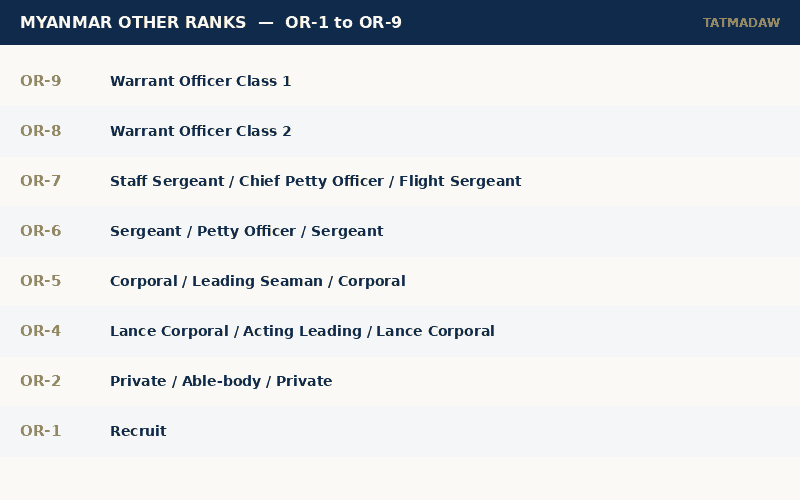
Key point: the OR codes in the table above are estimates. No official OR mapping for Myanmar exists in the sources used for this guide, so the OR-9 to OR-1 column is a standard equivalence drawn up for comparison, not an official grade. The same is true of the OF codes: Myanmar is not a NATO member, so every code in this guide shows roughly where a Myanmar rank sits beside its counterpart elsewhere, and nothing more.
How to Read a Burmese Rank Title
A Burmese rank title can look long and unfamiliar at first sight, but the officer table has a pattern running through it. The pattern is the word Dutiya, which opens four titles: the Vice-Senior General, the Lieutenant General, the Lieutenant Colonel and the Second Lieutenant. In each case Dutiya marks the second or deputy form of a rank — the Vice-Senior General is the second beside the Senior General, the Lieutenant General the second beside the General, and the Second Lieutenant the second beside the First Lieutenant.
The rest of the titles are built from a small set of repeated words. Builʻ appears in nearly every officer title, from the single-word Builʻ of the First Lieutenant up to the long Builʻkhyupʻmhūʺkrīʺ of the Senior General. As a rule, the longer the title, the higher the rank: the senior generals carry the longest titles in the system, and the junior officers the shortest.
One more habit of the titles is worth carrying away. The same Burmese title can sound very different in English depending on the service, and the biggest jumps come at sea: a Colonel becomes a Captain in the Navy, a Major a Lieutenant Commander, and a Captain a Lieutenant. None of those officers has changed rank — only uniform, and the translation with it. A Myanmar rank quoted in English without its service is only half a title.
What the Tables Cannot Tell You
An honest guide says plainly where its sources stop. The first edge is the insignia themselves: the sources give the rank titles and their translations, but they do not describe what the insignia look like — no stars, stripes, chevrons or shoulder boards are described for any rank. That is why every row of both tables says “Not described in sources” in the insignia column, and why the two charts are text ladders rather than drawings of devices.
The second edge is the size of the force. Published estimates of active personnel in the Tatmadaw vary widely, from around 100,000 to around 356,000, a range so broad that any single figure would mislead. This guide therefore gives the range and no single number. The breadth of the range is itself useful information: it tells a reader that the size of the force is genuinely uncertain in the open sources, and that any article which states one neat total without noting the disagreement is hiding that uncertainty rather than resolving it.
The third edge is the names of the people who hold the ranks. The top rank is held by the Commander-in-Chief of Defence Services, and that is as far as this guide goes: leadership names change, and the sources disagree about the current holder, so no name is printed here. The same caution applies to the codes: the OF and OR grades are equivalents for comparison, Myanmar is not a NATO member, and the OR mapping is an estimate with no official table behind it. Where the sources disagree — the Navy’s top two titles, the crowding at OF-6 — the disagreement is shown in the notes, not smoothed away.
To set Myanmar beside the armies it is most often compared with, see our guides to US Army ranks, US Navy ranks, British military ranks and Ukrainian military ranks, or the military ranks and insignia overview.
Read next
US Army Ranks · US Navy Ranks · British Military Ranks · Military Ranks and Insignia Overview · Ukrainian Military Ranks
FAQs
What is the highest rank in the Myanmar military?
Senior General (OF-10) is the highest rank in the Tatmadaw. It is held by the Commander-in-Chief of Defence Services, who commands the Army, Navy and Air Force together.
Do the Army, Navy and Air Force use the same ranks?
Yes. All three services use the same rank system and the same Burmese titles. Only the English translations differ by branch — the same title is a General in the Army and an Admiral in the Navy.
What is a Vice-Senior General?
Vice-Senior General (OF-9) is the second-highest officer rank in Myanmar, one step below the Senior General. The rank is unique to Myanmar — no other country has a title of that name.
Are Myanmar’s NATO codes official?
No. Myanmar is not a NATO member, so the OF and OR codes are equivalents for comparison only. The OR codes are estimates, since no official OR mapping exists in the sources.
What do Saya and Bo Lay mean?
Saya (ဆရာ) means “teacher” and is what non-commissioned officers are called by officers and enlisted soldiers alike. Bo Lay means “little lieutenant” and is what warrant officers are called.
What rank does a new Myanmar officer hold?
Officer cadets commission directly as Second Lieutenant in the Army and Air Force, or as Sub-Lieutenant in the Navy. There is no separate cadet rank in the tables.
All images in this article are original graphics drawn for Forces Guide. The hero is a flag-inspired abstract, and the two charts are text ladder diagrams — not drawings of real insignia, which the sources used for this guide do not describe.