A Taiwanese shoulder board tells its story in two symbols: stars and plum blossoms. Junior officers wear stars, field officers wear the five-petalled plum blossom, and generals go back to stars — one to four of them — so learning those two marks opens up the whole ladder, from a new private with a bare sleeve to the four-star general at the top. This guide goes through every Taiwan military rank in plain language: the Chinese name, the English equivalent, the NATO-style code, the insignia, and the job that goes with each rank, covering 19 Army titles, from 二等兵 (Private Second Class) to 一級上將 (Full General) — and the Chinese rank names are identical in every service, with only the English translations changing.
AT A GLANCE
- Services: Republic of China Armed Forces — Army, Navy (including the Marine Corps), Air Force and Military Police; all share one rank ladder in Chinese, with service-specific English titles
- Top rank: 二級上將 General (OF-9) in everyday use; 一級上將 Full General is wartime-only and not currently held
- Titles: 19 Army titles — 9 other ranks (OR-1 to OR-9) and 10 officer ranks (OF-1 to OF-9), with no OF-6 grade
- Note: Taiwan is not a NATO member, so the OF/OR codes are equivalents for comparison, not official NATO grades
From Private Second Class to First Class Master Sergeant: The Enlisted Ladder (OR-1 to OR-9)
Every Taiwanese soldier begins as a 二等兵, a Private Second Class, and the sleeve gives that away at once: it carries nothing at all, while a 一等兵 (Private First Class) wears a single narrow stripe and an 上等兵 (Private Upper Class) wears two — and most conscripts hold one of these three grades, many never climbing past them. The names count upward: 兵 means soldier, and 二等, 一等 and 上等 mean second class, first class and upper class. The ladder changes shape at 下士, Corporal, the first rank of the non-commissioned officers, who wears a broad chevron with a narrow one beneath it, and from there the marks grow into the sergeants’ chevrons — 中士 (Sergeant) with two broad chevrons and 上士 (Staff Sergeant) with three — while at the top sit the three master sergeants, the 士官長, literally “warrior commanders”: 三等士官長, 二等士官長 and 一等士官長, third, second and first class, the most experienced enlisted soldiers in the force, with the top grade at OR-9, the highest any enlisted soldier can reach; in the Navy the same title means master chief petty officer, and in the Air Force chief master sergeant.
| Rank (Chinese) | English Equivalent | NATO Equivalent | Insignia | Typical Role |
|---|---|---|---|---|
| 二等兵 Èrděng Bīng | Private Second Class (Private) | OR-1 | Plain sleeve, no device | New soldier in basic training; most conscripts start here |
| 一等兵 Yīděng Bīng | Private First Class | OR-2 | One narrow sleeve stripe | Trained soldier |
| 上等兵 Shàngděng Bīng | Private Upper Class | OR-3 | Two narrow sleeve stripes | Experienced junior soldier |
| 下士 Xiàshì | Corporal | OR-4 | One broad chevron with a narrow chevron | Team leader; most junior NCO |
| 中士 Zhōngshì | Sergeant | OR-5 | Two broad sleeve chevrons | Squad leader |
| 上士 Shàngshì | Staff Sergeant | OR-6 | Three broad sleeve chevrons | Platoon sergeant |
| 三等士官長 Sānděng Shìguānzhǎng | Third Class Master Sergeant | OR-7 | Three chevrons with a star above | Senior NCO; company-level adviser |
| 二等士官長 Èrděng Shìguānzhǎng | Second Class Master Sergeant | OR-8 | Three chevrons with two stars above | Senior NCO at battalion level |
| 一等士官長 Yīděng Shìguānzhǎng | First Class Master Sergeant | OR-9 | Three chevrons with a sun emblem above | Most senior enlisted soldier; adviser to senior commanders |
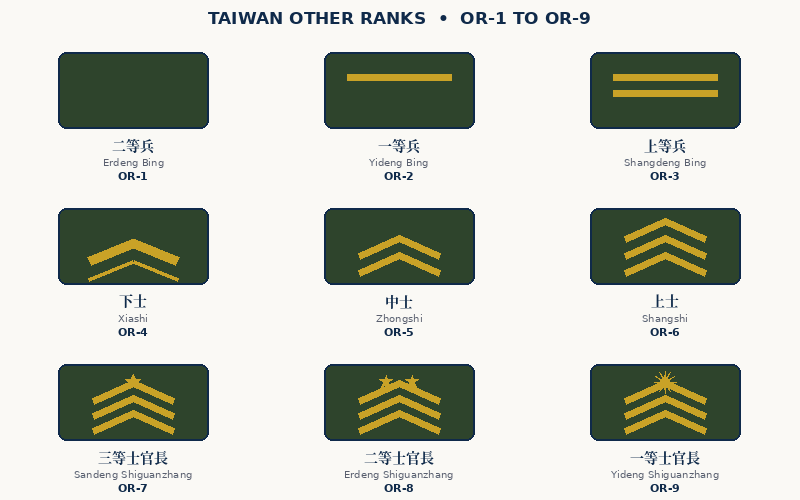
Did you know? Two sergeant titles are translated both ways round: the Republic of China’s commissioning law renders 上士 as “Sergeant” and 中士 as “Staff Sergeant”, but the NATO-code tables grade them the other way round — 上士 at OR-6, 中士 at OR-5. This guide follows the NATO-code mapping.
How to Read a Taiwanese Uniform
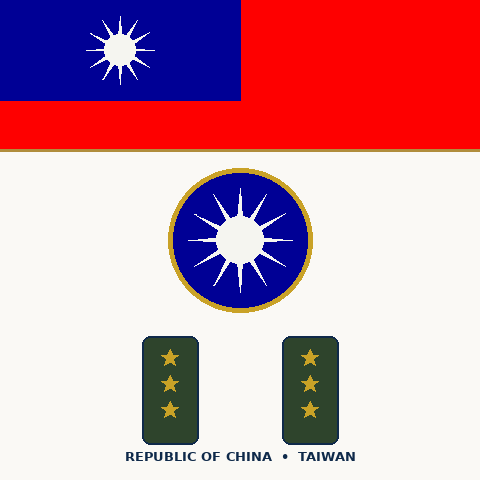
A Taiwanese uniform is read in two places: the shoulder boards for officers and the sleeve for other ranks, and everything is built from just two devices — gold stars and gold plum blossoms. Count the stars for junior officers and generals: a second lieutenant wears one star, a lieutenant two, and a captain three, then the stars vanish for field officers — major, lieutenant colonel and colonel wear plum blossoms instead, one, two and three of them — and above the colonels the stars come back, one for a major general, two for a lieutenant general, three for a general and four for a full general, with generals’ boards also carrying a gold band along the base that tells a one-star major general from a one-star second lieutenant at a distance. The plum blossom, the republic’s national flower, is the mark that trips up newcomers, since a colonel’s three blossoms are easily mistaken for a general’s three stars at a glance, and colour helps too: Army boards are dark green and Air Force boards blue, while Navy officers are recognised by gold stripes on the sleeve rather than by stars, on black boards, and most uniforms carry the red flag with its blue canton and white twelve-rayed sun on the sleeve.
Officers: From Second Lieutenant to Full General (OF-1 to OF-9)
Anyone who knows a Western army will recognise this ladder, because it was deliberately built to match one: a new 少尉, fresh from the academy, takes command of a platoon, a 中尉 does the same job with more years behind him, and a 上尉 commands a company, while above them the field officers — 少校, 中校 and 上校 — run battalions and regiments and hold the staff posts that keep a formation moving. The names are systematic: 尉 means a junior officer, 校 a field officer and 將 a general, while 少, 中 and 上 mean junior, middle and upper — so 少尉 is “junior officer” and 中將 is “middle general” — and at the very top sit the four generals, with two quirks: there is no brigadier general in Taiwan, no OF-6 at all, so the ladder jumps straight from major general (OF-7) to colonel (OF-5), and there are two generals at the top, 二級上將, the “second class” general, the highest rank in everyday use, held by the service commanders and the Chief of the General Staff, while above it stands 一級上將, the “first class” general, a wartime-only rank that nobody holds today. The Navy uses the same Chinese titles with naval English names, from Full Admiral down to Ensign, the Marine Corps tops out at 二級上將, and the Military Police at 中將.
| Rank (Chinese) | English Equivalent | NATO Equivalent | Insignia | Typical Role |
|---|---|---|---|---|
| 少尉 Shàowèi | Second Lieutenant | OF-1 | One gold star | Platoon leader, newly commissioned |
| 中尉 Zhōngwèi | Lieutenant | OF-1 | Two gold stars | Platoon leader |
| 上尉 Shàngwèi | Captain | OF-2 | Three gold stars | Company commander |
| 少校 Shàoxiào | Major | OF-3 | One gold plum blossom | Battalion executive officer or staff officer |
| 中校 Zhōngxiào | Lieutenant Colonel | OF-4 | Two gold plum blossoms | Battalion commander |
| 上校 Shàngxiào | Colonel | OF-5 | Three gold plum blossoms | Regiment or brigade commander |
| 少將 Shàojiàng | Major General | OF-7 | One gold star above a gold band | Division or brigade commander; first general rank |
| 中將 Zhōngjiàng | Lieutenant General | OF-8 | Two gold stars above a gold band | Corps commander or senior staff officer |
| 二級上將 Èrjí Shàngjiàng | General | OF-9 | Three gold stars above a gold band | Service commander; Chief of the General Staff |
| 一級上將 Yījí Shàngjiàng | Full General | OF-9† | Four gold stars above a gold band | Wartime-only top rank; not currently held |
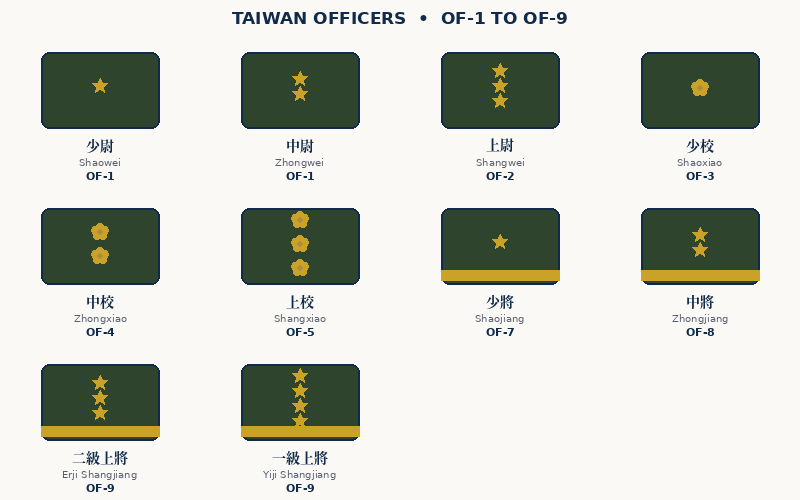
Key point: Taiwan is not a NATO member, so every OF and OR code here is an equivalent for comparison, not an official NATO grade. Some tables place 一級上將 at OF-10 (marked † above); the cross-checked tables grade both top generals at OF-9, which this guide follows. There is no OF-6 at all.
A Century of Ranks: From Whampoa to the 1956 Reform
The system as it stands today dates from a large reform in 1956, which deliberately brought the ranks closer to those of the United States Armed Forces, after American advisers had spent the early 1950s rebuilding the Taiwanese military — setting up its schools, supplying its equipment and reshaping its Army — and the ladder has barely changed since. Two old ranks did not survive: the highest, 特級上將 — a special general’s rank held only by Chiang Kai-shek himself, effectively a generalissimo — was never awarded after his death and was formally abolished in 2000, along with the lower oddity 代將, an “acting general”. The first-class general’s rank, once the traditional reward for the Chief of the General Staff, had that tradition suspended in 2013 and is now awarded in wartime or posthumously for exceptional service — which is how General Shen Yi-ming received it after the crash in January 2020.
Taiwan Today: A Small Force Rebuilt for a Hard Job
The force that wears these ranks is small by the standards of its neighbourhood: about 169,000 personnel serve on active duty — roughly 95,000 in the Army, 45,000 in the Navy including some 10,000 marines, and 40,000 in the Air Force — backed by about 1.66 million reservists, facing an army many times its size across the strait with a doctrine of making an attack too costly to attempt, holding the beaches and the strait with missiles, mines, drones and a mobilised reserve. The biggest recent change has been to who serves, not to the ranks they wear: compulsory service, cut to just four months in the 2010s, was restored to a full year in January 2024 for men born in 2005 and later, with better pay, longer training and time that counts towards their pensions.
Climbing the Ladder: Time in Rank and the Route to a Commission
Moving up the Taiwanese ladder is governed by law, and the law is unusually specific about time: the Act of Commission for Officers and Noncommissioned Officers sets a minimum time in each rank — the 停年, or “years of standing” — before the next step can even be considered, with a second lieutenant serving one to two years before promotion, a lieutenant three years, and a captain, a major and a lieutenant colonel four years each, while among the other ranks a corporal serves one to two years and a sergeant two. Time alone is never enough: promotion also needs the right training courses passed and an open post to step into, and for generals the timetable is set separately by the Ministry of National Defense. The way in is through the academies: a first commission as a second lieutenant goes to graduates of the Republic of China Military Academy, the Naval Academy or the Air Force Academy, or to men who complete an approved reserve officer course — and the top of the ladder has one more hurdle that exists nowhere else in the system, since the law requires a lieutenant general to earn a special medallion before promotion to general, and a second one before promotion to full general.
To set Taiwan beside the armies it learned from, see our guides to US Army ranks, British military ranks, Ukrainian military ranks and Polish military ranks, or the military ranks and insignia overview.
Read next
US Army Ranks · British Military Ranks · Military Ranks and Insignia Overview · Ukrainian Military Ranks · Polish Military Ranks
FAQs
What is the highest rank in the Taiwanese military?
二級上將, General (OF-9), is the highest rank in everyday use, held by the service commanders and the Chief of the General Staff. Above it stands 一級上將, Full General, a wartime-only rank that nobody holds today.
How many ranks are there in the Taiwan Army?
There are 19 titles in total: 9 other ranks, from 二等兵 up to 一等士官長, and 10 officer ranks, from 少尉 up to 一級上將. The Navy, Air Force, Marines and Military Police use the same Chinese titles, with their own English translations.
Are Taiwan’s NATO codes official?
No. Taiwan is not a NATO member, so the OF and OR codes here are equivalents for comparison only, showing roughly where a Taiwanese rank sits beside its counterpart elsewhere. Two are also disputed: some tables grade 一級上將 as OF-10 rather than OF-9.
What does the plum blossom on a Taiwanese officer’s shoulder mean?
It marks a field officer: one blossom for a major, two for a lieutenant colonel, three for a colonel. The blossom is the plum flower, the republic’s national flower. Because the blossoms are gold like the generals’ stars, a colonel’s three blossoms are often mistaken for a general’s three stars at a glance.
All images in this article are original graphics drawn for Forces Guide. The charts are simplified, stylised versions of Army shoulder boards and sleeve devices — diagrams, not photographs of real insignia.