Norway runs its armed forces on two equal ladders, not one: commissioned officers, from Fenrik to General, and specialist officers — the other ranks — from Menig to Sersjantmajor. The two ladders climb different walls but stand equal in standing, and a Norwegian soldier spends a whole career on one of them. This guide covers every Norwegian military rank in plain language: the Norwegian name, the English equivalent, the NATO code, the insignia and the job — all 21 Army titles, plus the Navy’s very different titles.
Those ranks belong to the Norwegian Armed Forces (Forsvaret, literally “the Defence”): the Army, the Royal Norwegian Navy, the Royal Norwegian Air Force, the Home Guard and the Cyber Defence Force. Norway was one of the twelve founding members of NATO, so the OF and OR codes below are real NATO grades — and the system itself is young, rebuilt in 2016 and tidied again in 2023.
AT A GLANCE
Services: Army, Royal Norwegian Navy, Royal Norwegian Air Force, Home Guard, Cyber Defence Force
Top rank: General (OF-9) in the Army and Air Force; Admiral (OF-9) in the Navy
Key note: Two equal career ladders — officers (OF-1 to OF-9) and specialist officers (OR-1 to OR-9), including the half-grades OR-1+ and OR-5+
Menig to Sersjantmajor: The Other-Ranks Ladder (OR-1 to OR-9)
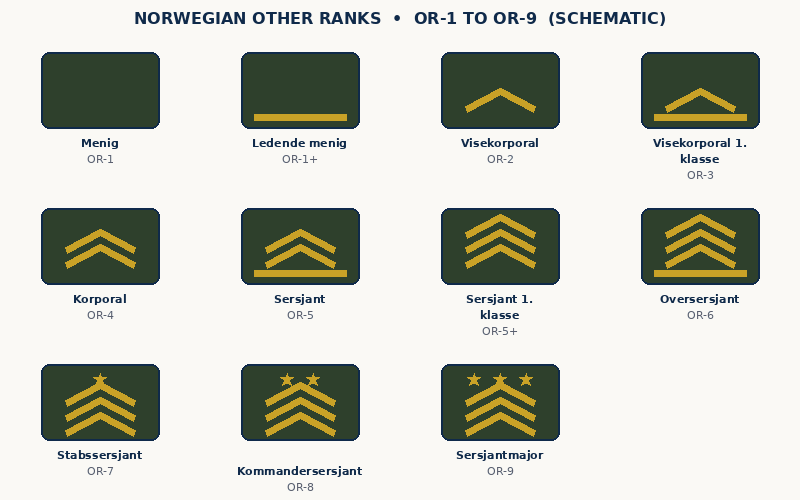
Every Norwegian soldier starts as a Menig, a private — and the uniform gives it away at once, because a Menig wears no rank device at all. A Menig in the cavalry is called a Dragon, a dragoon, and in His Majesty the King’s Guard a Gardist: same grade, same empty board, different name for a different unit. One step up, a Ledende menig, a leading private, wears a single gold stripe — the first of two half-grades, graded OR-1+.
From there the ladder climbs through the corporals and sergeants, and the marks change from stripes to chevrons, the V-shaped marks most armies use for junior leaders. A Visekorporal wears one chevron, a Visekorporal 1. klasse adds a stripe beneath it, and a Korporal wears two. Then come the sergeants: a Sersjant wears two chevrons over a stripe, and a Sersjant 1. klasse — the second half-grade, OR-5+ — wears three. At the top sit the four senior grades, where stars join the chevrons: Oversersjant (OR-6), Stabssersjant (OR-7), Kommandérsersjant (OR-8) and Sersjantmajor (OR-9), the most senior other rank in the force.
Two things catch newcomers out. First, the English names in the table are the Norwegian Armed Forces’ own official equivalents, not word-for-word translations: Visekorporal literally means “vice corporal”, yet the official English equivalent is “Specialist”. Second, the half-grades are a Norwegian quirk some foreign tables leave out — a few sources fold Sersjant 1. klasse into OR-5 and Ledende menig into OR-1, which is why you may see this ladder listed as nine grades instead of eleven.
| Rank (Norwegian) | English Equivalent | NATO Code | Insignia | Typical Role |
|---|---|---|---|---|
| Menig | Private | OR-1 | No device — plain board | New soldier in initial service |
| Ledende menig | Private 1st Class | OR-1+ | One gold stripe | Experienced private with extra responsibility |
| Visekorporal | Specialist | OR-2 | One gold chevron | Trained soldier in a specialist trade |
| Visekorporal 1. klasse | Specialist 1st Class | OR-3 | One gold chevron over a stripe | Senior specialist soldier |
| Korporal | Corporal | OR-4 | Two gold chevrons | Team leader; most junior NCO |
| Sersjant | Sergeant | OR-5 | Two gold chevrons over a stripe | Section leader |
| Sersjant 1. klasse | Senior Sergeant | OR-5+ | Three gold chevrons | Senior section leader |
| Oversersjant | Staff Sergeant | OR-6 | Three gold chevrons over a stripe | Platoon sergeant |
| Stabssersjant | Sergeant 1st Class | OR-7 | Three gold chevrons with one star | Company sergeant; senior adviser |
| Kommandérsersjant | Master Sergeant | OR-8 | Three gold chevrons with two stars | Senior NCO at battalion level |
| Sersjantmajor | Sergeant Major | OR-9 | Three gold chevrons with three stars | Most senior other rank; adviser to senior commanders |
Did you know? Norway was the first NATO member — and the first country in Europe — to make national service compulsory for women as well as men. Parliament voted for it in 2013, it took effect in 2015, and by 2020 women made up about a third of new conscripts. In practice only a small share of each year’s young people are actually called up, and the most motivated are the ones picked.
How to Read a Norwegian Uniform
A Norwegian uniform is read by shape first, stars second. Other ranks wear chevrons and stripes on a dark-green patch, while officers wear stars on the shoulder board — so the first thing to check is whether the mark is a V or a star. Count the chevrons to place a sergeant, count the stars to place an officer, and you will rarely be wrong.
The second thing to check is the branch, because the same grade can wear a different name in each service. The Air Force keeps the Army’s sergeant names at the top, but its junior grades are its own: Ledende spesialist at OR-4, Spesialist at OR-3, Visespesialist at OR-2, and Ledende flysoldat and Flysoldat at OR-1+ and OR-1, with Vingsersjant at OR-5+ instead of Sersjant 1. klasse. The Navy is different again: its other ranks run from Menig at OR-1 up through Visekonstabel and Konstabel to Kvartermester (OR-5), Senior kvartermester (OR-5+), Skvadronmester (OR-6), Flotiljemester (OR-7), Orlogsmester (OR-8) and Flaggmester (OR-9). A Kvartermester is literally a quartermaster, and a Flaggmester a flag master — old sea words for senior sailors.
The third thing to look for is the golden lion. Officer cadets at the Norwegian Military Academy wear the Norwegian golden lion on their insignia, with one star below it in the first year, two in the second and three in the third. Apprentices — the Armed Forces are Norway’s largest employer of them — wear a stylised letter L, for Lærling, with the same one-two-three stars for their three years.
Fenrik to General: The Officer Ladder (OF-1 to OF-9)
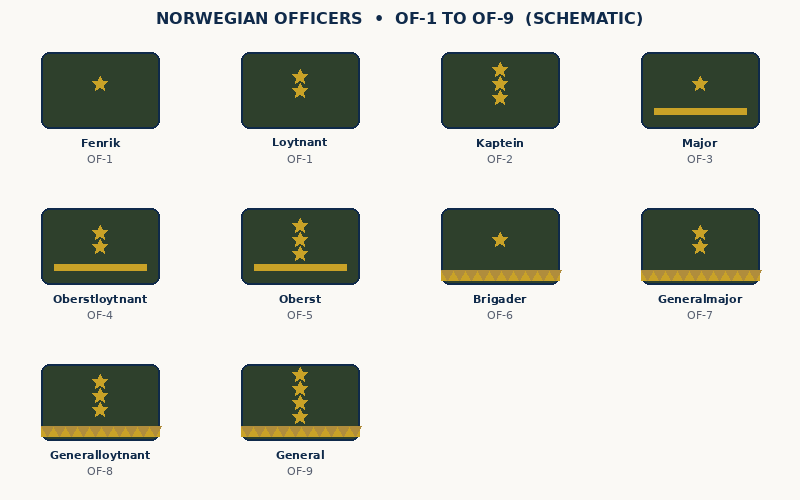
Anyone who knows a Western army will recognise this ladder at once. A new Fenrik, fresh from the academy, takes charge of a platoon; a Løytnant does the same job with more years behind him; and a Kaptein commands a company — in the cavalry called a Rittmester, a riding master, the same grade and the same three stars. Above them come the senior officers — Major, Oberstløytnant and Oberst — who command battalions and regiments and hold the staff posts that keep a formation moving.
At the top sit the four generals — Brigader, Generalmajor, Generalløytnant and General — one to four stars above a broad gold braid. Brigader is the youngest of the four: it replaced the old Oberst I, first colonel, when the ladder was tidied up, and what is now plain Oberst used to be Oberst II, second colonel. The Navy’s ladder is the mirror image in naval dress: Fenrik and Løytnant at OF-1, then Kapteinløytnant (OF-2), Orlogskaptein (OF-3), Kommandørkaptein (OF-4), Kommandør (OF-5), Flaggkommandør (OF-6), Kontreadmiral (OF-7), Viseadmiral (OF-8) and Admiral (OF-9). There is no OF-10 anywhere in the Norwegian system, so General and Admiral are the ceiling.
| Rank (Norwegian) | English Equivalent | NATO Code | Insignia | Typical Role |
|---|---|---|---|---|
| Fenrik | Second Lieutenant | OF-1 | One gold star | Platoon leader, newly commissioned |
| Løytnant | Lieutenant (First Lieutenant) | OF-1 | Two gold stars | Platoon leader |
| Kaptein | Captain | OF-2 | Three gold stars | Company commander |
| Major | Major | OF-3 | One gold star above a bar | Battalion executive officer or staff officer |
| Oberstløytnant | Lieutenant Colonel | OF-4 | Two gold stars above a bar | Battalion commander |
| Oberst | Colonel | OF-5 | Three gold stars above a bar | Regiment or brigade commander |
| Brigader | Brigadier | OF-6 | One gold star above a broad braid | Brigade commander; first general officer rank |
| Generalmajor | Major General | OF-7 | Two gold stars above a broad braid | Division commander |
| Generalløytnant | Lieutenant General | OF-8 | Three gold stars above a broad braid | Corps commander or senior staff officer |
| General | General | OF-9 | Four gold stars above a broad braid | Chief of Defence; highest rank in the force |
Key point: Norway joined NATO at its founding in 1949, so the OF and OR codes here are official NATO grades, not estimates. Two ranks can share one code without being the same rank: both Fenrik and Løytnant sit at OF-1. And some tables still show the pre-2023 ranks Korporal 1. klasse and Seniorspesialist, which were removed in 2023. Some tables also list Sjefssersjant as a separate OR-9 rank; it is the chief-NCO form of the Sersjantmajor grade.
The 2016 Reform: Two Ladders Instead of One
Norway’s rank system is young by European standards, because for forty years it barely had a specialist ladder at all. From 1975 the armed forces ran a one-tier officer system: everyone of any seniority was an officer of some kind, the old NCO corps was gone, and Norway ended up the only NATO member without a professional other-ranks career. Parliament adopted the new personnel scheme, Militærordningen, in 2015, and on 1 June 2016 the NCO corps came back and the two equal ladders began. The system was tidied once more in 2023, when three ranks were removed — Korporal 1. klasse, Ledende konstabel and Seniorspesialist — which is why older tables disagree with newer ones.
Moving Up: Schooling, Service and the Senior Adviser
Climbing either Norwegian ladder is a matter of schooling first, service second. Officers earn their commissions through the military academy or a university degree plus qualification courses and start as Fenrik; specialist officers come through NCO school, where the ladder rewards trade skill and leadership in equal measure. Moving up needs time in the rank, the right courses passed and a post to step into — and no fixed number of years is published for each step, so this guide gives none. The most distinctive step on the way up is not a rank at all: in every unit, the specialist officer with the longest unbroken service becomes the senior enlisted adviser to the commanding officer — the Command Sergeant Major in the Army and Air Force, the Command Master Chief Petty Officer in the Navy.
Norway in NATO: Guarding the Northern Flank
Norway’s ranks have always been shaped by where the country sits on the map. After the Second World War, Norway gave up its old neutrality and became one of the twelve founding members of NATO in 1949, guarding a long coastline, a border with Russia in the far north, and the sea lanes of the Norwegian and Barents seas. The force is small — roughly 33,000 active personnel, with a Home Guard of tens of thousands — but it is built for its own ground: cold-weather warfare in the north, a navy watching a huge stretch of sea, and sergeants who have spent years learning that ground, which is exactly why the specialist corps was brought back in 2016.
To set Norway beside its neighbours and allies, see our guides to US Army ranks, British military ranks, Canadian Armed Forces ranks and Polish military ranks, or the military ranks and insignia overview, which lines all of them up together.
Read next
US Army Ranks · British Military Ranks · Military Ranks and Insignia Overview · Canadian Armed Forces Ranks · Polish Military Ranks
FAQs
What is the highest rank in the Norwegian military?
General, graded OF-9, is the highest rank in the Army and the Air Force, and Admiral, also OF-9, is the highest in the Navy. Norway has no OF-10 rank — no field marshal or admiral of the fleet — so OF-9 is the ceiling.
How many ranks are there in the Norwegian Army?
There are 21 titles in the current Army system: 11 other ranks, from Menig (OR-1) up to Sersjantmajor (OR-9), including the two half-grades OR-1+ and OR-5+, and 10 officer titles, from Fenrik (OF-1) up to General (OF-9). The Navy and Air Force use their own titles for many of the same grades.
Are Norwegian ranks the same as NATO ranks?
Yes — Norway was a founding member of NATO in 1949, so the OF and OR codes are official NATO grades. A Norwegian Kaptein is an OF-2 and a Norwegian Oberst is an OF-5, the same grades as their counterparts in any allied army. The half-grades OR-1+ and OR-5+ are a Norwegian addition that some foreign tables leave out.
Does the Norwegian Navy use the same ranks as the Army?
No — the Navy has its own titles. Its officers run from Fenrik (OF-1) to Admiral (OF-9), through Kapteinløytnant, Orlogskaptein, Kommandørkaptein and Kommandør, and its other ranks run from Menig (OR-1) to Flaggmester (OR-9), through Konstabel, Kvartermester and Orlogsmester. The Air Force shares the Army’s senior sergeant names but has its own junior titles, such as Spesialist and Flysoldat.
All images in this article are original graphics drawn for Forces Guide. The charts are simplified, stylised diagrams — the chevron, stripe and star counts are schematic reconstructions, not photographs of real insignia.