
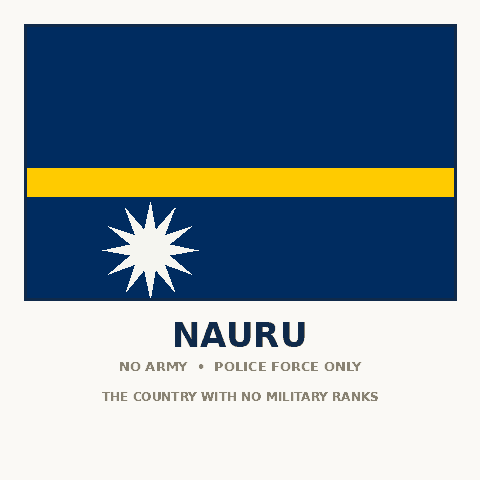
Nauru has no military at all — no army, no navy and no air force. There is no such thing as a Nauru military rank, because there is no military to hold one. The island’s security rests on two things instead: a small civilian Nauru Police Force of around eighty to a hundred officers, and Australia, which is responsible for Nauru’s defence. This guide lists the real ranks of the police force and corrects the invented “Nauru Defense Force ranks” that some websites publish for a force that does not exist.
AT A GLANCE
Army: none · Navy: none · Air force: none
Security instead: Nauru Police Force (about 80–100 officers) + Australia (external defence)
Island: 21 km² in the South Pacific, about 12,000 people — the world’s smallest island country
Key note: any list of “Nauru Defense Force ranks” is invented — no such force exists
Why Nauru Has No Military
Nauru is a single coral island of 21 square kilometres in the South Pacific and the third-smallest country in the world, with about 12,000 people. A country of that size has never had the population or the land to raise an army — and it has never tried. When Nauru became independent on 31 January 1968, no law created a military, no barracks were built for one, and no military budget has ever existed.
What Protects Nauru Instead
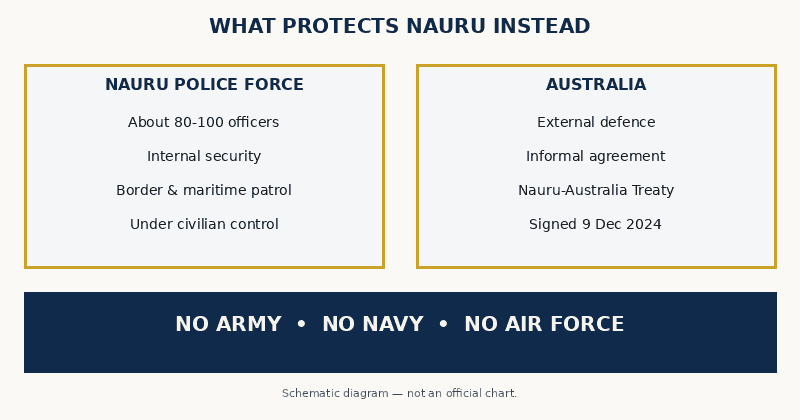
Inside the island, security is the job of the Nauru Police Force, established by the Nauru Police Force Act 1972 under the Ministry of Justice and Border Control. It has six units, including a Maritime Unit that patrols an exclusive economic zone of more than 300,000 square kilometres. Outside the island, Nauru’s defence is Australia’s responsibility under an informal agreement, strengthened by the Nauru-Australia Treaty signed on 9 December 2024 — $100 million in budget support and $40 million for policing and security over five years — which entered into force on 19 September 2025.
Nauru Police Force Ranks
Nauru has no military ranks, but it does have police ranks — nine of them, from the Commissioner of Police at the top to the Cadet Constable at the bottom. The current titles were settled by later law, most recently the Nauru Police Force (Amendment) Act 2021.
| Rank | Role | Insignia |
|---|---|---|
| Commissioner of Police | Commands the force | Not described in sources |
| Deputy Commissioner of Police | Second-in-command | Not described in sources |
| Superintendent | Oversees a major unit or division | Not described in sources |
| Senior Inspector | Senior supervisory grade | Not described in sources |
| Inspector | Supervisory grade | Not described in sources |
| Sergeant | Non-commissioned officer | Not described in sources |
| Corporal | Junior non-commissioned officer | Not described in sources |
| Constable | Police officer | Not described in sources |
| Cadet Constable | Recruit or trainee | Not described in sources |
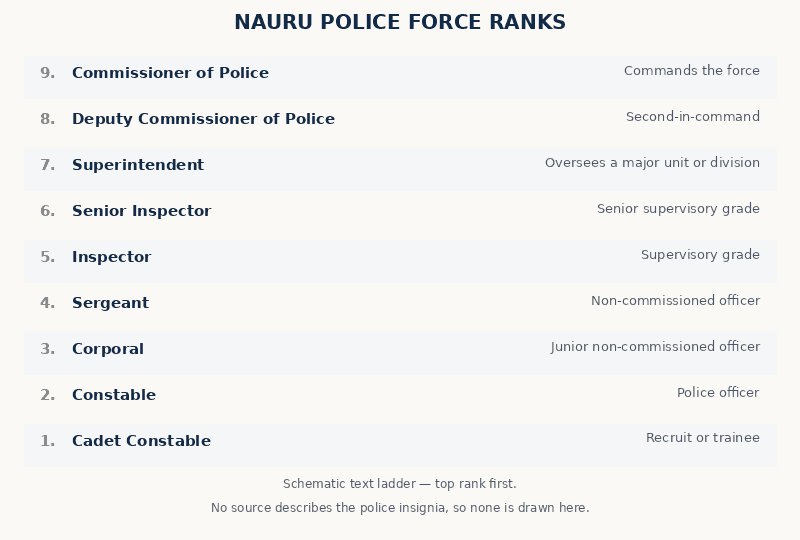
Key point: these are police ranks, not military ranks. No source describes the insignia, so the table says “Not described in sources” and the chart is a text ladder, not a drawing of devices.
The “Nauru Defense Force Ranks” You May See Online
Some websites publish a full rank ladder for a “Nauru Defense Force”. The best-known example is an article on MilitarySphere titled “Unlocking the Hierarchy of Nauru Defense Force Ranks”, which lists a complete set of officer and enlisted ranks — Officer Cadet to General, Private to Corporal — and describes their promotions and insignia. It reads like a normal ranks article, but the force it describes does not exist. Nauru has no Officer Cadets and no Generals, because it has no military of any kind. The ladder is invented for a force that was never formed, and every rank in it is wrong for the same reason: there is nothing underneath it.
Nauru’s Military History in Brief
Germany annexed the island in 1888; phosphate was discovered in 1900 and mining began in 1906. Japanese forces occupied Nauru from August 1942 to September 1945, deporting about 1,200 Nauruans to Chuuk — only 737 came home. Nauru became independent on 31 January 1968, and the phosphate industry collapsed in 2002. Through all of it, no Nauruan government ever formed an army, and the police force created in 1972 is still the only uniformed force the country has ever had.
Read next
US Army Ranks · US Navy Ranks · British Military Ranks · Military Ranks and Insignia Overview
FAQs
Does Nauru have an army?
No. Nauru has no army, no navy and no air force, and it has never formed a military — not since independence in 1968 and not before it.
Who defends Nauru?
Australia is responsible for Nauru’s defence under an informal agreement between the two countries, strengthened by the Nauru-Australia Treaty signed on 9 December 2024 and in force since 19 September 2025.
Does Nauru have a navy?
No. Nauru has no navy and no coast guard as a separate service. Maritime work is done by the Maritime Unit of the Nauru Police Force, which patrols an exclusive economic zone of more than 300,000 square kilometres.
All images in this article are original graphics drawn for Forces Guide. The hero is a schematic of the Nauru flag, the second chart is a schematic diagram of what protects Nauru instead of an army, and the third chart is a text ladder of the nine Nauru Police Force ranks — not a drawing of real insignia, which no source describes.