Almost everyone knows “Who Dares Wins”. Far fewer can name the motto of the regiment standing next to the SAS on parade — yet every British Army regiment has one, and many of the lines are older than the regiments that carry them. This article lists 21 of them, with what each one means.
A motto in the British Army is not a slogan for parades. It is worn on the cap badge and carried on the colours. Most are in Latin, but a few are in Welsh, Irish or Nepali — and some are in plain English. Forces Guide already covers the American mottos and the Indian Army’s regimental mottos — this article completes the set for Britain.
AT A GLANCE
• Regiments and corps listed: 21
• Most famous motto: “Who Dares Wins” (SAS)
• Languages: Latin, Welsh, Irish, Nepali, German — and plain English
• Two corps, one motto: the Royal Artillery and Royal Engineers both carry “Ubique”
• Key note: several regiments merged in 2006–2007, and their mottos were carried over
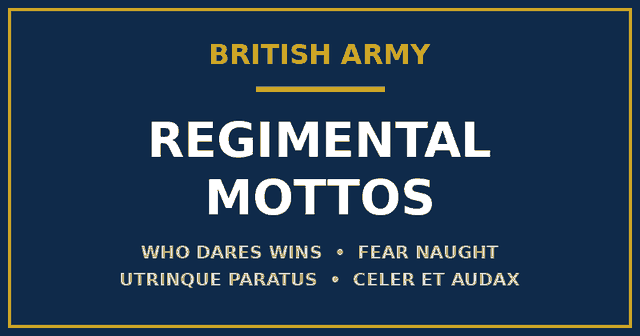
All 21 mottos at a glance
| Regiment / Corps | Motto | What it means |
|---|---|---|
| Special Air Service | Who Dares Wins | The bold win. |
| Parachute Regiment | Utrinque Paratus | Ready for anything. |
| Grenadier Guards | Honi soit qui mal y pense | Evil be to him who evil thinks. |
| Coldstream Guards | Nulli Secundus | Second to none. |
| Scots Guards | Nemo Me Impune Lacessit | No one touches me with impunity. |
| Irish Guards | Quis Separabit | Who shall separate us? |
| Welsh Guards | Cymru am Byth | Wales forever. |
| Royal Tank Regiment | Fear Naught | Fear nothing. |
| The Rifles | Celer et Audax | Swift and bold. |
| Royal Irish Regiment | Faugh A Ballagh | Clear the way. |
| Royal Gurkha Rifles | Kaatar Hunnu Bhanda Marnu Ramro | Better to die than to be a coward. |
| Mercian Regiment | Stand Firm, Strike Hard | Hold your ground, then hit back. |
| Royal Welsh | Ich Dien | I serve. |
| Royal Artillery | Ubique — Quo Fas Et Gloria Ducunt | Everywhere — where right and glory lead. |
| Royal Engineers | Ubique — Quo Fas Et Gloria Ducunt | Everywhere — where right and glory lead. |
| Royal Corps of Signals | Certa Cito | Swift and sure. |
| Royal Electrical and Mechanical Engineers | Arte et Marte | By skill and by fighting. |
| Royal Logistic Corps | We Sustain | We keep the Army supplied. |
| Intelligence Corps | Manui Dat Cognitio Vires | Knowledge gives strength to the arm. |
| Royal Army Medical Service | In Arduis Fidelis | Faithful in adversity. |
| Royal Military Police | Exemplo Ducemus | By example shall we lead. |
Note: the Gurkha motto is Nepali; its English spelling varies.
The Guards: five regiments, five mottos
The five Foot Guards each carry a different motto. The Grenadier Guards carry “Honi soit qui mal y pense”, the motto of the Order of the Garter — the same words sit on the Household Cavalry badges. The Coldstream Guards answer with “Nulli Secundus”, second to none. The Scots Guards carry the thistle’s warning, the Irish Guards a line from St Paul’s letter to the Romans, and the Welsh Guards two words of their own: “Cymru am Byth”, Wales forever. The Household Division’s own motto is “Septem Juncta in Uno” — seven joined in one.
Did you know? The Royal Artillery and Royal Engineers share the same two mottoes — “Ubique” and “Quo Fas Et Gloria Ducunt”, both granted in 1832. “Ubique” took the place of all battle honours: the gunners carry none, because the single word “Everywhere” covers every battlefield.
Mottos born in battle
Some mottos were first shouted on a battlefield. “Faugh A Ballagh” — clear the way — was the cry of the 87th Foot as they charged the French at Barrosa in 1811 and captured an Imperial Eagle. “Celer et Audax” was given to the 60th Regiment by General Wolfe after Quebec in 1759. “Fear Naught” was adopted in 1923, when the Tank Corps became Royal. The Special Air Service motto is younger still — “Who Dares Wins”, chosen by founder David Stirling in the Second World War.
New regiments, old mottos
Most of today’s regiments are younger than their mottos. The Rifles kept “Celer et Audax” from the 60th Regiment, the Royal Welsh kept “Ich Dien” from the Prince of Wales’s badge, and the Royal Gurkha Rifles kept the Gurkha line from its four parent regiments. The Mercian Regiment, formed in 2007, took a new motto of its own: “Stand Firm, Strike Hard”. The Royal Logistic Corps, formed in 1993 from five corps, kept “We Sustain” from the Army Catering Corps. The newest change came in November 2024, when the Royal Army Medical Corps merged into the Royal Army Medical Service, taking “In Arduis Fidelis” with it.
“Honi soit qui mal y pense” is not a regimental motto in origin — it is the motto of the Order of the Garter, and it appears on the badges of several regiments with “Royal” in their name. It is even on the Royal Logistic Corps cap badge, on the Garter band — but the RLC’s own motto is “We Sustain”.
Which line would you live by? “Who Dares Wins” gets the fame, but “Faugh A Ballagh” and “Celer et Audax” have been shouted in battle for more than two centuries.
Read next
US Military Mottos
Indian Army Regimental Mottos
Nigerian Army Motto: Victory Is from God Alone
Frequently asked questions
What is the motto of the SAS?
“Who Dares Wins” — chosen by founder David Stirling in the Second World War.
What is the motto of the Parachute Regiment?
“Utrinque Paratus” — “Ready for Anything”.
Are all British Army mottos in Latin?
No. Most are Latin, but the Welsh Guards’ motto is Welsh, the Royal Irish Regiment’s is Irish, the Royal Gurkha Rifles’ is Nepali, and “Who Dares Wins”, “Fear Naught” and “We Sustain” are plain English.
Mottos verified against army.mod.uk, the National Army Museum, the Royal Irish Regiment’s site, the Imperial War Museum’s Household Division memorial and regimental association pages. All text original for Forces Guide; image is an original graphic.