
Ask a soldier what hurts most after a long march and the answer is rarely the pack or the rifle — it is the boots. One wrong pair turns a patrol into blistered feet and a ruined week — which is why armies do not issue one boot for every job. They issue twelve, each one betting on what matters more: protection or speed, warmth or airflow, grip or comfort.
AT A GLANCE
Types covered: 12, from everyday issue to bomb disposal
The rule: every boot trades something — nothing is best at everything
Warmest: bunny boots, rated down to −65°F
Oldest design here: tanker boots, designed in 1937
The 12 types at a glance
The table is the short version. The sections after it give each boot two lines — what it does, and what it costs you.
| Boot type | Best for | Strength | Weakness |
|---|---|---|---|
| Standard issue | Everyday wear | Lasts for years | Struggles in heat, snow and water |
| Desert | Hot, dry ground | Keeps feet cool | Dust gets in through the mesh |
| Jungle | Swamps and rivers | Drains water fast | Lets in insects and cold water |
| Bunny boots | Arctic cold | Warmth down to −65°F | Sweat builds up inside |
| Mountain | Steep, rocky ground | Grip and ankle support | Heavy and slow on flat ground |
| Jump boots | Parachute landings | Protects ankles on impact | Stiff and heavy to march in |
| SEAL assault | Close-quarters raids | Light, quiet, fast-drying | Thin, so less protection |
| Tanker | Inside a tank | No laces to snag | Weak ankle support on foot |
| Diver | Underwater work | Fits swim fins, grips rock | Little warmth in cold water |
| Chemical overboots | Chemical threats | Sealed barrier | Heavy and stiff to move in |
| Bomb disposal | Explosive threats | Blast and shrapnel protection | Weight slows a retreat |
| Amphibious | Ship-to-shore landings | Dries fast, resists rust | Heavy right after leaving the water |
The boots, one by one
1. Standard issue combat boots
The everyday boot: thick leather and a grooved sole, built to last years and keep water out. Its weakness is that it is a generalist — in real heat, deep snow or standing water it is the wrong tool, which is why the other eleven types exist.
2. Desert assault boots
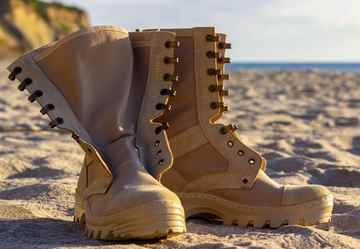
Built for hot, dry ground: light tan leather and suede with mesh panels that let air move through, so feet stay cooler. The trade is protection — the same mesh lets fine dust and sand in. The US Army issues them for desert operations.
3. Jungle warfare boots
The jungle boot accepts a fact other boots fight: in swamp country, the foot will get wet. So instead of sealing water out, it lets it drain — canvas and leather uppers with vent holes at the instep, and a steel plate against hidden spikes. The cost is exposure: the same holes let in insects, leeches and cold water.
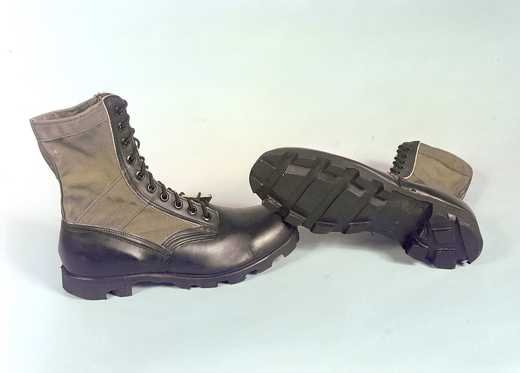
Did you know? The jungle boot’s steel plate was added in May 1966, after troops in Vietnam were hurt by punji stakes — sharpened bamboo spikes hidden in the ground. The Panama sole dates to 1944, when Sergeant Raymond Dobie designed angled lugs that shed soft mud instead of clogging.
4. Cold weather bunny boots
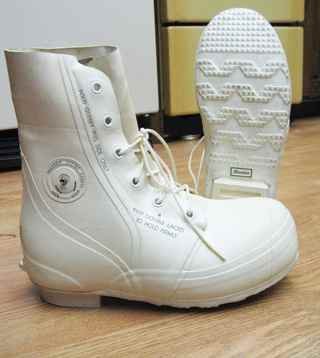
The oddest-looking boot here, and the warmest: a big white rubber shell with wool and felt sealed between two rubber layers and a small air valve on the side. The white version is rated down to −65°F, which is why it is still the Arctic boot. The price is breathability — sweat has nowhere to go, so feet get damp inside.
5. Mountain assault boots
Built for steep rock: a stiff sole that does not bend, high ankle support, and a rigid shank that holds the foot’s shape on uneven ground. They work with crampons — this is a climbing boot in uniform. On flat ground the same stiffness makes them bulky and slow — a specialist tool.
6. Airborne jump boots
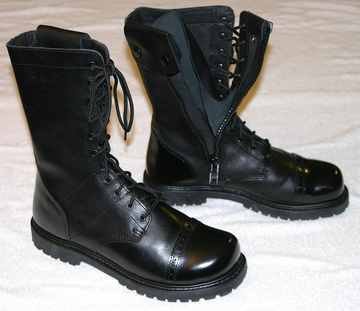
Made for the hardest landing a soldier does on purpose: heavy leather, a tall shaft that braces the ankle, a reinforced toe cap, and lacing up the calf. Designed in 1941, they are still earned through training — a mark of qualification, not just kit. The trade: marching far in them is slow work, because they are stiff and heavy.
7. Navy SEAL assault boots
Built for quiet work in tight spaces: light, with nylon panels and a flexible sole for moving fast and silently, and drain holes so the boot dries quickly after water. Everything is traded for speed and stealth — the thin materials give far less protection than a standard boot, a fair price only on short, close missions.
8. Tanker boots
The only boot here with no laces: three leather straps with buckles wrap the shaft instead. Inside a tank that matters — a loose lace can catch in moving machinery, and nylon laces can melt in a fire. The soft leather suits long hours sitting at a crew station. The trade is ankle support: on foot, away from the vehicle, they hold the ankle far less than a laced boot.
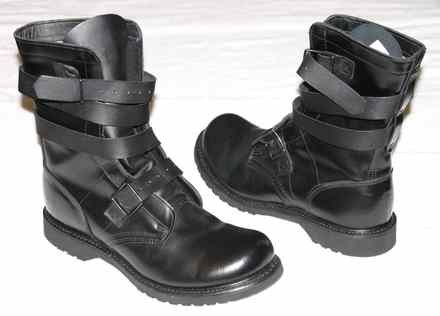
Did you know? Tanker boots were designed in 1937 by General George S. Patton and bootmaker H. E. Ketzler, who wanted a boot a tank crewman could get on fast. The guiding fear was simple: inside a tank, a lace can kill.
9. Combat diver boots
A thin, flexible neoprene boot made for the water first and the land second: it fits inside swim fins, grips wet rock when the swimmer comes ashore, and dries fast. What it does not do is keep feet warm — in cold water, on a long swim, that is the limit.
10. Chemical warfare overboots
Not a boot on its own but a second skin: a thick rubber overboot pulled on over the normal boot and sealed with straps, as part of chemical-protection gear. It keeps hazardous agents off the foot and the boot beneath. The cost is movement — the extra weight and stiffness make fast marching hard, so they go on only when the threat is real.
11. Bomb disposal boots
Built for the worst few seconds of a technician’s day: composite soles and blast-resistant plating underfoot, with thick padding around the foot and ankle to take shrapnel. They are the heaviest boots on this list — survival first, everything else second. The weight is the trade: if things go wrong, a quick retreat is harder.
12. Amphibious assault boots
Made for the moment a landing force leaves the water: quick-drying synthetics and rust-proof hardware, so the boot sheds water instead of holding it and keeps working on land. The Navy and Marine landing forces use them for ship-to-shore work. The catch is the first minute on dry ground — the boot is still wet and heavy until it drains.
Key point: No boot on this list is the best at everything — that is the lesson. Picking footwear is picking a trade-off, and the right pick matches the ground, the weather and the job, in that order.
Read next
Top 5 most dangerous special forces · Best special forces in Africa · Top 5 special forces in the world · Nigerian special forces · US Army ranks and insignia · World military ranks index
If you had to pick one pair for a week in the mountains — stiff and slow, or light and fast?
FAQs
Why don’t all soldiers wear the same boots?
Because no single design survives every environment. A boot that keeps feet warm at −65°F would cook them in the desert, and a boot that drains in a swamp would freeze on a mountain. Armies match the boot to the ground and the job.
What makes a desert boot different from a normal boot?
Light tan leather and suede with mesh panels that let air through, so feet stay cooler. A standard leather boot seals heat in — fine in mild weather, miserable in the desert.
Can one pair of boots handle water and land?
Amphibious boots come closest: quick-drying synthetics and rust-proof hardware let a landing force walk out of the water and keep fighting. They still feel heavy for the first minute on dry ground, until the water drains.
Photos: U.S. Army Natick Soldier Systems Center (public domain); Randall McNair, CC BY-SA 3.0; Pretzelpaws, CC BY-SA 3.0; Lixeiden, CC BY-SA 4.0. Cover diagram drawn for Forces Guide.